Does Google penalize AI content? Learn Google’s guidelines, risks, and how to rank AI-generated content safely in 2026.
Introduction
AI tools are changing how content is created, but one question still confuses many creators: does Google penalize AI content?
Whether you’re a blogger, student, or digital marketer, this concern is valid. Publishing content that gets penalized can hurt your rankings, traffic, and credibility.
The truth is simple—Google does not care how content is created. It focuses on quality, usefulness, and trust. That means AI-generated content is not automatically bad, but it is not guaranteed to rank either.
In this guide, you’ll learn what Google actually says, whether AI content hurts SEO, and how to use AI the right way without risking your rankings.
What Does Google Say About AI Content?
Google has clearly stated that content should be created for people first, not search engines. This is part of its Helpful Content System.
Key Takeaways:
- AI-generated content is allowed by Google
- Automation is acceptable if it provides value
- Low-quality or spammy content can be penalized
In short, Google AI content guidelines focus on quality—not the method of creation.
Does Google Penalize AI Content?
Short Answer: No—but low-quality content gets penalized
Google does not directly penalize AI content. However, it does penalize content that is:
- Thin or shallow
- Duplicate or copied
- Keyword-stuffed
- Lacking originality or expertise
So if your AI-generated content is low-quality, it may struggle to rank.
This is why many people think AI content is bad for SEO, when in reality, it’s poor execution that causes the issue.
Does AI Content Hurt SEO?
AI content does not hurt SEO by default.
However, it can negatively impact rankings if:
- It lacks depth or useful information
- It repeats common ideas without adding value
- It does not match search intent
Example:
A generic blog like “Best Digital Marketing Tips” generated by AI may:
- Provide basic advice
- Miss real-world examples
- Offer no unique insights
In such cases, Google may treat it as unhelpful content.
How Google Evaluates Content (Not AI Itself)
Google does not rely on AI detection tools. Instead, it evaluates content using multiple signals:
🔍 Content Quality Signals
- Depth of explanation
- Original insights
- Relevance to search intent
🔍 User Experience Signals
- Time spent on page
- Bounce rate
- Engagement
🔍 Trust Signals (EEAT)
- Author credibility
- Website authority
- Consistency of information
This is why AI-generated content can rank on Google—if it meets these criteria.
Why Some AI Content Fails to Rank
Many creators assume AI tools automatically produce high-ranking content. That’s not true.
Common Problems:
- Generic and repetitive writing
- No unique insights
- Lack of structure
- Missing EEAT signals
This leads to poor performance, even if the content is technically correct.
How to Use AI Content Without Google Penalty
To avoid risks and rank successfully, follow these best practices:
1. Add Human Value
AI should be your assistant—not your replacement.
Improve content with:
- Personal insights
- Real-life examples
- Updated context
2. Match Search Intent
Ask:
- What does the user actually want?
- Are they beginners or advanced users?
For this topic:
- Intent = Informational
- Goal = Clarity + myth-busting
3. Follow Google’s EEAT Principles
Focus on:
- Experience – Real-world insights
- Expertise – Accurate explanations
- Authority – Topic coverage
- Trust – Clear and honest content
As explained in our guide on EEAT SEO examples and strategies, strong trust signals improve rankings.
4. Avoid Bulk AI Publishing
Publishing too many AI blogs quickly can signal low quality.
Instead:
- Focus on fewer, high-quality posts
- Build topical authority over time
5. Optimize for Natural Readability
AI content often sounds robotic.
Fix this by:
- Using simple language
- Adding conversational tone
- Removing repetition
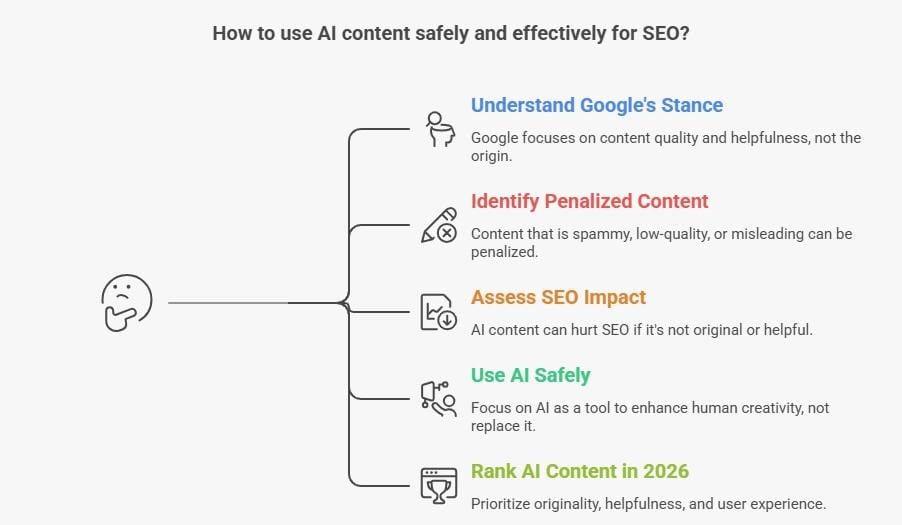
AI Content Best Practices for SEO (2026)
✅ Optimization Checklist:
- Do proper keyword research
- Use AI for structured drafts
- Add human insights
- Improve readability
- Add internal links
- Cite trusted sources
- Align with EEAT
You can explore more in our guide on AI-powered SEO content writing in 2026.
Can AI Content Rank on Google?
Yes—AI content can rank on Google if it is:
- Helpful and informative
- Original and well-structured
- Aligned with user intent
- Optimized with EEAT principles
The key difference is not AI vs human—it’s quality vs low quality.
Final Thoughts: Should You Use AI Content?
Yes—but use it wisely.
AI is a productivity tool, not a shortcut to rankings.
Use AI for:
- Drafting content
- Structuring ideas
- Speeding up research
Avoid using AI for:
- Publishing without editing
- Creating low-value bulk content
- Replacing expertise completely
Conclusion
So, does Google penalize AI content?
No—but it penalizes bad content.
If your AI-generated content is helpful, original, and trustworthy, it can rank just like human-written content.
But if it lacks value or clarity, it won’t perform—regardless of how it was created.
The future of SEO is not AI vs humans.
It’s AI + human intelligence working together.
If you want to stay ahead in SEO and AI-driven content creation, don’t stop here.
Explore:
- AI-powered SEO strategies for 2026
- EEAT SEO examples that rank
- SEO Guide for Beginners India: Rank #1 on Google for Free in 2026
Or browse more guides on TrendChaska to build smarter, high-ranking content.
FAQs

Nidhi Patel is an SEO and digital marketing content strategist focused on AI SEO, content marketing, blogging, and personal branding. Through TrendChaska, she shares practical digital marketing insights, SEO strategies, and AI tools for beginners, students, and small businesses in India.