Discover how to rank on Google AI in 2026. Practical SEO advice tailored for India — create AI-friendly, voice-search optimized content now.
The Search Game Has Shifted — Are You Keeping Up?
Google AI in 2026 is completely transforming how search engines rank, summarize, and recommend content online
Google has reworked how search operates. The introduction of AI Overviews driven by Google’s Gemini model now supplies millions of people with direct answers right on the search results page. They don’t even need to visit a website. This change is a game-changer for Indian users, who make up over 750 million internet users in a booming digital economy. The stakes have never been higher.
Here’s the exciting part: this is one of the biggest chances in SEO right now. In India, most bloggers, creators, and businesses are still using outdated SEO techniques. If you learn to optimize for Google AI Overviews and the Generative Search Experience (SGE) by 2026, you can stay ahead of 90% of your competitors.
This guide is a straightforward, easy-to-follow resource to help you navigate modern SEO. Whether you’re a student, a blogger running a startup, or working as a digital marketer in India, this article provides practical tips to rank better, show up in AI-generated answers, and grow your website traffic in 2026.
Let’s get started!
1. What Exactly Is Google AI Search? Grasping AI Summaries
Before diving into strategies, it’s important to first know what has shifted.
Google AI in 2026 is changing how search engines understand, summarize, and deliver information to users
Google AI Overviews, earlier called SGE — Search Generative Experience, is a feature powered by Artificial Intelligence. It shows up right at the top of the search results. Rather than showing a usual list of links, Google’s AI pulls data from several trusted web pages, combines the information, and delivers a brief summary on the results page.
Picture it like this: you ask Google something like, “How can I start a blog in India in 2026?” Instead of listing ten links, Google AI reviews several top articles, picks out the most useful and accurate details, and then gives you a personalized answer. It even backs it up with sources.
What Makes Google AI Overviews Special:
- Show up first on the search results page
- Combine info from multiple reliable sources in a summary
- Provide links to the original pages they reference (this could work in your favor!)
- pop up for questions or searches about information or transactions
- Introduced in India by late 2024, with fast growth during 2025 and 2026.
Quick Tip: When your content gets quoted as a source in an AI Overview, it can bring quality traffic to your site. You don’t even need to hit the top three organic rankings anymore. This is the modern way of standing out.
2. How Google Search Evolved in 2026
We’ll explore the major changes Google Search went through from 2024 to 2026. Learning about these shifts helps you adjust your SEO approach.
| Year | Major Google Search Change | SEO Impact |
| 2022 | Core algorithm updates, spam filters | Content quality became critical |
| 2023 | Bard AI launched, SGE testing begins | AI answers started appearing |
| 2024 | AI Overviews go live globally | Zero-click searches increased by 35%+ |
| 2025 | Gemini 2.0 powers search, India rollout | Topical authority overtook backlinks |
| 2026 | Personalised AI search, voice + visual AI | Content structure & EEAT are king |
Data shared by SparkToro and Rand Fishkin reveals that over 65% of all searches on Google around the world lead to zero clicks now. In India, where most people use their phones to search, voice and chat-based queries have boosted this number even more.
Bottom line: Google has moved beyond being just a collection of links. It is transforming into an AI-driven answer engine. You need to adjust your SEO game to match this shift.
3. Why Relying on Traditional SEO Doesn’t Cut It
A while back, SEO was straightforward. You picked keywords, wrote content around them, gathered backlinks, and waited for Google to bump up your rankings. That approach isn’t obsolete, but relying on it alone won’t work anymore.
Old SEO Methods Looked Like This:
- Stuffing your keyword 30 times into a single article
- Paying for backlinks from random websites
- Pushing out short 500-word content just to hit a keyword
- Using exact-match domains as a shortcut to rank
- Neglecting user experience and skipping mobile optimization
Why This Fails in 2026:
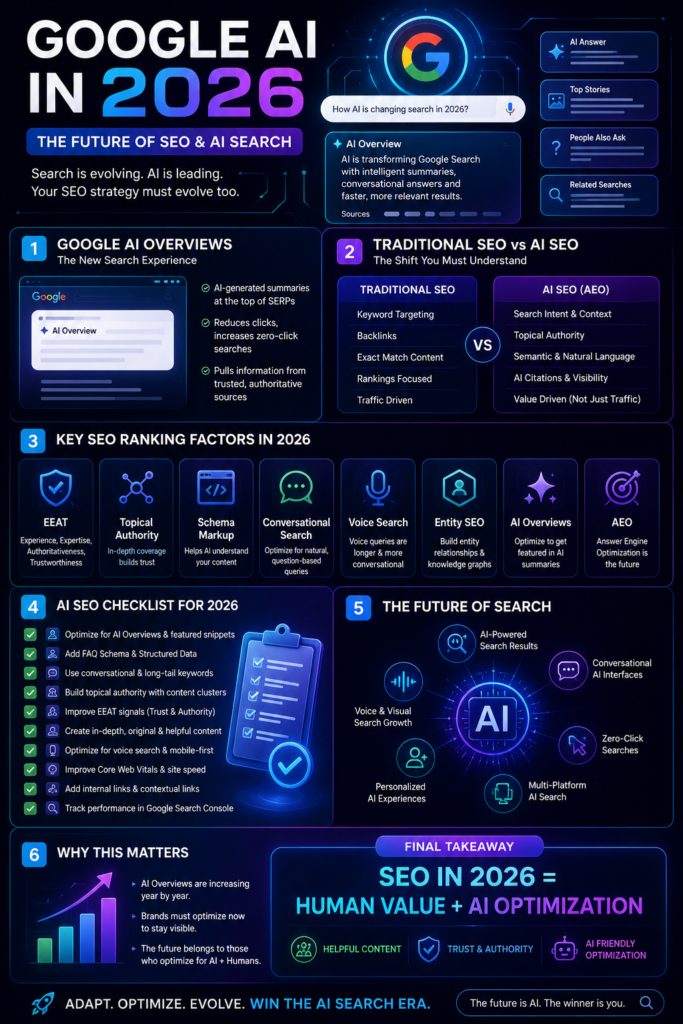
Google AI in 2026 now focuses more on contextual understanding, EEAT signals, conversational search, and topical authority instead of traditional keyword-heavy SEO strategies.
- Google’s AI now looks at context instead of just individual keywords. It analyzes your whole cluster of content.
- AI Overviews prioritize deep, accurate information rather than repeating keywords.
- EEAT (Experience, Expertise, Authoritativeness, Trustworthiness) now affects how AI includes citations.
- Personalized search makes one-size-fits-all content less effective.
- Over 40% of Indian mobile users rely on voice search, making conversational content more important.
Quick Stat: In 2025, a BrightEdge study showed that sites designed to align with AI Overviews saw a 24% increase in organic impressions, even if they weren’t in the top 5 search results. Optimizing for AI works better than old-school SEO.
4. Comparing Traditional SEO with Google AI in 2026
| Traditional SEO (Pre-2024) | AI SEO / Google AI Overviews SEO (2026) |
| Focus on keyword density | Focus on semantic relevance & NLP |
| Target single keywords | Target search intent & topic clusters |
| Backlinks = primary ranking signal | EEAT + topical authority = primary signals |
| 1 blog post per keyword | Content hubs & pillar pages |
| Meta tags are enough | Schema markup + structured data required |
| Write for search engines | Write for humans first, AI second |
| Click-through drives traffic | Citations in AI Overviews drive visibility |
| Mobile-friendly as an option | Mobile-first is non-negotiable |
| Ignore voice search | Conversational + voice queries are critical |
| Author does not matter | Author expertise & E-E-A-T signals matter hugely |
5. Main Ranking Factors for Google AI by 2026
This is the most critical part of this guide. Google’s AI does more than rank web pages. It picks the ones it considers reliable sources for AI-generated responses. Here’s what counts the most in 2026.
A. E-E-A-T: Experience Expertise, Authority & Trust
Google introduced the extra ‘E’ to stand for Experience back in 2022, and by 2026, this plays an even bigger role. Your content needs to prove that a knowledgeable, experienced individual created it.
- Add bios for authors with their qualifications, like “5 years doing digital marketing, worked with over 50 Indian startups.”
- Use actual stats, studies, and references that come from credible sources.
- Share your own experiences, like, “I tried this method on TrendChaska, and here’s what I found.”
- Create an About page and set up detailed author profiles on your site.
B. Writing In-Depth Content
Google AI prefers detailed content that explains a subject. A short 500-word post on ‘SEO for India’ won’t stand a chance against a deep 3,000-word guide that explores all angles.
C. Optimizing Semantic SEO and NLP
Your writing needs to include words and phrases connected to the main topic. Don’t focus on one keyword. For this article, use terms like search intent, entity SEO, zero-click searches, conversational queries, AI-generated answers, knowledge graph, and topical authority.
D. Organizing and Formatting Content
Google’s AI processes web pages to understand how people read them. It values well-placed headings, short and clear paragraphs, lists, and FAQs. Formatted content stands a better chance of being featured in AI Overviews.
E. Core Web Vitals and User Experience
Performance, ease of use on phones, and how interactive a site feels all remain important. In India, lots of people use mid-range Android phones with 4G to browse the internet. A website that loads slowly can hurt both your rankings and the chances of converting visitors.
Pro Tip:
Check Google Search Console to find out which of your pages already show up with AI-powered features in Search. Use filters like ‘Rich Results’ and ‘AI Overviews’ to focus your optimization on those specific pages.
6. Tips to Optimize Content to Appear in Google AI Overviews
Let’s dive into the hands-on part. Here’s how you can organize and write content to ensure it gets included in Google AI Overviews.
Step 1: Dive Deep into Search Intent
Before typing anything, think about one question: why would someone make this search? In 2026, four types of search intent exist. Your content needs to be a perfect match for the correct one.
- Informational: ‘How does Google AI Overviews work?’
- Navigational: ‘TrendChaska SEO blog.’
- Transactional: ‘Buy SEO course India.’
- Commercial Investigation: ‘Best SEO tools for beginners India 2026.’
Step 2: Put a Clear Answer Right at the Top of Your Article
AI Overviews answer questions. Start your article by providing a short and clear response in the first 100 to 150 words. It’s similar to crafting a featured snippet since this approach works well for both.
Example:
If you’re writing an article called “What is Google AI Overviews,” start your introduction by saying something like this: “Google AI Overviews are summaries created with AI. They show up at the top of search results thanks to Google’s Gemini AI. These summaries aim to answer user questions so they don’t have to click on a website for answers.”
Step 3: Write Headings That Match Questions
Make your H2 and H3 headings look and feel like natural questions. For instance:
- H2: “What Are Google AI Overviews?” is better than just writing “Google AI Overviews.”
- H3: “How Does Google Choose What Appears in AI Overviews?”
- H4: ‘Does the Length of Content Change AI Overview Citations?’
Step 4: Add FAQ Sections Using Schema Markup
To include FAQ sections boosts AI Overviews.
- Add 5 to 10 simple questions with short answers at the end of your article.
- Use FAQ Schema JSON-LD to help Google understand them better.
Step 5: Focus on Featured Snippets First
Featured snippets connect to AI Overviews. Pages that show up in featured snippets often get more citations in AI Overviews. Add definition boxes, numbered steps, and side-by-side comparison tables to target these spots.
Pro Tip:
Start your article with a ‘Quick Answer‘ or a ‘TL;DR‘ box. Place it above the table of contents. This gives Google an easy summary to use in AI Overviews and boosts the chances of your article being cited.
7. EEAT and Brand Authority in AI SEO
Now, let’s look at a topic Indian bloggers often miss—personal branding and growing digital authority. By 2026, Google’s AI will identify trustworthy, knowledgeable sources using specific signals.
Ways to Build EEAT for Blogs and Websites in India:
- Put together an in-depth author page, including your photo, bio, expertise, and links to your social profiles
- Appear on reputable external websites through guest posts, interviews, or press features.
- Share links to trustworthy sites like Google’s Search Central Blog, Moz, Neil Patel, and Ahrefs.
- Update your content. Old and outdated articles can lower your authority score.
- Include references, data, and citations in your articles.
- Post content. Google values websites that are active and dependable.
Real-life example:
Take Simplilearn and WsCube Tech as examples. These Indian brands teach digital marketing and show up in AI Overviews when people search SEO-related queries in India. Their strong presence isn’t just because of backlinks. They’ve spent years building solid topical authority with thousands of useful articles, courses, and community-based content.
To succeed in 2026, TrendChaska needs more than just a high content output. It must create smarter, detailed, and reliable content.
8. Topical Authority and Content Clusters: The New SEO Blueprint
The idea of Topical Authority has shifted the game in SEO over the past two years. Google no longer favors random standalone articles. Now, it rewards websites that dominate an entire subject by covering it in depth.
What Is a Content Cluster?
A content cluster brings together a collection of related articles all centered around a Pillar page. The Pillar page gives a full overview of the main topic. Meanwhile, the Cluster pages focus on detailed aspects of that topic. These pages all interlink to show Google that your site serves as a complete guide on the subject.
Example of a Content Cluster for TrendChaska in the SEO Niche:
- Pillar Page: ‘Complete SEO Guide for India 2026’ (this main article)
- Cluster: ‘Steps to Do Keyword Research in India.’
- Cluster: ‘Beginner’s Checklist for On-Page SEO.’
- Cluster: ‘Ways to Build Backlinks in 2026.’
- Cluster: ‘Tips on Local SEO for Indian Businesses’
- Cluster: ‘Beginner-Friendly SEO Tools in India.’
Pro Tip:
Publish 8 to 12 supporting cluster articles tied to your main pillar topic. Give it time because Google takes about 3 to 6 months to acknowledge your authority on the subject. Patience is necessary for this approach to succeed.
9. Entity SEO: The Future of Search Rankings
Google AI in 2026 is increasingly relying on Entity SEO and Google’s Knowledge Graph to understand brands, topics, and website authority more accurately.
Entity SEO is a game-changing approach to climbing the ranks in 2026, but many still overlook its potential. In Google’s eyes, an “entity” can be any unique idea, person, location, company, or object that’s identifiable and linked through its Knowledge Graph.
Once Google recognizes that ‘TrendChaska‘ is an entity — a brand providing expert insights on SEO and digital marketing in India — it develops a stronger connection between your site and those specific subjects, going beyond simple keywords.
Steps to Build Entity SEO:
- Set up a Google Business Profile and confirm your brand identity
- Secure a Wikipedia or Wikidata page, if possible
- Keep the same Name, Address, and Phone (NAP) details across all online directories.
- Add your business to trusted platforms like LinkedIn, Crunchbase, and websites tailored to your industry.
- Use Schema markup types like Organization, Person, Article, or FAQ to help Google recognize your entities.
- Include your brand in your content in a natural, organic way.
Did You Know? Google’s Knowledge Graph holds facts on over 500 billion subjects and 5 billion entities. If your website becomes a recognized entity, Google’s AI is more likely to rely on it as a trusted resource in AI Overviews.
10. Optimize for Conversational Search
With AI chatbots, voice assistants, and Google’s conversational search getting more popular, how Indians search online has taken a huge turn. Many don’t type simple phrases like ‘SEO tips India’ anymore. Instead, they ask detailed questions like ‘What are the best SEO tips for small business owners in India in 2026?’
This big move to longer conversational, question-style searches has shifted the game. It also changes how content needs to be written.
Ways to Optimize Content for Conversational Search:
- Write in a simple and casual way. Keep it easy to read and not too formal or robotic.
- Focus on long, question-based keywords such as ‘How to’, ‘Why does’, ‘What is the best’, or ‘How can I’.
- Look at Google’s People Also Ask (PAA) questions to find new content ideas.
- Start sections by giving straightforward answers to common questions, then explain in more detail afterward.
- Use everyday language that your audience tends to use in conversation.
Example: A startup owner in India might type, “How can I rank my business website on Google without spending money?” rather than just “free SEO.” Try to include such natural phrases in your content.
11. Strategy to Adapt to Voice and AI Search in India
Voice search isn’t something for the future in India—it’s happening right now. Over 200 million people across the country already use voice search on their phones. Most of them search in Hindi regional languages, or even in Indian-accented English. This is a huge area you can’t afford to overlook.
How Indian Content Creators Can Improve Voice Search SEO:
- Focus on natural spoken-style questions that reflect how people speak rather than type.
- Make sure to target searches like “near me” and location-specific phrases such as “top SEO course near me in Bangalore.”
- Develop content in Hinglish or combine Hindi and English as well as regional languages when that fits your audience.
- Keep your answers direct and concise since voice assistants pull snippets for quick responses.
- Make sure your website opens in less than 2.5 seconds. This aligns with Core Web Vitals related to LCP.
- Add Speakable Schema to show Google which sections of your text work well for voice reading.
Helpful Tip:
Try recording yourself while you answer your article’s main questions. If the way you’ve written it sounds awkward or unnatural, edit it until it flows better when spoken aloud. Natural-sounding language helps improve voice search SEO and works great for AI Overview optimization.
12. Content Types That Perform Best for AI Search in 2026
Not all types of content are visible in AI Overviews. Here’s an ordered list of which ones are most effective in 2026.
| Content Format | AI Overview Potential | Why It Works |
| FAQ Articles | Very High | Direct Q&A format mirrors how AI generates answers |
| How-To Guides | Very High | Step-by-step numbered lists are easily parsed |
| Comparison Tables | High | Structured data is AI-friendly |
| Pillar Pages | High | Topical depth signals authority |
| Definition Articles | High | Clear definitions match informational intent |
| Case Studies | Medium | EEAT signals, real-world data |
| Listicles | Medium | Easy to scan, good for snippets |
| Opinion/Commentary | Low | AI prefers factual over opinion content |
13. Common SEO Mistakes to Avoid in 2026.
Even seasoned bloggers slip up on these errors. Ensure you stay clear of them.
- Writing content that doesn’t align with search intent means Google AI will overlook it.
- Skipping Schema markup makes you lose out on potential AI-based citations.
- Publishing articles below 1,000 words on competitive topics puts you at a disadvantage.
- Failing to update older posts results in stale content that loses citations in AI Overviews.
- Neglecting internal links means you miss a chance to show Google your topical authority.
- Depending on AI-generated content without human edits or fact-checking, gets flagged by Google’s Helpful Content system and leads to penalties.
- Ignoring page speed can hurt your site for Indian users browsing on 4G.
- Skipping an author bio raises a major EEAT concern by 2026.
- Overusing keywords feels unnatural and gets penalized by modern NLP-based algorithms.
- Targeting keywords without first assessing whether AI Overviews dominate the SERP is a poor strategy.
Heads-up: If Google hits your site with a penalty due to its Helpful Content Update, tweaking AI Overview alone won’t save you. Focus on creating content that helps people and is reviewed by humans.
14. The Future of SEO After AI Search: What Lies Ahead
Google AI in 2026 is reshaping the future of SEO with personalized search, visual search, zero-click results, AI agents, and regional language optimization.
Let us think about what SEO might look like by 2026 and beyond.
Trend 1: Personalized Search with AI
Google keeps getting better at tailoring search results by tracking things like where users are, what language they speak, and what they have searched for before. Something ranking high for someone in Mumbai might rank for another person in Chennai. Content made for specific groups of people will do better than content made for a general audience.
Trend 2: Search Through Multiple Formats
In India, using tools like Google Lens and searching by image is becoming much more common. More people will search by snapping photos of things like products, documents, or even famous places. Making sure images have proper alt text, filenames, and captions is now necessary for SEO. It’s no longer just a suggestion.
Trend 3: Zero-Click Searches Keep Growing
As AI information summaries become smarter, more searchers won’t click on websites. Instead, they’ll find their answers in search results. Measuring website traffic from SEO might need to change. Being mentioned or visible in AI-generated responses could matter more than just getting clicks.
Trend 4: AI Agents Doing Tasks for You
AI tools like Google’s Project Astra and Gemini Advanced are starting to handle tasks for people. They can book trips, locate products, or provide summaries. To rank better, ensure your content is easy for machines to process.
Trend 5: Regional Language SEO in India
Google AI now handles regional Indian languages like Hindi, Tamil, Bengali, Telugu, and Marathi much better than before. Producing content in these languages or in a mix of regional and English offers Indian businesses and creators a chance to reach a huge untapped audience.
15. Practical AI SEO Optimization Checklist for 2026
Follow this list whenever you update or create new content.
Before You Begin Writing:
- Understand if the main search purpose is informational, transactional, commercial, or navigational.
- Look into whether AI-generated overviews are already showing up on Google for the keyword you’re targeting.
- Plan this article as part of your content cluster or link it to a related pillar page.
- Gather “People Also Ask” questions to address in the FAQ section.
During Writing:
- Start by providing a short, direct, two-to-three sentence answer to the main question within the first 150 words.
- Use heading hierarchy like H1, H2, and H3, and phrase headings as questions.
- Include related keywords and natural language processing terms in the text.
- Add at least one table that compares ideas and a numbered list explaining steps.
- Reference at least two or three credible external sources and link to them.
- Support content with examples, actual data, or case studies to add value.
- Create an FAQ section with more than five relevant questions at the end.
After Finishing the Writing:
- Add Schema markup such as FAQ Schema, Article Schema, and BreadcrumbList Schema using JSON-LD.
- Ensure images are optimized with clear alt text and reduced file sizes.
- Place three to five internal links from the article to other related TrendChaska content.
- Confirm the page has a speed score of over 85 on Google PageSpeed Insights.
- Use Google’s Rich Results Test tool to verify rich result eligibility.
- Submit the page URL in Google Search Console, so it gets indexed.
- Set a reminder to review and update the content after six months.
16.AEO – Answer Engine Optimization: A New Strategy Beyond SEO.
Google AI in 2026 is rapidly increasing the importance of AEO (Answer Engine Optimization) for AI-powered search visibility and direct answer rankings.
You know about or AEO. Maybe you’ve also come across GEO, which stands for Generative Engine Optimization. By 2026, here’s another term Indian content creators and digital marketers must add to their toolbox: AEO, Answer Engine Optimization.
AEO focuses on formatting and creating content in a way that AI-based answer engines, like Google AI Overviews, ChatGPT search, Perplexity AI, and Microsoft Copilot, can pick it up, make sense of it, and deliver it as the direct response to a user’s query. To put it, SEO works to get you visible in search results, while AEO aims to turn your content into the exact answer users want.
AEO Meaning: Answer Engine Optimization (AEO) involves crafting content built to be quoted or used as direct answers by AI-powered search platforms and language models. It focuses on adapting Featured Snippet strategies for an AI-driven search landscape.
Why AEO Matters for Indian Creators by 2026
Google AI in 2026 is making AI-assisted search and Answer Engine Optimization (AEO) more important than traditional search visibility alone.
AI-assisted search is changing how Indian users browse online. With Google’s AI Overviews already running across India and tools like Google Assistant and Siri relying on web-sourced answers, your content needs to be ready to act as a reliable answer not just another webpage. Imagine a student in Hyderabad searching on Google, “What is the best way to learn SEO for free in India?” If your content explains this question well and is designed to align with AEO, Google’s AI could pick up your page and mention TrendChaska in its AI Overview. This boosts brand awareness even without the user clicking on your link. That is the kind of visibility AEO provides.
AEO vs SEO vs GEO: How Are They Different?
| Strategy | Primary Goal | Where It Works |
| SEO (Search Engine Optimization) | Rank high in blue-link search results | Google, Bing organic results |
| AEO (Answer Engine Optimization) | Become the cited answer in AI responses | Google AI Overviews, ChatGPT, Perplexity, Copilot |
| GEO (Generative Engine Optimization) | Appear in AI-generated content & summaries | LLM responses, AI writing tools |
| Voice SEO | Rank in spoken voice assistant answers | Google Assistant, Siri, Alexa |
| LLM SEO | Get cited by ChatGPT and Claude | AI chatbots answering queries |
By 2026, any solid content approach in India must involve these five areas. Focusing on AEO gets you noticed fastest in AI-powered searches.
The 7 Main Ideas of AEO
1. Frame Your Content as Questions and Answers
Organize every big part of your article by starting with a question and following it with a clear and short answer. AI tools are designed to connect questions with answers. By using a Q&A style, you make it easy for AI to pull information from your content.
Example: Instead of titling your section ‘SEO Tools,’ you could say, ‘What Are the Best Free SEO Tools for Beginners in India?’ Then begin with a simple two-sentence answer and expand on details after.
2. Prioritize Key Info First Using the Inverted Pyramid
Journalists often use the inverted pyramid method, which puts the most crucial points at the top and extra details later. AEO works in the same way. Start every section with your answer right away in the first line. Then provide additional information after that. AI tools seek the quickest and most relevant answer, not something hidden deep in paragraph five.
3. Focus on ‘Zero-Click’ Question Keywords
AEO content pays close attention to questions where users expect a direct answer without needing to click. These often include queries like ‘What is’, ‘How to‘, ‘Why does‘, ‘When should I‘, or ‘Difference between X and Y‘. In India, some common zero-click questions are things like ‘what is digital marketing in Hindi’, ‘how does Google rank websites’, or ‘what is a backlink in SEO’.
Pro Tip: To discover a wide range of zero-click keywords in your field, check tools like Google’s ‘People Also Ask’ section or visit Answer the Public at answerthepublic.com. Your content is a goldmine for AEO.
4. Write Short and Memorable Answers.
To help AI engines refer to your content, keep your answers brief and to the point. The sweet spot for AEO answers is 40–60 words. That way, they’re detailed enough but short enough to quote. Think of each answer as a quick sound bite AI can deliver.
Poor answer: “SEO is a broad topic with a bunch of different elements you might want to learn about before getting started…”
Better AEO answer: “SEO (Search Engine Optimization) improves a site’s ranking in search engine results, helping it draw more organic traffic.”It requires making your content, site layout, and backlinks align with what people are searching online.
5. Use Structured Data (Schema)
AEO works with Schema markup. Adding FAQPage, HowTo, and QAPage Schema tells AI which sections of your content include questions and answers. This boosts your chances of being cited in AI summaries and results from voice searches.
6. Create Trust Signals Recognized by AI Systems
AI answer engines do not choose websites as sources. They prefer sites that show strong EEAT signals, such as verified author credentials, accurate facts, use of reputable external sources, a steady history of publishing, and mentions around the web. For TrendChaska, you need to grow your brand authority step by step. It is not just about improving single articles.
7. Adapt to Multi-Platform AI Responses.
By 2026, search will not be limited to Google anymore. More people in India depend on tools like ChatGPT, Perplexity AI, Google Gemini chat, and Microsoft Copilot to get information. AEO requires crafting content that earns trust, stays factual, and has an organized structure so any AI system can use it as a source. Pay attention to being accurate in citations and keeping the tone objective and easy to understand.
AEO Content Checklist: Make Articles Clear for Answer Engines
- Does your article start with a 40-60 word straightforward answer to the primary question?
- Are the section headings written as real questions that people would search for?
- Does each section begin by answering its heading question in the first one or two sentences?
- Have you used the FAQ Page Schema in your FAQ section?
- Are all facts backed up with evidence or reliable sources?
- Is the content factual, current, and without any false information?
- Did you include a ‘Quick Answer’ or ‘TL;DR’ summary box at the beginning of the article?
- Does your content sound natural and conversational so AI can quote it?
Quick Tip: To test your AEO setup, try putting your article’s main question into search tools like Google, ChatGpt, or Perplexity AI. If your site doesn’t show up as a source within 4 to 8 weeks after publishing, check your answer structure. Review your Schema markup and EEAT signals too.
Real-Life AEO Example for Indian Bloggers
Let’s say you have a personal finance blog in India. You publish an article called: ‘How to Save Tax in India for Salaried Employees 2026.’
Traditional SEO might suggest targeting the keyword ‘save tax India,’ making it a 1,200-word post, and spreading the keyword all over.
But with an AEO mindset, you’d start by saying something like, ‘Salaried employees in India can save tax in 2026 by investing in Section 80C options such as PPF, ELSS, and LIC (up to Rs. 1.’Claiming HRA exemption, using the National Pension System (NPS) for an extra Rs. 50,000 deduction under Section 80CCD(1B), and staying within the 5 lakh taxable income limit are ways to reduce taxes. This complete idea fits in 55 words and can boost visibility when cited in Google AI’s summaries for tax-related queries in India.
This is exactly how Google AI in 2026 prefers concise, structured, and answer-focused content for AI-generated search results and AI Overviews.
Structured Explanation
What is HRA Exemption?
HRA exemption allows employees who receive a house rent allowance as part of their salary to lower their taxable income. The deduction depends on factors like rent paid and salary structure.
What is Section 80CCD(1B)?
Section 80CCD(1B) gives taxpayers an extra Rs. 50,000 deduction for contributions made to the National Pension System. This is over and above the Rs. 1.5 lakh limit under Section 80C.
How Does the 5 Lakh Limit Work?
By applying various exemptions, deductions, and rebates, individuals with taxable income under Rs. 5 lakh can reduce their tax liability to almost zero.
Conclusion: SEO Has Changed. Adapt to Thrive.
Google AI Search isn’t just another passing trend. It’s now the future of how search works, and it’s advancing faster than any other update Google has ever brought out. Bloggers, digital marketers, students, and business owners in India will find both hurdles and huge opportunities here. The hurdle? You must let go of old practices and adopt new strategies. The opportunity? Many of your competitors are still stuck in their old ways.
Google AI in 2026 is transforming the future of SEO, AI-powered search, and digital visibility for creators and businesses.
To succeed with AI search in 2026, creators and businesses will need to rely on real expertise, detailed and organized content, meaningful topics, and actual user value. Tricks, hacks, and keyword stuffing won’t cut it anymore. Focus on creating content with people in mind first. Create content that’s truly useful, organized, and trusted. Use tools like Schema, boost EEAT factors, and include smart internal links. Keep improving as Google’s AI keeps changing. TrendChaska is ready to support you as you lead the way. Go ahead and take charge of that Google AI Overview.
FAQs
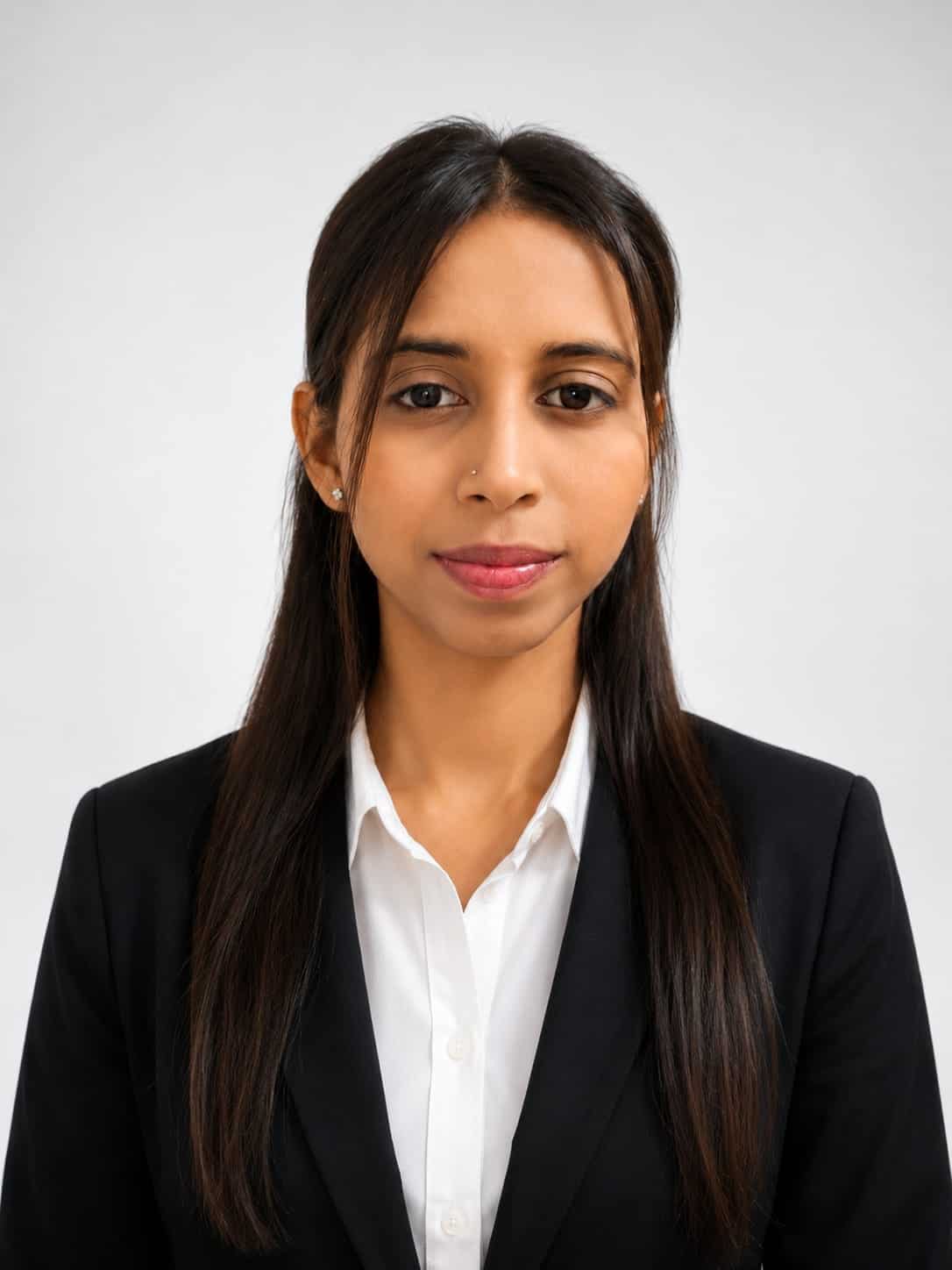
Nidhi Patel is an SEO and digital marketing content strategist focused on AI SEO, content marketing, blogging, and personal branding. Through TrendChaska, she shares practical digital marketing insights, SEO strategies, and AI tools for beginners, students, and small businesses in India.