Learn Hyperlocal Keyword Research for Indian Cities with this 2026 step-by-step guide. Discover free tools, local SEO tips, and keyword strategies.
Introduction
Currently, if you own a local business or write for one, then you know firsthand that achieving rank on Google is not as easy as it once was in days gone by. Search has changed in the last five years. They look for stuff nearby, in their own language, on mobile phones, while they are walking/driving/at a chai tapri. That is exactly the reason why Hyperlocal Keyword Research for Indian Cities has become one of the recognized must-have skills for present-day SEO professionals.
Hyperlocal SEO is the practice of optimizing your website or business listing for searches associated with a very exact location, not just a city but a neighborhood, street, or landmark. If a dentist in Satellite, Ahmedabad, is trying to outrank “best dentist” keywords, which even dental practices from all over India compete for, it’s not going to help. But the keyword “best dentist near Satellite Ahmadabad” drives patients who are ready to schedule an appointment.
As India is not a generic market, Indian cities require a different keyword strategy. Mumbai searches differently from Jaipur. The tech crowd of Bengaluru has a different type of search than the traditional retail buyers in Lucknow. Now take into account regional languages, local slang and names of the area – combine that, and you have a search environment that common keyword tools are blind to.
This hyperlocal Keyword Research for Indian cities guide covers what Hyperlocal Keyword Research means, why it matters in 2026, and how to do it (step by step) yourself using free tools, real examples and a checklist you can follow today.
What is Hyperlocal Keyword Research for Indian Cities?
Hyperlocal keyword research refers to discovering search terms that are associated with a true pinpoint rather than an entire city or even a state. At the next level, it goes beyond normal local SEO.
Local SEO vs Hyperlocal SEO
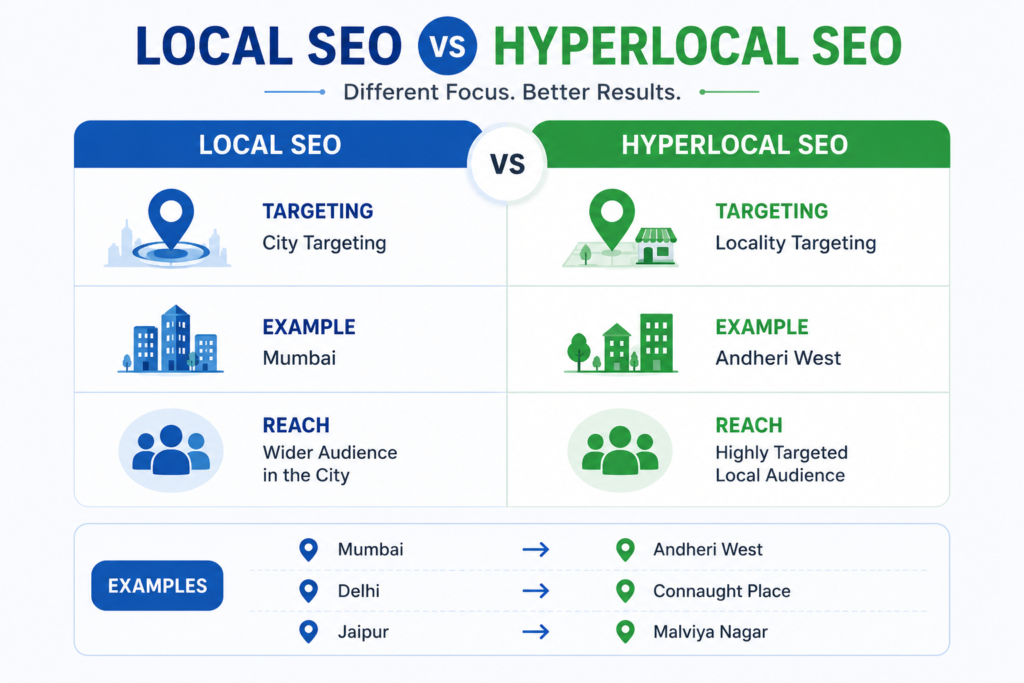
Local SEO typically targets a city or region in general. Local keywords are regional searches; for instance, “packers and movers in Pune.” This is a helpful phrase, but it is also competitive, as every mover in Pune needs to rank for it.
Hyperlocal SEO refines this even further. You have refined your target keyword from “packers and movers in Pune” to “packers and movers in Kothrud, Pune, or packers and movers near Pune University.” Although these keywords have a lower number of searches, the people searching them are much more likely to become paying customers as they are looking for something that is located in their exact neighbourhood.
And this is, basically, the essence of what Hyperlocal Keyword Research for Indian Cities is all about — not targeting a city, but targeting streets, localities and micro-markets within it.
Benefits of Hyperlocal Keyword Research
- Not as competitive as broad city-level keywords
- The ability to convert better as searchers are likely having a good local intent
- Improved location results in Google Maps and Google Business Profile
- Greater relevant website traffic factors extra bounce-backs.
- More solid basis for an ongoing local SEO strategy
The Significance of Hyperlocal SEO in India 2026
Hyperlocal SEO was a “nice to have” a few years ago. By 2026, it is almost a must-have — and there are obvious reasons for that.
Mobile searches are growing fast. The majority of Indians now search mainly on their phones, usually while they are out and about. If, for example, Someone standing outside a Bhubaneswar mall looking at their shoe being repaired wants results local to him/her and not anything from across the state.
Voice search is redefining how people type or speak. Voice Search SEO is growing as a part of local search behaviour. Complete sentences spoken: “where to have good biryani near me right now” instead of typing “biryani Hyderabad.” This shift indicates that your content must answer questions in a conversational, location-centric way.
AI Search features from Google are changing the results pages. Today, every local business should consider AI Search Optimization precisely because summaries generated by AI typically draw from the surface of well-structured, locally relevant content and Google Business Profile listings.
“Near me” searches keep climbing. “AC repair near me,” “salon near me” — these types of Near Me Keywords very clearly indicate commercial intent, and if you have a business that is not optimized for these phrases, you will get customers from your competitors.
Even regional language searches are increasing. More people in cities like Lucknow, Surat, and Jaipur now search partially in Hindi or Gujarati, or partly in English + a regional language. Overlooking this change means missing a big part of the local search traffic.
This is why it should be at the core of every serious local SEO strategy and not an optional extra.
Understanding Search Intent
You need to know why someone is searching for it before you pick a keyword. This is search intent, and it separates the wheat from the chaff in terms of spending your content capital effectively or writing useless fluff assets.
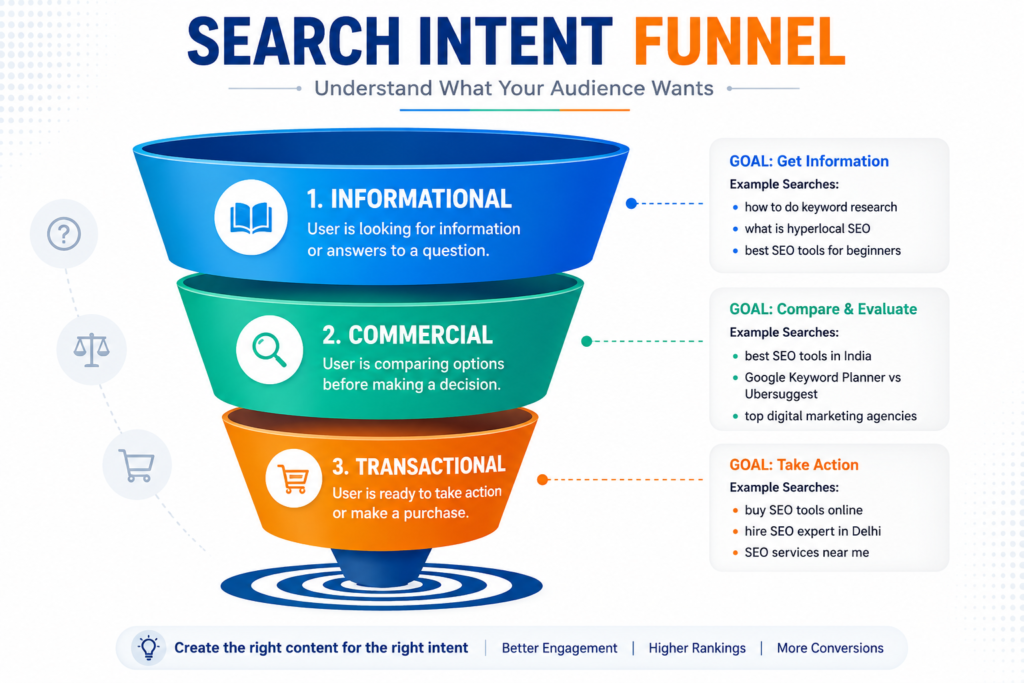
Informational Intent
The searcher is looking for knowledge. Similar: — What documents are required for a passport in Ahmedabad? They’re not ready to buy anything; however, if you respond to their issue correctly, they could be a customer later.
Commercial Intent
The searcher is in a comparison stage before making a decision. For e.g., best interior designers in Pune, top CA firms in Bengaluru. This is an excellent stage to show up in because the individual is close to a decision.
Transactional Intent
This is the person searching for what you are about to put into action now. For example: book AC repair service in Mumbai today or order cake near me in Surat. These are the quickest-converting keywords, so you want these at the top of your list.
Navigational Intent
It is when the person searching already has a (local) brand or place in mind. They are just looking for directions, finding an address, or wanting to get your contact details. This can include searches like “Law Garden Ahmedabad address” or “Phoenix Mall Lucknow timings.”
Pairing each KW with the corresponding phase of Local Search Intent guides you on what type of page to create — an informational search suggests a blog post, a commercial one advises service pages, and a transactional one guides towards booking pages. The step of intent-matching is an important part of good Hyperlocal Keyword Research for Indian Cities.
Guide To Hyperlocal Keyword Research for Cities in India
This is a complete and actionable Hyperlocal Keyword Research for Indian Cities workflow that you can follow even if you have never done keyword research prior to this.
Step 1: Choose Your City
Focus on the city that you plan to visit. For all details about the project, just click here. This means that a florist in Jaipur will have greater customer behaviour than any other florist in Chennai, even if the products are the same.
Step 2: Target Prospects
So, ask yourself, who really is searching? For example, a student searching for PG accommodation in the vicinity of the college searches very differently from a working professional searching for a 2BHK flat. Once you understand your target audience, it influences all of the keywords you select going forward.
Step 3: Brainstorm Seed Keywords
Without thinking about search volume, just write the relevant basic terms of your business. Some of the seed keywords for a bakery in Surat would be “cake shop”, “bakery”, “birthday cake”, and “eggless cake”.
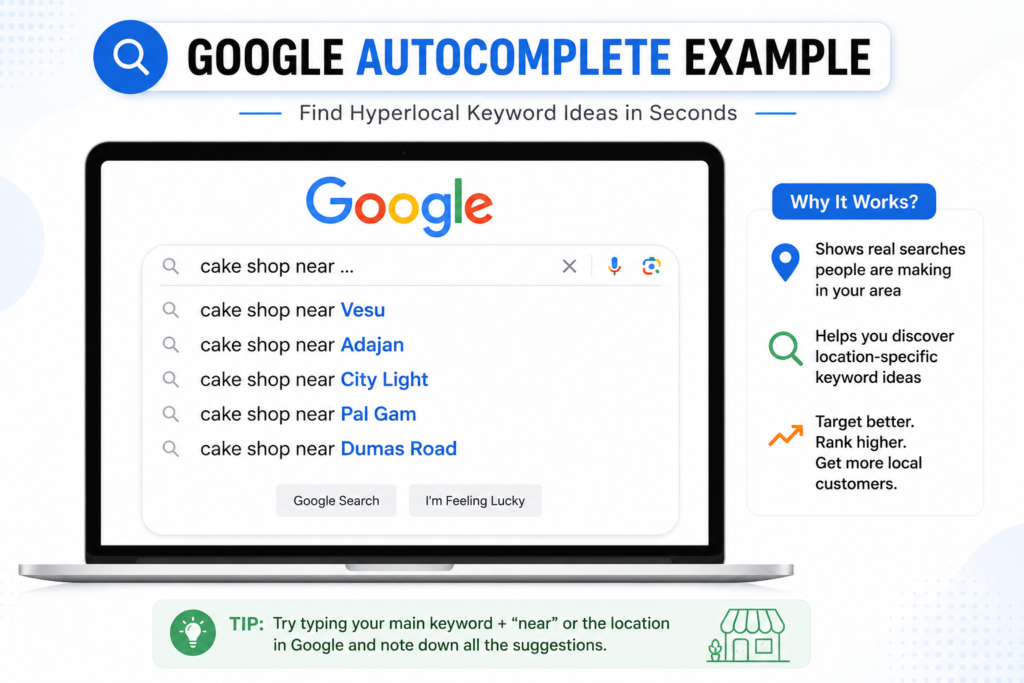
Step 4: Use Google Autocomplete
Google suggestions: Type your seed keyword in Google and see what Google suggests. This is one of the fastest, cost-free methods to find actual phrases people are typing. Type cake shop near and see what parts of Surat Google auto-suggests to you.
Step 5: Use of Google Keyword Planner
Google Keyword Planner may be the most accurate tool for checking search volume and advanced related keyword ideas, only if you filter results for a specific city/region of India.
Step 6: Use Google Trends
Google Trends in India lets you figure out if a keyword is getting popular, losing its popularity, or is seasonal in a specific Indian city. Example — AC Repair catapults in cities like Ahmedabad and Delhi every summer; Raincoat Shop Near Me usually gets many searches during monsoon in Mumbai & Pune.
Step 7: Analyze Competitors
Look up the keywords that you’d like to rank for and find out which local people are already ranking. Look at their websites and Google Business Profile listings to see what they are targeting in terms of keywords, services, and area names.
Step 8: Find Long-Tail Keywords
Long-Tail Keywords are longer and more precise phrases with lower search volume but higher intent. Long-tail keywords are basically put a lot closer — instead of “salon Bengaluru,” think about a bridal makeup salon in the proximity of Indiranagar, Bengaluru. These are very good for hyperlocal targeting.
Step 9: Check Keyword Difficulty
Some keywords just aren’t worth the pursuit. You should verify the competitive nature of a keyword before developing content on top of it through the use of free or paid tools. If a keyword seems too competitive for a small business, try the next more specific and less competitive variation instead.
Last Step: List of Keywords
Put everything in a simple spreadsheet with the following columns: Keyword, Search Intent, Approx Volume, and Priority. This turns your working document into creating content and optimizing your Google Business Profile.
It is not a one-time exercise, but actually, if you follow these ten steps consistently, then only it is possible.
Top Free Hyperlocal Keyword Research Tools for Cities in India
You do not require an expensive subscription to join in on the fun. So, here are some of the best Local SEO Tools that are in the free version.
- Google Keyword Planner — Awesome for search volume and keyword suggestions, but tends to show a range instead of a specific number more frequently.
- Google Trends — This is great for looking for seasonality trends as well as comparing the interest level of different cities within India, but it shows relative popularity vs actual search numbers.
- Google Search (Autocomplete & “People also ask”) — For free, fast, and straight to the point, what real users are typing as queries – no volume data.
- Google Business Profile — More than a listing, the insights section tells you which searches really lead people to your profile.
- Google Search Console — This is great for when your site starts getting live search volume; it shows you the exact queries people used to find your pages so that you can refine your keyword list as time goes on.
- AnswerThePublic — Great if your keyword ideas are in the form of questions, but be warned that the free version puts a cap on how many searches you can do per day.
- Ubersuggest gives keyword ideas and approximate difficulty scores, with limited free searches per day.
- Keyword Surfer — This is a free browser extension that provides approximate search volume right inside Google with easy searching capability on the fly.
These tools will give you a fairly good perspective for no money, as using a mix of these tools is important, especially if you are new to Hyperlocal Keyword Research for Indian Cities.
Examples of Hyperlocal Keywords from Tier-1 Indian Cities
Now, take a look at this table providing an example of hyperlocal thinking for the keyword from generic to specific.
| City | Business | Keyword | Search Intent |
| Ahmedabad | Dentist | best dentist near Satellite Ahmedabad | Commercial |
| Mumbai | Real Estate | 2BHK flats rent in Andheri West — CGI of 167,799gp | Transactional |
| Delhi | Restaurant | Where to Find the best Butter Chicken Near Connaught Place | Commercial |
| Pune | Movers | Moving firms insurance coverage packers and movers in Pune | Transactional |
| Bengaluru | Salon | bridal makeup artist near Indiranagar | Commercial |
| Hyderabad | Coaching | JEE coaching centre near Ameerpet | Informational |
| Jaipur | Florist | flower delivery in Malviya Nagar Jaipur | Transactional |
| Bhubaneswar | Electronics | AC repair near Chandrasekharpur Bhubaneswar | Transactional |
| Lucknow | Clothing | bridal lehenga shop near Hazratganj Lucknow | Commercial |
| Surat | Bakery | eggless cake shop near Vesu Surat. | Transactional |
All the keywords have one main service and an area name. That is the core of City-specific Keywords, separating hyperlocal targeting from basic Local Keyword Research.
Common Mistakes to Avoid
As marketers, we commit these follies while conducting Hyperlocal Keyword Research for Indian Cities. Watch out for these ten:
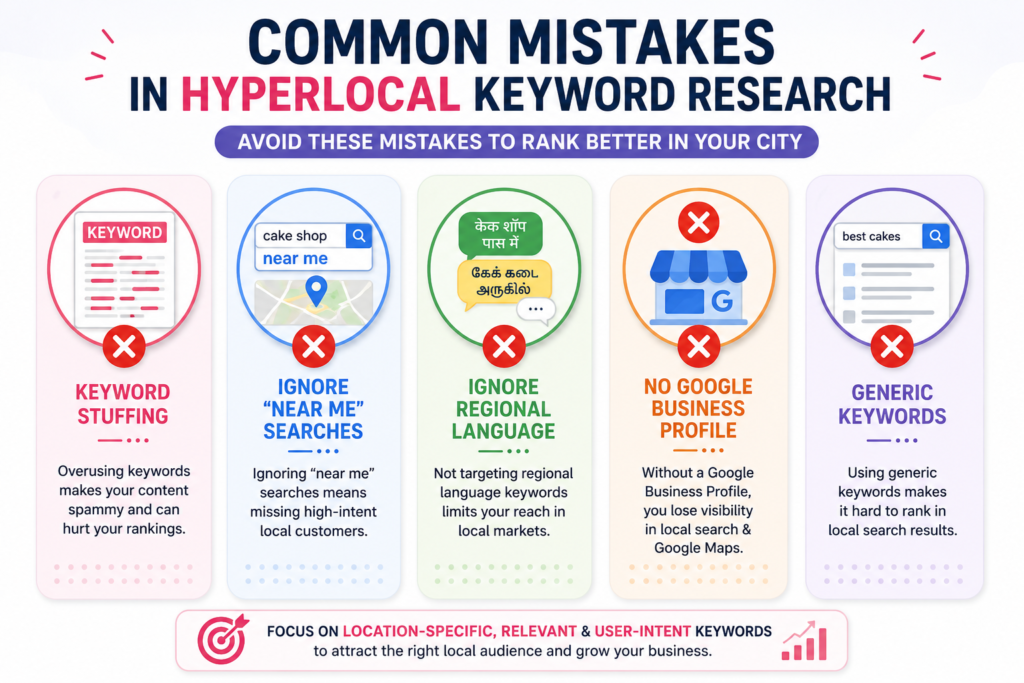
- Targeting all over the city rather than specific localities — this creates unnecessary competition.
- Overlooking regional language queries — we lose out on a huge segment of local traffic.
- You copy the keywords from a national competitor without verifying them against local search behaviour.
- Not Using Google Trends to Check Seasonality — some keywords are only for 3 months in a year.
- Keyword stuffing area names, elephantthink, and purpose in contents that ruin the readability of your text and may make it look spammy.
- Failing to optimize for Google Business Profile, even though it can be one of the first things your potential clients see.
- Forgetting mobile users when working on pages (ie, most local search happens on phones).
- Neglecting to update keyword lists as new localities or landmarks gain in popularity.
- Ignoring “near me” and voice queries that don’t remain traditional typed keywords.
- Not researching each city but treating all the same instead.
Just by avoiding these mistakes, you can place your local SEO Strategy ahead of most of your competitors, who still have to learn and implement outdated methods.
Best Practices for 2026
With the relentless evolution of search behaviour, there are 4-5 practices that really take significance this year when it comes to Hyperlocal Keyword Research for Indian Cities.
- Content that is clear, well-structured, and truly helpful has the edge because AI Search determines what types of businesses tend to show up in Google AI-generated summaries.
- Since people speak to their phones in this manner, Voice Search SEO rewards content written in these naturally (conversation-centered) natural language tones, including full questions and answers.
- Optimizing your Google Business Profile is still one of the highest-impact, yet lowest-cost activities. Make sure to have your hours, photos, services, and posts up to date on your profile.
- What Schema Markup does is give the search engines data deductions about your business description, address, and services, enabling you to get better visibility in local results.
- Mobile SEO is non-negotiable. Businesses with slow, non-responsive websites are gone in seconds when it comes to local customers.
- Local Landing Pages designed specifically for each neighbourhood or niche service area have better results than a single flat “contact us” page trying to cover an entire city.
- Reviews still carry a lot of weight when it comes to rankings and customer trust, so actively encourage satisfied customers to leave honest reviews.
- User experience — a well-structured, fast-loading website will keep visitors on the page longer, leading to conversions, which in turn helps your rankings too.
Case in Point: A Small Business Success Story
A small furniture store is a classic case for Hyperlocal Keyword Research for Indian Cities. For each keyword we went after, the store’s website was only targeting broad terms such as “furniture shop Ahmedabad” and barely made it to the first two pages of Google before doing any hyperlocal work.
Following a defined process for it, the owner discovered local keywords such as “wooden sofa set near Bopal Ahmedabad” and “dining table shop near Science City Ahmedabad”. They updated their Google Business Profile with these terms, built two corresponding local landing pages, and encouraged recent clients to leave reviews referencing their locality.
Over several months, the store began showing up in Google Maps pack results for many of these particular searches, and foot traffic from search queries dramatically increased. These results weren’t instant, and a number one search result was never guaranteed, but the steady strategy concentrating on the local audience proved to work infinitely better than the store’s previous vague approach.
Hyperlocal Keyword Research Action Checklist for Indian Cities
Use this checklist to get you started right away!
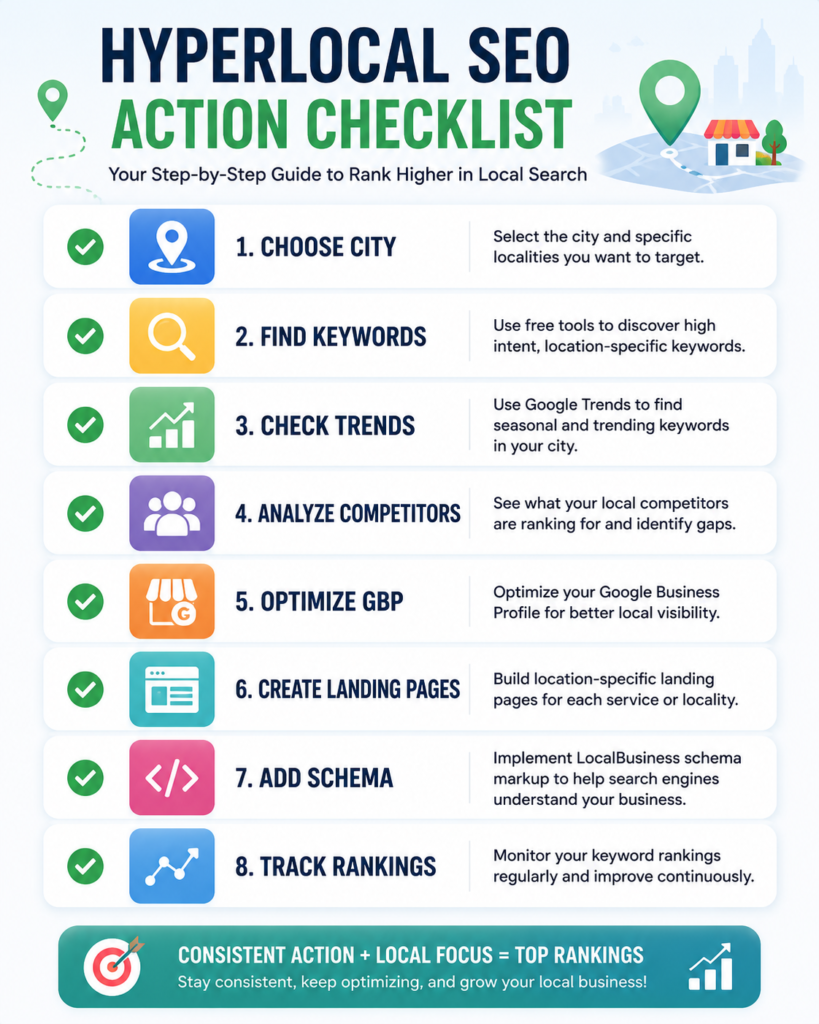
- Choose the city you wish to focus on, along with the localities.
- Define your target audience clearly.
- Make a list of seed keywords.
- Looking for real suggestions, check Google Autocomplete
- Use Google Keyword Planner and enter your seed keywords.
- Check seasonality using Google Trends.
- Look at three to five direct competitors in your area.
- Compile a list of long-tail, local keywords.
- Check keyword difficulty before committing.
- Organize everything into a spreadsheet.
- Use Selected Keywords to Optimize your Google Business Profile
- Create locality-specific landing pages.
- Integrate on-page schema markup into your site.
- Encourage genuine customer reviews.
- Use Google Search Console to track your results.
Conclusion
In 2026, hyperlocal keyword research for indian cities is not a choice anymore. Indian cities vary so massively, mobile-first and seeing a rise in voice and AI-powered search, that broad, generic keywords just don’t work like they used to.
You can create content and listings that speak to the people in your exact neighbourhood. Click To Tweet — With a little help from this ten-step process, this guide will walk you through it – from selecting your city to putting together a comprehensive keyword list. Throw in some effective Google Business Profile Optimization, genuine reviews, and a mobile-friendly website, and you really give your business a fighting chance to shine in local SEO.
Start small. Select a single locality, go through the checklist above, and observe how your local visibility starts to change. Hyperlocal Keyword Research for Indian Cities is far more beneficial with consistency and patience, so start today and scale it up every month.
Frequently Asked Questions
1. Hyperlocal Keyword Research for Indian Cities: What is it?
It refers to the process of targeting search terms related to a particular locality, neighbourhood, or landmark in an Indian city instead of just focusing on the whole city. It enables nearby customers to find local businesses with high purchase intent.
2. What is hyperlocal SEO and how is it different from local SEO?
Local SEO typically aims to cover an entire city, while hyperlocal seo zeroes in on individual areas in that city (like a neighborhood or popular landmark), so it is usually more specific and ventures into less competitive areas.
3. Best Free Tools for Local Keyword Research in India.
These are some of the most reliable free tools available to Indian local SEOs: Google Keyword Planner, Google Trends, Google Autocomplete, insights from your Google Business Profile page, and information pulled via the GSC.
4. Why “near me” searches carry such huge value.
These terms are very commercial or transactional because the searcher is usually ready to go visit a place or buy something, and are therefore extremely valuable for local businesses.
5. Am I supposed to also target regional languages?
Yes. A large section of users in Indian cities is searching partially or completely in vernacular languages or a mixture of English + their mother tongue, and to ignore this means losing out on a huge segment of your potential audience.
6. What Is The Frequency Of Updating Hyperlocal Keywords List?
With the environment of search constantly changing, competitors entering & new localities & landmarks emerging, it’s advisable to revisit your keyword list every few months, especially in rapidly growing Indian cities.

Nidhi Patel is an SEO and digital marketing content strategist focused on AI SEO, content marketing, blogging, and personal branding. Through TrendChaska, she shares practical digital marketing insights, SEO strategies, and AI tools for beginners, students, and small businesses in India.