
The Ultimate Guide to Google Algorithm Updates 2026: What changed, why rankings fluctuate, and how to come back and survive search.
Introduction
If your traffic moved up or down without an obvious reason this year, a Google algorithm update likely caused it. Google Algorithm Updates 2026 have redefined the rules of content ranking, and even more changes are expected before we ring in a new year.
These shifts aren’t background noise for website owners, bloggers, and marketers. A core update can make or break organic traffic in days, and the sites that end up recovering fastest are usually those that were not reactive to social media rumors about what happened but actually understood, with insight as to why they were affected.
This guide outlines what Google Algorithm Updates 2026 have contained so far, how you can determine whether one of them has impacted your site — and the practical moves that actually help. All of this is sourced only from official statements released by Google, not conjectures dressed up as facts.
What Are Google Algorithm Updates?
An Google Algorithm Updates 2026 is a modification to the system Google utilizes for ranking pages on its search engine. While Google does run thousands of minor updates every year, only a few are large enough — or prominent enough — for Google to announce and confirm.
The web keeps changing, and in turn Google updates its search systems. New types of content emerge, spam techniques grow, and users’ expectations change. If Google does not keep updating and coming up with better ways to promote sites that real searchers find useful, Google ranking updates will become meaningless.
Not all updates function in the exact same manner. Be aware of the difference:
- Core updates — a broad, global recalibration of what Google considers to be quality content across the web. They don’t zero in on a specific problem; they reset the system entirely.
- Spam updates — target sites that employ spammy practices, including manually tweaking certain aspects of the site or using manipulative link techniques like artificially boosting chunks of low-quality content.
- Helpful-content-related updates — now bundled into core updates and considered part of the ranking signals rather than their own update, these evaluate whether content was produced to benefit people or mainly drive search traffic.
- Other search-system changes — may impact features such as Discover, image search, or displaying rich results without modifying the underlying ranking algorithm.
Any one of these can impact websites, but just because a site is impacted does not mean the effect will be large or small based on how closely their content matches what the update is measuring.
Google Algorithm Updates in 2026
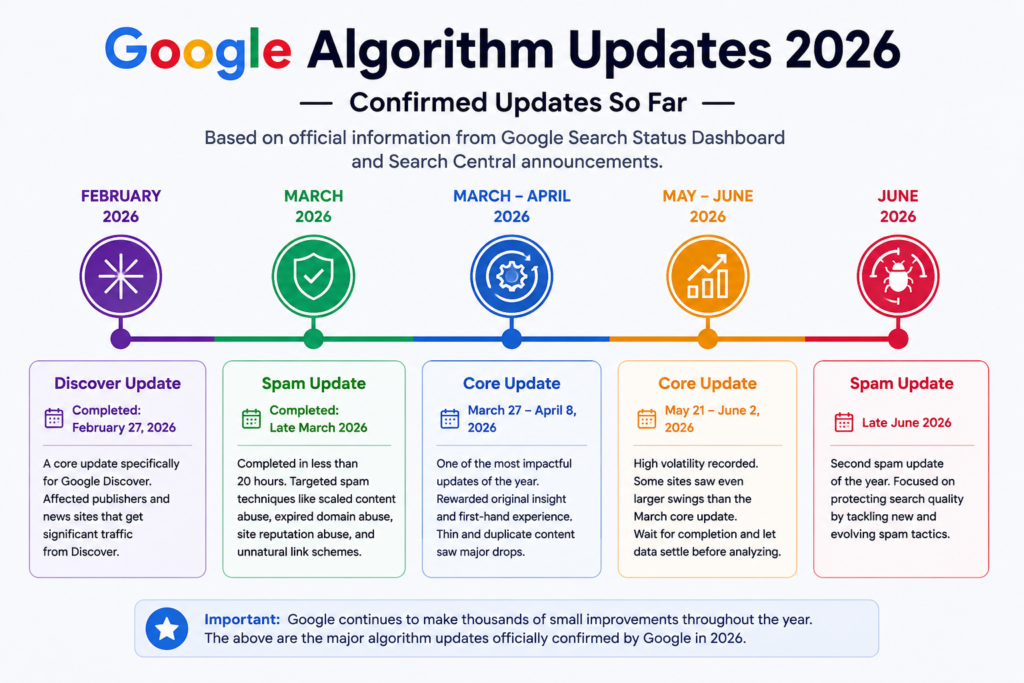
Based on Google’s Search Status Dashboard and Search Central announcements, here’s what Google has confirmed this year so far. Dates and details are of things confirmed publicly; anything that has not received confirmation is labelled as such.
February 2026 Discover Update
Google released a core update just for Discover over about three weeks, completing on February 27. This was noteworthy since Google openly labeled this as Discover-only, something it had not done before. Most of those who noticed the shift were publishers and news sites, which rely quite a bit on Discover traffic. If you are getting an outsized chunk of your traffic from Discover, it’s worth looking at this separately from how your rankings shift for regular search, as the two surfaces don’t always move in tandem.
March 2026 Spam Update
In late March, this update rolled out and was completed in less than 20 hours, making it the swiftest confirmed spam update to date. Spam-oriented updates like this target everything, including scaled content abuse, expired domain abuse, site reputation abuse, and unnatural link schemes. The most exposed were sites that also relied on any of these tactics — even indirectly, through a vendor or agency.
March 2026 Core Update
Spread out between March 27 and April 8, this was somewhat of the most impactful Google Algorithm Update 2026 has seen to date, with a significant portion of sites exhibiting prominent ranking alterations. There were no new guidelines published by Google at the time; like all other core updates, the previous Search Central documentation on core updates still applies. Analysts tracking ranking movement noted that original insight with first-hand experience tended to hold up better than generic, broad-based content. Drops tended to hit sites with thin or duplicate content across many unrelated topics.
May 2026 Core Update
The rollout of this update began on May 21 and continued through June 2, just weeks after the March core update had finished. The volatility was described by industry trackers as rare, and even greater for some than the March update. As with any Google core update in 2026, best practice remains the same: wait for Google to confirm that the rollout is complete before concluding your data, and then give your data at least another week to settle.
June 2026 Spam Update
Late in June, a second spam-focused update was pushed out, continuing Google’s pattern of pairing spam enforcement with core ranking changes. It targeted the same categories as the March spam update, with no new spam policies introduced.
What’s Unconfirmed Right Now
At the time of writing, publishers and SEO trackers have been reporting unusual ranking fluctuations in early August 2026. Google, however, has not announced a new update during this time frame on its Search Status Dashboard. This is something to watch, but until Google gives official confirmation, it should not be considered a confirmed 2026 Google update. A key reason site owners chase after the wrong fix is that they react to volatility before it is confirmed.
How Do Google Algorithm Updates Impact How Websites Rank?
Google Algorithm Updates 2026 don’t just impact raw rankings. There are several ways their effects can manifest, often connected:
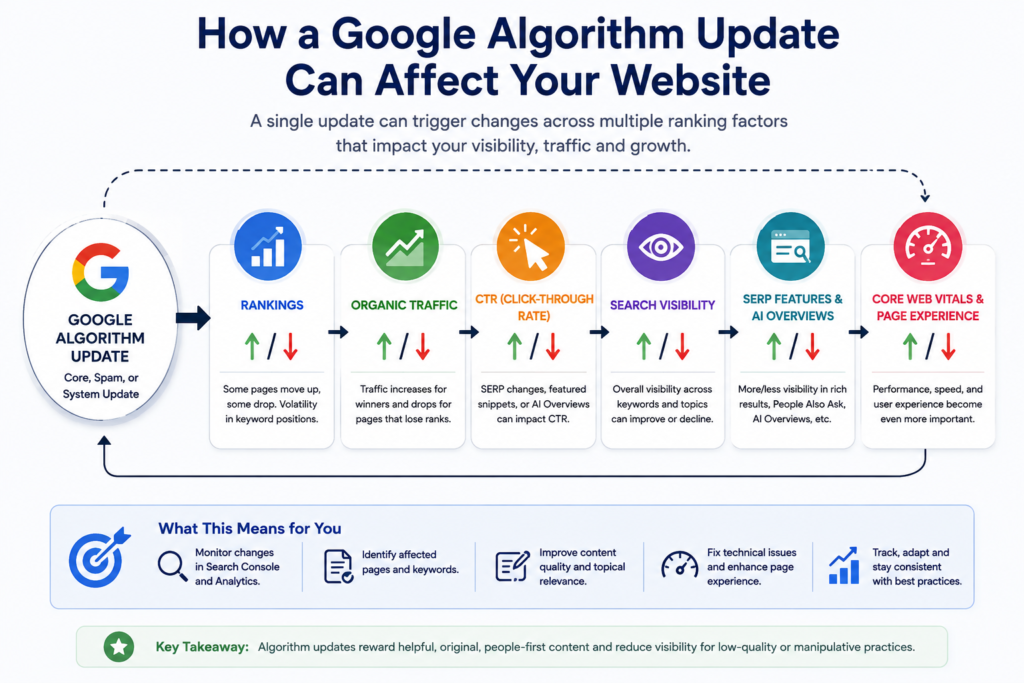
- Organic traffic can go up or down as pages rise and fall in results, sometimes with a noticeable lag between the change to the SERP and the subsequent effect on traffic.
- Keyword rankings may shift for some queries but remain stable for others, since core updates very rarely affect every page on a site equally.
- Domain-level search visibility as a whole — how much your domain shows up across all queries it should rank for — might fluctuate even if you seem stable at the top of relevant searches.
- Click-through rates can move without a change in ranking position, depending on how much of your listing is visible in SERP features such as AI Overviews.
- Featured snippets and other SERP features might appear, disappear, or move from one competing site to another as Google evaluates which content best satisfies a query.
- Content performance across an entire section of a site can shift together if that content shares similar quality or intent issues.
- User experience signals, such as page speed and Core Web Vitals, influence how content is assessed but are not a quality replacement.
Let me repeat this loud and clear: a drop in ranking following a Google algorithm update 2026 rollout does not imply that a site was hit by a manual penalty. Since core updates consider the entirety of the web at once, some sites might drop simply because other pages were rated as more relevant to a particular query — not because anything was broken.
My Website Lost Rankings After a Google Update — Here Is Why
In most cases, there’s never a single cause, but a few patterns keep recurring for websites that lose visibility after Google ranking updates:
- Content quality issues — pages that are thin, generic, or clearly written to a keyword rather than to answer a specific question.
- Search intent mismatch — where a page technically covers the topic well but doesn’t align with what searchers are actually trying to accomplish.
- Outdated information, especially in areas where facts, prices, or advice change over time.
- Weak topical relevance, which happens when a site covers a topic only superficially compared to competitors who go deeper.
- Poor user experience, such as slow load times, obtrusive ads, or difficult navigation.
- Technical SEO issues, including indexing problems, broken internal links, and duplicate content.
- Weak internal linking, which can make it harder for Google to understand which pages are most important.
- Low-quality or spammy backlinks, particularly from paid link schemes rather than organically earned through content.
- Stronger competing content — another site simply did a better job answering the same query.
None of the factors listed above are guaranteed or officially named Google ranking factors at this time. Some are patterns SEO professionals have noted coinciding with ranking changes — not a Google statement. Consider them things worth checking, not guarantees.
How to Know if Your Site Was Affected by a Google Update
Validate what actually occurred before making changes. Here’s a practical process:
- Visit the Google Search Status Dashboard to find out exactly when an update is confirmed to have begun and ended, so you can compare your data against a real timeline instead of a guess.
- Go to Google Search Console and review clicks, impressions, and average position for a week or two prior to the update, then again a couple of weeks after — filtering by page and by query to identify patterns.
- Check Google Analytics for organic sessions, landing page performance, and conversion trends mapped to the same period.
- Search your own target queries in Google to check whether you still have visibility, and whether the pages now ranking above you look meaningfully different from yours.
- Verify your Core Web Vitals and page experience report in Search Console to rule out a technical trigger that coincidentally aligns with the update.
- Segment your data by page type or topic, since a broad core update generally only impacts one part of a site, and averaging your whole site’s performance can obscure that.
Look for changes that closely correlate with the confirmed update window. If your drop started well before or after the official dates, another cause might be more plausible.
Recovering From a Google Algorithm Update
There is no magic button, and any plan that promises rapid recovery from a Google algorithm update 2026 rollout should be treated with caution. That said, a systematic approach gives you the best shot:
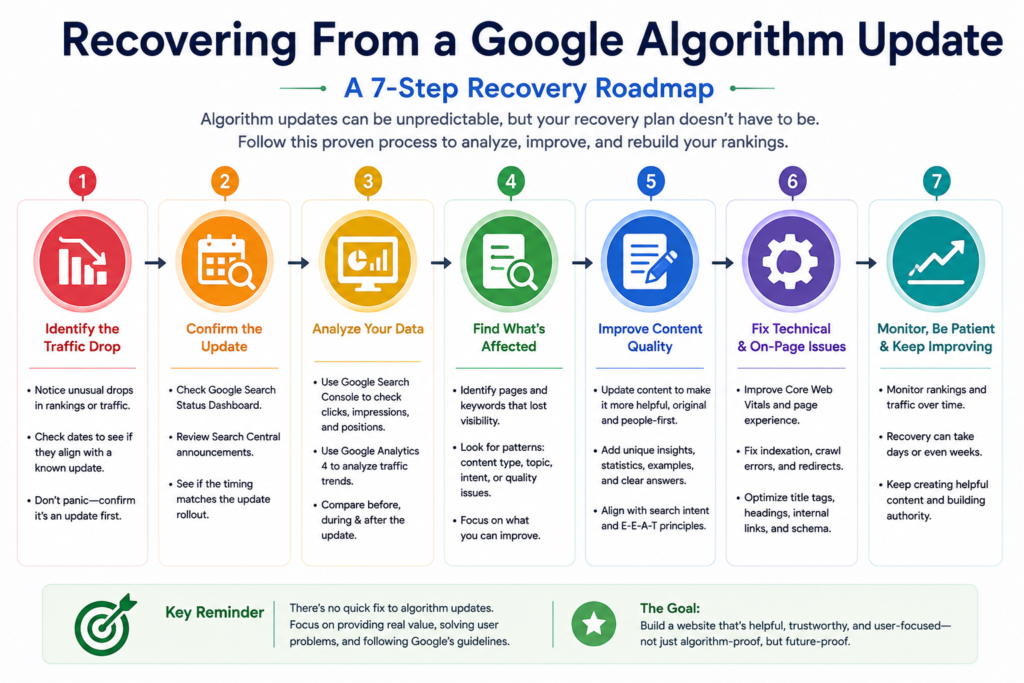
- Analyze the traffic and ranking drop using Search Console and Analytics data — not gut feeling.
- Identify which specific pages and queries were affected, rather than assuming the whole site took a hit equally.
- Audit search intent for those pages and check whether they still align with what searchers want.
- Improve content quality and usefulness — add real depth, first-hand experience, or clearer answers where content falls short.
- Update outdated information, especially statistics, prices, dates, or rules that have changed.
- Improve internal linking so that both users and Google find your best content more easily.
- Enhance technical SEO — repair crawl errors, broken links, and indexing issues.
- Review user experience, including page speed, mobile usability, and ad placement.
- Don’t reflexively delete pages — remove or improve genuinely low-value content when necessary.
- Monitor performance after making changes, giving Google enough time to recrawl and reassess before concluding.
Recovery timelines vary. Some sites improve by the next related update; others take longer. While there’s no way to guarantee that these steps will restore rankings, they address the same signals Google’s systems are designed to reward.
SEO Best Practices for 2026
While every update is different, a few best practices apply to almost every Google algorithm update 2026 has brought:
- Write useful, original content answering a specific question better than the sites currently ranking, instead of regurgitating what competitors already say.
- Show experience in the field or topic where it applies — through product reviews, tutorials, or personal stories.
- Build topical depth — you’re much better off covering one subject thoroughly than publishing disparate, thin posts across unrelated topics.
- Match search intent carefully — confirm what type of content currently ranks for a query before creating your own.
- Keep information up to date, especially anything that relies on prices, regulations, or fast-moving topics.
- Improve page experience — page speed, Core Web Vitals, mobile usability, and ad placement.
- Strengthen internal linking so related content is connected naturally and is easy to navigate.
- Use structured data correctly where relevant, and avoid marking up content in a misleading way.
- Monitor Search Console data regularly — not just when you suspect an update.
- Build a trustworthy website with author transparency and legitimate, accurate contact information.
The SEO trends of 2026 have been reinforced and aren’t new. They’re the same fundamentals Google has laid out for years, now applied more consistently as updates arrive faster and more frequently.
Mistakes to Avoid After a Google Update
A bad reaction to a ranking drop can be worse than the update itself. Watch out for these:
- Making radical changes without data — you risk trying to fix what isn’t actually broken.
- Culling large numbers of pages immediately — this can delete content that still brought value, or that would have recovered on its own.
- Keyword stuffing to “reinforce relevance” tends to reduce content quality and may flag spam-related issues.
- Copying competitors who currently rank well rarely works, since Google is good at spotting a lack of originality.
- Chasing every SEO rumor wastes time on theories that are unproven until Google confirms them.
- Buying low-quality backlinks to “recover fast” is one of the most frequent causes of a later, worse drop.
- Changing URLs unnecessarily rarely helps and can create avoidable indexing and redirect issues.
- Publishing large amounts of low-value AI-generated content to rebuild volume tends to reinforce exactly the quality issues spam updates are designed to catch.
All of these mistakes share one thing in common: responding fast, not responding right.
Staying Ready for Future Google Algorithm Updates
Instead of speculating on what the next Google Algorithm Updates 2026 will involve, it helps to build habits that hold up against whatever changes are coming:
- Conduct regular content audits to identify old, thin, or poorly performing pages before an algorithm update forces your hand.
- Run ongoing technical SEO monitoring — not just after you think something dropped.
- Check Search Console regularly so you catch gradual changes instead of being surprised by sudden ones.
- Watch competitor content to see what’s raising the bar in your niche.
- Refresh content periodically, especially pages with facts or figures that change quickly.
- Collect user feedback to identify usability problems before they show up as ranking issues.
- Track organic traffic and conversions together, since rankings only tell part of the story.
- Follow Google’s official announcements on the Search Status Dashboard and Search Central blog, rather than relying solely on secondhand summaries.
This approach won’t protect you from every Google search algorithm change, but it puts your website in a far more stable position when the next update arrives.
Conclusion
2026 has already brought a Discover-focused update, two spam updates, and two core updates to Google Algorithm Updates, all reinforcing the same fundamental message: show real, helpful content rather than material designed only to game rankings. Fearing every piece of news about the next update drains energy that’s better invested in the fundamentals Google has been clear about for years.
If you take away only one part of this guide, make it this: don’t obsess over backlinks, keyword metrics, or competitor gap analysis alone. Build good, relevant, well-structured content, and treat data from Search Console and the Search Status Dashboard as your source of truth. Applied consistently, this approach is what actually helps you recover from a Google algorithm update and improve Google rankings over the long term — far more reliably than reacting to speculation.
Frequently Asked Questions
Q1. What are Google Algorithm Updates 2026?
These are the confirmed changes Google has made to its ranking systems through 2026 — including core updates, spam updates, and a Discover-focused update — all meant to produce better matches between search results and what searchers want.
Q2. How often does Google’s algorithm change?
Google makes continual adjustments, but only names and confirms a few major updates each year. So far in 2026, we’ve seen a confirmed Discover update, two spam updates, and two core updates.
Q3. How do I know if I was affected by a Google update?
Get the confirmed start and end dates of an update, then compare them to your Search Console and Analytics data. If your traffic or rankings shifted closely within that window, the update is likely related.
Q4. How long does it take to recover from a Google algorithm update?
There’s no fixed timeline. It could take a few weeks for some sites, while others may not recover significantly until another closely related update lands. Consistent quality improvements matter more than speed.
Q5. Can an algorithm update cause a sudden traffic drop?
Yes. Core updates in particular can produce clear, abrupt ranking changes because Google is re-evaluating many sites’ relevance together at the same time.

Nidhi Patel is an SEO and digital marketing content strategist focused on AI SEO, content marketing, blogging, and personal branding. Through TrendChaska, she shares practical digital marketing insights, SEO strategies, and AI tools for beginners, students, and small businesses in India.