
Learn how to write SEO blog posts India that rank in 2026 using keyword research, NLP writing, content structure, and SEO strategies.
Why Writing Blogs With SEO is Even More Important in India Now
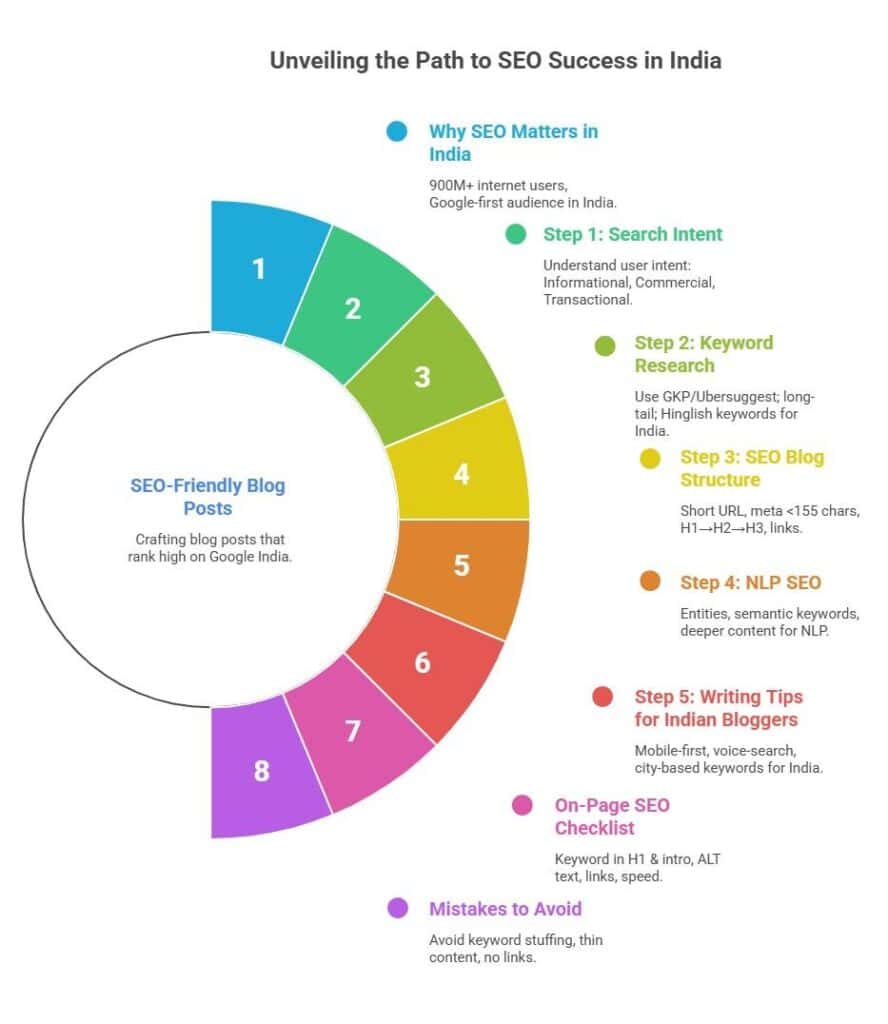
India now has more than 900 million people using the internet. Most of them begin their online experience with a Google search. It doesn’t matter if you’re a student writing in Pune, someone running a small shop in Jaipur, or a marketer in Bengaluru. Creating SEO-friendly blogs remains the most effective way to attract free, organic visitors.
The tricky part is that Google’s 2026 algorithm has gotten smarter. It goes beyond scanning for keywords. Now, it focuses on recognizing context, understanding user intent, and identifying relevant expertise. Repeating the same keyword again and again no longer works. The key now is to write content that provides value to people.
This guide shows you how to write SEO blog posts India that can reach Google’s first page—no unnecessary extras, just actionable steps.
What Does It Mean to Write an SEO-Friendly Blog Post?
An SEO-friendly blog post is:
- Written to address a question people are searching for
- Organized in a way that Google can interpret and rank
- Quick to load, mobile-friendly, and trustworthy
This is important in India. If your local rivals write shorter or messier posts, they won’t rank as high as you, provided you master SEO.
Figure Out Search Intent — A Critical First Move
Search intent explains why someone searches on Google. If your blog doesn’t match their intent, it won’t rank, no matter how good it is.
I
| INFORMATIONAL User wants to learn something“how to start a blog in India” | COMMERCIAL User is comparing options“best hosting for Indian bloggers” | TRANSACTIONAL User is ready to buy or act“buy Hostinger plan India” |
PRO TIP:
This blog aims to teach, not sell, so it focuses on informational intent. Always ensure your content aligns with the intent behind the keyword you target.
To Research Keywords for India (2026)
Before you start writing, figure out what people in India are searching online. Use tools like Google Keyword Planner, Ubersuggest, or Ahrefs while focusing on India as your target region.
Picking the right keywords
- Aim to target long-tail keywords. For example, “how to write SEO blog posts in India” works better than using “SEO.”
- Start out with keywords that show 500 to 5,000 searches every month and have low competition.
- Add Hindi-English mix keywords like “blog kaise likhe SEO ke liye” to reach Indian audiences better.
Where and how to use keywords
- Place the main keyword in the H1 title, the introductory 100 words, one H2 heading, the URL, and the meta description.
- Maintain keyword usage between 1% and 2% to avoid keyword overstuffing.
- Include natural synonyms and related words as part of the content flow.
Easy Template to Write SEO-Friendly Blog Posts
Good structure is key. Google values content that is organized . Follow this setup to write every SEO blog post:
| URL | Short, keyword-rich, no dates /how-to-write-seo-blog-posts-india |
| Meta | Under 155 characters, include primary keyword, add a clear value hook |
| H1 | One H1 only — contains your primary keyword, ideally under 60 characters |
| H2 | Main sections — each targeting a secondary keyword or subtopic |
| H3 | Sub-points under H2 — break down complex ideas simply |
| Links | Internal links (to your own content) + 1-2 external links to authoritative sources |
Apply NLP Techniques to Boost SEO
NLP, or Natural Language Processing, helps Google understand your content in ways that go beyond basic keywords. By 2026, it will play a key role in determining rankings.
What NLP means to improve your blog
- Entities are specific names of people, places, or brands that are important to your topic. For example, if you’re discussing SEO in India, mentioning entities like Google India (a search engine platform), SERP (Search Engine Results Page), or terms like meta tags (HTML elements that describe your webpage) can help Google understand your topic better, instead of just using the main keyword.
- Semantic keywords: Add similar terms that relate to your main keyword. So, if your focus is “SEO blog writing,” mix in phrases like “content strategy,” “organic traffic,” “search rankings,” or “Google algorithm” to enrich your content.
- Topical depth: Go in-depth with your topic. Short posts with just 300 words won’t perform well by 2026. Aim to write between 1,000 and 2,000 words when tackling competitive subjects.
INDIAN EXAMPLE
A blog titled “best mutual funds India” should include terms like SEBI, SIP, NAV, AMFI, Zerodha, and Groww. These are keywords that Google connects with this topic.
SEO Writing Tips for Indian Bloggers
Focus on mobile users first.
More than 75% of Indians access the internet using mobile phones. Write with short paragraphs of two to three lines. Use large fonts and leave enough blank space to make reading easier.
Adapt to voice search trends.
More and more Indians rely on voice commands while searching, both in English and Hindi. Keep your writing conversational. Frame headings as questions, like “What is SEO?” or “How can I rank on Google?”
Understand local search behavior.
People in India add city names or local references to searches, like “digital marketing course in Hyderabad” or “best CA in Mumbai.” If your blog is meant for an audience from a particular area, it’s helpful to work these kinds of local terms in a natural way.
Keep It Easy to Read
- Write sentences shorter than 20 words.
- Stick to plain language. Don’t use complex terms like “canonicalization” unless you explain them first.
- Divide your content into easy-to-skim bits using bullet points or subheadings.
Essential On-Page SEO Tips to Optimize Every Blog
- Add the main keyword in the H1 and opening paragraph.
- Write a unique meta description using relevant keywords and keep it below 155 characters.
- Create a simple and short URL with the main keyword.
- Insert 2–3 internal links that connect to related posts (like “Beginner’s SEO Guide for India“)
- Use keyword-focused ALT text for all images.
- Save image files with clear names (for example: seo-tips-india.jpg)
- Include an FAQ section with questions people search for.
- Ensure your page loads within 3 seconds on mobile.
- Add schema markup such as FAQ, Article, or HowTo.
- Avoid duplicate or written content on the page.
Typical Errors to Avoid in Blog SEO
- Keyword stuffing— Using the same phrase over and over in a way that feels unnatural. Google punishes this, and readers dislike it too.
- Thin content— Posting short, 200-word articles that fail to answer the question. These posts won’t help anyone and won’t rank well.
- Skipping internal links— Not connecting your own blogs together misses out on better crawlability and can hurt your rankings.
- Copying competitor content— Plagiarizing from others damages your site’s SEO. Original content built on your own expertise works best.
- Lack of a clear CTA or structure— Disorganized blogs confuse readers and Google because they don’t follow a logical structure or provide clear action steps.
Conclusion
Creating blogs optimized for SEO in 2026 isn’t about tricking search engines. It’s about helping the people who read them. Google now prioritizes content that does just that.
Focus first on understanding what people are searching for. Find keywords relevant to readers in India. Use clear headings to organize your post well. Cover the topic in detail. Adjust on-page details . Connect your content through links.
Stick with this approach on a regular basis. You can achieve good rankings on Google India, whether it’s for yourself, your brand, or your business.
Your Plan to Take Action — Begin Now
- Choose one keyword with the help of Google Keyword Planner (set region to India).
- Figure out the search intent linked to that keyword.
- Draft your blog layout using the H1 → H2 → H3 format mentioned earlier.
- Write a detailed post with 1,000 or more words, including relevant semantic keywords and NLP cues.
- Go through the on-page SEO checklist before publishing.
- Make sure to include internal links that point to your SEO Guide for Beginners India.
FAQ
Q: How long should an SEO blog post be to rank on Google India?
or tough or competitive topics, writing 1,000 to 2,000 words works best. To cover local or less competitive niches, 700 to 800 well-organized words are often enough. The quality of your content matters more than how long it is, but very short or incomplete posts usually won’t rank well by 2026.
Q: What’s the ideal keyword density for SEO blog posts in India?
Try keeping your main keyword density between 1 and 2%. This means mentioning the keyword 10 to 20 times in a 1,000-word post. Adding too many can make Google see it as stuffing keywords. Instead, mix in related terms and phrases to balance your content.
Q: How can I write to help Indian voice search users?
Use friendly conversational headings that sound like questions people ask. For example, try “How can I start a blog in India?” or “What are some free SEO tools?” This aligns with how folks speak to virtual assistants like Siri or Google Assistant in Indian English.
Q: What does NLP SEO writing mean, and why is it important?
NLP SEO writing involves creating content in a way that Google’s language model can interpret the topic key details and context, instead of just focusing on keywords. This is important because Google’s ranking system for 2026 will depend on its ability to recognize meaningful, helpful content.
Q: Do I have to write in Hindi to rank in India?
Not always. Many Indians still search for business and technical information in English. But if your readers are in places like UP, Bihar, or Rajasthan, creating content in Hindi or Hinglish faces less competition and may rank more . Think about who you’re targeting before deciding.

Nidhi Patel is an SEO and digital marketing content strategist focused on AI SEO, content marketing, blogging, and personal branding. Through TrendChaska, she shares practical digital marketing insights, SEO strategies, and AI tools for beginners, students, and small businesses in India.