Learn the on-page SEO checklist India bloggers need in 2026. Improve rankings with keywords, meta tags, schema, and mobile SEO best practices.
Introduction: Why On-Page SEO is Vital to Indian Bloggers in 2026
Starting a blog in India this year feels both thrilling and challenging. With so many bloggers sharing their insights on topics such as managing money or exploring Rajasthan, the competition is intense. At the same time, Google continues to improve. So, how can you make your blog noticeable? Building a strong plan using an on-page SEO checklist for India is the best way to begin.
Whether you blog in Hindi, Tamil, English, or another language, on-page SEO should be your top priority before you hit “publish.” Whether you’re sharing recipes from Maharashtra, covering startup updates from Bengaluru, or tracking cricket stats, what you upload performs well when the foundations of SEO are strong. Backlinks and domain authority are helpful, but on-page SEO is in your hands.
💡 QUICK INSIGHT
There are over 700 million internet users in India now. Voice searches in regional languages are growing fast, and Google’s Helpful Content algorithm is in place. Indian bloggers who know how to master on-page SEO will have a big advantage by 2026.
This guide explains each step, covering topics like keyword research and schema markup with relatable examples from India. Save it, share it, and make sure to use it whenever you create a new post.
What Does On-Page SEO Mean? (An Easy-to-Understand Definition)
On-page SEO includes all the actions you take within your blog post or webpage to help Google grasp your content’s topic and rank it better in search results. It involves improving individual pages rather than focusing on the entire site or external links.
Think about it like this: Google works like a super dedicated library helper. On-page SEO is how you name your book’s title, write its summary, and organize its chapters so the helper knows where to put it. If your labels don’t make sense or you forget them, your book might get lost on a shelf nobody ever checks.
On-page SEO includes things like:
- Your page’s title and meta description
- The way you set up headings (H1 through H6)
- The keywords you pick and where they appear
- How you design your URLs and link within your site
- Alt text for images: how fast your site loads, and if it works well on phones
- Schema markup that helps Google understand your content better
All parts need to work together. If you skip even one, you might lose ranking opportunities. With the basics covered, let’s move step by step through the on-page SEO actions you should take for success in 2026.
Step-by-Step On-Page SEO Checklist for 2026
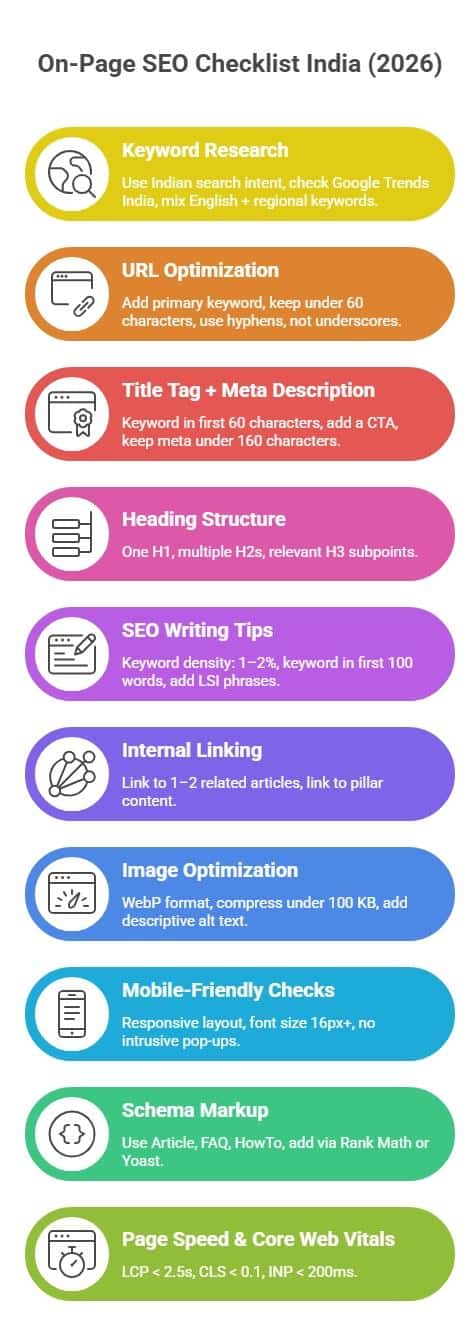
1 Basics of Keyword Research (To Focus on Indian Searches)
You must understand what your audience is searching for before writing anything. Search behavior in India stands out, as people often blend English with regional languages. For example, they might search for “best mutual fund India 2026” or “ghar pe biryani kaise banaye.” What matters more than search volume is understanding the intent behind those searches.
Different Kinds of Search Intent
- Informational: “How to start a blog in India” — people want to know and learn.
- Commercial: “Best web hosting India 2026” — people are checking options before buying
- Transactional: “Buy a domain name in India cheaply” — people are ready to act.
- Navigational: “TrendChaska SEO guide” — people are searching for a specific page or brand.
Quick tip for Indian bloggers:
Try using the “People Also Ask” section on Google in the language of your audience. If you’re working on local content, Google Trends India helps compare search interest across cities like Mumbai, Delhi, or Hyderabad. This is super helpful when creating geo-specific content. With keyword research in mind, let’s move to optimizing other on-page SEO factors like your URLs.
You can rely on tools like Google Keyword Planner (free), Ubersuggest, Ahrefs Free Tier, and Google Search Console. These tools help you see what search terms already bring visitors to your blog.
2 Create SEO-Friendly URLs India
Google looks at your URL first to understand your page. Make it brief, clear, and packed with keywords.
| ❌ Avoid | ✅ Use Instead |
|---|---|
| yoursite.com/post?id=2387 | yoursite.com/on-page-seo-checklist-india |
| yoursite.com/2026/04/08/new-post-title-here-today | yoursite.com/seo-writing-tips-india |
| yoursite.com/seo%20tips%20for%20bloggers%202026 | yoursite.com/seo-tips-bloggers-2026 |
- Try to keep URLs short with fewer than 60 characters if you can.
- Use hyphens (-) to split words, not underscores(_).
- Always try to add your main keyword to the URL.
- Cut out small common words like “the,” “a,” or “and” from URLs.
3 Title Tag Optimization (Using Indian Examples)
Optimizing title tags can bring one of the biggest benefits to any web page. The title tag shows up as the bold blue headline in Google’s search results. It has to achieve two goals at the same time: include your target keyword and encourage users to click.
A Title Tag Formula That Delivers
[Main Keyword] — [Advantage or Figure] | [Brand Name]
Examples from Indian blogs:
- ✅ “On-Page SEO Guide India: 11 Tricks to Rank Better by 2026 | TrendChaska”
- ✅ “Top Mutual Funds to Start Investing in India 2026 – Compare 10 Best Picks.”
- ✅ “Home Loan Calculator India – Find Eligibility in 2 Minutes.”
- ❌ “Updated SEO Guide 2026 India – Blogging Tips and Tricks.”
⚠️ REMEMBER
Title tags should stay between 50 and 60 characters. Titles over 60 characters might get cut off by Google, which truncates anything beyond ~580px width. Use tools like Mangools SERP Simulator to see how your title looks before publishing it.
4 Understanding SEO Meta Tags in India
Meta descriptions don’t change rankings, but they have an influence on click-through rate (CTR), which helps rankings. Treat your meta descriptions like short ads for your content.
To write meta tags SEO India, use the first or second person, add a call to action, and include your main keyword.
Meta Description Formula
[What’s in the post] + [Who it’s meant to help] + [Special value or call to action]. Keep it shorter than 160 characters.
Example: “Learn step-by-step on-page SEO with this detailed guide created for Indian bloggers in 2026. Includes samples, free tools, and tips. Start now.” (149 characters ✅)
5 Guide to Using Heading Tags (Best Practices for H1 to H6)
Think of headings as a book’s table of contents. They help Google figure out how your content is organized. Indian bloggers should stick to this simple rule:
| Tag | Usage | Frequency |
|---|---|---|
| H1 | Page title — must contain primary keyword | Only once per page |
| H2 | Main sections of your post | 3–6 times typically |
| H3 | Subsections under each H2 | As needed |
| H4–H6 | Deeper nested content, FAQs, notes | Sparingly |
Using this guide to organize heading tags helps make your post easy to read and ensures Google’s bots can crawl it . Don’t jump from H2 to H4. Always keep the structure in order.
6. SEO Writing Tips India
To write for SEO in India, you need to strike a balance that challenges many bloggers. You must sound human and conversational while keeping the content optimized . These practical SEO writing tips could help:
Keyword Density India
In 2026, India’s ideal keyword density target is between 1 and 2%. For a blog with 1,000 words, you should use your main keyword about 10 to 15 times . Avoid stuffing it into sentences in a way that feels forced or odd.
- Add your main keyword within the first 100 words.
- Include it in at least one subheading, like an H2 or H3 tag.
- Sprinkle related phrases across the text. For example, if your focus is “on-page SEO checklist India,” mention terms like “meta description,” “page optimization,” and “heading structure” in the content.
- Avoid repeating the same keyword back-to-back. Writing has come a long way—don’t treat it like it’s still 2012.
Tips to Keep Your Writing Authentic While Optimizing for SEO
- Write like you’re explaining to a friend who just started their blog
- Use Indian context: mention platforms like Hostinger India, local payment gateways, regional language content
- Vary sentence length — mix short punchy lines with slightly longer explanations
- Add your own experience or opinion somewhere in the post
7. Internal Linking Strategy (Cluster + Pillar Method)
Indian bloggers often overlook internal linking as an SEO tool even though it’s super useful. Think of it like this: every new blog post you create should connect to at least one other related post on your site. And don’t forget—the most crucial links should go back to your key or core content, also known as pillar content.
When I started my first blog, I had no clue about this. I’d just write posts and leave them floating by themselves. But once I learned about the cluster and pillar method, everything clicked. It’s simple . Let’s say your blog is about Indian street food. Your “pillar” could be an ultimate guide to Indian snacks, and your “cluster” posts might include recipes for samosas, pav bhaji, or specific sweets like jalebi. You create connections between these posts and your main guide. See where I’m going with this?
This method doesn’t just make your blog easier to navigate; it also helps search engines like Google understand your content better. Plus, tools like Yoast SEO can make checking your internal links a breeze. If you’re using platforms like Hostinger India to host your blog, they often have guides on these techniques too. Once I started doing this, I saw better traffic, and it also meant people were staying on my blog longer because they kept clicking around.
Also, a little tip. If you’re targeting Indian readers and they prefer content in their regional language, be smart about linking regional posts to one another. It works wonders. But don’t overdo it—linking is worse than not linking at all. Keep it relevant. Think of it like arranging books on a shelf; group them together if they’re in the same genre.
🔗 RELATED READ — SEO Guide for Beginners India — It’s an easy-to-follow SEO guide that helps Indian bloggers. It explains everything, starting from setting up a domain to creating links. You can use it along with this checklist for better results.
The cluster-pillar model works this way: Your pillar content, like the beginner SEO guide mentioned earlier, discusses a big topic. Cluster articles such as this on-page SEO checklist, focus on smaller connected ideas. Each cluster post links to the pillar and also receives a link back from it. This helps Google recognize your site as a reliable source on the topic.
8 Improving Images: Alt Text, Size, and Naming
Google cannot see images unless they are optimized . To make sure your blog images are search-friendly, do these things before you upload:
- Give files clear names. Don’t use something like “IMG_3847.jpg.” Instead, try names like “on-page-seo-checklist-india-2026.webp.”
- Compress your images. Try free tools such as ShortPixel or Squoosh. Keep file sizes under 100KB if you can. This is helpful because mobile networks in India can vary a lot.
- Write meaningful alt text. An example like “Screenshot of on-page SEO checklist India for bloggers 2026” is more useful than calling it “image1.”
- Whenever possible, save them as WebP files. This format keeps the quality but reduces the file size better.
- You can include a title attribute on your images to give more context. It’s optional but useful.
9. Making Your Blog Mobile-Friendly for Indian Users
Think about this: more than 75% of people in India use their phones to access the internet. If your blog doesn’t work well on mobile, you’re telling them to stay away.
- Choosing a responsive WordPress theme can solve this. Free themes like Astra, GeneratePress, or Neve work well.
- Use Google’s Mobile-Friendly Test tool to check your blog’s mobile performance.
- Don’t use pop-ups that block important content — Google doesn’t like them.
- Keep your font size easy to read at least 16px, and design buttons and links so they’re not too tiny to tap.
10. Schema Markup Made Simple
Schema markup is just a bit of code you put on your page. It helps Google show extra details in search results, like star ratings, FAQs, cooking times, or article dates. These details, called rich snippets, can make more people click on your page.
Indian bloggers can benefit the most from these types of schema:
- Article Schema helps highlight blog posts and news.
- The FAQ Schema is great to show FAQs in search results. It works well on “how-to” content.
- HowTo Schema is handy to show tutorials or step-by-step guides like this one.
- Review Schema is perfect for blogs reviewing products.
If you use WordPress, install the free Rank Math or Yoast SEO plugin. These tools handle schema for you so you won’t have to touch any code.
11. Page Speed and Core Web Vitals (Tools to Use in India)
Google uses page speed as a ranking factor. While India sees growing 4G and 5G usage many rural areas still rely on 2G. A blog that loads can reach more people and perform better in search rankings.
Core Web Vitals goals by 2026:
- Largest Contentful Paint (LCP): Below 2.5 seconds
- Interaction to Next Paint (INP): Below 200ms (replaced FID in 2024)
- Cumulative Layout Shift (CLS): Below 0.1
You can test through free tools like PageSpeed Insights from Google, or try GTmetrix and WebPageTest for other options. To boost speed, use a CDN to load content faster, turn on lazy loading to make images load when needed, and cut out unused CSS or JavaScript.
On-Page SEO Tips Checklist Table 2026
Rely on this table as a quick guide before publishing any blog posts. Task Status Tools Notes
| Task | Status | Tools | Notes |
|---|---|---|---|
| Primary keyword in URL | ☐ To Do | WP Permalink Settings | Keep under 60 chars |
| Keyword in title tag (first 60 chars) | ☐ To Do | Rank Math / Yoast | Power word + number boosts CTR |
| Meta description written (under 160 chars) | ☐ To Do | Rank Math, Mangools Preview | Include CTA + keyword |
| H1 contains primary keyword (only one H1) | ☐ To Do | SEO plugin / manual | Matches or mirrors title tag |
| Proper H2/H3 heading hierarchy | ☐ To Do | Screaming Frog (free) | No skipping from H2 to H4 |
| Keyword in first 100 words | ☐ To Do | Manual | Naturally, not forcefully placed |
| Keyword density maintained at 1–2% | ☐ To Do | SurferSEO, Semrush WA | Use LSI keywords to vary |
| Images compressed and renamed | ☐ To Do | Squoosh, ShortPixel | Under 100KB, WebP preferred |
| Alt text added to all images | ☐ To Do | WP Media Library | Descriptive, include keyword |
| 1–2 internal links to relevant posts | ☐ To Do | Manual + Link Whisper | At least one to pillar article |
| 1–2 outbound links to authoritative sources | ☐ To Do | Manual | Wikipedia, gov sites, publications |
| Schema markup implemented | ☐ To Do | Rank Math, Schema Pro | Article + FAQ at minimum |
| Mobile-friendly test passed | ☐ To Do | Google Mobile-Friendly Test | Check on real device too |
| Core Web Vitals within threshold | ☐ To Do | PageSpeed Insights | LCP <2.5s, CLS <0.1, INP <200ms |
| Page indexed / sitemap updated | ☐ To Do | Google Search Console | Request indexing after publishing |
On-Page SEO Fill-in-the-Blanks Template:
Copy the template below and complete it before starting any new blog post. This takes just five minutes but can save hours of fixing mistakes later.
| POST PLANNING TEMPLATE 🎯 Primary Keyword: ____________________________ 🔁 Secondary Keywords: ____________________________ 📋 Search Intent: [ ] Informational [ ] Commercial [ ] Transactional 🔗 URL Slug: yoursite.com/____________________________ 📌 Title Tag (max 60 chars): ____________________________ 📝 Meta Description (max 160 chars): ____________________________ 🗂 H1 Heading: ____________________________ 📂 H2 Sections: → Section 1: ____________________________ → Section 2: ____________________________ → Section 3: ____________________________ 🖼 Featured Image File Name: ____-india-2026.webp 🖼 Image Alt Text: ____________________________ 🔗 Internal Link 1: [Post title → anchor text] ____________________________ 🔗 Internal Link 2 (Pillar): SEO Guide for Beginners India 🌐 Outbound Link: ____________________________ 📊 Schema Type: [ ] Article [ ] FAQ [ ] HowTo [ ] Review ✅ Keyword in first 100 words: [ ] Yes [ ] No ✅ Keyword density target: ~1.5% = _____ times in _____ words |
Common On-Page SEO Mistakes Made by Indian Bloggers
Understanding what not to do matters just as much as what to do. Watch out for these common mistakes:
- Keyword Stuffing: Stuffing your keyword fifteen times in a 500-word article does more harm than good. In 2026, Google is onto this tactic. Rankings drop because of it. Use related terms and synonyms instead of overloading your content with the same keyword.
- Duplicate Title Tags: Avoid repeating the same title across different articles. Each page must have its own unique and clear title. Even posts with similar topics should stand out with distinct titles.
- Ignoring Mobile: Creating a website for desktop users is a big miss. In India, most users depend on their phones with 4G speeds to browse. Designing with mobile in mind is no longer optional but necessary.
- Skipping Meta Descriptions: Leaving the meta description empty and relying on Google to create one? That’s not a good idea. Write one yourself instead. It helps searchers understand your content. You lose control over what snippets users see in search results.
- Broken Internal Links: When you link to posts you’ve deleted or renamed, it creates 404 errors. These errors hurt your crawl efficiency and ruin the user experience.
- No Alt Text on Images: If your images lack alt text, Google can’t interpret them. This makes you lose out on image search traffic, which is important for recipe and fashion bloggers.
Conclusion
On-page SEO isn’t something you do just once. It’s a skill you need to practice as part of your blogging routine. The upside for Indian bloggers is that most competitors aren’t doing even half of what’s on this list. If you stick to this on-page SEO checklist for India, you’ll already be ahead. Start simple: focus on creating accurate title tags, writing interesting meta descriptions, organizing your headings , and ensuring your content loads on mobile devices. After that, work on more advanced aspects like using schema markup and building internal link groups. Don’t stress about perfecting everything all at once. Choose three tasks from the checklist and apply them to your next post. Once those are done, pick another three. Before you know it, optimizing will start to feel natural.
💡 REMEMBER
SEO takes time to show results. Most pages might need 3 to 6 months to see real progress. But every post you optimize now could help drive traffic for years to come.
Want to Learn More About SEO?
This checklist is just a part of the bigger picture. To find a complete step-by-step guide from scratch to improving your rankings, look at the Beginner-friendly SEO guide designed for Indian bloggers on TrendChaska. This guide explains all the basics, from picking a domain name to getting your first backlink.
➡ Read: SEO Guide for Beginners India →trendchaska.com/seo-guide-beginners-india
Quick SEO Checklist (Save This!)
Print this checklist or keep it on hand whenever you’re writing a new blog post. Go through and tick every box before publishing.
| ☐ | Checklist Item |
|---|---|
| ☐ | Keyword inserted in URL (slug) |
| ☐ | Keyword in title tag — within first 60 characters |
| ☐ | Meta description optimized — under 160 characters with CTA |
| ☐ | H1 contains primary keyword — only one H1 on page |
| ☐ | Proper heading hierarchy (H1 → H2 → H3) — no skipping levels |
| ☐ | Keyword appears naturally in first 100 words |
| ☐ | Keyword density maintained at 1–2% |
| ☐ | Images compressed (under 100KB), renamed with keyword |
| ☐ | Alt text added to all images with descriptive copy |
| ☐ | 1–2 internal links added — at least one to pillar article |
| ☐ | 1–2 outbound links to authoritative sources |
| ☐ | Schema markup implemented (Article + FAQ at minimum) |
| ☐ | Mobile-friendly test passed via Google’s tool |
| ☐ | Core Web Vitals checked — LCP, CLS, INP in green |
| ☐ | Page submitted to Google Search Console for indexing |
Frequently Asked Questions
Q1. What’s the best keyword density for India in 2026?
Experts recommend keeping your main keyword density between 1% and 2% in India. This means in a 1,500-word article, you should include your keyword about 15 to 20 times. Try to include LSI and related keywords too, as they show your content covers the topic without repeating the same phrase too often.
Q2. How many meta tags does Google pay attention to?
Google focuses on the meta description and title tags. These are used in search results for snippets and headlines . Meta keywords are ignored by Google. Indian bloggers should prioritize the title, description, robots canonical, and Open Graph tags because they have the biggest effect on social sharing.
Q3. Is on-page SEO still important in India in 2026?
Yes, it is, and maybe more now than before. Google’s Helpful Content system focuses on pages that are clear and helpful to users. Strong on-page SEO helps show that your content is high quality. In crowded fields like finance, health, or travel in India, it can decide whether you land on the first page or the third.
Q4. How long does it take to rank after doing on-page SEO?
For new Indian blogs, you need 3 to 6 months to notice big ranking changes. Long-tail keywords with little competition may show results in 4 to 8 weeks if internal links are well-placed. Hard-to-rank keywords might need anywhere from 6 to 12 months, no matter how well your page is optimized.
Q5. Should I use this checklist on every blog post?
Try to apply it before posting, not after. Fixing SEO while you’re writing is way easier than trying to adjust things later. Once you get into the habit, it’ll take less than 15 minutes per post to run through the checklist, as it will feel like a natural part of your routine.
Q6. Is it possible to do on-page SEO for blogs in Hindi or other regional languages?
Yes, it is possible. The same SEO rules work here, too. Just use Google Keyword Planner and set the language to Hindi, Tamil, Marathi, or any other regional option to find India-focused keywords. Check if your site’s hreflang is set up . Write title tags and meta descriptions in the language that matches your content. Since 2023, Google has made big improvements in how it understands Indian regional languages.
Q7. What’s the one on-page SEO change that will have the biggest impact today?
Focus on adjusting your title tags. Revisit your 10 most popular posts and rewrite their titles. Use the formula from this guide with a strong keyword, a number, and a power word, and keep it under 60 characters. This simple change can lead to significant CTR improvements. A lot of Indian bloggers have noticed better results within weeks after making just this tweak.
Published on TrendChaska

Nidhi Patel is an SEO and digital marketing content strategist focused on AI SEO, content marketing, blogging, and personal branding. Through TrendChaska, she shares practical digital marketing insights, SEO strategies, and AI tools for beginners, students, and small businesses in India.