Learn personal branding for students India with LinkedIn strategies, networking skills, and portfolio ideas to stand out early.
Personal Branding for Students India: Build Your Brand Before You Graduate
Here’s something to think about.
If a recruiter searched your name on Google today, what would they find?
If your answer is “nothing” or “just my old account full of memes,” you’re missing out on some major opportunities.
Here’s how things stand in 2026: having a degree doesn’t set you apart anymore. Every year, countless students finish college with the same scores, almost identical resumes, and similar college names. Recruiters, startup owners, and clients aren’t just relying on your CV to make decisions now. They’re checking you out online long before making a call or scheduling a meeting.
To build a career as a student in India today, personal branding isn’t just a nice-to-have—it’s a crucial step.
The students landing dream internships, signing freelance clients, and getting attention for their startups even before finishing college? They didn’t just burn the midnight oil studying for exams. They took the time to create their own brand.
This guide will walk you through step by step how to do the same.
What is Personal Branding? (And Why It’s Not Just for Famous People)
Personal branding shows the world how it sees you at work. It’s built from your abilities, your beliefs, what you create, and how you exist online. All this gives others a sense of who you are and what you offer.
Here’s one way to put it: a resume is just a piece of paper. Your personal brand is what people remember about you.
Your resume explains the things you’ve achieved, but your brand shares the story of your mindset, character, and why people can count on you — even before meeting you.
Indian students need to notice this shift now more than ever. The job market is cutthroat. Every year, engineering colleges pump out over 1.5 million graduates. MBA programs add thousands more to the list. Having a degree isn’t enough anymore. What many lack is a visible and professional digital identity.
Your personal brand answers this: “Why should someone pick you over anyone else?”
This isn’t about being a social media influencer or chasing viral fame. It’s about showing up regularly in your field, sharing what you’ve learned, and building a trustworthy identity as a professional—starting while you’re still in college.
Why Indian Students Should Care About Personal Branding in 2026
The Job Market Has Evolved Forever
India’s job market changed a lot after COVID and never went back to how it was. Companies now prefer marketing, design, product, finance, and tech talent who show abilities beyond just academic achievements. Employers want to see results and examples, not just promises.
A survey by LinkedIn in 2024 revealed that 70% of recruiters check candidates’ social media profiles before deciding. That figure has grown since. If your profile is messy, incomplete, or missing, you’re already at a disadvantage even before the interview.
AI Has Made It Crucial to Show Off Skills
Here’s what a lot of college students don’t get told : AI tools are now doing plenty of beginner-level tasks. To stand out, you can’t just be “smart.” You need to show your skills out loud. Highlight your projects. Share your thoughts . Build up work that shows you’re a creative, flexible thinker, not just someone with a degree in hand.
If people can’t find you online, then to many employers, you may as well not exist.
Fighting Hard for Internships
Some of the best internship programs at places like Google, Razorpay, Zomato, and CRED get flooded with thousands of applicants. Those who make the cut aren’t the ones with sky-high GPAs. Instead, they’re the ones whose LinkedIn pages tell a story of action, curiosity, and real-world talent.
A second-year BBA student who shares marketing insights to build a personal brand stands out more than a final-year student who just offers a resume.
The Creator Economy and Freelance Opportunities Are Expanding
India’s creator economy grew beyond ₹2,200 crore in 2023 and keeps growing. Indian brands are now hiring more student creators, social media experts, and content marketers, often on a freelance basis. You don’t have to be a full-time creator to benefit. Posting in a specific area of interest turns you into a top pick for such roles.
Clients and companies now scout for freelancers through the content they share. A meaningful LinkedIn post or a solid portfolio project could lead to job offers.
Startups Value a Strong Personal Presence
India’s startup scene is growing , with cities like Bangalore, Mumbai, Delhi, Hyderabad, and Pune leading the charge. Startups, venture capitalists, and founders often keep an eye out for young, creative talent. They notice people who create interesting projects, whether it’s something small like a newsletter or a series of posts. In a way, the way people see you becomes your first pitch to this busy and competitive ecosystem.
Why Building Your Personal Brand as a Student Matters
1. Land Better Internships
Let the recruiters come to you. With an active and well-crafted LinkedIn profile, you’ll start receiving messages about opportunities before you even send out any applications.
2. A Network That Grows Over Time
Every person you talk to, every comment you share, and every discussion you join all count in the long run. The people you meet at 22 can become the contacts who recommend you at 27. Start connecting now.
3. Stand Out on LinkedIn with Consistent Activity
If you post on LinkedIn, the algorithm gives your profile more attention. Someone who adds a post every week for six months shows up in searches much more than someone who stopped posting two years ago.
4. Attract Clients Without Reaching Out
When people can find your work, see how you think, and notice your activity, they come to you. Developing your personal brand works like doing long-term marketing for yourself.
5. Real Confidence That Stays
When you share your ideas and projects on a regular basis, something changes — you improve. You begin to trust your own knowledge more. Building a brand does more than create an image. It shapes who you are.
6. Becoming Respected in Your Field
You don’t have to master a subject to share what you’re learning. Sharing your progress as a learner is a story audiences connect with. People enjoy growing alongside you.
7. Better Job Opportunities
Campus placements aren’t disappearing anytime soon. However, HR teams and recruiters look into candidates beforehand. Having a solid LinkedIn profile might just set you apart when options are otherwise matched.
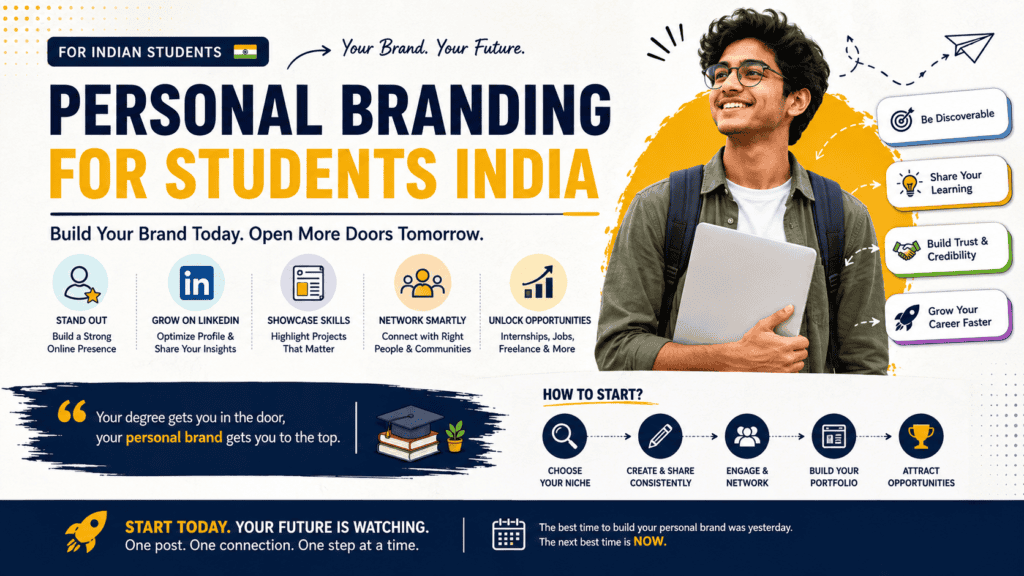
How to Build a Personal Brand as a Student in India: A Step-by-Step Approach
Step 1: Pick Your Niche (Go Narrow, Not Broad)
Saying “I’m into marketing” isn’t choosing a niche. Saying “I analyse how D2C brands approach marketing” is much clearer.
Think about this:
What topic excites you?
What could you talk about for half an hour without preparing?
Where do your skills meet what people care about?
Here are some niche ideas for Indian students: explaining fintech, exploring sustainable businesses, analysing UI/UX designs, covering campus startup trends, giving career tips to students at smaller colleges, showcasing data science experiments, or breaking down marketing strategies.
You’re not stuck with one niche forever, but starting with a super-specific focus helps you stand out.
Step 2: Take Your LinkedIn Profile
LinkedIn matters the most when it comes to building a personal brand as a college student in India. Compared to this, all other platforms take a backseat.
We’ve got more advice on this later, but at the very least, don’t let your headline just say, “Student at XYZ College.” That doesn’t tell anyone anything meaningful.
Step 3: Share What You’re Learning with Others
Build a simple routine. Whenever you learn something interesting in a class, from a course, or while reading, write a quick post about it. Even a couple of paragraphs work. For example, “Today I learned about Porter’s Five Forces and how Swiggy uses it in their strategy.”
That post will stay on your profile forever. It shows others that you’re curious and take initiative.
Step 4: Keep Creating Content (Even If Nobody’s Watching Yet)
Students often wait too long, thinking they need to wait for “the perfect thing to share.” The truth is, you already have valuable things to talk about. Talk about what you learned during your internship. Share how you tackled a challenge on a project. Write about an event you went to.
Posting for six months does more for you than chasing one viral hit.
Step 5: Build a Portfolio (Even a Simple One)
Portfolios aren’t optional for designers, developers, or writers. But students studying marketing, finance, or management should also have one. A portfolio, even a basic one, can show off your projects, case studies, or opinions on industry trends.
You can use tools like Notion, Carrd, or even a basic Google Sites page. A fancy website isn’t necessary.
Step 6: Put Effort into Networking
Avoid sending random connection requests. Take time to leave meaningful comments on posts shared by experts in your field. Interact with other students who are working on building their own brands. When reaching out, be specific. For example, say something like, “I saw your post about D2C marketing and had a question about what you mentioned regarding CAC. Is it okay if I message you?”
Taking a genuine approach always works better than blasting out generic messages to everyone.
Step 7: Join Communities and Participate
India has tons of professional spaces on LinkedIn, Discord, WhatsApp, or Slack filled with chances for students. You’ll find marketing groups, design hubs, developer forums, and product management teams. Being active in these places can get your name noticed by people who might boost your career.
Step 8: Attend Events, Webinars, and Fests
Then talk about it online. Share something like, “I went to [Event Name] today and learned these 3 surprising things.” This does two things—it builds content and shows you’re involved in your field. It’s a win on both fronts.
Step 9: Highlight Projects, Not Just Qualifications
Every project you take on in college matters. Whether it’s a marketing strategy, a financial plan, a mobile app, or a design framework, those are gems for your portfolio. Share them. Talk about the challenges you tackled, the steps you took, and the results you achieved. Even your incomplete projects highlight your effort and willingness to learn.
Step 10: Learn to Express Yourself
Post on LinkedIn. Start a quick newsletter. Record an audio clip. Try out anything that lets you share your ideas . Public communication is a skill that grows over time. The more you practice it out in the open, the easier it gets, and you’ll sound more confident, too.
Student Personal Brand LinkedIn Strategy: The Full Breakdown
If you’re a college student in India, LinkedIn is where personal branding can turn into real chances. Here’s how you can make it work for you.
Your Headline: The LinkedIn Gem Most People Overlook
A lot of students go with: “Student at [College] | Aspiring [Job Title]”
Flip the script with something like: “BBA Student | Exploring D2C Marketing Tactics | Writing Content that Helps Marketers Grow”
Use your headline to show what you’re about, who you help, and why someone should take a closer look at your profile.
Your About Section: Share a Story that Matters
Skip listing random hobbies here. Instead, craft 3–5 engaging paragraphs to share:
- What you’re passionate about in your field
- The work or learning you’re diving into right now
- The challenges you’re tackling or aiming to solve
- A simple note inviting others to connect with you
Focus on the first two lines — those are the only ones people see before they hit “See more.” Make them attention-grabbing.
Your Banner: Branding in One Image
Your banner is a valuable visual space. Create a straightforward design that highlights your niche. A quick Canva edit works wonders—think just your name, tagline, and a fitting background. It shows you mean business right away.
Posting Strategy: What and How Often
Aim for 2–3 posts a week if possible. Once a week works too, as long as it’s regular. Posting zero times isn’t an option.
Ideas to share things Indian students might care about on LinkedIn include:
- What you learned during your internship or project
- How lessons from a book or course came to life with real-world business cases
- Your opinion on industry news, app launches, or emerging trends
- A peek into a project you’re involved in
- Career advice you wish you’d received sooner
- Sharing your (anonymised) interview stories
Networking Tips
Connect with:
- Graduates from your college working in fields you’re targeting.
- People whose posts or content you like
- Fellow students creating personal brands in similar areas
- Recruiters from companies you’re interested in—start by getting on their radar, not pitching right away.
Consistency Is the Whole Secret
Building your personal brand on LinkedIn isn’t about crafting one flawless post. Instead, it’s about showing up . Think of it like this: by the time you’ve shared your 50th decent post, someone might say, “Wow, they know what they’re talking about.”
Just start. Share your thoughts. Get better as you go.
Mistakes Students Often Make While Growing Their Personal Brand
1. Imitating Influencers Instead of Speaking for Themselves
Sharing someone else’s opinion with a caption like “This spoke to me 🔥” doesn’t make a personal brand. What sets you apart is how you see things — as a college student in India. Don’t let originality take a backseat by copying others.
2. Failing to Stay Consistent
Putting up 5 posts in a single week and then going silent for two months doesn’t build any momentum. Consistency works way better than sudden activity followed by nothing.
3. Posting That Doesn’t Offer Anything
Each post should either teach, inspire, entertain, or make people think. If your post does none of these, it might be worth rethinking before you share it.
4. Caring Too Much About Follower Numbers
At the beginning, follower count doesn’t matter. Having 500 people in your industry who care about what you share is way more valuable than 5,000 random connections. Focus on meaningful engagement, not just collecting numbers.
5. Pretending to Know Stuff You Don’t
You don’t have to act like you’ve been in the industry for a decade. Saying something like, “Here’s what I figured out as a second-year student learning growth marketing” is more relatable. Pretending to be an expert when you’re not can backfire and wreck people’s trust in you.
6. Skipping Interaction With Others’ Content
Building a personal brand isn’t about shouting your thoughts into the void. It’s about having real conversations. Reply to people’s posts. Throw out some thoughtful questions. Cheer folks on when they accomplish something. Often, the bonds you create by being real and engaged with others can be more valuable than what you post on your own.
Realistic Student Personal Branding Examples
Priya, BBA student based in Pune
During her second year, Priya began sharing her thoughts on FMCG marketing campaigns. At the start, no one noticed. Within three months, though, her posts about Mamaearth and Boat’s branding started pulling in over 2,000 views. A startup founder from Mumbai contacted her with an offer for a part-time content strategy job. She hadn’t even applied. Her personal brand spoke for itself.
Arjun, Engineering Student in Bangalore
Arjun started sharing his machine learning projects on LinkedIn. Instead of sharing fancy guides, he posted straightforward updates like, “This is what I created, and these are the issues I faced.” He added links to his GitHub, making his work easy to find. People could see how he approached problems step-by-step. By the time his college’s placement season began, five companies contacted him on their own. His online profile worked better than sending out cold resumes.
Sneha, Design Student in Ahmedabad
Sneha shared her UX case studies on Behance and often talked about her design process on LinkedIn. Her follower count wasn’t massive. Still, when a Bangalore-based edtech company searched for a UI/UX intern on LinkedIn, they came across her profile. Her portfolio spoke for itself. She secured the position even against students from bigger design schools.
Stories like these aren’t rare. This is what happens when regular students stay consistent and share their work .
The Future of Personal Branding in India: What’s Coming Next
AI Strengthens Personal Brands Instead of Weakening Them
As AI takes over more jobs, people who shine will be those with unique perspectives, clear ideas, and real connections with others. Building your personal brand is the way to avoid getting left behind.
Traditional Resumes Are Being Replaced by Digital Ones
Recruiters are paying more attention to online presence like LinkedIn profiles, GitHub projects, Behance galleries, or personal websites instead of paper resumes. Students who focus on creating strong digital footprints now will make themselves ready for the future.
Hiring Through Communities Is Growing
More roles in startups are filled through referrals from trusted community members. Being active and noticeable in a community builds connections and opportunities that traditional job boards cannot match.
Personal Websites Are Becoming the Norm
Getting a domain and creating a basic website costs very little. Having a personal website shows you mean business. Platforms like Framer, Webflow Starter, and Notion-based sites make it easy for anyone to start.
Students Are Turning Into Entrepreneurs
These days, being a student with a personal brand and being a founder are almost the same. Students are using their niche audiences to start newsletters, courses, agencies, or even SaaS tools, all while still in school. Your personal brand becomes your earliest business asset.
Start Now: Your Personal Brand Can’t Wait
Here’s something you’ll hear in college: The ideal moment to start shaping your personal brand was two years ago. The next best moment is today.
With every single day you push it off, someone else in your class maybe even that person you’re low-key competing with is online, networking, grabbing opportunities, and building an advantage that will grow bigger with time.
You don’t have to be flawless. A massive audience isn’t necessary. You don’t need to have all the answers yet.
What matters is getting started.
Log in to LinkedIn right now. Update your headline. Share one post about something new you’ve learned. Send a few meaningful connection requests to people. That’s your first step into creating your brand.
Do it all over again tomorrow.
Having a degree gets you through the door. Your personal brand secures you a spot at the table.
Create it. Take control of it. Begin before you finish school because the ones who start are the ones shaping the rules others will live by.
At TrendChaska, we share practical career growth, digital marketing, and personal branding insights to help students stay ahead in today’s competitive world. Keep learning, keep building, and keep showing up — your future brand starts today.
Frequently Asked Questions
What does personal branding mean for students?
Personal branding helps students shape how they are seen in a professional and online space. This includes what they post on LinkedIn, how they present their projects, the type of content they share, and the ways they interact in their career field. The goal is to get recognized for bringing value even before finishing their studies.
How should Indian students begin creating a personal brand?
First, pick a niche that excites you and sparks your interest. Then polish up your LinkedIn profile and try to post . Just sharing one update a week about what you’re learning is a solid start. Work on creating a simple portfolio as you go.
Is LinkedIn important for college students in India?
Indian recruiters, startup leaders, and industry experts often look for talent on LinkedIn. To build a career, students should focus on maintaining an active and well-structured LinkedIn profile.
Can personal branding help in campus placements?
It sure can. A strong and professional online profile shows you’re proactive, can communicate well, and care about your field. Many recruiters and placement teams check LinkedIn profiles of candidates both during and after interviews.
How many times should students post on LinkedIn?
Try to post 2 to 3 times each week if you can. If that’s too much, even posting once a week is a lot better than posting a bunch of times all at once and then going silent. It’s more about staying consistent and sharing good stuff rather than just posting often.
What should students share on LinkedIn?
Talk about things like what you’re learning, your projects, stuff you’ve picked up during internships, thoughts on your industry, interesting takeaways from books or courses, write-ups about events, or even just your student journey. Sharing real and personal experiences gets more attention than generic posts with empty motivation.
Do I need my own website to build a brand?
What if I don’t feel like I’m an expert?
Can I still build a personal brand?
Absolutely and this might be the most important thing to know. Being an expert isn’t a requirement. What matters is curiosity and showing up . Sharing your journey as you learn — sometimes called “learning in public” — creates one of the most relatable and effective brand stories. People don’t expect you to have all the answers. They just want to follow your progress.

Nidhi Patel is an SEO and digital marketing content strategist focused on AI SEO, content marketing, blogging, and personal branding. Through TrendChaska, she shares practical digital marketing insights, SEO strategies, and AI tools for beginners, students, and small businesses in India.