A few years ago, most Indian businesses saw social media as a channel for broadcasting. Create a post, add a caption, collect likes. Threads promotes a different philosophy. It rewards businesses that act like opinion makers, answering questions and participating in discussions rather than one-way broadcasting.
And that’s precisely the reason why this text-based social network has been generating interest among small business owners, D2C founders, influencers, and marketers for the last year. Threads is not a replacement for Instagram or WhatsApp, as some claim, but a completely different app. And businesses that understood the difference first realized it most.
This article explains what Threads is, why it can be beneficial for Indian businesses in 2026, and how to build a sustainable strategy for Threads marketing in India.
What Is Threads?
Threads is a text-based social media app, created by the same parent company (Meta) that owns Instagram, Facebook, and WhatsApp. The app was launched in mid-2023 as a companion to Instagram, enabling users to share short text notes, respond to each other’s notes and participate in open Twitter-style conversations.
Several notes are worth keeping in mind:
Threads ownership: Meta owns and operates Threads, the same parent company that owns Instagram, Facebook, and WhatsApp.
Threads functionality: users publish short text notes (500 characters, with pasted text being split into multiple notes), which can be replied to, reposted, or quoted.
Threads and Instagram: your Instagram account is your Threads account. When you join Threads, your Instagram followers will receive a notification. You can cross-post content between Instagram and Threads, but the content will appear in different feeds with different audiences.
Threads difference: Unlike Instagram or Facebook, Threads prioritizes text over video and images. It is a place for opinions, questions, and answers. The audience is engaged in conversations, not in watching photos or videos.
Threads’ popularity: By June 2026, Threads had reached 500 million monthly active users, a milestone Meta attributed largely to the growth of Threads Communities groups formed around shared interests such as books, parenting, or specific industries. Around the same time, Meta moved Communities out of beta and added features like community icons, a dedicated communities hub, and expanded recognition for active community members. For Indian businesses, this matters because communities are essentially built-in, interest-based audiences you can participate in without having to build a following from zero.
Why Should Indian Businesses Use Threads in 2026?
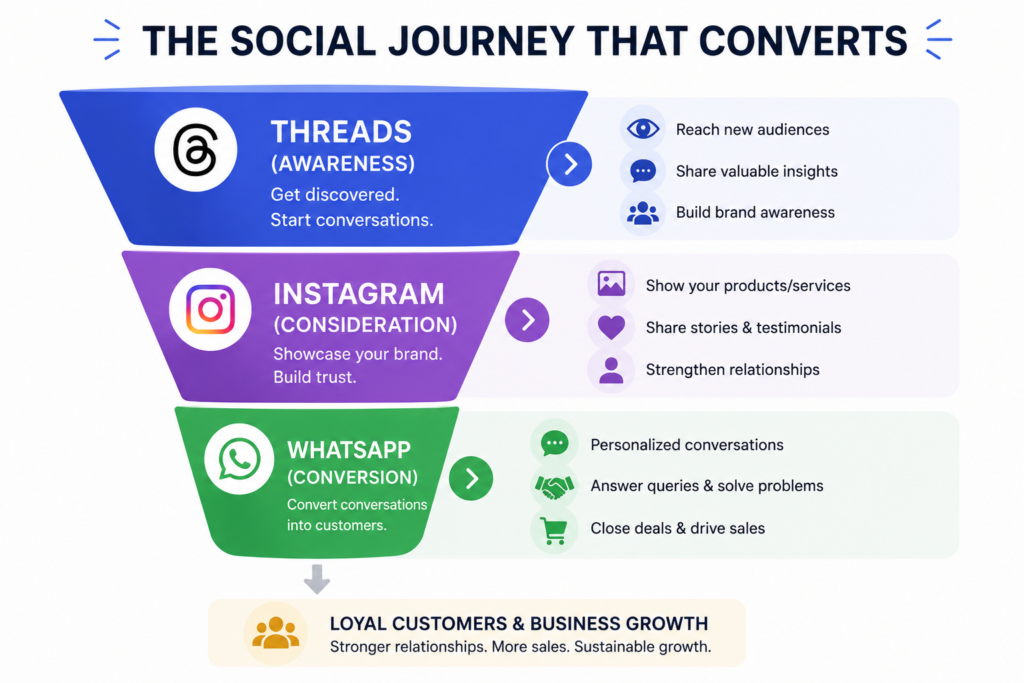
Threads is unlikely to replace your Instagram or WhatsApp accounts, but it provides one critical benefit that other social media lack – conversation.
For businesses exploring Threads marketing in India, the platform offers:
Brand awareness. A thoughtfully written note can get discovered by people who had never heard of your business before. Unlike Instagram, there is no need for Threads accounts to have a visually appealing profile picture, an engaging bio, or high-production-value content in order to post notes. Threads rewards interesting opinions.
Organic conversations and feedback. Threads encourages asking questions and responding to other posts. Instead of broadcasting your opinions, state a problem your audience might face and ask how they would solve it. For example, a Mumbai-based skincare business can ask
“What skincare myth did you believe in till recent times?”
to get discussion going and gather content ideas for later posts.
Communities. As mentioned above, Threads has built-in support for creating and joining conversations around topics with specific audiences. This functionality is available to all users, including businesses. A Mumbai-based coach can join or create a community around fitness, parenting, or finance and actively participate in it rather than just broadcasting messages to one’s followers.
Personal branding. Threads is a great discovery tool for consultants and influencers. Your note can get picked up by a relevant audience simply because it contains interesting information or a unique opinion. It is much easier to build one’s authority on a text-based platform as opposed to Instagram.
Customer engagement. Threads encourages engagement by enabling businesses to reply directly to customers’ notes. This is a good way to get your business on the radar of potential clients and simultaneously engage with current followers.
Thought leadership. Threads provides opportunities for expressing one’s views on industry-specific topics, from opinion pieces to announcing product releases. This positions a business as an expert in a certain space, thus building trust with the audience. In addition, a business can share its take on a subject of general interest, such as a recent change in GST policies affecting e-commerce.
Content distribution and traffic generation. Threads notes allow publishing hyperlinks, which means that it is possible to direct one’s followers to a blog, website, or WhatsApp catalog. However, it should be remembered that traffic generation is not the main point of using Threads. For most businesses, it will serve as a discovery and engagement tool rather than a direct acquisition channel.
Niche-audience discovery. Many note that conversations on Threads are centered around a particular topic, with businesses asking questions and offering advice to specific audiences. It enables joining and interacting with a particular group of people, such as small business owners in Surat or interior designers in Lucknow, who might be harder to reach on other platforms.
Threads vs Instagram: What’s the Difference?
Many businesses wonder if it is worth dedicating resources to yet another social media platform when they already utilize Instagram. The answer depends on one’s objectives, as the functionality of the two apps is fundamentally different.
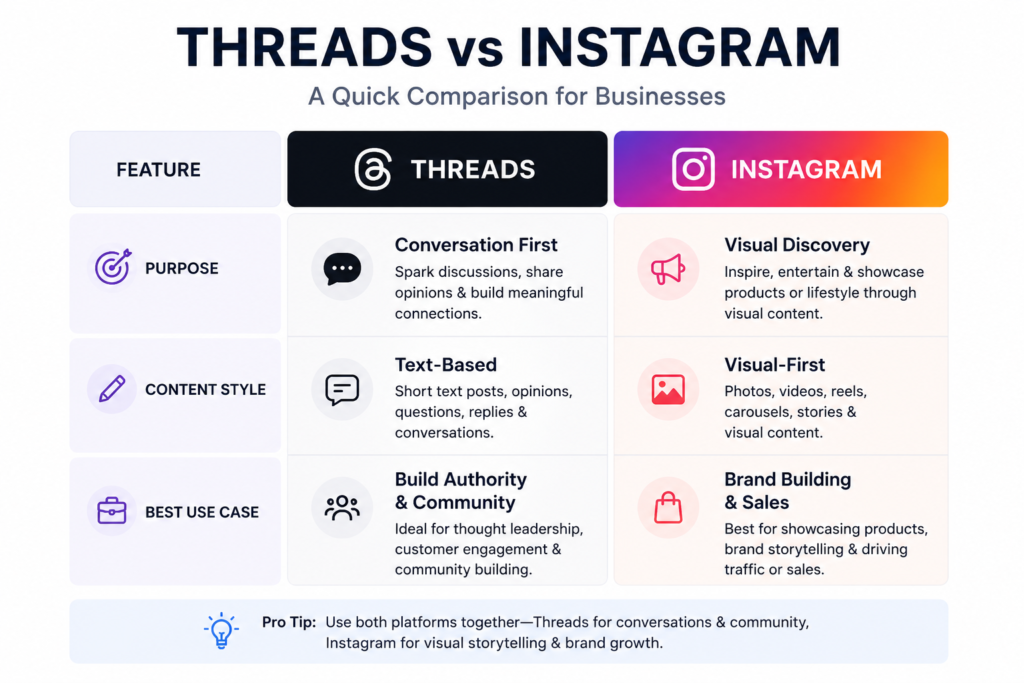
| Feature | Threads | |
|---|---|---|
| Primary functionality | Text-based conversation | Visual storytelling |
| Content type | Short-form text, opinions | Photos, Reels, Stories |
| User engagement | Reading, replying, discussing | Watching, saving, reacting |
| Conversation functionality | Central discovery mechanism | Not a priority |
| Visual content | Optional, can include images | Always necessary |
| Target audience | Similar to one’s Instagram | Following one’s Instagram |
| Best publishing practices | Asking questions | Broadcasting |
| Opportunities for businesses | Engagement, thought leadership | Brand awareness, visual content |
In reality, the two platforms are complementary, with each serving a different set of purposes. If a restaurant promotes a new dish by publishing a Reels video on Instagram, it can follow up by asking its followers about their preferences on Threads
“Would you rather we kept the menu as is or brought in new dishes?”
How Does Threads Marketing in India Work for Businesses?
In essence, it does not involve any unique mechanics. Businesses simply publish short-form text notes similar to Facebook or Instagram posts. However, in practice, this has little in common with the visual-centric Instagram and can be much more engaging than traditional text posts.
For businesses exploring Threads marketing in India, the key is to focus on conversations rather than traditional promotional posts. A consistent presence, useful insights, and genuine interaction can help Indian brands build visibility and develop stronger relationships with their target audience.
Businesses can begin using Threads by publishing the following types of notes:
Educational. Threads notes resemble Facebook posts in that they can be used for sharing knowledge. A business can give tips on a regular basis or publish longer posts on complex subjects that require more explanation than a typical Instagram caption allows.
Questions. Threads encourages asking questions and responding to other users. A business can get conversation going by posting questions related to its industry. This is also a good way to engage with one’s followers by responding to their questions.
Opinions. This includes sharing one’s thoughts on industry-specific discussions, as well as giving answers to questions asked by other users. An opinion piece from a business owner in Ahmedabad about a controversial local topic can get discovered by people outside one’s Instagram network.
Industry-specific insights. This category is similar to publishing educational posts, but it is more narrow in scope and focused on one’s industry. For example, a business can share an insight from its experience on what it takes to run a successful clinic in Jaipur.
Behind-the-scenes notes. Businesses can use Threads to post various content that one would typically not see on other social media, from explaining what exactly a business does to giving real-life examples of daily operations or challenges being solved.
Discussion participation. Threads is a discovery channel first and foremost, with businesses being able to boost their presence by participating in conversations that already take place on the platform. This includes replying to notes from other businesses and engaging with one’s followers.
Trending topic discussions. Businesses can join the conversation around popular topics of general interest, particularly in the early stages before they become oversaturated on other platforms.
Community moderation. Businesses can take an active role in engaging and motivating conversation within the communities they join or create, as well as assist members.
How to Create a Marketing Strategy on Threads for India
An effective Threads strategy does not require a large team or extensive resources. It can be built using the following guidelines.
A successful strategy for Threads marketing in India should align with the business’s overall marketing objectives while adapting to the conversational nature of the platform. Indian businesses can use Threads to build awareness, engage niche communities, share expertise, and gradually turn conversations into meaningful business opportunities.
1. Define marketing goals. It is critical to understand what one hopes to achieve with Threads, as different goals require drastically different strategies. Brand awareness, community engagement, and traffic generation are three common purposes, but most businesses will find it hard to execute all of these at the same time, particularly at the outset.
2. Define the target audience. This depends heavily on the intended marketing goals. For example, a B2B software business targeting CFOs will have a vastly different audience than a D2C cosmetics brand targeting millennial women.
3. Optimize the Threads profile. First impressions are important, so it is essential to make one’s profile engaging and informative. It should include a clear profile picture, an attractive bio that conveys what the business is about, and a link to the business’s website or landing page.
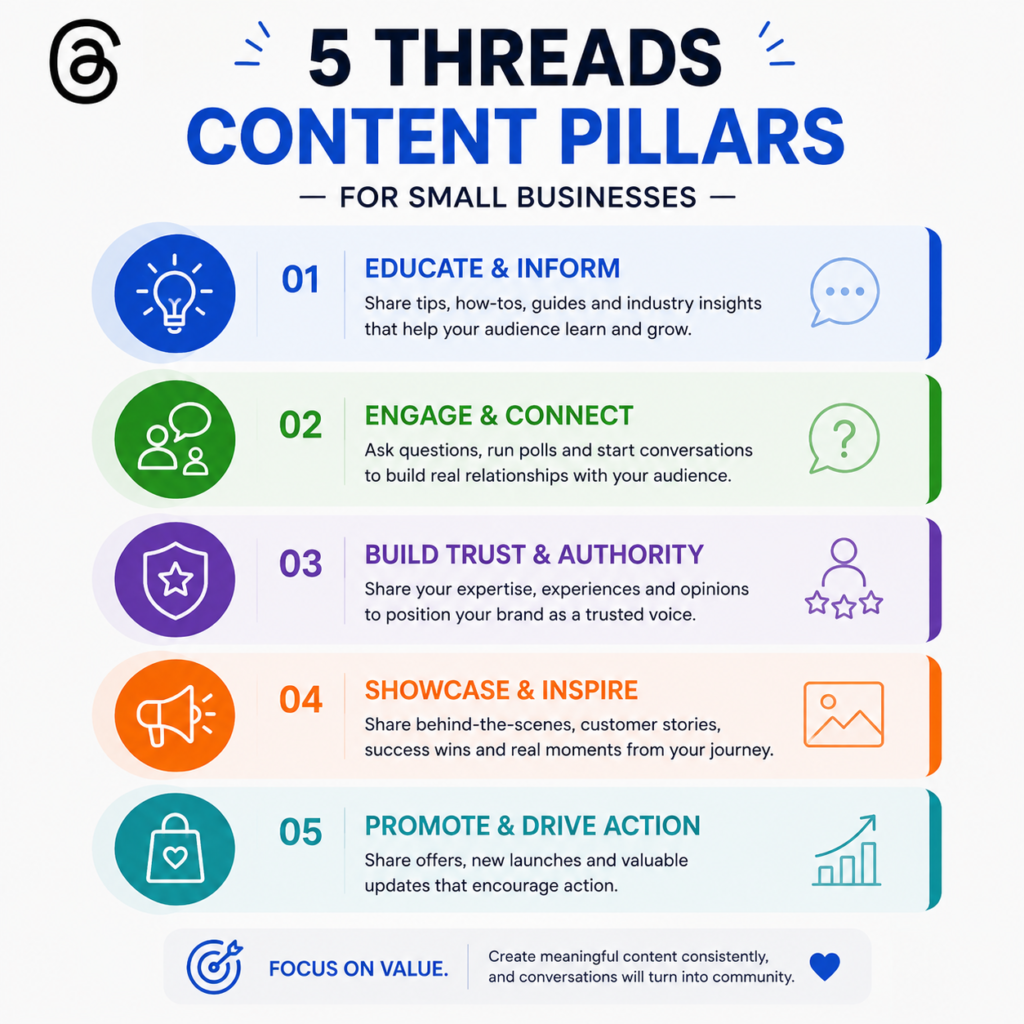
4. Identify content pillars. In order to begin publishing notes, a business needs to have a general idea of what topics to write about. Having three to five content pillars helps maintain consistency while giving the audience something different to consume on a regular basis.
5. Establish a publishing schedule. A Threads account does not require one to post frequently, but it is important to have a publishing schedule that is realistic for the team. It should dictate how often one will publish notes, as well as what topics to write about.
6. Participate in conversations. It is not enough to publish notes – businesses need to build their audiences by engaging with other users. This is particularly important on Threads, where conversation is the driving force. A business account cannot simply publish notes and expect people to follow it. It needs to actively participate in discussions and reply to other users’ notes.
7. Repurpose content. It is unnecessary to create new content from scratch for Threads. In fact, most businesses will benefit from being able to do the opposite – take content that one publishes elsewhere and cross-post it to Threads. A well-written Instagram Reels caption or an engaging Instagram Stories poll can become the basis for a series of notes on Threads. This way, one can use the resources that are already being utilized for other platforms, including one’s Instagram Reels strategy in India, instead of trying to produce something completely new.
8. Analyze performance data and optimize the strategy. It is critical to regularly assess the effectiveness of one’s content and strategy. Threads encourages experimentation, and it is important to determine what resonates with one’s audience. Businesses need to remember that it takes time to build an active audience on any social media, including Threads.
Best Business Content Ideas for Threads Marketing in India
Different businesses can use Threads in different ways. The following are a few examples of notes that can be published on the platform.
When planning Threads marketing in India, businesses should create content that encourages people to stop, think, and respond. Questions, opinions, educational insights, and industry observations can make a brand more approachable while creating opportunities for meaningful conversations with potential customers.
Local businesses.
“Month 2 in the gym is when most of our clients start seeing progress, but the number one reason they stop coming is…”
Followed by an explanation.
D2C brands.
“Filter coffee or French press – which one saves you the most time in the morning?”
Followed by an opinion.
Restaurants and cafes.
“We changed the recipe for our chai last month. About 50% of you have not noticed, but here are the changes and why we made them.”
Fashion brands.
“We stopped using [X] fabric after receiving customer feedback, here is what we replaced it with and why.”
Coaches and consultants.
“The worst resume mistake I see from freshers applying to Indian startups is…”
Digital marketing agencies.
“We ran the same ad copy on Meta and Google for one of our clients last month and saw drastically different results. Here is our ROI breakdown.”
Freelancers.
“When a client asks you to ‘make the logo pop’, this is what they actually mean.”
Startups.
“We lost our first customer this week and here is what happened.”
Followed by a description and lesson learned.
Educational institutions.
“When preparing for the CAT exam, most students overestimate the importance of Quantitative Aptitude and neglect Verbal Ability. Here is why that is a mistake.”
Personal branding. A BBA student can share an opinion on a topic discussed in one of their classes.
A Threads Marketing Strategy for Small Business
Small businesses typically have a limited amount of time and resources to invest in a new social media platform. Here is one possibility for a Threads strategy, although it can be modified according to one’s resources and goals.
For small businesses, Threads marketing in India can be particularly useful because it allows brands to build visibility through conversations without depending entirely on paid advertising. A simple and consistent posting routine can help a local business gradually develop an engaged audience.
| Day | Content Type |
|---|---|
| Monday | Educational note |
| Tuesday | Opinion / Question |
| Wednesday | Industry-related insight |
| Thursday | Behind-the-scenes note |
| Friday | Question / Discussion |
| Weekend | Light conversation |
It is important to recognize that this strategy can vary depending on one’s time and energy commitments. Some businesses will find it harder to keep up with a regular publishing schedule, especially on weekends. It can be especially challenging for women who may have less free time due to familial responsibilities. In such cases, it is better to post only when one has the time and energy to do so.
How Often Should Businesses Post on Threads?
There are no hard and fast rules about how often a business should post on Threads. In reality, it depends on one’s time and resource commitments, as well as the audience’s reaction. An account with fewer followers that generates high engagement on every third post will be much more successful than an account with thousands of followers that has a difficult time getting any reactions.
How to Grow a Business on Threads?
Threads can be a great tool for growing one’s audience and promoting one’s products or services. However, it is important to understand the best practices and avoid common pitfalls.
Businesses using Threads marketing in India should focus on building relationships instead of chasing follower numbers alone. Regular participation in relevant conversations can help brands become more recognizable within their niche and create opportunities for long-term audience growth.
Here are a few ways to grow one’s Threads account:
- Participate in discussions relevant to one’s audience.
- Ask questions and respond to other users’ notes.
- Engage by replying to other businesses’ content.
- Have consistent content pillars.
- Use relevant topics rather than random tags.
- Collaborate with other creators or businesses.
- Cross-post from Instagram to get one’s audience on Threads.
- Repurpose one’s content rather than publishing the same thing multiple times.
- Share one’s own opinions rather than just commenting on other people’s notes.
- Reply to comments on one’s notes.
Avoid the following practices, which will typically get one’s account flagged or unfollowed by other users:
- Mass-follower accounts.
- Automated spam accounts.
- Repeatedly posting the same note in different communities.
- Using unrelated hashtags to get one’s note in front of a larger audience.
- Posting anything other than original content.
- Automated engagement.
- Posting the same message in multiple unrelated communities.
- Posting notes without an intended audience in mind.
- Assuming that a Thread will bring immediate sales.
- Using third-party tools to boost one’s account.
Threads for Business: Common Mistakes to Avoid
Certain practices should always be avoided when using Threads for marketing purposes. They are typically the reverse of best practices mentioned earlier.
One of the biggest mistakes in Threads marketing in India is treating the platform like another advertising channel. Businesses are more likely to benefit when they contribute useful ideas, respond to conversations, and communicate in a natural and human voice.
Here are a few common mistakes that beginners tend to make when using Threads for business.
- Treat Threads the same way as one treats Instagram.
- Post too much promotional content.
- Simply copy content from other social media platforms.
- Ignore comments.
- Over-participate in conversations.
- Ignore the importance of a strong first impression.
- Use Threads to chase trends that have nothing to do with one’s audience.
- Include too many irrelevant keywords in one’s notes.
- Post without knowing one’s target audience.
- Expect immediate sales from every note published.
- Use automation or spam accounts to grow one’s following.
How to Measure the Performance of Threads Marketing?
For businesses investing in Threads marketing in India, these metrics can reveal whether their content is generating visibility, meaningful engagement, and business value. Tracking performance over time also makes it easier to identify which topics and content formats resonate most with the audience.
It depends on one’s marketing goals, but one should track the following metrics:
- Impressions
- Likes
- Replies
- Reposts
- Quotes
- Profile visits
- Followers
- Website traffic (if applicable)
- Engagement rate
- Conversions (for businesses that use Threads as a lead generation channel)
Most businesses will find it helpful to track impressions and follower growth as a measure of brand awareness, engagement and repeat visits as a measure of one’s impact on the audience, and website traffic as a measure of direct sales.
Is Threads Worth It for Indian Businesses in 2026?
It really depends on the business, but it is worth mentioning which businesses are likely to find success on the platform. As mentioned earlier, Threads is a text-based conversation tool, which means that it prioritizes opinions and ideas. With that in mind, here are a few types of businesses that are well-suited for Threads:
- Coaches
- Consultants
- Agencies
- D2C brands
- Influencers
- Educational institutions
- Niche service providers
In other words, any business that has something to say and can consistently share useful information or express one’s opinion will find a receptive audience on Threads. The app rewards businesses that engage in meaningful conversations and share one’s knowledge in an accessible way, thus building authority in their niche. In addition, businesses that have an existing Instagram presence and/or spend resources on personal branding will find it relatively easy to transition into using Threads.
Meanwhile, businesses that are visually driven (such as a jewelry brand) are better off focusing on Instagram and other image-centric platforms. The same goes for businesses that do not have the time to commit to yet another social media platform. It is important to recognize that Threads is a discovery channel, meaning that most conversations will take place organically, rather than being driven by a strict content calendar.
Conclusion
Threads rewards companies that have the guts to sound human. That is why businesses, especially Indian ones in 2026, should treat it as an equal to human dialogue, not as a place to re-post the same Instagram captions with fewer characters.
Overall, Threads marketing in India can be a valuable part of a modern social media strategy for businesses that are willing to participate in genuine conversations. The strongest results are likely to come from brands that consistently provide useful perspectives rather than treating every post as a sales opportunity.
It is important to start small, choose one or two verticals to post about, and set a certain frequency. It is also important to invest as much time as possible in responding to other users. The algorithm does not care how great the strategy is; it cares about consistency and engagement.
Frequently Asked Questions
What is Threads marketing?
Threads marketing in India refers to using Meta’s Threads platform to promote a business, build brand awareness, engage with audiences, share expertise, and participate in relevant conversations. Instead of relying only on promotional content, businesses can use Threads to develop relationships and establish their presence within specific communities.
Is Threads useful for Indian businesses?
It can be, depending on the business and the target audience. Threads was launched globally in mid-2023, with its peak following occurring in India in 2026.
Is Threads free for businesses?
Yes, it is a free app. Meta Verified is an optional paid service that can be used to increase one’s discoverability on the platform.
How is Threads different from Instagram?
Threads is primarily a text-based social media platform, while Instagram is image- and video-centric. The two complement each other, rather than compete.
How often should a business post on Threads?
There are no hard and fast rules about this, as it depends on the business and one’s ability to consistently publish content.
What should businesses post on Threads?
Educational notes, opinions, and questions tend to perform well on the platform. Conversations should feel like one is having a dialogue with someone, rather than broadcasting messages to one’s followers.
Can Threads help generate traffic to my website?
It can, but it is not the primary objective of using the app. Threads is mainly a discovery and engagement platform.
Is Threads suitable for small businesses?
Yes, it can be a great fit for small local businesses that want to build an online presence without having to invest significantly in advertising or other marketing tools.

Nidhi Patel is an SEO and digital marketing content strategist focused on AI SEO, content marketing, blogging, and personal branding. Through TrendChaska, she shares practical digital marketing insights, SEO strategies, and AI tools for beginners, students, and small businesses in India.