Learn how Indian businesses use marketing automation to save time, generate more leads, and achieve growth with actionable tools, tips, and real-life examples.
Introduction
Imagine someone scrolling through a clothing brand’s Instagram at night and adding two kurtas to her cart. She then closes the app, distracted by something else. The next day, a WhatsApp message reminds her about her unpurchased items and offers a small discount. She finishes buying them in less than two minutes—all without anyone stepping in.
This isn’t some far-off possibility. Thousands of businesses in India already operate this way, and it is becoming a standard expectation rather than just an advantage. This is marketing automation in action.
In India, customer habits have changed a lot. People now want quick responses, tailored deals, and messages that reach them on platforms they already use—like WhatsApp, email, Instagram, or SMS. Managing all this by hand every day won’t work once things get too big — which is exactly the gap that marketing automation is built to close.
This is why adopting marketing automation in India has shifted from being optional to becoming a key driver of growth. Whether you manage a D2C skincare company in Ahmedabad, a SaaS firm based in Bangalore, or a service-oriented business in Jaipur, automation helps you handle more customers without overloading your team.
This guide explains what marketing automation actually is, why it’s so crucial to Indian SMEs, which tools are worth investing in, and how to set it up step by step. It also shares common errors to avoid and explores the future of the industry. By the end, you’ll have a clear, practical view of how marketing automation fits into your day-to-day growth strategy.
What Does Marketing Automation Mean?
Marketing automation means using software to manage repetitive tasks in marketing. It handles things like sending emails and segmenting audiences. It can also schedule posts, track customer activity, and nurture leads. This eliminates the need to manually repeat actions with each customer.
Instead of salespeople emailing every new lead, businesses can set up workflows. These workflows send a welcome email. If no one replies, the system can follow up after a few days. It also alerts the sales team if a lead visits the pricing page. The software does most of the work while people focus on decisions and building relationships. In short, this is the everyday reality of marketing automation for growing teams.
Marketing automation uses software to handle routine marketing jobs like sending emails, managing leads, grouping customers, and following up. It lets companies save time, connect with people more on a bigger scale, and turn more potential buyers into customers without needing to do everything by hand.
Every automation process relies on three main parts:
- Customer data — details about who someone is and what actions they’ve taken
- A trigger — an event or time that starts the process
- An automated response — the follow-up action, like a message, task, or update
When you put these three together, the result feels personal to the customer, even if it’s all done by a machine. This is the core mechanism behind every effective marketing automation setup.
Why Marketing Automation Is Crucial in India
India isn’t just a smaller version of Western markets. It operates as a unique ecosystem with its own specific dynamics. This is why adopting a tailored strategy for marketing automation plays such a critical role.
Understanding the Indian Business Landscape
- Most people in India do their shopping and research on their smartphones.
- Many businesses trust WhatsApp more than email to communicate.
- Using regional languages in messages drives better responses from customers.
- Small teams often handle marketing, sales, and customer support all at once.
- Festivals like Diwali and Eid or events like end-of-season sales lead to quick surges in demand.
Marketing automation helps Indian businesses tackle these challenges head-on. It gives even a small, two-person marketing team the ability to manage campaigns that feel timely and personalized. This happens at a scale that would need a team ten times larger.
To compete with small and medium Indian businesses, they can rely on this tool. A small team that sets up automated cart-abandonment messages, follow-up after purchases, and requests for reviews can match the efforts of far bigger rivals with large marketing teams behind them. Here, marketing automation acts as the great equalizer between small businesses and big-budget competitors.
An interesting trend is how Indian businesses are using WhatsApp Business. Many small merchants now see it as their main way to sell and support customers instead of a backup option — another sign of how deeply marketing automation has become woven into everyday commerce.
The True Value of Marketing Automation
Automation often sounds like just a concept, but what does it bring to the table? Here’s how it makes a difference.
| Benefit | What It Means to Your Business |
| Saves time | Automation handles repetitive jobs like sending emails and following up. |
| Boosts conversions | Well-timed messages that match customer needs work better than ones that come too late. |
| Improves lead management | Automation moves leads through the sales process without needing constant manual effort. |
| Increases customer retention | Automated follow-ups help keep customers involved after they’ve purchased something. |
| Ensures predictability | Automation makes sure no lead or customer is overlooked. |
| Helps make decisions | Tracking customer behavior reveals ways to fine-tune campaigns. |
| Grows your reach | Automation helps you manage more customers without needing lots of extra employees. |
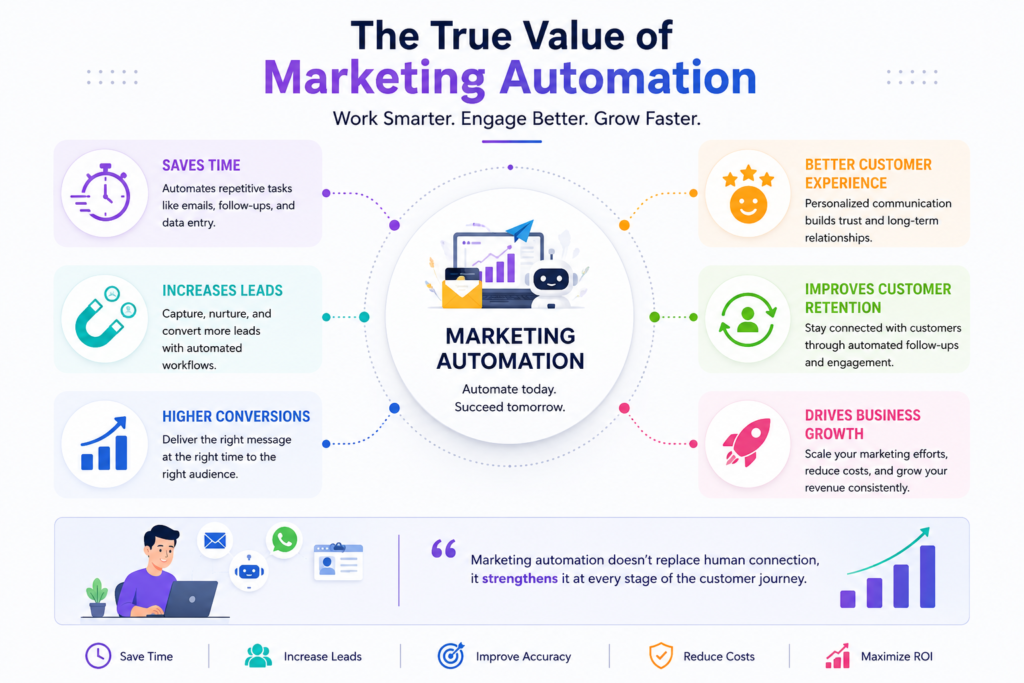
These benefits add up over time. The longer you keep your workflows active, the more useful data on behavior you gather. This makes your targeting more precise. With time, automation becomes more effective and smarter as you keep using it — which is why so many growing businesses treat marketing automation as a long-term investment rather than a one-off project.
Quick tip: Don’t rush to automate everything at once. Begin with just one workflow. A welcome email series is a solid place to start. Once that’s up and running, you can move on to other parts of the customer journey. Small, successful steps will help you gain momentum and also get others on board when it’s time to take on larger projects.
Important Features to Consider in a Platform
Not every automation tool is built the same. Choosing the wrong one can waste months on setup that doesn’t pay off. When choosing a marketing automation solution, focus on these priorities.
- Email marketing tools help you with drip campaigns, autoresponders, and sorting your audience into groups.
- CRM tools let you manage tasks like scoring leads, adding tags, and updating pipelines without manual effort.
- WhatsApp marketing features allow sending broadcasts using chatbots and providing order updates.
- Easy workflow builder lets you design sequences by dragging and dropping, no coding needed.
- Analytics in one view keeps track of opens, clicks, and conversions. You can measure these metrics effectively using Google Analytics 4 (GA4).
- Integration options connect to your site, store, or ad platforms.
- Multi-channel support brings email, SMS, WhatsApp, and social media into one system to work together.
A strong marketing automation tool isn’t just about sending messages at set times. It helps you understand how customers act so you can keep improving your overall strategy. Choosing the right platform is really the foundation on which every successful marketing automation effort is built.
Key Categories of Marketing Automation
Your specific goals determine which of these you’ll mix and use.
1. Email Marketing Automation
This includes sending automated welcome emails, regular updates, reminders for abandoned carts, and reconnecting with inactive customers.
2. CRM Automation
It takes care of tasks like updating customer details, assigning leads to the right team members, and tracking progress on deals without needing manual input.
3. Lead Nurturing Automation
Sharing the right content at the perfect time during a buyer’s journey forms the backbone of any strong lead nurturing system.
4. Automating the Customer Journey
Planning every interaction from the first visit of a person to their fifth purchase is often called automating the customer journey.
5. Automating Sales Processes
Keeping sales teams on track involves automated reminders, generating quotes, and tracking deals. These tasks help them stay organized and efficient.
6. Streamlining Social Media
Preparing posts ahead of time, responding to typical comments, and monitoring engagement can be done without watching a dashboard.
7. Automating WhatsApp and Chatbots
Businesses send order confirmations, answer FAQs, and offer customer support right through WhatsApp. This has become a key part of WhatsApp marketing automation in India.
Together, these seven categories show just how wide the scope of marketing automation really is — it’s far more than just email.
Top Marketing Automation Tools Tailored for Indian Businesses
| Tool | Ideal For | Key Strengths |
| HubSpot | Small businesses and growing agencies | Complete package with CRM and automation in one |
| Zoho | Startups and Indian SMEs | Budget-friendly with pricing suited to Indian markets |
| Mailchimp | Small businesses focused on email campaigns | Simple and intuitive email automation |
| Salesforce | Large corporations | Robust CRM with advanced automation features |
| WATI / AiSensy | Companies prioritizing WhatsApp marketing | Specialized in WhatsApp automation |
Evaluating the Pros and Cons
| Tool | Pros | Cons |
| HubSpot | Offers a robust free version and a sleek interface | Costs rise as you grow |
| Zoho | Affordable option with strong support tailored to India | Can feel outdated to some folks |
| Mailchimp | Super easy to use | Lacks deeper features for CRM tasks |
| Salesforce | Versatile with lots of power | Harder to learn for smaller teams |
AI-driven marketing tools keep getting better. You can also explore the latest AI marketing tools to improve productivity and campaign performance. Many platforms now include features like predicting the best times to send emails and smarter ways to group your audience. You should compare these features before signing a deal, since the right fit can make or break your entire marketing automation strategy.
Straight to the point: The best tool depends on what your business needs. HubSpot works great if your team wants everything in one place. Zoho is ideal for Indian SMEs on a budget. Mailchimp is a top pick for businesses focused on email marketing. Retail and D2C brands can use WhatsApp tools like AiSensy or WATI.
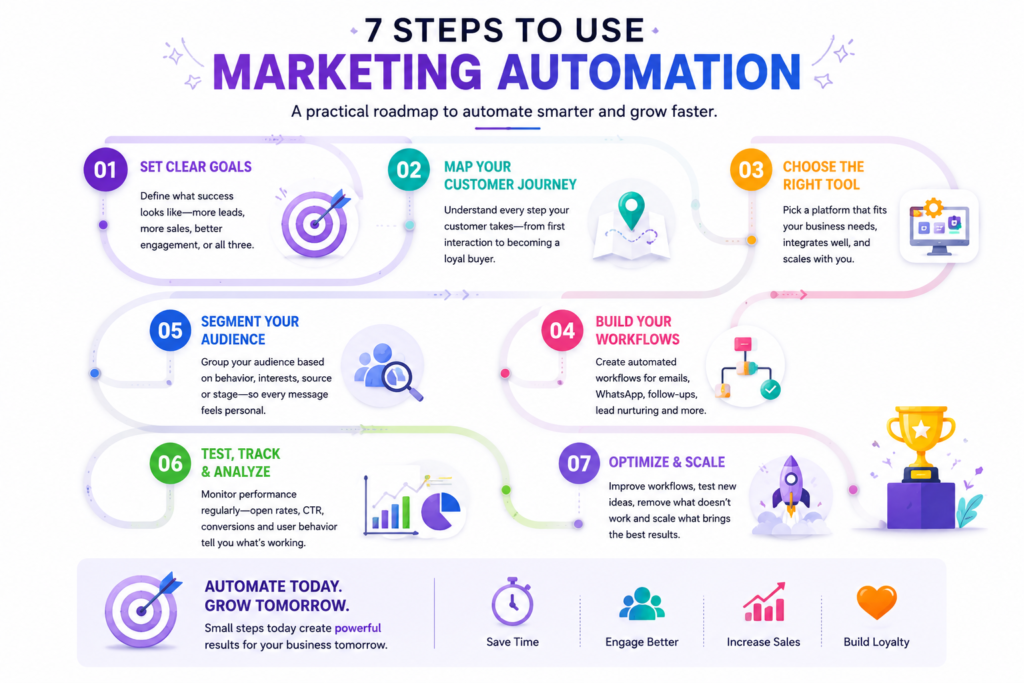
Steps to Use Marketing Automation
Jumping into automation without a clear strategy leads to chaotic and unreliable workflows. Instead, stick to this clear process.
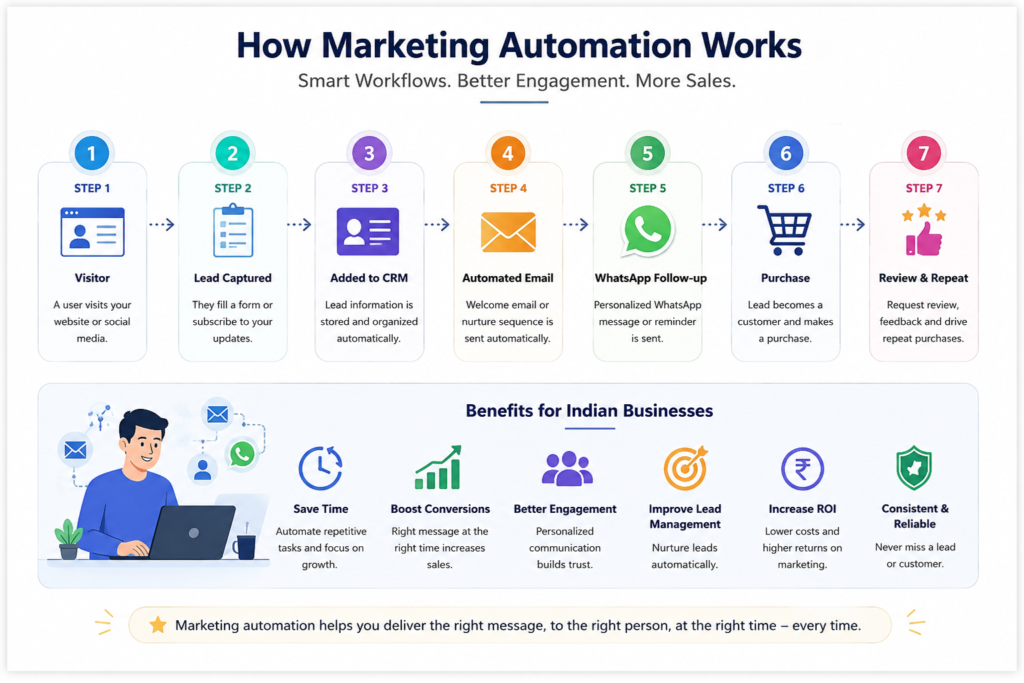
Step 1: Set Clear Goals. Decide what you want to achieve—like more quality leads, quicker responses, or better customer loyalty. Unclear goals lead to confusing processes.
Step 2: Lay out the Customer Journey. Detail every step a customer goes through. Start with how they first hear about your brand, then cover the process of them buying once and eventually turning into a loyal customer.
Step 3: Pick the Best Platform. Find a marketing automation tool that fits your budget and works well with your team’s size. Make sure it supports the platforms and channels your audience uses most.
Step 4: Create Your First Automation. Don’t try to automate everything at once. Focus on simple, impactful workflows like sending a welcome email series or reminders for products left in carts.
Step 5: Break Your Audience into Groups. Organize your contact list based on things like location, past purchases, or actions they’ve taken. This helps you send messages that feel personal rather than one-size-fits-all.
Step 6: Test Before Launching. Take time to check everything before going live. Test every workflow with a small internal group first. It’s much easier to catch and fix broken links or wrong triggers before they end up in front of actual customers.
Step 7: Monitor and Improve. Check open rates, clicks, and conversions. Use the insights from the data to adjust your workflows as needed.
Following these seven steps in order is the most reliable way to roll out marketing automation without breaking anything along the way.
Action Plan
- Set clear goals
- Lay out the customer journey.
- Choose and set up the platform.
- Create and test the first workflow.
- Divide the audience into proper segments.
- Turn on analytics tracking.
- Train the team to use the system.
To get started in email automation, pick one simple task like setting up a welcome email series. Use a platform that’s easy to navigate. Over time, grow into handling lead nurturing, audience segmentation, and full customer journey automation as you gain more confidence.
Real Example: How a Brand Cut Their Response Time to Just Minutes
Imagine a clothing brand in Surat selling through Instagram and a Shopify store. The team used to spend hours answering every DM and email, often taking a full day or two. During busy festive sales, these delays hurt their business. Customers would leave and shop with faster-responding competitors, causing missed sales and revenue.
The brand introduced email marketing automation and added a WhatsApp chatbot to track orders. They set up three key systems:
- Quick WhatsApp responses to handle common customer queries
- Automated emails are sent an hour after customers abandon their carts.
- Follow-up emails after purchases to ask for honest feedback
In just a few months, response times went from over a full day to less than five minutes. They also saw a clear boost in repeat purchases, all without hiring extra staff. This example shows how using automation boosts sales for a small business instead of creating more tasks that keep a team busy. It’s a great real-world snapshot of what marketing automation can do for even a small, lean team.
Mistakes You Should Avoid
Automation, even with good intentions, often ends up failing in ways we cannot expect. Keep an eye on these:
- Trying to automate everything all at once — this creates chaotic, untested processes that might harm customer trust without being noticed.
- Leaving out segmentation — sending the exact same message to everyone makes it less relevant and lowers response rates.
- Not testing before launch — broken links or messed-up triggers can cause harm before anyone even spots the problem.
- Thinking automation is “set it and forget it” — automation setups need regular attention, not just a one-time setup to run forever.
- Overusing automation for personal connections — certain interactions, like handling complaints or having important sales chats, still require a human touch.
- Skipping mobile optimization — most Indian users check their messages on phones first.
Avoiding these mistakes is just as important as setting things up correctly, since even the best marketing automation platform can underperform if it’s poorly managed.
Quick tip: Test new workflows with a small team first before sharing them with everyone on your list. A short test of just five minutes might prevent a whole week of fixing problems later.
Key Tips to Turn Good Automation Into Great Automation
- Make the tone feel personal, even if the message is automated.
- Stick with straightforward language. Avoid trying too hard to sound like a sales pitch.
- Combine automated messages with real human follow-ups for top-priority leads.
- Keep your contact list up-to-date to maintain good message delivery.
- Test different subject lines and message content by using A/B testing.
- Always honor privacy and get consent for WhatsApp and SMS communication.
- Check how your automation tools are performing every month, not just when you first set them up.
Apply these tips consistently, and your marketing automation workflows will keep improving rather than going stale.
Main Points to Remember
- Indian businesses use marketing automation to save time and keep customer interactions consistent.
- Since WhatsApp plays a key role in how people in India communicate, automating it offers great value.
- Begin with smaller steps, test your strategies, and expand your workflows with intention.
- Combine automation along with a personal human approach to see lasting success.
- Pick the tools that match what your business needs rather than chasing what’s trending.
What’s Next for Marketing Automation?
A few trends are shaping how marketing automation will evolve in the digital space, and it’s important to watch these.
- AI-driven customization — tools that predict ideal send times and suggest content based on how individuals act
- Shopping through conversations — people completing purchases in WhatsApp or other messaging apps without needing a separate checkout process
- Voice and regional language tools — becoming more vital due to India’s immense variety of languages
- Lead scoring prediction — AI spotting leads with high intent before anyone checks them.
- Stronger CRM and automation links — sales and marketing teams getting access to a shared unified customer database
As these AI-powered tools evolve further, automation will move beyond just responding to customers and begin predicting what they might require next. These trends make it clear that marketing automation is only going to become more central to how Indian businesses grow.
Closing Thoughts
Marketing automation delivers even better results when combined with a strong SEO strategy. Learn how to build long-term organic growth with our Topical Authority SEO Strategy guide. It’s about ensuring no leads, customers, or opportunities go unnoticed while your team is tied up with other tasks. Whether it’s using WhatsApp automation or setting up CRM workflows, having the right systems in place allows your business to grow without overburdening your team.
To sum it up: this guide explained what marketing automation means, why it’s particularly relevant to Indian SMEs, the tools and categories available, the process to set it up, common pitfalls to avoid, and where this field is heading. It gives you a solid foundation to start developing your own marketing automation approach.
Ready to Start?
Stop wasting time chasing leads by hand. Automate your growth. Start with one simple workflow this week. Even setting up an automated welcome email can be the first step toward smarter and more efficient marketing automation.
Common Questions Answered
1. What does marketing automation mean?
Marketing automation relies on software to take care of tasks like sending emails, managing follow-ups, or nurturing leads. Businesses use it to save time and maintain consistent engagement with their customers.
2. Why should Indian businesses adopt marketing automation?
Indian SMEs can gain an edge over big players through automation. It allows small teams with tight budgets to ensure timely follow-ups, steady communication, and tailor-made customer experiences.
3. What’s the top marketing automation tool to pick?
The choice depends on your business. HubSpot is great if you need a complete platform. Zoho works well for Indian SMEs looking to spend less. Mailchimp handles email-based tasks. AiSensy or WATI are excellent for automating marketing on WhatsApp.
4. Should small businesses invest in marketing automation?
Yes. Simple tools like follow-up emails or instant WhatsApp responses can speed up replies and boost conversions. You don’t even need to hire extra help to see the benefits.
5. What’s the main difference between marketing automation and email marketing
Email marketing is one part of marketing automation. Marketing automation goes beyond and includes CRM updates, lead scoring, WhatsApp messages, and tracking the customer journey—not just emails.
.

Nidhi Patel is an SEO and digital marketing content strategist focused on AI SEO, content marketing, blogging, and personal branding. Through TrendChaska, she shares practical digital marketing insights, SEO strategies, and AI tools for beginners, students, and small businesses in India.