Struggling with ROI, pricing, or hiring in 2026? These are the 6 digital marketing challenges India faces right now, plus what actually works.
Introduction
Digital marketing has been the talk of the year every year. But they tend not to take into account what it is like to do this jobDigital Marketing. It’s a hard business to be in, whether you’re new to digital marketing, freelancing, or running an agency. This article explores the biggest digital marketing challenges that Indian digital marketers might encounter in 2026. We have collated data from industry research, platforms, and reporting to provide a true picture of the situation. From the beginning to the end, it will identify the pain points that are pertinent to your situation—whether you are a beginner or managing a team.
The disorientation of the moment is heightened by its rapid pace of change. One marketer might think that their Instagram Reels strategy in 2024 is not working by 2026, even though it was a good idea, just because the platform mechanics changed. But it’s not just that: hundreds of millions of new and returning users and dozens of languages and price sensitivities can make a strategy that works well for a metro audience look like it’s flopping in other parts of the world.
Key Takeaways
- Content strategy is most difficult for beginners and small businesses.
- The use of AI has skyrocketed. Any content that is not edited by a human will not provide any return on investment.
- Once marketers step past the novice level, establishing the return on investment and the attribution can be difficult.
- The number one challenge for India’s more than 65,000 active freelance marketers is pricing.
- One of the reasons that agencies grow at a limited rate is not because clients are so demanding that there is a shortage of work but because of hiring bottlenecks.
- In 2026, the platform landscape is evolving: voice search, commerce via WhatsApp, and micro-influencers.
Why “Digital Marketing Challenges in India” Looks Different in 2026
At present India has approximately 806 million Internet users, with the majority using different media. The challenges faced by digital marketers have changed dramatically as a result of this growth. It’s not just about getting online anymore; it’s about standing out, proving results, and staying profitable in a cutthroat market.
There are three things that are affecting the way digital marketers work, and they’re all significant: the use of AI tools, a slim budget, and shifting platform algorithms. The effect of these factors depends on your position as a student, freelancer, or agency owner.
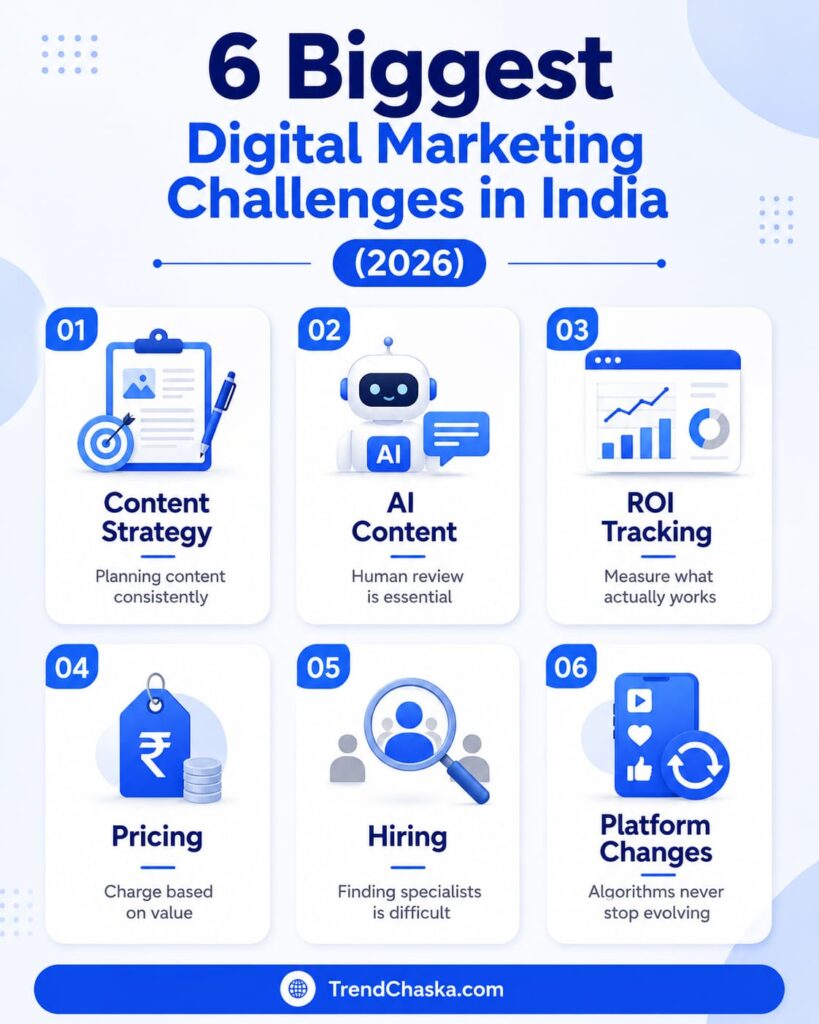
Challenge 1: Content Strategy Consistency
This is more of a problem for novice users and smaller companies. A lot of digital marketers don’t have an effective content strategy. Invest time in digital marketing and get involved in too many platforms.
One of the issues is that being active is confused with having a strategy. On the one hand, it makes people feel that they are being productive when they post daily, and it helps stave off the fear that they are falling behind. On the other hand, it inevitably leads to content that doesn’t make sense or build on itself. They begin each post from scratch instead of repeating a theme that the audience already knows, and it’s for this reason that even if they’re producing a lot, engagement drops off.
This means that for business owners and beginners, it means the following:
- Spontaneous posting, unplanned
- There are no content themes or pillars.
- Exhaustion due to attempting to engage in activity across all platforms. Fatigue and/or over-doing it on all platforms.
The easiest way is to make a content calendar for the month that has 12-16 planned posts. Make all content at once, rather than work under pressure every day.
For example, a small home decor company in Jaipur started posting on Instagram, Pinterest, and WhatsApp Status without any consistency. The marriage rate was unchanged for months. In an 8-week experiment, the number of reaches nearly doubled, with the founder introducing a new calendar and introducing 3 different types of posts (behind-the-scenes, styling tips, and customer stories) while maintaining a consistent posting schedule. The lesson wasn’t about posting more often—it was posting with intention.
Common errors to steer clear of:
- Avoiding the mistake of treating all platforms equally and not targeting two or three platforms that your audience is on.
- Creating content the night before its due date, which will be visible in the quality
- Copying competitor formats without making them your own
- It also helps to start with proper keyword research before planning your content
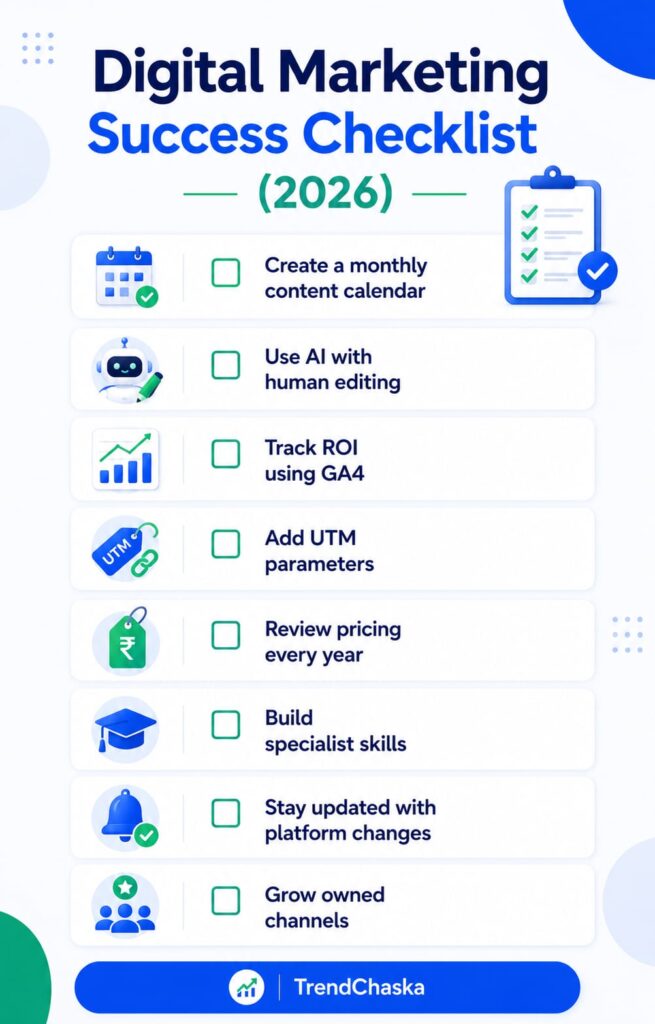
Quick action checklist:
- [ ] Mark the three content pillars that align with your audience’s interests.
- [ ] Make sure that each month you set aside one afternoon to batch create content.
- [ ] Repurpose one piece of content into three formats instead of creating three original ones.
A seasoned content strategist would attest to the fact that consistency outweighs creativity. It’s better to post a less polished but on-schedule post than a very polished one posted irregularly.
Challenge 2: AI Content Without Human Oversight
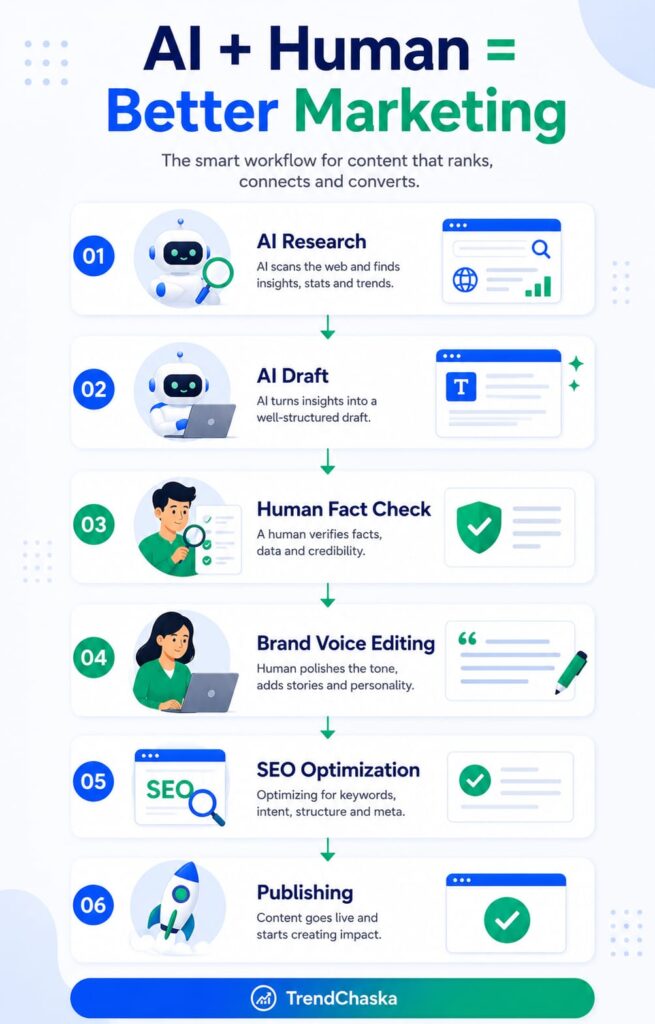
AI has become one of the biggest trends in digital marketing. While one report suggested that AI is saving marketers 12-15 hours every week, many businesses report no results from AI content without human editing.
The problem isn’t AI itself but how it’s used. Many teams treat AI-generated drafts as finished content, skipping essential steps like fact-checking, tone alignment, and final editing. Human oversight remains essential for maintaining accuracy and trust.
This issue impacts everybody:
- New writers can over-rely on AI-generated content without understanding the qualities of effective writing.
- There is a pressure from clients for freelancers and agencies to produce content fast, at the cost of quality.
The best alternative is to leverage AI for writing and research, then have it reviewed by a human before publishing.
For instance, a skincare brand created 40 blog posts that were created by AI and targeted long-tail keywords without enough editing over a span of three months. There was little traffic, and two posts were incorrectly filled with false information around ingredient safety, which is a serious concern in the health industry. Once they cut down their posting frequency to 12 posts a month, started the human edit, and added a fact-checking process, organic traffic started to increase in the following quarter. The more unsupervised posts, the better the results.
AI vs. Human Workflow Roles
| Stage | AI’s Role | Human’s Role |
|---|---|---|
| Research | Provide source and surface information summaries. | Check for accuracy and provide original comments. |
| Drafting | Complete a rough version of the paper as quickly as possible. | Rewrite for a clear voice / brand voice. |
| Fact-checking | Uses the flag to indicate errors when asked to. | Validations contain concrete references. |
| Publishing | None | Review and approval |
Top errors to steer clear of:
- Creating and publishing AI-generated content without fact-checking, particularly for health, finance, and legal information.
- Just because AI-generated content sounds good, it does not necessarily mean it is accurate.
- Utilizing the same AI prompt that flattens your brand voice with each piece.
Quick action checklist:
- [ ] Require human editing prior to anything going live.
- [ ] Avoid assuming that any statistics or claims produced by AI tools are accurate.
- [ ] Keep a short style guide, as it will help the AI-generated drafts to sound like you.
Challenge 3: Proving ROI and Attribution
As digital marketers grow, their attention moves away from creating content and toward proving the value of their content. One of the biggest challenges is measuring ROI on channels.
This challenge tends to come up later on, due to the fact that in the beginning it feels like your output is proof of progress, whether it’s more posts, advertisements, or campaigns. When budgets begin to expand and questions are being asked by stakeholders, then it becomes clear that there’s no true measurement system! By then, months of expenditure could be lying in a black box with little awareness of the impact of those funds.
Here are some common errors in attribution to watch out for:
- Having a link without a UTM tag
- Attributing a lead to a particular piece of content by using just the click can be problematic.
- Lacking a dashboard that links spending to results
A typical situation is a startup in Bengaluru. They were running Google Ads, LinkedIn Ads, and an email nurture sequence but weren’t sure which one was the channel that was actually causing them to sign up. They added UTM parameters and integrated Google Analytics 4 to a basic dashboard tracking leads qualified per rupee and found that LinkedIn was able to produce three times the qualified leads per rupee as Google Ads. The discovery ran counter to the team’s suspicions they had been building for months and changed their quarterly budget.
Quick action checklist:
- [ ] Add UTM tracking codes to all paid and organic campaign links.
- [ ] Create at least one dashboard that ties spending to actual conversions, not just clicks.
- [ ] Conduct a monthly review of attribution, rather than only at the end of the quarter.
Challenge 4: Pricing Yourself Correctly
The number of digital marketers in India is now more than 65,000 freelance digital marketers, and the most common hassle with them is pricing. Too little is too much, and too much is underpaid. Overcharging or overfilling too rapidly will cause loss of prospective customers.
Pricing is difficult because there is no universal benchmark in India’s freelance digital marketing industry. Many freelancers set their rates based on their first client or competitors without considering experience, scope, or value delivered.
The end result is a market where two marketers with the same level of ability are able to make a lot of different prices, and neither knows which way they’re going wrong.
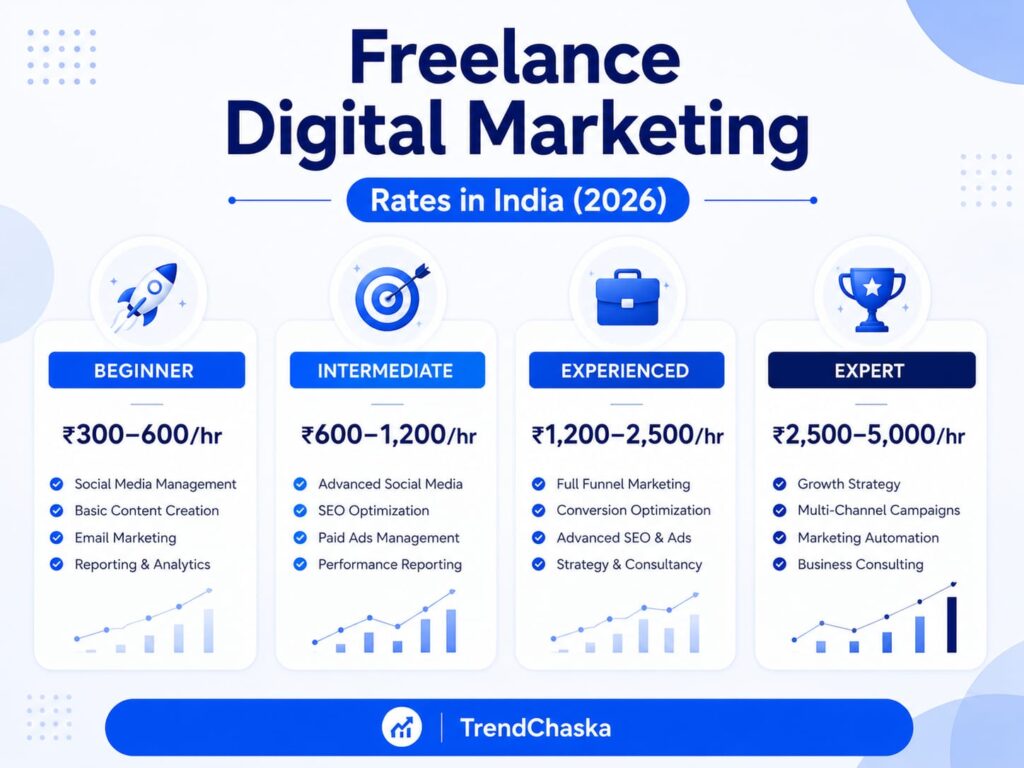
Freelance Marketing Rates in India (Current Market)
| Experience Level | Hourly Rate |
|---|---|
| No prior experience or less than 1 year of experience | ₹300-600 per hour |
| Open to all intermediate-level players (1-3 years of experience) | ₹600-1,200 per hour |
| Experienced: having worked in the industry for between 3 and 5 years | ₹1,200-2,500 per hour |
| Expert who has experience of over five years | ₹2,500-5,000 per hour |
One social media manager from Kochi charged her clients a fixed fee of ₹8,000 per month for managing five social media accounts. She would work long hours and make little money. She adjusted her pricing after doing work and increased her income by around 40%. She was concerned with her clients and ensured that she was paid for everything she did.
Mistakes to avoid:
- Service prices are based on the first client or on your own opinion of value.
- A dollar amount and not stating exactly what you’ll be doing per month
- This is when you may lower your rates to the point of not being worth the client’s while.
Things to do:
- Compare to other rates according to experience level.
- When quoting, outline the work you’re going to deliver.
- Check your rates twice a year with the growth of experience and portfolio.
Challenge 5: Recruitment of Appropriate Personnel and Lack of Specialists
As agencies grow, they encounter a new issue. It is no longer a question of the skills of employees; it’s how many employees have the right skills. Studies reveal that there are numerous agencies in India and the rest of the world that find it difficult to find suitable personnel.
This dearth is a little bit surprising in the face of the number of digital marketing degree holders entering the workforce annually. It’s not a lack of people; it’s a lack of people who can perform a specific technical skill effectively and in a way that is trustworthy enough to take on a live client account on day one. Many digital marketing graduates that are clearly able to articulate their strategy in an interview have trouble putting that strategy into practice in the absence of close supervision, whether it be in setting up a campaign that tracks conversions or resolving a technical problem with their site’s SEO.
This barrier is due to two reasons:
- Generalists, who can handle a variety of tasks, are not as valuable as before. There is a need for agencies to hire specialists and experts like those from SEO or performance marketing.
- Indian graduates don’t have the skills that companies want. This is a challenge for agencies to get qualified candidates.
A medium-sized agency in Mumbai had to decline its clientele due to the lack of the manpower to accommodate the clientele. The agency’s founder said that it wasn’t about fewer clients but fewer qualified workers. This is a common issue faced by a lot of agencies in India.
Things to do:
- Determine which special skills you’re lacking.
- Procure relationships with freelance professionals before you need their help.
- Consider training your employees to become specialists.
Challenge 6: Change in Platforms and Change in Search
This challenge is always there. Changes in 2026 are new. The three important changes for digital marketers are the following:
- Voice and vernacular search is now a must.
- A strong local SEO strategy can help businesses capture these local search opportunities.
- Today, WhatsApp is a place where people can sell and purchase. Combining WhatsApp marketing with an optimized Google Business Profile can improve local visibility and customer inquiries.
- Micro-influencers are taking the place of the traditional influencers.
This challenge is different from the rest because it is based on watching, not on knowledge. The language they use on their search bar, the first app they open, the influencers they follow, etc., are behaviors that marketers can observe and witness months before the reports come out. When a trend is going on, the earlier the person to notice it on the ground, the better the chances of having the trend written about first.
One of the kitchenware companies in Ahmedabad discovered that many of their customers used voice search in both Hindi and Gujarati. They have added content to their website in these languages and created a second-best sales channel for them: their WhatsApp catalog. They also discovered that micro-influencers were more effective than larger influencers.
This example shows how a strong hyperlocal digital marketing strategy can help Indian businesses connect with local audiences and improve customer engagement.
Mistakes to avoid:
- Producing copy that targets the audience who reads in other languages. Creating content for readers who read in other languages.
- Limiting WhatsApp use to customer support only, rather than sales
- Leveraging the number of followers instead of the engagement rate of an influencer.
Things to do:
- Look for the alternative vernacular or voice search terms for your keywords.
- Create a simple WhatsApp catalog for your products, if you have any.
- Try out micro-influencers before you go for bigger influencers.
A Quick Comparison: Career Stage Challenges
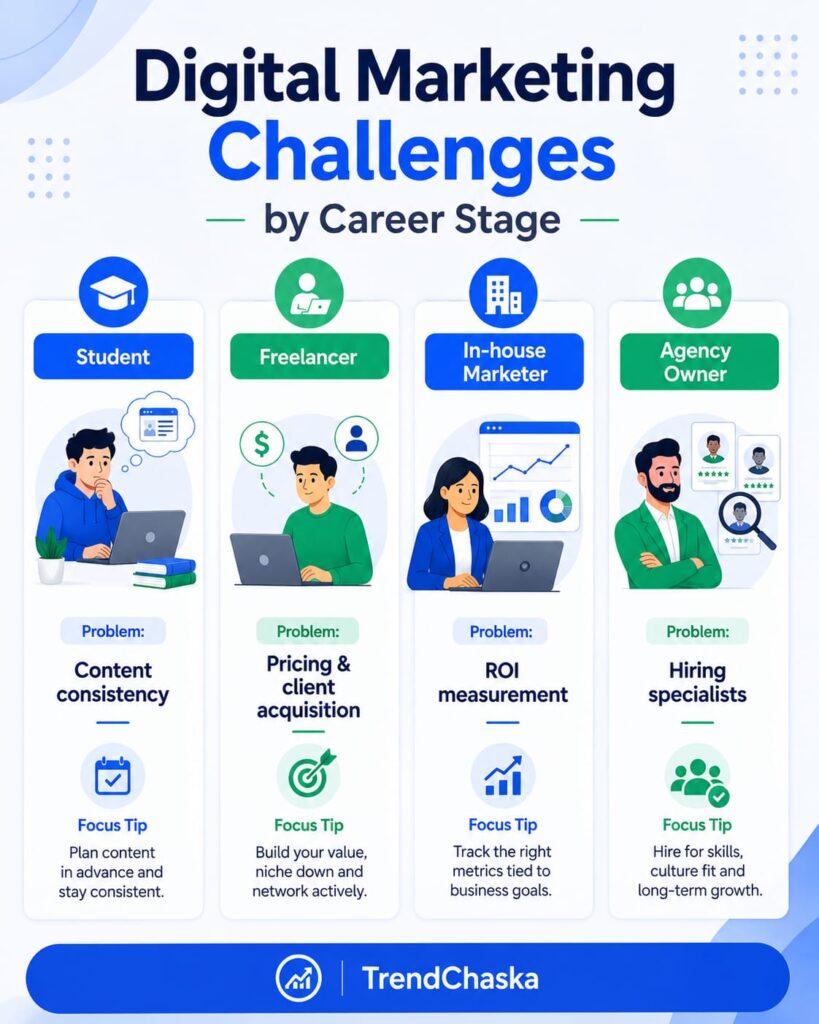
Top Challenge and Root Cause by Career Stage
| Career Stage | Top Challenge | Root Cause |
|---|---|---|
| Student / Beginner | Lacking a strategy for content and over-theorizing. | Some lack practical project experience. Some have little hands-on project experience. |
| Freelancer | The price and the irregularity of earnings | Lack of a clear rate structure and lack of client acquisition. |
| Mid-level / in-house marketer | It is important to demonstrate ROI through every channel. | No or incomplete attribute setup. |
| Agency owner | Hiring bottlenecks | A trend towards more specialism and less generalism. |
Next Skill to Build, by Career Stage
| Career Stage | Next Skill to Build |
|---|---|
| Student / Beginner | Planning in depth for content in the initial stages. |
| Freelancer | Understand how to write a proposal in accordance with scope-based pricing. |
| Mid-level / in-house marketer | Multi-touch dashboard reporting |
| Agency owner | Creating a pipeline of specialists to hire and a freelance network to call upon. |
If you read across the table, you’ll notice that the most difficult challenge in each row is actually a magnified version of the previous one. A novice without a content plan turns to one without a pricing plan when turning into a freelancer. Without the structure of the clients, the freelancer becomes the lack of structure of the measurements.
The inability for a mid-level marketer to substantiate the effectiveness of his or her efforts turns into, at the agency level, an inability to staff the efforts proven to be effective. All these issues don’t go away with practice—they just become larger and take different forms.
Want to stay ahead of digital marketing trends in India? Explore more practical SEO, AI, and digital marketing guides on TrendChaska to keep your skills updated.
Conclusion
The challenges in digital marketing in India in 2026 will vary from one digital marketer to another. For instance, when a student is struggling to find some time for practicing, the owner of a marketing agency in India might find it difficult to find the appropriate people to recruit. Well, there is a trend if we pay attention. Those that are doing well are using their intelligence to aid them rather than lording it over them.
They also pay more attention to assessing their performance and less to just guessing. They focus on a specific subset of their job and don’t try to get it all done, and whether it’s a content calendar or an attribution dashboard or a network of trusted experts, they know to create something that remains stable as platforms and algorithms continue to evolve around them.
FAQs
1. What is the common pitfall for the new digital marketers who are just starting to earn as freelance marketers?
They are inclined to undercharge for too long.
2. Is it worth pursuing digital marketing careers in India in 2026?
Yes. Digital marketing continues to offer strong career opportunities in India, but employers are becoming more selective. Professionals with specialized skills in areas like technical SEO, performance marketing, or paid media are in higher demand than generalists, making specialization an important advantage in today’s job market.
3. Which are the digital marketing tools that Indian digital marketers should learn in 2026?
Every digital marketer should learn GA4 and Google Search Console to track campaign performance. AI tools, Looker Studio, and even a simple spreadsheet can also help streamline daily tasks and improve decision-making.
4. How can a new entrant in the investment world start putting together a portfolio if he or she has no experience with clients?
The best way to build a portfolio is by working on real projects, even if they’re small. Manage a friend’s social media, grow your own blog, or volunteer for a local nonprofit. Practical results, no matter how small, often leave a stronger impression on employers and clients than a list of certifications alone.
5. Which digital marketing challenge is the biggest for Indian businesses in 2026?
There isn’t a single challenge for every business. Small businesses often struggle with content consistency and limited budgets, freelancers usually face pricing issues, while agencies commonly deal with hiring skilled specialists and proving ROI. The biggest challenge depends on the stage of the business and its digital marketing goals.

Nidhi Patel is an SEO and digital marketing content strategist focused on AI SEO, content marketing, blogging, and personal branding. Through TrendChaska, she shares practical digital marketing insights, SEO strategies, and AI tools for beginners, students, and small businesses in India.