Discover simple Email Automation Ideas to save time, boost sales conversions, and build stronger customer connections with effortless marketing strategies.
Introduction
Today’s business owners wear multiple hats, because nowadays the businessman must wear over a dozen hats at once. Managing customers, operations, and trying to scale your brand — marketing becomes last on your list of things to do. And this is exactly why more and more small business owners are leveraging smart, simple ideas to keep their marketing on autopilot. it helps businesses create personalized customer journeys and improve communication with their audience.
If you ever wanted to deliver a message only to someone without having to write the exact same thing over and over again every time, when the time is right, then this guide will be your best friend. So we bring you the first five simple ideas that any business, whether big or small, can implement today.
The best part? You do not have to become a tech enthusiast or bring an entire marketing machine aboard. The right email automation workflows have your emails working for you while you spend time running your business. So, in this article, let us understand what it really stands for and why it is one of the greatest changes that modern marketing automation has to offer.
Why Is Email Automation Important?
The idea behind simple: automatically sending emails upon a specific action, date, or behavior from your prospect without you hitting the send button every time. This is sort of like one-time dominoes that knock themselves down on repeat.
For instance, when someone subscribes to your newsletter, an automated welcome email is sent right away. You don’t have to do any manual work on your side. This is the beauty of good ideas: they operate behind the scenes as you sleep, travel, and concentrate on other areas of your business.
This is something all businesses need now more than ever, as customers are demanding an immediate personalized response. Personalized email marketing allows businesses to deliver relevant messages based on customer behavior and preferences. No one wants to wait three days for a response or a follow-up. By using automated email campaigns, you will be able to react to the actions of your customers within ten seconds, which builds trust and keeps people engaged with your brand.
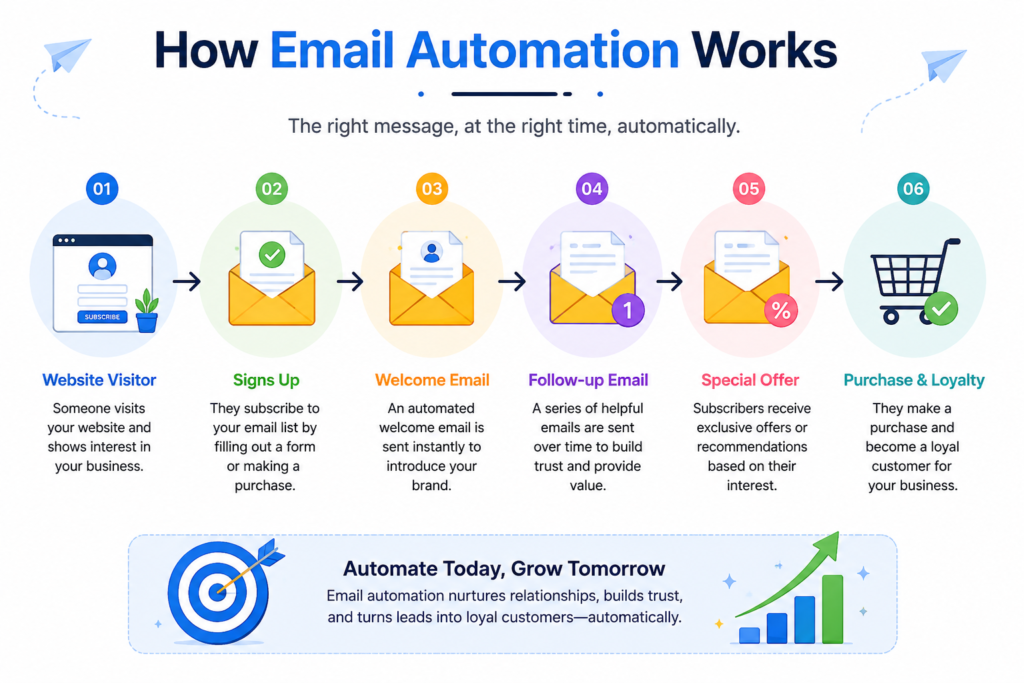
Here’s a simple, real-world example. Experience As If You Operate An Online Bakery. A customer purchases a birthday cake for the first time. Once email automation is in place, they receive it automatically:
- Thank you, email shortly after checkout
- A delivery confirmation email
- An email was sent a few days later asking for feedback.
- A special birthday email discount before their next one
This all occurs without you having to do anything after the initial setup. And this is the true magic of smart email automation ideas — continue to stay top of mind with customers without adding any work to your list.
Advantages of Email Automation in Business
But before I get into this ideas, here is a brief look at an email strategy that is worth your time and investment.
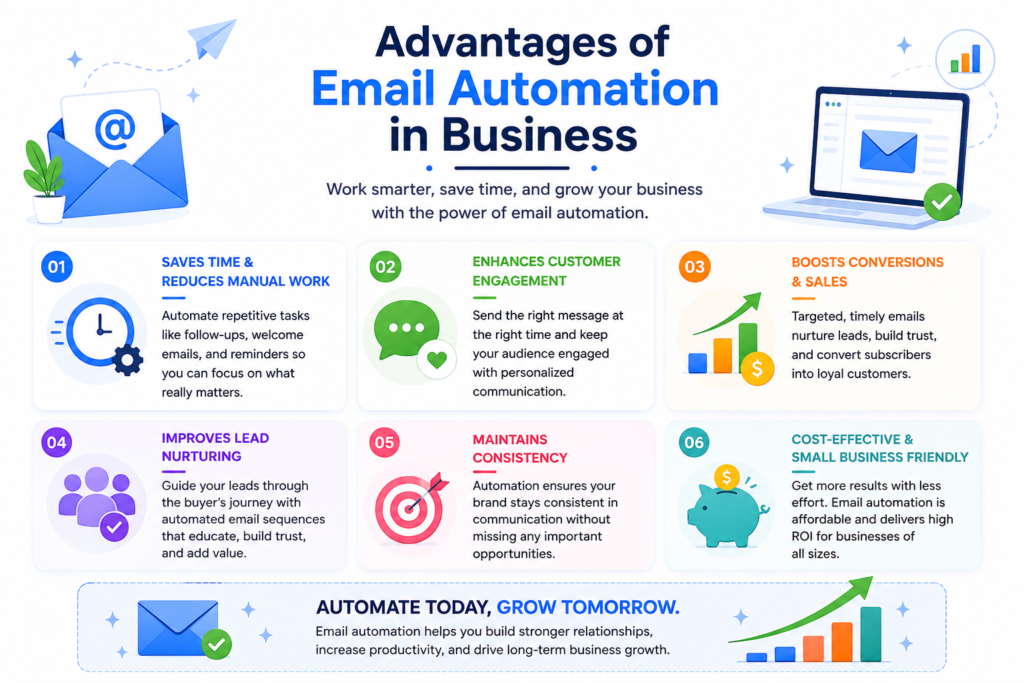
Saves time and reduces manual work. Automation does your repetitive tasks for you instead of writing emails one by one and sending them. This opens hours in the week that you can shift to strategy, sales, or customer service.
Enhances customer engagement. The audience will be engaged if they get the right email at the right time. If customers think that a brand understands them, they will open emails, click through to links, and ultimately follow up with a purchase.
Enhances lead nurturing emails’ performance. Not every person who visits you is ready to purchase right away. These automated lead nurturing emails gently usher potential customers along the buying process, each step building trust until they are ready to convert.
The more consistency you have, the better. Automation makes sure that no customer falls through the cracks. Each new subscriber, buyer, or query receives an identical and consistent professional experience each time.
Takes small businesses that have a limited budget for email marketing and gives them tools to start. Small business email marketing is easy, even for solo entrepreneurs, thanks to a host of affordable tools.
Bolsters long-term email marketing techniques. Automation is not a one-time strategy. It provides a basis for long-term email marketing strategies that grow with your business.
You know why, now let’s not waste time in getting practical. Below are five examples of email automations you can begin implementing this week.
5 Email Automation Ideas That Make Marketing a Breeze
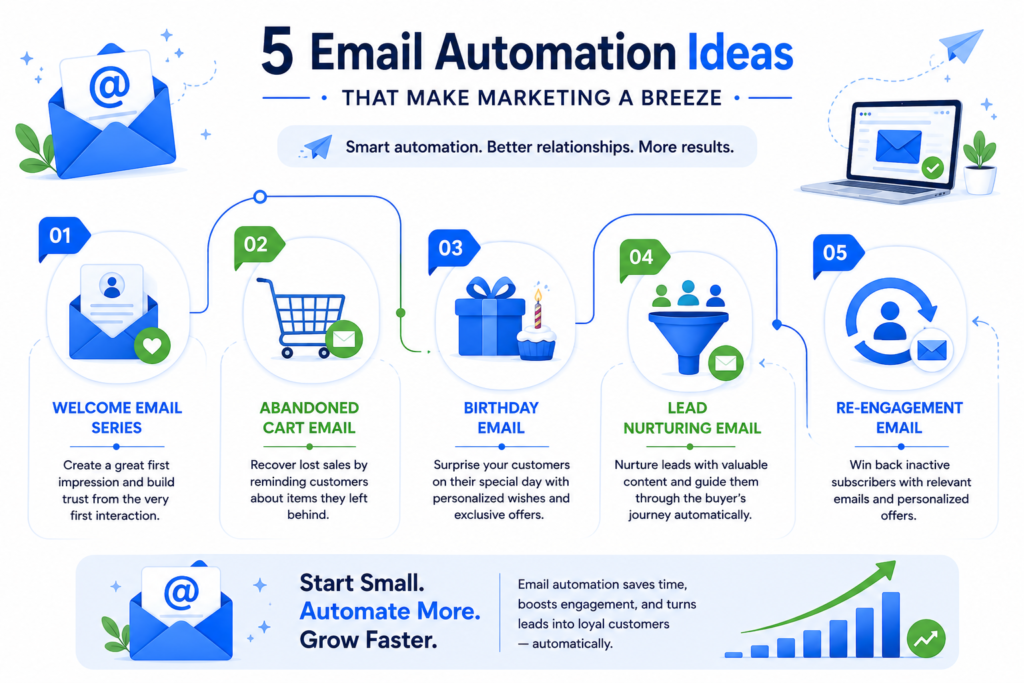
1. New Subscriber Series or the Welcome E-mail
This is one of the simplest and most effective ideas for email automation to start with. Whenever someone subscribes to your list, they get a short, welcome series of emails introducing them to your business. Welcome emails are an effective way to engage new subscribers and create a strong first impression.
How it works: The instant someone signs up on your site, your email tool starts a series. That could be three to five emails over a week telling your story, best-sellers, or anything that has been useful for others.
Example from the real world: A skincare brand might send you a welcome email with a discount code, then an email about their bestsellers, and a third one featuring skincare tips. Simple, helpful, and non-pushy.
Why it works: Making a great first impression. Setting the stage for trust from day one with a warm welcome is just a great tone-setting for your whole relationship with that subscriber. It is mostly the first of several strategies that companies execute, as it provides rapid, tangible success.
2. Abandoned Cart Reminder Emails
This is one of the most effective ideas that you can set up if you run an online store. It is aimed at consumers who placed an item in their basket but then abandoned it.
How it works: If a shopper abandons their cart, an automated email is sent out after several hours to remind them what they left in their cart, usually with an added incentive (and nudging) either in the form of free shipping or an occasional discount.
Example from real life: “Are you still thinking it through?” — maybe at a clothing store via email. And your cart awaits, here’s 10% off to help you decide. This nudge frequently retrains customers to finish checking out.
Why it works: A friendly reminder brings back a large portion of missed sales. Cart abandonment is inevitable. For marketers, it translates into increased revenue with near-zero marginal effort. For fans, it comes across as a little nudge rather than an overt sell.
3. Birthday or Anniversary Emails
Automation with a personal touch: this is one of the really simple ideas for genuine customer engagement. These emails are mostly triggered emails for the customer’s birthday or the anniversary of their first purchase.
How it works: Based on the data customers gave you when they signed up, your system will trigger an appropriate automated email with a unique discount, gift, or message to be sent exactly on that day.
Use case: A chain of coffee shops would send a “Happy Birthday! This week” email for “On Us (drink).” It completely is, yet it feels deliberate, not automated.
Why it works: These emails have the highest open rates as they seem personal and come across as a surprise. It is a small ask that creates a large emotional connection, deepening long-term loyalty with little day-to-day effort by your team.
4. Lead Nurturing Email Sequences
If you have a longer sales cycle, this is one of the most effective ideas. These emails provide valuable information and resources to those prospects who may be a little further away from making a purchase.
What it does: When someone downloads a free guide, shows up to a webinar, or expresses interest without purchasing, they are queued on an email nurturing sequence. They are exposed to helpful content, testimonials, and casual calls to action over the course of a few days or weeks.
For example, a software company may highlight the use of key features and roll out customer success stories via email to free trial users before introducing an upgrade offer.
Note: because not everyone purchases on day one, these email automation suggestions help keep your brand fresh in a potential customer’s mind, but more importantly, deliver trust over time and hopefully increase the chances of conversion when they are ready.
5. Re-Engagement Emails for Inactive Subscribers
Every email list has readers who go silent. Re-engagement campaigns are one of the smartest ideas for cleaning up and reviving your list (see them in action).
How it works: An automated email is sent to a subscriber who hasn’t opened or clicked an email in a certain amount of time, for instance, 60 or 90 days, and asks if they still want to receive emails from you (usually with a special offer for trying to win them back).
Here is a real-world example: A fitness app might email you, “We miss you! Bow again and save 20% off the next membership renewal.” Should there still be no response, they can then be excluded from future sends.
Works because: Keeps your list clean and open rates high. And it gives inactive customers a last real reason to return to your brand before you abandon them.
Email Automation: Avoid These Common Mistakes
Customizing is crucial. Even the best email automation ideas fall flat without personalization. Here’s what to watch out for:
- Sending too many emails too fast can result in subscriber confusion and higher unsubscribe rates.
- Lack of personalization — generic emails are felt to be robotic and get ignored.
- Failing to test your automation workflows — always validate links, timing, and formatting before you launch.
- Mobile optimization — people read their emails on their phones, so your design needs to look good there too.
- Not segmenting — no one wants to receive the same message, and since relevance is directly correlated to engagement, this can really hurt overall results.
- Old sequences not updated — leaving outdated offers or broken email links in an automated sequence can be a quiet brand killer for months.
Avoiding these errors means your workflows create connections rather than irritate your audience.
How to Optimize Your Email Automation
Do you want to take advantage of your email automation ideas during its max capacity? Be with these practical tips:
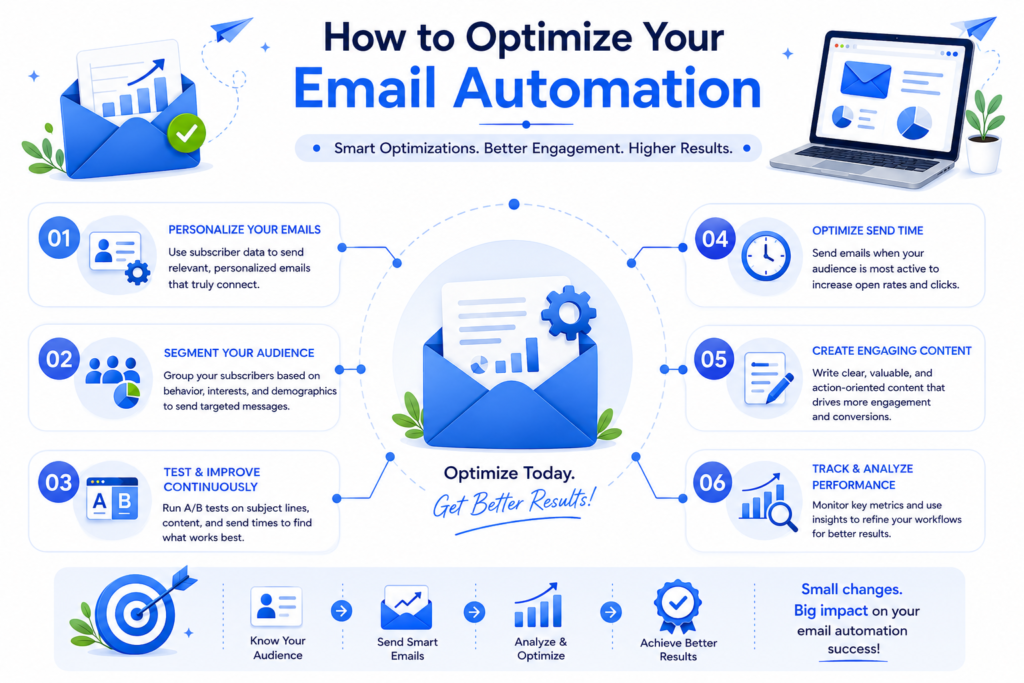
- Start small. Start with one or two automations (such as a welcome series) and then layer in the more complex workflows.
- Personalize whenever possible. Make emails relevant using the purchase history, name, or browsing behavior of a subscriber.
- Test subject lines. You can gradually improve your open rates using A/B testing.
- Keep emails short and clear. No one has the time for a long email on their phone in the middle of a workday.
- Review performance monthly. Evaluate what is working well and what needs tweaking by checking open rates, click rates, and conversions.
- Align automation with your goals. Some will drive sales, while others may encourage engagement or boost subscriber retention — make every email meaningful in the larger context of your email marketing strategies.
As the months go by, all of your systems must become smarter and more profitable as small incremental improvements compound.
Final Thoughts
But marketing can be simple; it doesn’t have to take lots of time. it plays a huge role — and when it is implemented correctly, it helps you develop real relationships with your customers while trimming hours off of manual work every week.
A simple welcome series, an abandoned cart mailer, or a quick birthday email, all of these touch points contribute towards a very smooth and personalized customer journey! Focus on one idea, see how it works, and then grow your workflows from there.
The ones that win at marketing automation aren’t always the businesses with the largest budgets. They are the ones who utilize these tools most mindfully and regularly. So just choose one idea from this article today, implement it, and let your marketing begin to feel like a breeze.
Frequently Asked Questions (FAQs)
01. Email Campaign Costs: How Much Does Automation Cost For Small Businesses?
Most small business email marketing tools come with free or low-cost plans so you can get started right away. When your list starts increasing and you get more sophisticated with your workflows, you can move on to paid packages with additional functionalities.
02. So, do I need to know coding to implement email automation?
Not at all. Many modern email CMS are just simple drag-and-drop builders, so you can create the most mind-blowing automated email sequences in minutes without ever writing a single line of code.
03. When to send an automated email?
While the answer is not universally applicable, it is recommended to space emails so as to not overwhelm subscribers. A basic guideline is to leave a few days between messages in an email sequence, amending based on the response from the recipients.
04. Some types of email automation about customer engagement?
Yes, definitely. Sending timely, personal emails is one of the most powerful ways to engage customers as they make subscribers feel seen and attended to, rather than just a name on a list.
05. What is email automation as opposed to normal email marketing?
Traditional email marketing typically means sending email campaigns manually at once in bulk to your entire list. Email automation, by contrast, is in response to a particular action or date range, which allows for much greater personalization and efficacy from your email marketing strategies.

Nidhi Patel is an SEO and digital marketing content strategist focused on AI SEO, content marketing, blogging, and personal branding. Through TrendChaska, she shares practical digital marketing insights, SEO strategies, and AI tools for beginners, students, and small businesses in India.