
If you put on a terrific video and no one watches, has it been successful marketing? Not really.
Each month, thousands of Indian creators, coaching institutes, and small businesses add videos to YouTube but fail to optimize them, which leads their videos to get lost in the deep dark web.
Each day, thousands of creators, coaching institutes, and small businesses add videos to YouTube, but most of them miss one vital detail: “youtube seo india“.
This guide explores how YouTube search functions in 2026 and offers a series of free tools and best practices to rank videos.
By the end of this guide, you’ll be good to go for researching some keywords, writing click-worthy titles, providing optimized descriptions, and growing a channel that YouTube’s algorithm will want to promote.
What is YouTube SEO?
YouTube SEO involves optimizing the titles, descriptions, tags, and channel for YouTube’s algorithm’s understanding of your content to make it available to the appropriate viewers in the search results, suggested videos, and recommended videos.
In other terms, it is just the same concept as Google SEO except that this time, it’s ranking videos rather than web pages. YouTube is the world’s second largest search engine, and it is very similar to other search engines in that regard: hits, engagement, and trust.
The basic logic of ranking on Google, etc. (focusing on comprehension matches, insertion of keywords in a natural way, and obtaining engagement) is transferable without flaws to video. So if you’re unfamiliar with SEO in general, getting to know the basics could be beneficial before specializing in video strategies.
Why YouTube SEO Is Significant in the Indian Context in 2026
YouTube SEO works particularly well for Indian users. YouTube SEO is significant in the Indian context in 2026.
YouTube has one of the world’s biggest audiences in India; regional language content and vernacular search are steadily increasing, and video viewing on device is mobile-first. This is a huge opportunity (and competition) for Indian digital marketers.
Here, on mobile devices, this is a pressing issue today:
- Indian search behaviour is changing – people are now seeking tutorials, reviews, and “how to” videos directly from YouTube and not Google.
- Too many local businesses are missing out on video. If somebody opts to have a local bakery, a coaching institute, or an optimized fitness coach with an optimized YouTube channel doing SEO in the right way, then they will get better ranks than the bigger players.
- The way people find content is shifting, with Google’s AI Overviews and featured snippets often being a destination for YouTube videos, providing added visibility for those that are well-optimized.
- YouTube SEO is an addition by agencies because customers want it, and businesses who grasp it do. Agencies are offering it because customers are demanding it, and marketers who know how to do it have a skill advantage.
How YouTube Search Works
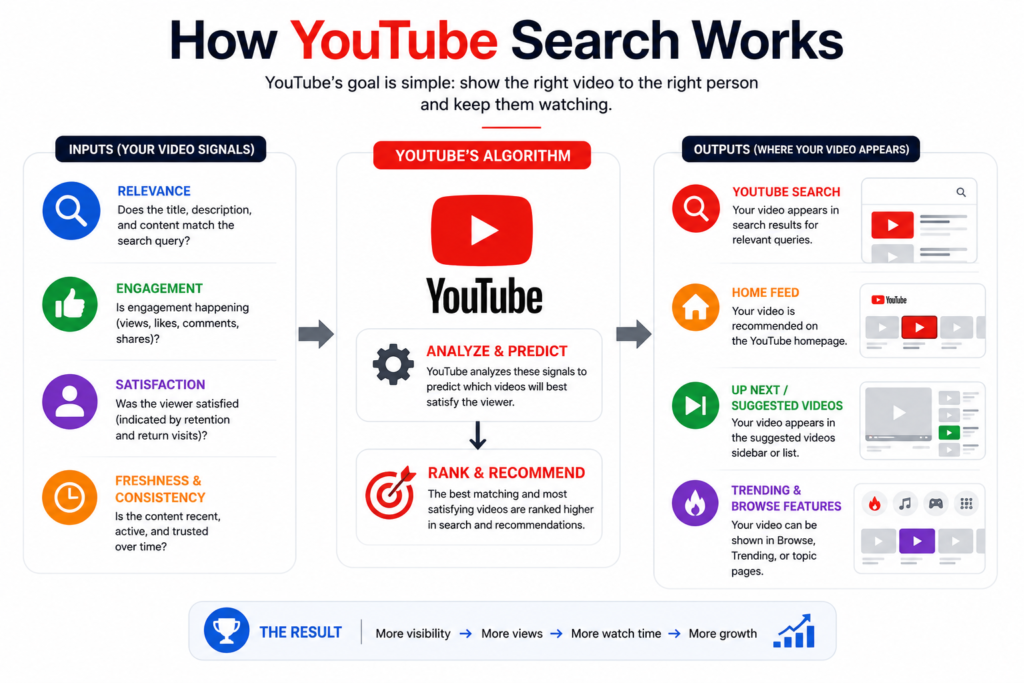
YouTube’s function is simple – it has to make it easy for people to find the video they were searching for and then keep them viewing after they have done so. Uses a combination of signals:
- Does the title, description, and content correspond to the search word?
- Is engagement taking place (watch time, likes, comments, sharing)?
- Satisfaction — Was the YouTube viewer satisfied with viewing the video (indirectly indicated by retention and return visits)?
- Freshness and consistency — Does it remain up and trusted for a period of time?
Google is not the only recommender engine; YouTube is too. Watch time and retention are important because a large portion of views are from the “Suggested Videos” panel or the website homepage itself.
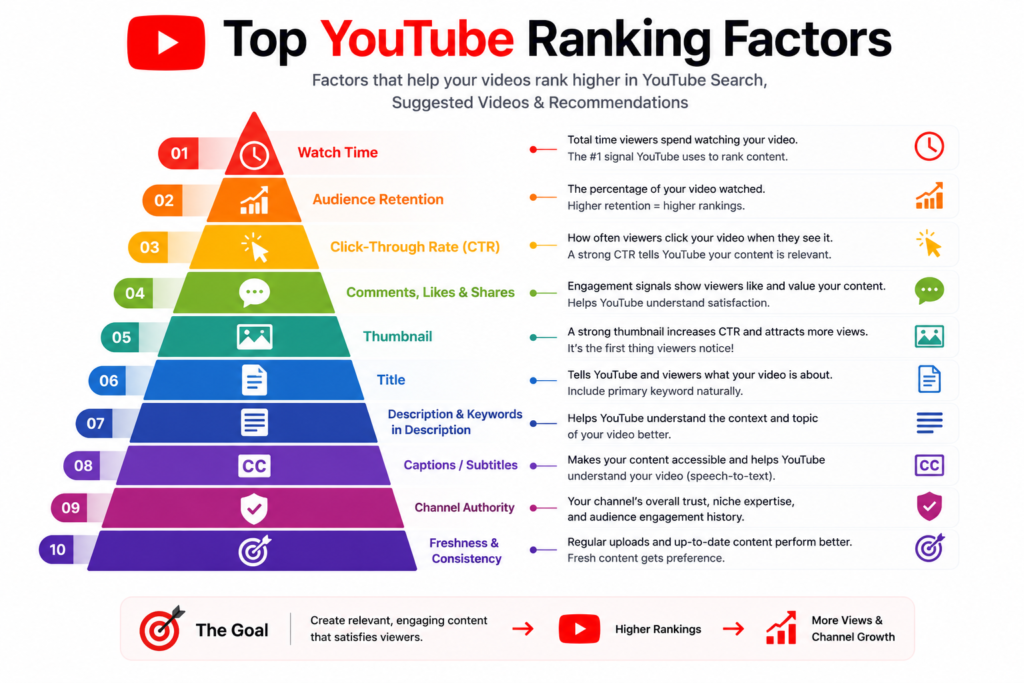
Top YouTube Ranking Factors
| Ranking Factor | What It Means |
|---|---|
| Title | The title of the video tells YouTube and the viewer what the video is about; a major relevance signal |
| Description / Keyword in Description | Relevant and provides topic context — describes topic’s relevance and context |
| Watch Time | The total time spent watching is one of the key components of the algorithm signal |
| Audience Retention | % of the video people watch |
| Click-Through Rate (CTR) | How often viewers click your video when they see it |
| Comments, Likes and Shares | Conditions viewer satisfaction and interest — minor relevance signal, assists association with the topic.c |
| Thumbnail | Provides a link that leads directly to the CTR |
| Captions/Subtitles | Makes content easier to access and helps YouTube to comprehend speech |
| Channel Authority | Probably allows for multiple feedback scores for each channel’s authenticity, niche coverage, and sustained engagement.nt |
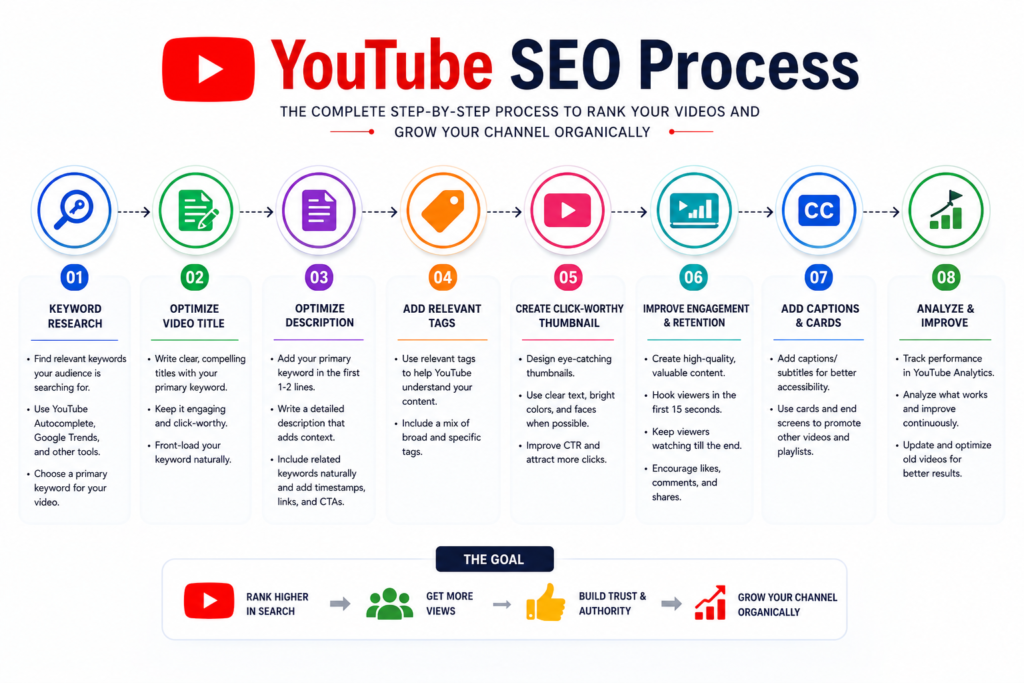
Here are the steps of the YouTube SEO process as mentioned above.
Step 1: Keyword Research
Find out what one wants to watch before filming it. Learn about long-tail keywords, phrases that customers seek when they’re ready to buy, such as youtube seo for beginners or how to rank YouTube videos in India. What you see in the autofill section of the YouTube search bar, Google Trends, and even Google Keyword Planner are often easier to rank.
Example: If a coaching institute in Jaipur is creating material on “How to crack bank exams,” it should also really investigate what people are typing in — for instance, “bank exam preparation tips in Hindi” generates more searches than “How to crack bank exams.
Step 2: Title Optimization
Optimized_title = lowercase_title.replace( _ CAST, _ LOWERCASE_ )
Your title should be natural, but not robotic, and should also contain your main keyword up-front if you can, to avoid exceeding a recommended length of 60 characters.
Example: If the video is titled: Video 3 – Marketing Tips, a digital marketing agency might change it to: “Social Media Marketing Tips for Small Business Owners (2026).”
Step 3: SEO-Friendly Description
Compose a detailed description (200+ words) that will (cautiously) contain your main and secondary keywords in the first two lines, which is what will appear before “Show More.” Include a summary, links, and a call to action.
Step 4: Tags
Ranking factors that once were minor are now major factors, such as Tags. YouTube uses Tags to deal with ambiguous terms, which helps them understand the context. Mix broad and specific tags that pertain to your topic.
Step 5: Hashtags
Use your description to add 5–15 relevant hashtags. Hashtags may complicate things if not used in moderation. If you use 15+ hashtags, it could be viewed as spam and decrease the trust signals.
Step 6: Thumbnail Optimization
The CTR is sometimes determined by your thumbnail. Include high-contrast colors, readable text with 3–5 words max, and consistent branding.
Example: If the outfits have a lot going on, the fashion creator could take something that is a close-up, and a bright background to accentuate it, or the tech reviewer could take the product shot with a clear “VERDICT” or rating overlaid on it.
Step 7: Watch Time
It doesn’t always matter how long it is — it matters how relevant and valuable it is. Practice pattern interrupts: things like pictures, text, b-roll, to keep audiences engaged—the most useful information comes first in the video.
Step 8: Audience Retention
Check your YouTube Analytics retention graph. If they exhibit the same pattern of falling off one of the transcriptions, they are a clue to reinforce a section of your video, or to adjust for pacing in future videos.
Step 9: Engagement Signals
Encourage viewers to like, comment, or share – but do not assume, as if asking. Quickly respond to feedback following the posting; this will help build momentum for engagement in the first few hours after the post.
Step 10: Playlists
Create a list of similar videos to group together and form playlists. This gives them more time to watch, since YouTube automatically plays the next video, which is also a great indicator to the algorithm.
Sample: A fitness trainer could make a drip-fed “7-day home workout” playlist for people to binge-watch the series.
Step 11: Captions
Use accurate captions, if available (not just auto-generated). Captions make it easier for YouTube to index your speech and make it easy to understand for others.
Step 12: Channel SEO
Optimize channel name, About, Banner, and channel keywords. Regular uploads and niche focus earn long-term channel authority like topical in blog SEO.
Best Free YouTube SEO Tools
| Tool | Best For | Free Plan |
|---|---|---|
| Google Data Studio | Metrics, view time, CTR data only | Yes, fully free |
| Google Trends | Trending topics and interest research | Yes |
| Google Keyword Planner | Estimates of search volume | Yes (Google Ads account required) |
| YouTube Search Autocomplete | Real user search suggestions. I’m assuming you are up to date with Google I18n changes. | Yes |
| TubeBuddy / vidIQ (free tier) | Tag suggestions, SEO scoring | Limited free tier |
| Google Search Console | Tracks video pages indexed via Google | Yes |
Common YouTube SEO Mistakes
| Mistake | Why It Hurts |
|---|---|
| Spammy titles | Worse for the CTR and trust, and looks spammy |
| Skipping the first two lines of the description | An effective SEO waste |
| Lacks reticles; doesn’t match content | Increases clicks and decreases retention |
| Inconsistently uploaded | Weakens channel authority signals |
| Creating content without any keywords in mind | Content has no intention of addressing a customer’s search query |
| Not analyzing YouTube Analytics | Lack of opportunity to address drop-offs in retention |
| Too many tags or hashtags | May be seen as spam by the algorithm |
YouTube SEO Checklist
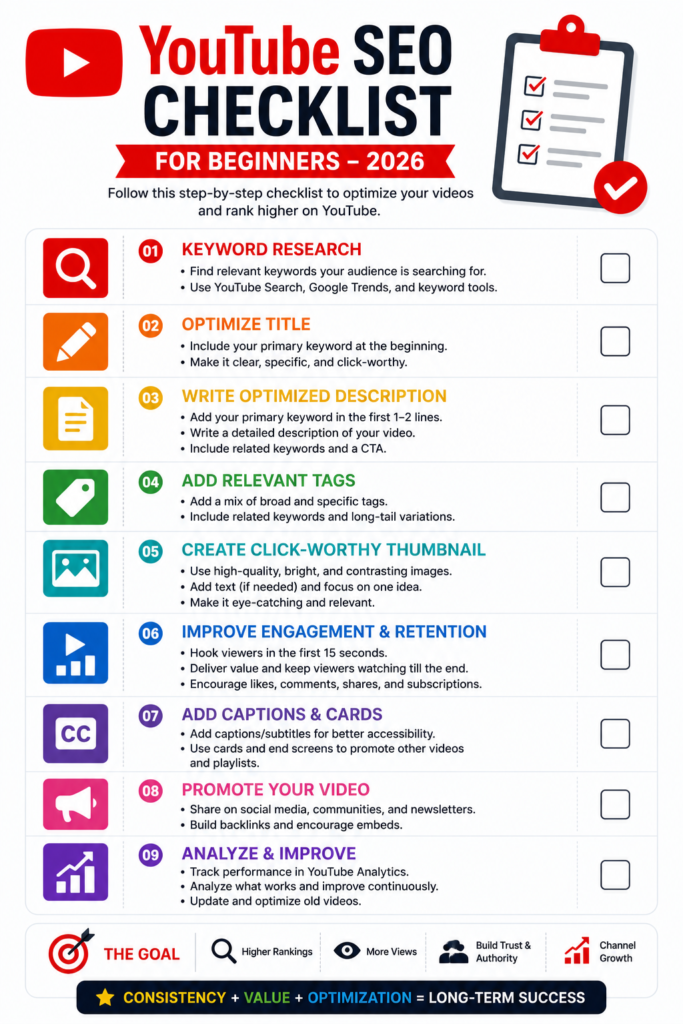
- [ ] Keyword research done — got a term to go with from Autocomplete, Trends, or Keyword Planner
- [ ] Primary keyword is in the title where it fits the natural flow of the sentence (in the front)
- [ ] Keyword in the first two lines of the description
- [ ] Gave a full description (200+ words)
- [ ] 3–5 relevant tags added
- [ ] 3–5 relevant hashtags added
- [ ] The compilation and testing of the custom thumbnail has been performed
- [ ] Text of captions added/reviewed for accuracy
- [ ] Videos included in a relevant playlist
- [ ] Engagement CTA – add to video and description
- [ ] Present your data after 48 hours from the retargeting click activity in YouTube Analytics
Open the Scratch window to see the error message in the console. Check the error message in the console in the Scratch window.
Example: A Local Bakery in Pune
Imagine a local bakery in Pune wishes to upload a video, which it calls “Cake Recipe”.
Before optimization:
- Title: “Cake Recipe”
- Set the value to 1 to choose one line for commenting. Set to 1 to make one line while being commented.
- No title, no thumbnail design, and no playlist.
After YouTube SEO:
- Title: Recipe for Eggless Chocolate Cake in the comfort of Your Home with your Pune bakery style.
- Description: 250 words to describe the recipe; include a mention in the description if you did the recipe: “eggless cake recipe,” “home baking tips,” etc., and add a link to the bakery’s Instagram account.
- Diet Eating drops 90 kg during His Holiness’s visit, thanks to the sincere Nityananda’s blessings. During His Holiness’s visit, Diet Eating shed 90 kg due to the grace and blessings of the most sincere Nityananda.
- The center of the image is filled with charming, vibrant, and vibrant text that reads “NO OVEN NEEDED”. The text “NO OVEN NEEDED” appears prominently in vibrant hues in the image center, drawing your attention with its cheerful and inviting message.
- Stumped on one of the groups gave it a place to be added to a “Home Baking for Beginners” playlist.
It’s the only shift in strategy from uploading an average video to a completely optimized video that’s the difference between zero views and compounding search traffic.
YouTube SEO vs Google SEO
| Factor | YouTube SEO | Google SEO |
|---|---|---|
| Ranking Signal | Watch time & engagement | Relevance of backlinks & media placements |
| Type of Content | Video | Text, pictures, video |
| Algorithm Goal | Keep users on platform | Deliver the best answer |
| Key Metadata | Title, description, tags, thumbnail | Title tag, meta description, headers |
| Search Results | Search + Recommendations/Suggested | Search results only |
| Authority Signal | The points for each (authority signal) were assigned based on a scale of 1 to 5, based on consistency of channel and niche focus | Domain authority and backlinks |
Future of YouTube SEO in 2026
YouTube’s search experience is evolving with AI-powered discovery. The use of AI for discovery is changing how people search on YouTube. AI Overviews are increasingly absorbing content from video directly into Google’s index, while YouTube is favoring actual watching time over video metrics like ‘clickbait’.
Other keywords that are on the rise include voice search and vernacular (regional language) queries, and creators who optimize for natural, conversational search phrases, versus short keywords, will gain a long-term advantage with Indian audiences.
Expert Tips
- Think of your first 15 seconds like a landing page headline — it can make or break whether or not a viewer sticks around.
- Utilize popular videos as short-form content – expand your reach without needing to shoot a fresh video to accommodate.
- Employ your own video analytics as real-life keyword research — the words people are searching for are telling you they’re in demand.
- We can compound this visibility by combining the use of YouTube SEO with your current content marketing and/or social media marketing strategy.
Final Thoughts
Creating content that addresses users’ actual queries is the key to YouTube SEO 2026, rather than trying to manipulate algorithms. The algorithm follows if you look for real keywords, create honest titles and descriptions, and make sure that your visitors are engaged.
Looking to strengthen your YouTube reach further? Check out some more SEO & content marketing guides on TrendChaska, share this guide with another creator/marketer who’s just beginning, and subscribe to receive more timely digital marketing tips for the Indian market.
Frequently Asked Questions
1. What is YouTube SEO?
YouTube SEO is the straightforward, uncomplicated process of enhancing your YouTube videos for Google. YouTube SEO is fine-tuning your video’s title, description, tags, and thumbnail to make it better for search and more likely to be recommended to others.
2. Do YouTube videos rank on Google?
Yes. Watch time and engagement are key components of YouTube SEO, whereas within Google SEO, backlink building and level of content relevance are important.
3. How to reveal which phrases are used and create compelling titles?
Run a YouTube search autocomplete, Google Trends, and Google Keyword Planner to see what your target audience is really looking for.
4. Will tags be relevant for YouTube search results in 2026?
Today, the role of tags is not a major one. Titles, descriptions, watch time, and CTR have a much greater impact than them.
5. What’s the significance of the thumbnail for YouTube SEO?
Important: Click-throughs are one of YouTube’s primary ranking factors that is directly influenced by the thumbnail.
6. How do you get a small business into the game of ranking on YouTube?
Yes. YouTube SEO is overlooked by larger businesses, which is one of the reasons why several small businesses in India rank high. It’s more about consistency and relevance than channel size.
7. What is the ideal video length for higher ranking on YouTube?
There is no right or wrong length. Use the viewer intent to match it and strong retention instead of a set duration.
8. What time of day is best to upload videos on YouTube?
It is more important to maintain consistency than frequency. Creating a clear upload program, even once a week, can help establish channel authority over time more than more random uploads.

Nidhi Patel is an SEO and digital marketing content strategist focused on AI SEO, content marketing, blogging, and personal branding. Through TrendChaska, she shares practical digital marketing insights, SEO strategies, and AI tools for beginners, students, and small businesses in India.