Use this Google Core Update Recovery Checklist to diagnose ranking drops, fix SEO issues, and recover your website rankings.
Introduction
If your traffic dropped after a recent Google update and you’re not sure why, you’re not alone. Every few months, Google rolls out a core update, and website owners across India start seeing ranking swings they can’t explain. Some pages fall out of the top 10 overnight. Others lose 30-40% of their organic traffic within days. If you’re searching for a way to recover from Google update damage, this guide gives you a practical, step-by-step google core update recovery checklist you can actually follow — no guesswork, no panic fixes.
This is written specifically for Indian bloggers, small business owners, marketers, and website managers who don’t have an in-house SEO team but still need a clear, methodical plan.
What Is a Google Core Update, and Why Do Rankings Change?
A Google core update is a broad change to Google’s ranking systems, rolled out several times a year. Unlike smaller algorithm tweaks that target one specific issue, core updates reassess how Google evaluates content quality, relevance, and usefulness across the entire web.
Here’s the important part: a core update isn’t a punishment. Google isn’t “penalizing” your site in the traditional sense. Instead, it’s re-evaluating which pages best satisfy a search query — and sometimes, pages that ranked well under the old system don’t hold up as well under the new one.
This is why a ranking drop after an update isn’t always about something you did wrong. It can also mean:
- Competitor content has improved and now better matches search intent.
- Your content was thin, outdated, or not as helpful as it once was.
- Google’s understanding of relevance for your niche has shifted.
- Technical issues on your site are affecting how pages are evaluated.
Knowing this distinction matters because it changes how you approach recovery. You’re not looking for a “penalty” to remove — you’re looking to make your site genuinely more useful than what’s currently outranking you.
Before You Touch Anything: Diagnose the Drop First
The biggest mistake website owners make after a ranking drop is making changes before understanding what actually happened. Random edits — deleting pages, rewriting everything, disavowing links without evidence — often do more harm than good.
Follow this diagnostic process first.
Step 1: Confirm It’s Actually a Core Update
Check Google’s Search Status Dashboard and cross-reference the date your traffic dropped with any announced core update rollout. If the timing doesn’t line up, the drop might be caused by something else entirely — a technical issue, a manual action, or a seasonal search trend.
Step 2: Check Google Search Console
Go to the performance report and compare the weeks before and after the suspected update. Look at:
- Which specific pages lost impressions and clicks
- Whether rankings dropped for the same keywords across the board or only in certain categories
- Whether the drop happened gradually or all at once
A sudden, site-wide drop that coincides with an announced update date is a strong signal you’re dealing with a core update.
Step 3: Identify Which Pages Were Hit Hardest
Not every page on your site will be affected equally. Export your Search Console data and sort by traffic loss. This tells you exactly where to focus your recovery effort instead of rewriting your entire site.
Step 4: Check for Technical Problems in Parallel
Rule out unrelated issues — a broken redirect, a robots.txt error, a server outage during crawling, or a Core Web Vitals regression. These can compound a core update’s impact and are worth fixing regardless.
Only once you’ve confirmed the cause should you move into the recovery checklist below.
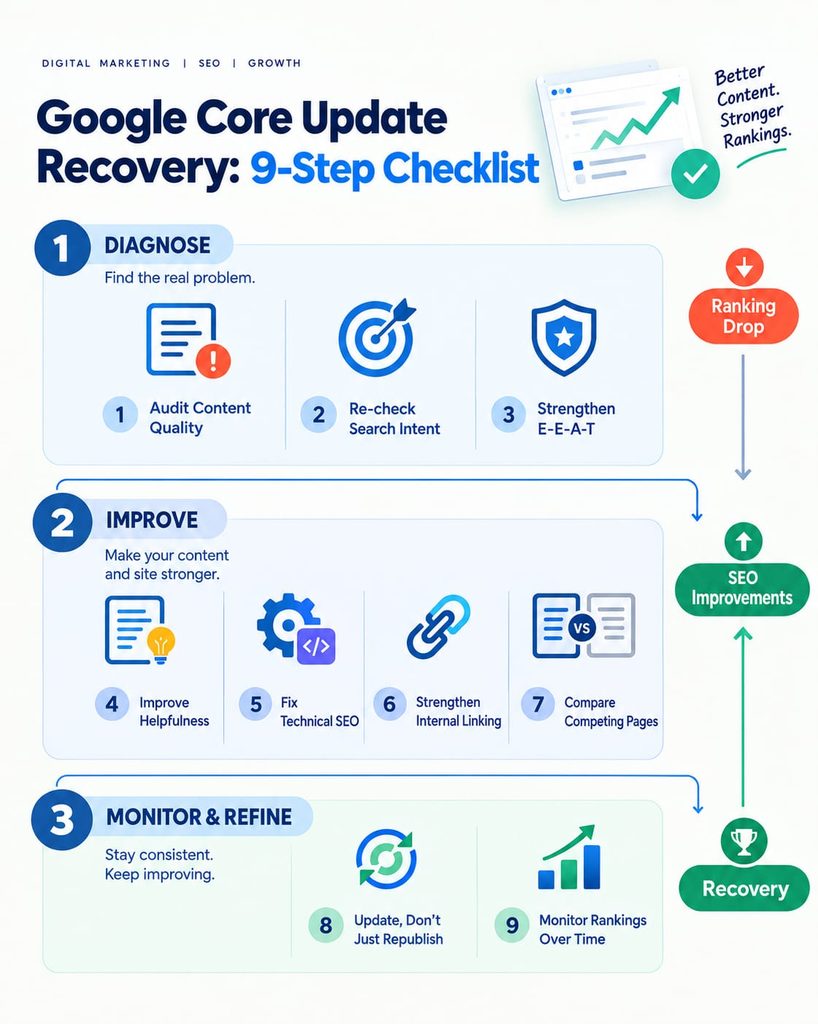
The Google Core Update Recovery Checklist
This is the practical, step-by-step process to follow. Work through it in order — each step builds context for the next.
1. Audit Content Quality on Affected Pages
For every page that lost significant traffic, ask honestly: does this page still deserve to rank? Google’s core updates increasingly reward content that demonstrates real expertise and depth, not content written to simply hit a word count.
Look for:
- Outdated information, statistics, or examples
- Sections that repeat the same point without adding value
- Content that reads like it was written for search engines rather than people
2. Re-check Search Intent Alignment
Search intent shifts over time, and a page that matched intent perfectly two years ago might not match it today. Search the primary keyword yourself and study what’s currently ranking on page one. Are they how-to guides, listicles, comparison posts, or product pages? If your content format doesn’t match what’s now ranking, that’s often a bigger issue than the writing quality itself.
3. Strengthen E-E-A-T Signals
E-E-A-T — Experience, Expertise, Authoritativeness, and Trustworthiness — has become central to how Google evaluates content, especially after core updates. Practical ways to strengthen this on affected pages:
- Add author bios with relevant credentials or experience
- Include first-hand examples, screenshots, or case-specific details instead of generic advice
- Cite credible sources where you’re making factual claims
- Make sure your site has clear About, Contact, and Privacy pages
4. Improve Helpfulness, Not Just Length
A common misconception during recovery is that longer content ranks better. It doesn’t — helpful content does. Trim sections that exist only to pad word count, and add sections that answer the specific questions your audience is actually searching for.
5. Fix Technical SEO Issues
Technical SEO doesn’t cause core update drops on its own, but weak technical foundations make recovery harder. Check:
- Page load speed and Core Web Vitals scores
- Mobile usability
- Broken internal links or redirect chains
- Proper use of title tags, meta descriptions, and header structure
6. Strengthen Internal Linking
Internal linking helps Google understand which pages on your site matter most and how they relate to each other. After a ranking drop, review whether your affected pages are well-linked from other relevant, high-authority pages on your site. Isolated pages with few internal links often struggle to recover, even after content improvements.
7. Compare Against Competing Pages
Open the top three ranking pages for your target keyword and compare them honestly against yours. Look at depth of coverage, formatting, use of examples, and whether they answer follow-up questions your content misses. This isn’t about copying competitors — it’s about identifying real gaps.
8. Update, Don’t Just Republish
If you’re updating a page as part of your recovery, make substantive changes — new information, better structure, updated examples — rather than just changing the publish date. Google can tell the difference, and superficial “freshening” rarely helps rankings recover.
9. Monitor Rankings Over Time, Not Days
Recovery from a core update is rarely immediate. In practice, meaningful ranking changes after content improvements often take weeks to show up, and sometimes don’t fully settle until the next core update rolls out. Set a realistic monitoring window — track weekly, not daily.
What NOT to Do After a Ranking Drop
Just as important as what you should do is what to avoid. These reactions are common but usually counterproductive.
- Don’t panic-delete content. Removing pages that lost traffic rarely helps and can lose whatever residual value they still have.
- Don’t mass-disavow backlinks without evidence. Disavowing links is meant for genuinely toxic, spammy backlinks — not a blanket reaction to a ranking drop.
- Don’t rewrite everything at once. Making sweeping changes across your entire site makes it impossible to know what actually worked.
- Don’t chase every SEO trend you read about. Not every recovery tactic applies to every niche or site. Diagnose your specific situation before acting.
- Don’t expect overnight results. Recovering from a core update is a process, not a single fix.
- Don’t ignore the possibility that it isn’t a core update at all. Manual actions, technical errors, and algorithm-unrelated traffic drops require different fixes entirely.
Quick-Reference Recovery Checklist
Use this as your at-a-glance action list:
- Confirm the drop coincides with an announced core update
- Review Search Console data for affected pages and keywords
- Rule out technical issues (speed, crawl errors, broken pages)
- Audit content quality on the hardest-hit pages
- Re-check search intent alignment for target keywords
- Strengthen E-E-A-T signals (authorship, sourcing, trust pages)
- Improve helpfulness over word count
- Fix internal linking to affected pages
- Compare content depth against top-ranking competitors
- Make substantive updates, not superficial ones
- Track rankings weekly, not daily, after making changes
Bookmark this google core update recovery checklist and revisit it after every future update — the process stays largely the same even as Google’s specific priorities evolve.
Final Thoughts
A ranking drop after an update can feel alarming, especially when it directly affects your business or blog income. But core update recovery isn’t about chasing a quick fix — it’s about methodically diagnosing what changed, honestly evaluating your content against what’s now ranking, and making real improvements rather than superficial ones.
Work through this checklist one step at a time, track your progress weekly, and resist the urge to make sweeping changes based on guesswork. Sites that treat core update recovery as an ongoing content quality practice — rather than a one-time scramble — tend to come out stronger after each update, not just back where they started.
FAQs:
1. How long does it take to recover from a Google update?
There’s no fixed timeline. Some sites see partial recovery within a few weeks of making improvements, while full recovery can take until the next core update rollout, since Google continuously reassesses content relevance.
2. Will my rankings automatically come back after the update finishes rolling out?
Sometimes rankings partially stabilize once a rollout completes, but if the drop reflects a genuine content or relevance gap, you’ll usually need to make real improvements to see lasting recovery.
3. Can a core update affect my whole website or just certain pages?
Both are possible. Some sites see broad, site-wide impact, while others see drops concentrated in specific content categories or page types.
4. Is a core update the same as a manual action?
No. A manual action is a direct penalty applied by Google’s team, usually for violating webmaster guidelines, and you’ll be notified in Search Console. A core update is an automated, algorithmic reassessment that doesn’t come with a notification.
5. Should I hire an SEO consultant after a ranking drop?
If you’ve worked through this checklist and still can’t identify the cause, or if the traffic loss is significant to your business, a second opinion from an experienced SEO professional can help you spot issues you might be too close to see.

Nidhi Patel is an SEO and digital marketing content strategist focused on AI SEO, content marketing, blogging, and personal branding. Through TrendChaska, she shares practical digital marketing insights, SEO strategies, and AI tools for beginners, students, and small businesses in India.