An effective content marketing strategy for small businesses in India. How to Plan, Write and Promote Content in 2026 for Next To No Money
Introduction
Imagine a tiny apparel store in Ahmedabad. The proprietor sells decent products at fair prices, with returning customers who stroll in every week. However, few discover her online. After running ads for about two to three days, she had spent a few thousand rupees. As soon as she stopped running the ads, the enquiries also stopped.
This is a common problem. Small businesses in India contend with bigger brands wielding larger ad budgets. Yes- paid ads work, but only for as long as you pay. As soon as the budget dries up, so does visibility.
This is where small business content marketing comes in handy. Not an easy fix, not a free-of-charge, time-consuming approach. The thing is, it builds something ads can not: a consistent yet compounding stream of trust and traffic that continues working when you are not paying.
What does content marketing really mean, why is it so important to the success of your small business, how can you develop a simple strategy, and how can you implement it with an achievable 30-day plan? The goal should be that you will be able to start today, not “someday”.
What Is Content Marketing?
Content marketing is using content–usually free and helpful–to attract, involve, and retain customers, rather than making a direct request to buy something.
Let me explain that in a simpler way. Imagine a Pune salon owner posts a reel, “3 hairstyles to wear for Indian summer weddings.” That’s content. Yet, if she regularly posts styling tips, educates on common hair-care topics, and showcases client transformations over a period — crafting an audience that knows and trusts her salon before having even walked in the door — that’s content marketing.
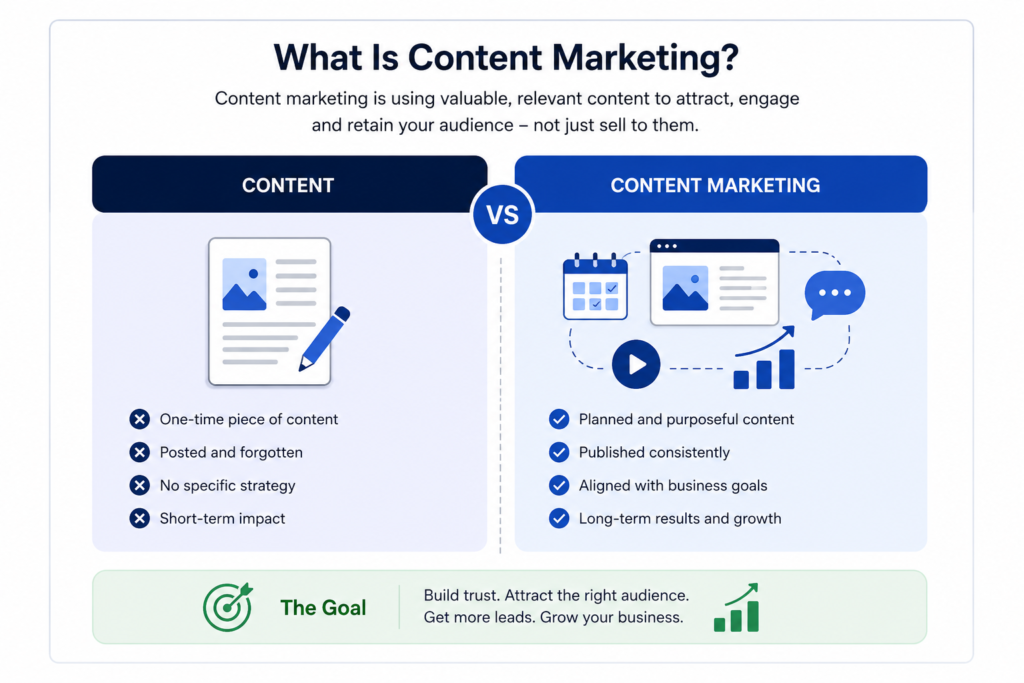
Content is a one-time thing. You post, and then that is the end of it.
Content marketing is a strategy. Which in a way means that you create purposeful content, regularly publish it, and relate it to a business outcome, whether that be more inquiries, footfall, or sales.
This distinction matters a lot. Small businesses also, of course, “do content” (which usually means Instagram posts rather than actually doing content marketing), but very few do the other type of content marketing, which requires a plan behind the random posts.
Content Marketing Essentials for Small Business
This is why small business content marketing works — it addresses the weak performance of paid ads in solving critical issues.
- It builds trust. When you regularly provide this useful information, then people begin to see your business as knowledgeable rather than just another seller.
- This allows you to be found on Google. SEO helps with getting your blog posts, guides, and FAQ pages to show up when people search for something you sell.
- It attracts the right customers. Content that gives answers to actual questions draws people who are genuinely interested in real interest and not just random clicks.
- It supports your SEO. Search engines prefer sites that regularly produce useful, relevant content.
- It creates brand recognition over time. Any content is just a micro interaction to show somebody that your brand exists.
- It gets you leads without the hard sell. A well-written blog post or video can quietly work as your sales pitch.
- Via newsletters, social posts, or even WhatsApp updates, it keeps in touch with existing customers.
- It decreases the need for paid ads over time, although it seldom removes paid ads.
We must be frank here: content marketing does not generate instantaneous results. SEO by its nature means weeks and months of continuous work before any real traffic or leads are produced. If someone is telling you that these kinds of effects happen overnight, they are not being completely honest with you.
Content Marketing vs Traditional Advertising
Either approach has a right to exist in a small business marketing strategy. Here’s how they compare.
| Factor | Content Marketing | Traditional Advertising |
| Cost | Requires time and effort, but less costly in the long run | Direct cost on per click or per impression |
| Reach | Grows gradually, compounds over time | In short, fast response; however, too fast ends when the budget ends |
| Trust | Builds trust through helpful information | Often seen as a sales pitch |
| Long-term value | Content that works for months or years | By the time you stop paying for it the value is non-existent |
| Speed | Slow to show results | Fast results |
| Customer relationship | Builds an ongoing relationship | Usually a one-time transaction push |
For most small businesses, the smartest way is to combine both. Paid ads can give you a burst of visibility, while your small business content marketing strategy lays a long-term foundation. Some even use small ad budgets to promote their best content to get it distributed faster.
How to Build a Content Marketing Strategy for Small Business
Small business content strategy does not have to be complicated. And In Conclusion, A Process You Can Follow
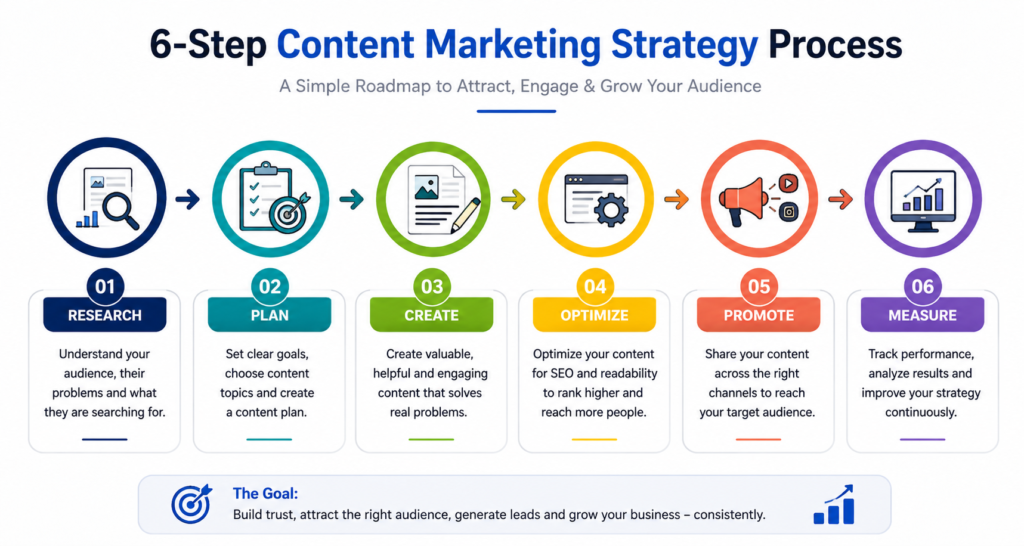
Step 1) Identify who your target customer is
Do your research on who you are making for before creating anything. Often referred to as a buyer persona — simply who your best customer is.
Sample persona: A coaching institute in Lucknow preparing students for bank exams.
Knowing this, your content inevitably becomes more relevant.
Step 2: Find customer problems
Good content answers real questions. To find these questions:
- Enter your topic in Google and see the auto-complete suggestions.
- Check what boxes “People also ask” in Google search results.
- Keep Track of What People Search for Before Visiting Your Site with Google Search Console
- Monitor Comments and DMs about Your Posts
- Check customer ratings, both positive and negative.
- Review discussions on Reddit or local Facebook groups.
Now this one step will bring you months of content!
Third Step: Pick Content Topics
C H 0 O S However, do not just post anything — Select areas that reflect your customers’ searches or inquiries. Q3. Your content needs to be representative of the end-user; for example, if it is a local bakery, it shouldn’t be shooting in the dark in case someone looks for “eggless cake near me” or wants to know about sugar-free and produce content based on that.
Step 4: Pick the ideal content types
You do not have to spread yourself thin. Select formats according to where your target audience hangs out and what you can actually create.
- Blog posts — helpful for SEO and in-depth explanations
- Instagram Posts — Useful for Feed and Visuals
- Reels — Good for Reach and Discovery
- YouTube Videos — Good For Tutorials And Demonstrations
- Guides and checklists — excellent for downloadability
- FAQs — used to respond to frequently asked questions
- Case study — nice for credibility
- Email newsletters — ideal to stay in touch with current customers
When a small business is attempting to handle six platforms at the same time, they are typically managing all six poorly. Choose one or two formats that you can commit to.
Step 5: Create useful content
Typically, valuable content does one of the following: it solves a problem, answers a question, saves the reader time, or educates them on something different. If your content does not do one of these, it may not be worth publishing!
Which brings us to step 6 of the process
SEO content marketing does not mean binging keywords everywhere. It covers doing content that is easily understood by both humans and search engines.
Keep these basics in mind:
- Search intent match — know what the reader actually searches for
- Implement your target keyword without being obvious in titles, the first paragraph, and a few headings.
- Structure your content with proper headings (h2, h3)
- Create internal links to other relevant pages on your site.
- Relevant and compelling meta title and meta description
- Use of on-page images with descriptive alt text
- Be succinct within a sentence and within a paragraph.
Step 7: Promote the content
Putting out a piece of content and crossing your fingers is not typically effective. But you need to take action to share it.
- It could well be a few links that you can just add on your social media channels.
- Send it to your email list.
- Post it to relevant WhatsApp groups or broadcast lists.
- Avoid spamming and post in suitable online communities.
- Make sure you link to it from other pages on your own site.
- Include it in the updates for your Google Business Profile.
- Turn one blog post into 5 Instagram slides, a reel, or an email.
Do not just drop your link in hardware-related groups or forums to get clicks. It rarely delivers you the proper audience, and it can also hurt your reputation.
Step 8: Measure results
Measure some metrics that actually mean something to you:
- Organic traffic — how many people are coming through search
- Engagement — likes, comments, shares, watch time
- Leads — enquiries generated
- CTR (Click Through Rate) — how many people click on your content in search results.
- Conversion rate — the percentage of visitors that perform the target action
- Organic traffic and rankings — visibility with Google
Not every metric matters equally. And a restaurant may have more concern with calls and tables booked than they do blog comments. Identify which numbers are tied to actual business outcomes, and stick there.
Even as small businesses and organisations, you have to come up with some Content Marketing Ideas.
In this post, you will find actionable content marketing ideas for small businesses in any industry.
- There is a common question; we provide the answer: “What documents will you need to register for the exam?”
- How to — A salon writing “How to keep your hair colour in between salon appointments”
- Customer stories — A digital marketing agency’s account of how local clients’ enquiries are better
- Product demo: A clothing store demonstrating how a fabric lays on various body types
- Before-and-after examples — A salon showcasing a hair transformation
- Common affairs — A restaurant promoting “Mistakes people do in 2023 when ordering a biryani for a party”
- Industry tips — A digital marketing agency publishing basic Instagram advice to other smaller businesses
- Because You → Behind-the-scenes content — A video of a bakery making a cake from scratch.
- Example of Product comparisons — A clothing store comparing cotton vs linen for Indian summers
- Local guides — Best street food spots in our place
- The Examples — A local service business that shares a difficult problem that it overcame for its customers
- Tutorials — A coaching institute teaches you how to do a difficult exam question as you send your gaze across a wide swath of empty test-takers’ seats in an auditorium
- Checklists – A salon providing a checklist for “Bridal prep”
- Common Myths — A digital marketing agency busting myths that say evidence such as ‘A large budget is required to run ads’.
- Customer Reviews — show customers what others say about you.
- Seasonal content — A clothing store giving Diwali festive outfit ideas
- Q&A sessions — A local service business hosts an Instagram live Q&A with existing customers
You won’t need to use all of them. Then choose five or six that work for your business and repeat them in various ways.
How to Do Content Marketing on a Shoestring Budget
Yes, affordable content marketing is actually possible at the one-person business level! Here’s how to keep costs low.
- Free SEO tools: Google Search Console and Google Keyword Planner provide valuable, complimentary data pertaining to what individuals are searching for.
- Tools: Canva → Free plan is sufficient for social media posts and simple solutions. Paid plan offers additional templates and features, but not needed to begin with.
- Google Business Profile: It is free to set up, and you need a Google My Business profile so that your local business shows when someone asks (in Google Maps or search)
- Google Analytics: Free tool to find out who visits your site and what they do on it.
- No cost to post: Posting on free social media platforms such as Instagram, Facebook and YouTube is zero.
- Smartphone videos: For most short-form video content, a good smartphone camera in natural light will do.
- Reuse, repurpose: One blog post as an Instagram carousel + a script for your reel + an email — Single Idea, Multiple Similar Content.
With content marketing on a budget, it’s mostly time over money. The main investment is consistency.
4 Best Marketing Content Tools for Small Business
| Tool | Best For | Free Option | How It Can Be Useful For Small Businesses |
| Google Search Console | Tracking search performance | Yes, fully free | Find out which queries drive traffic and correct indexing problems |
| Google Analytics | Understanding website visitors | Yes, fully free | Monitoring — Traffic sources, Popular pages and Visitor behaviour |
| Google Trends | Spotting trending topics | Yes, fully free | That being said, DON’T create seasonal content without checking what’s trending first |
| Canva | Designing graphics and posts | Free plan (limited) / paid plan for additional assets | Making Social media posts, Banners and simple videos |
| AnswerThePublic | Finding question-based content ideas | Limited free searches per day | Find out what actual customers want to know |
| Semrush | Keyword research and SEO analysis | Limited free trial/features; mostly paid | Target Keywords and Competitor Content Analysis |
| Ahrefs | Backlink and keyword research | Very few free tools (Ahrefs Webmaster Tools is one) but mostly paid | Study what content that ranks well, which content and why. |
Start with the free tools. That’s all you need to create a great content calendar for SMBs. You should only add paid tools once you find that content marketing is really showing positive results in your business.
An Easy Content Marketing Plan for 30 Days
This is a content marketing plan you can actually follow whenever you have the time!
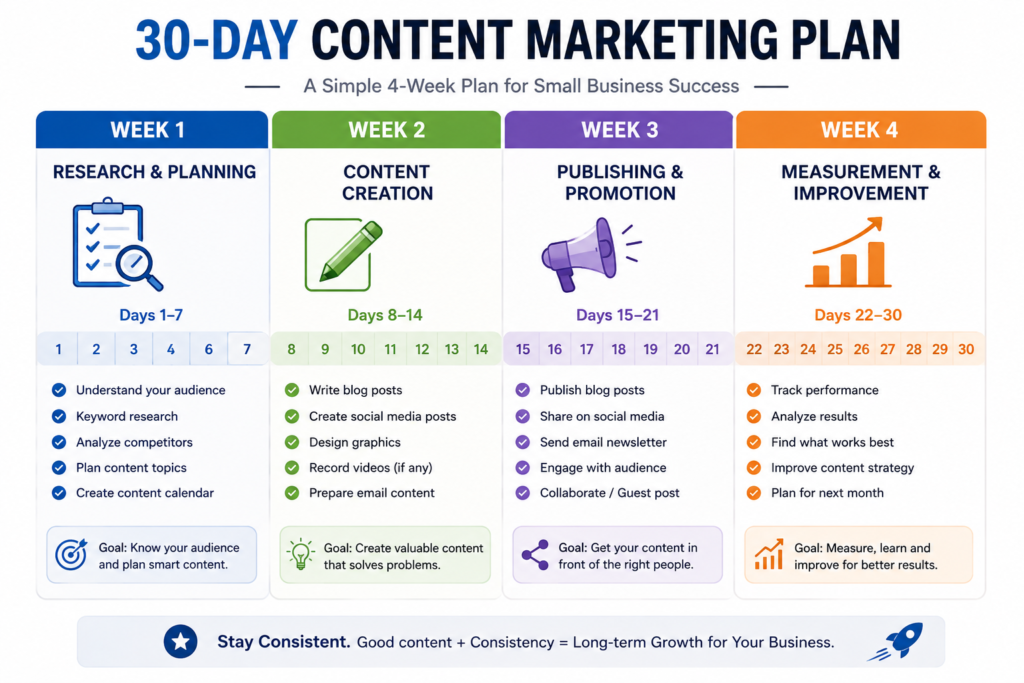
Week 1: Research and Planning
- Identify your audience and the problem they deal with
- Utilizing Google autocomplete, Search Console, and what people ask your customers — write down 15-20 content ideas.
- Select two or three content formats that you are going to run with
- Create free accounts on Google Search Console and Google Analytics.
- A simple content calendar for the month
Week 2: Content Creation
- Make 4-6 pieces of content from your list.
- Blog post 1 — Write a specific blog post that answers one of the customer questions
- Create social media graphics for the design with Canva.
- Create one or two brief videos with your phone.
- Captions and basic SEO (title, description) for every piece
Week 3: Publishing and Promotion
- Post your content in alignment with your calendar.
- Disseminate every piece onto your social platforms of choice.
- Send a plain message to your mailing list, or WhatsApp broadcast if you have one.
- Link to your blog post and other relevant pages internally
- Add a new post to your Google Business Profile.
Week 4: Measurement and Improvement
- Monitor Search Console for impressions and early clicks.
- Go through every individual post and track the social media activity.
- Take note of what content type does well.
- Narrow down the list to two or three ideas you can repeat or improve on next month.
- Base next month’s calendar off of what was successful
This is a framework to get you started with, not an inflexible playbook. Change it according to your time and resources.
How Small Businesses Can Avoid Common Errors in Content Marketing
- Posting without an audience — Solution: Decide who your target customer is before putting together any posts.
- Copying competitors — Their strategy might not be suitable for your business. Instead, focus on the question that your own customers are really trying to ask.
- Narrow approach of only selling — staying constantly on “buy now” content loses people. Mix in genuinely helpful content.
- Neglecting SEO — Have you ever spent hours crafting top content just for it to lie hidden and get no views? Add basic SEO to every piece.
- Headlines that are sporadic — By being erratic in your headlines, you slim down trust and rankings. This content calendar for small businesses allows you to be more consistent.
- Too Many Platforms — Attempting to juggle five platforms usually means doing everything poorly. Just choose two or three and do them right.
- Not tracking the results — You won’t have any idea about what is working if you are not tracking it. Keep an eye on Search Console and Analytics.
- Writing about things nobody is searching for — Check search demand and questions before you create a topic, not after.
- Using AI sparks content without modifying — Unedited AI content comes off generic, and trust is a casualty. Remember to research and fact-check with each piece of information, injecting your own personal experience as well.
- Having already given up — Marketing with content takes time before it actually pays off. Quitting after a fortnight hardly does it justice.
How SEO and Content Marketing Work in a Combined Manner
SEO content marketing is not simply plopping keywords into a blog post. It’s about writing for search engines and, most importantly, the reader.
Here’s how the two connect:
- Search intent: Your content has to align with what the searcher is really after — info, comparison, or purchase.
- Keyword research: This actually shows you what people are typing into Google, so you create content that is being searched for.
- Helpful content: This is primarily written as “Created by People, For People,” which, according to Google’s own guidance for creators, refers to any content that is created only for purpose other than generating rank in search results.
- Internal linking: it refers to linking relevant pages within your website so that both readers and search engines can recognise the site structure.
- Topical relevance — If you can cover a topic deeply amongst several pieces of related content, the topical footprint becomes an authority around that topic.
- Search visibility: Optimised content stands a better chance of making it to search results.
- Use for User experience: Pages that load quickly, are mobile-friendly and easy to navigate all enhance your SEO.
In a nutshell, SEO makes it easier for people to find your content, and good quality content makes it worth ranking.
Future of content marketing for small businesses- trends 2026
Below are a few realistic trends you would find in Content Marketing for small businesses in India this year.
- Human-edited AI-generated content. Now more and more businesses are using AI Tools to get quicker drafts for their content, but the really performing content is still reviewed, fact-checked, and made personalised by an actual person prior to going live.
- Primary experience and unique perspective weigh heavier. Search engines and readers are evolving to prefer content that is based on real experience, specific examples, and an authentic POV over generic repurposed information.
- Short-form video continues to grow. Despite Reels and short YouTube videos being a great means for small businesses to quickly access new audiences.
- Search behaviour is moving beyond traditional Google search. Search is the classic approach to discover brands and products, but more people are exploring brands through social platforms, AI chat tools and community talks.
- Local content remains valuable. Location-based content still delivers strong, relevant traffic for businesses like salons, restaurants, or any local services.
- Personalization is growing. Companies that deliver content targeting distinct customer segments generally see better engagement than those simply sending the same message to all.
- Content repurposing has become essential. Then again, you need to keep up with so many platforms; it saves you quite a lot of time and makes sure the content stays consistent by using one idea in multiple formats.
- Trustworthy, helpful content stands out. With AI content more than likely saturating the internet shortly, material that appears to be written by somebody with articulated common sense and principled authenticity stands out.
Measuring Whether or Not Your Content Marketing Is Making Any Difference
Success is defined differently across business lines, but here are a few indicators to keep an eye on.
- Traffic: Is your site or profile driving more visitors over time?
- Engagement — Are you seeing comments, shares, or saves?
- Leads: Are you getting more enquiries or form submissions?
- Sales: Is there an actual purchase (or booking) occurring as a result of the content?
- Search Visibility — Are Your Pages Showing Up For Relevant Searches?
- Repeat visitors: Is your content or site attracting repeat visits?
- Conversion: Out of the people that see your content, what percentage actually do something with it?
Kindly, let me set your expectations right. SEO content typically takes two or three months before you start seeing measurable results. The first two weeks, your micro-business content marketing strategy should not be judged. Be patient, run analysis often, and make adjustments based on data, not assumptions or guesses.
Final Takeaway
Small business content marketing is not about doing all things at the same time. It’s about keeping it small, repeatable, and building/iterating your processes based on what actually resonates with your audience.
This is your straightforward action plan to execute:
Begin small → Know your audiences → Write applicable content → Distribute it → Track → Perform better.
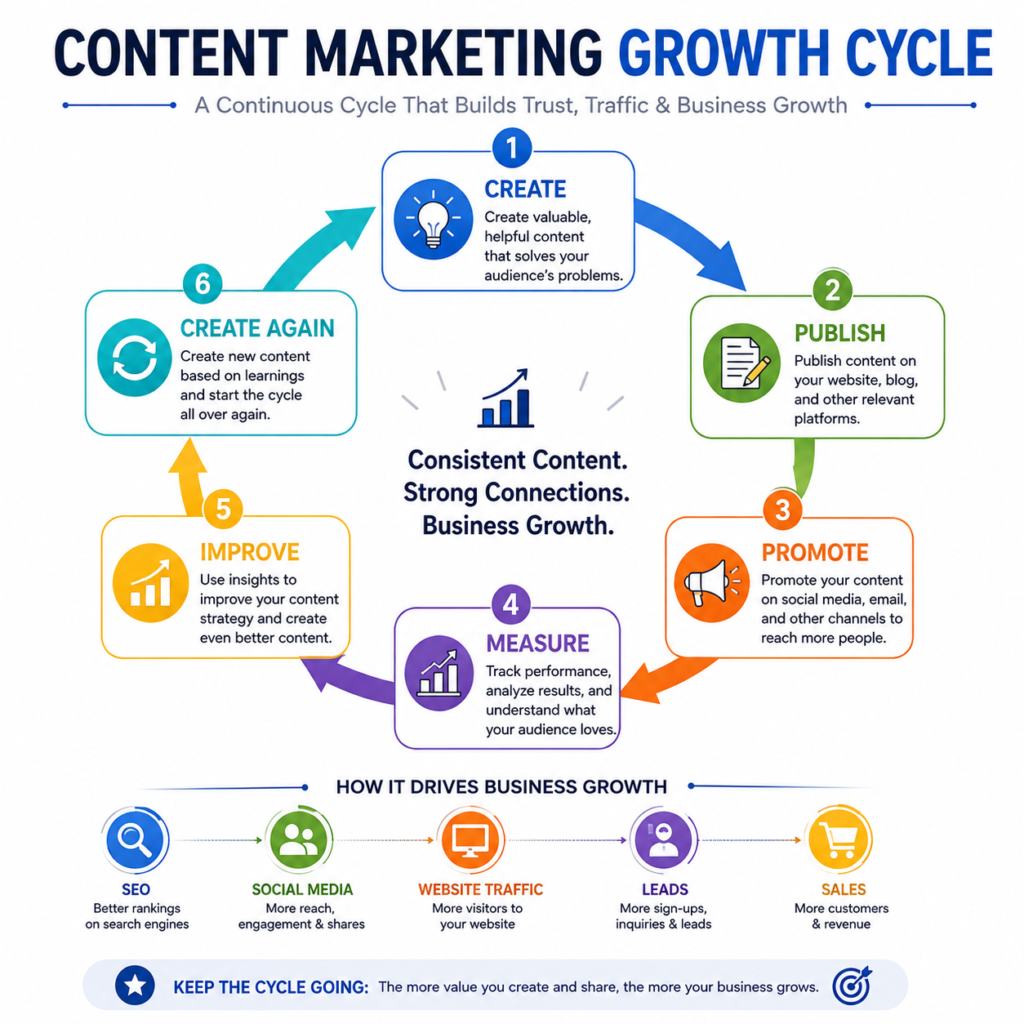
You can start with a small team, and you do not need a big budget. But you need to know your customers and be willing to put in the work, then have faith that over time the results will follow. Pick one piece of content this week, and then the rest will fall into place around it.
Frequently Asked Questions
Q1. What is content marketing for Small Businesses?
It involves creating or sharing useful content (such as blog posts, videos, or social posts) to draw customers in and build trust instead of running direct advertisements. This is a long-term way of building up visibility and credibility without relying fully on paid promotion.
Q2. Is content marketing expensive?
Not necessarily. However, some of the most effective tools (such as Google Search Console, Canva’s free plan, and social media platforms) are completely free. Usually the main investment is just time and consistency, which means that it can also be done on a small budget.
Q3. Can a small business implement content marketing in-house and not have to hire an agency?
Yes. The vast majority of small business owners with loads of content manage it successfully using free tools and a basic plan. An agency can help you scale processes quicker, but it’s not needed to get going with the fundamentals of content marketing.
Q4. Is content marketing superior to paid ads?
One is not strictly better than the other; they just fulfill different roles. Paid advertising can get you quicker visibility, while content marketing helps create trust and organic traffic over the long haul. For the majority of small businesses, both combined is the best solution.
Q5. So is content marketing useful for local businesses?
Yes. This can benefit local businesses —such as salons, restaurants, and service providers— by helping customers searching the web to find you nearby. Local guides, keywords related to that location, and a lively business profile at Google are your allies here.

Nidhi Patel is an SEO and digital marketing content strategist focused on AI SEO, content marketing, blogging, and personal branding. Through TrendChaska, she shares practical digital marketing insights, SEO strategies, and AI tools for beginners, students, and small businesses in India.