LinkedIn Ads vs Organic for Indian B2B: compare cost, targeting, lead generation, trust, and long-term value to choose the right strategy in 2026.
Introduction
Visualise a Pune based 40 people software company. The founder is posting on LinkedIn twice a week. The posts scrape a few likes, but not one asks for a demo. At the next meeting, the sales head chimes in: “Why don’t we just run ads?
Previously, imagine a manufacturer in Gujarat selling to plant managers. It has the opposite problem. How it bought a LinkedIn campaign, got some decent clicks and came away with enquiries from people who were never going to buy.
These two companies are asking the exact same thing. So, is the money for paid ads or to grow a free presence? This is the million-dollar question, but the answer to LinkedIn Ads vs. organic is somewhat subjective, as they each have a different job.
This guide describes both in plain English, compares and contrasts them, and helps you choose how to play 2026. This is written for people who have a few ideas about digital marketing but probably never run a campaign on LinkedIn.
Reading this guide: Data about LinkedIn itself is related to its own pages and noted in the section Sources. Hypothetical examples are used for illustrative purposes only. Rules, not industry patterns — observations? Not to mention average CPC, CPL or conversion figures change so much from one industry to another and seasonally – so I have not quoted them in this post.
What Is LinkedIn Ads?
LinkedIn Ads is LinkedIn’s onsite advertising system. You pay to have your message appear in a selected set of LinkedIn members. You do all of this inside a platform called Campaign Manager.
How paid campaigns work
- Pick an objective. For instance, brand awareness, website visits or lead generation.
- Choose your audience. Job title, seniority, industry, company size, location and skills.
- Choose an ad type and build your ad.
- Set a budget and bid. You set a daily cap on how much you want to spend and in what method.
- Send people somewhere useful. This will often end up being a landing page or some LinkedIn lead gen form.
- Track results and improve. Do it one change at a time; that way you know what worked.
Ad formats in plain words
Various formats are outlined within LinkedIn’s marketing pages. Which ones do most B2B teams start with?
- Sponsored Content: ads that will show up in the feed on LinkedIn. It may be a single image, video, carousel or a document.
- Sponsored messaging: messages that appear in the LinkedIn inbox of people who match your target audience.
- Lead Gen Forms: short forms in LinkedIn which pop up, and the person need not visit your website to provide his / her information.
- Dynamic Ads and Text Ads: more personalised or easier formats suited to some objectives.
Audience size matters too. According to LinkedIn, you’ll require a minimum of 300 members in a campaign. It recommends a higher purpose of over 50000 for single-image and text advertising and above 15000 in the case of message ads. However, these are guidance numbers that LinkedIn can modify, so check Campaign Manager before you schedule.
You can also create audiences based on your own data within LinkedIn (e.g., contact list, company list, or users that recently interacted with you). This allows you to really retarget and/or run those account-based campaigns.
Who can use it?
Any business can. LinkedIn Sponsored Content applies to startups, SMEs and even large companies. An ad account, a LinkedIn company page
Common B2B campaign goals
- Direct demo requests, or sales enquiries
- Promote a webinar or event
- This is the classic freebie in exchange for contact details, writing a report or checklist or case study.
- Target other roles specific to certain job functions or roles at a company
- Follow up with a message to redirect visitors to the website.
A practical example
(Hypothetical, for explanation only.) A logistics software company based in Mumbai is seeking supply chain heads at mid-size manufacturers across Maharashtra, Gujarat and Tamil Nadu.
It creates a campaign focused on manufacturing supply chains and operations roles. An ad said they provided a free “freight cost audit checklist”. Users who click fill in a lead generation form. The bana sale team calls these people the ideal customer profile and ignores the rest.
Only reach and clicks are paid for by the company; in exchange, it controls who sees the message when.
What Is Organic LinkedIn Marketing?
Your organic LinkedIn marketing equals creating visibility without any paid distribution. Attention comes to you from what goes up and the conversations you engage with.
It usually includes:
- Company Page posts: updates about products, hiring announcements, event promotions, customer stories.
- Founder-led content: lessons, opinions and stories shared directly from the founder’s profile.
- Employee advocacy: the act of team members sharing company content and adding their own commentary or addressing a piece of work that they have done themselves.
- Comments and conversations: responding to prospects, customers and industry voices effectively.
- Thought leadership: definitive opinions about your industry based on experience.
- Educational content: these are guides, explainers, how-tos and lists that educate a buyer about a problem.
When I say organic marketing mentality, I do not mean posting every day! A couple of useful posts a week — for a specific reader — are normally better than daily posts with no specific point.
A practical example
(Hypothetical, for explanation only.) An HR-tech startup from Bengaluru, which sells payroll software to companies on a growth trajectory. Their founder posts every week about payroll compliance pitfalls. Real-world product tips from our team A sales manager leaves mindful comments on HR heads’ posts.
HR professionals learn these names over the span of a few months. The pattern emerges. By virtue of the sales team reaching out to them, they already know who they are. But organic work is something that builds exactly that familiarity. It is slow, but it is real. And just as importantly, it often forms the lesser half of LinkedIn Ads vs. organic, which is too easily underestimated by teams.
Main Differences between LinkedIn Ads and Organic
To ease the pain, allow me to share a quick top-down comparison of paid vs organic LinkedIn marketing.
| Factor | LinkedIn Ads | Organic LinkedIn Marketing |
|---|---|---|
| Cost | Require an ad budget, in addition to effort on the creative and landing page. | Zero media costs, but requires time, writing ability and consistency |
| Speed | Can start quickly once set up | How long does it take? It is slow and usually takes months and consistent posting. |
| Reach | Reach you choose and pay for | That all comes down to your network, engagement and the way the feed will distribute posts. |
| Targeting | Optionally, job title, seniority, industry, company size, location and skills but also your lists. | The things you care about and talk about are what draw people to you, not formal targeting. |
| Trust | Doesn’t feel promotional (depending on the offer and message) | Developed gradually via valuable content and actual individuals |
| Content requirement | Some good ad creatives, an offer and a landing page | Regular posts, ongoing |
| Lead generation | Direct, through forms and landing pages | Indirect DMs, profile & referral visits |
| Long-term value | Your spend stops, and so does your reach, but you still have the learnings and data. | Post, profile rank and audience continue to grow. |
| Control | High: budget, audience, timing, message | Downsised: The feed determines who sees a post. |
| Best use case | Campaigns, Q&A, lead magnet and account targeting | Trust, visibility, thought leadership |
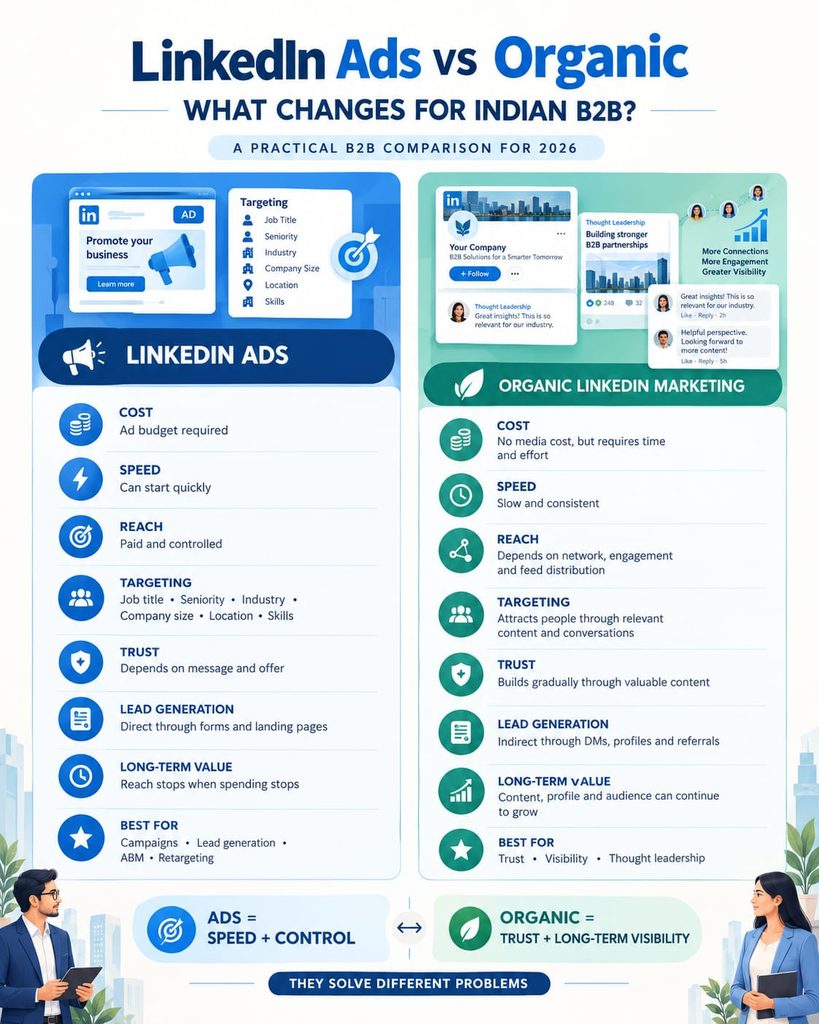
The takeaway here for this LinkedIn Ads vs. organic comparison is that neither of these approaches is necessarily “better” than the other. Ads provide you with control and speed. Organic provides you with authority and longevity. They solve different problems.
Organic for Indian B2B Businesses vs LinkedIn Ads
This is how the LinkedIn Ads vs. organic decision plays out for Indian B2B companies. These are general observations, not universal rules. Run them against your own buyers.
Buying cycles and decision-makers
Whereas in the world of B2B purchases, there are often multiple parties involved: a user, an IT/professional reviewer, someone from finance and finally a senior approver. Typically, in an owner-run enterprise, the fate is decided by the promoter/founder. You never close this type of sale with a single ad. The first is that it can initiate a conversation and the organic type of content to encourage people from being shy to keep doing it.
Not all buyers use LinkedIn
There are some decision-makers that prefer calls, WhatsApp, trade events or referrals. Here, before you spend, check if your buyers are using LinkedIn. One fairly simple method is to tap into where your top existing customers originated from.
Niche audiences
Most Indian B2B companies sell to a narrow set of end consumers — the plant head in speciality chemicals or the finance head at an NBFC. The guidance on audience size indicates that an audience can be too small to deliver well in ads. That way, organic conversations can directly reach the appropriate audience in these instances.
Founder-led marketing
Indian B2B businesses are mostly founder-led. A founder’s personal profile often has more credibility than a company page. This is rather an observation based on the activity of people reacting to content; it is not a measured fact.
Smaller budgets
Most industry guides will note that LinkedIn is one of the more expensive platforms to get your clicks. When you’re working with a monthly budget, that makes a difference. So choosing wisely with discipline, a good offer becomes even more imperative.
Lack of lead quality and longer sales cycles
A lead is not a sale. The quality over quantity adage is especially true here: one form fill from the target job title at a target company will be much more effective than ten of them from ones that are wrong. Since sales cycles can stretch for months, look to follow up and continue nurturing, not just the first contact.
Regional and industry targeting
Search Terms (for Ads) — Ads help you narrow your search down to specific locations and industries. You could target auto-component companies around Pune or pharma companies in Hyderabad and Ahmedabad, for instance! It is difficult to do this with organic posts only.
Trust before the sales conversation.
From now on, though buyers tend to research a company prior to exchanging messages. That first call can happen much more easily with a profile that is consistent with helpful posts. That is the point where organic marketing helps each channel, including paid.
When LinkedIn Ads Are More Effective
When it comes to LinkedIn Ads vs. organic, the need for speed and control gives paid a clear advantage. That is the best fit in these scenarios.
- Launching a B2B product. Organic reach takes a while; not a single person knows the product yet. Sample: a pharma distributor’s new inventory tool
- Promoting a webinar. Unlike an online course, webinars are held on a specific date and can thus only host as many registrants as you have before the webinar takes place. This is the window of opportunity in which ads can be directed at the right roles.
- Generating leads quickly. Paid gives you a quicker start, particularly when the business needs a pipeline right away.
- Reaching a specific job role. For example: CTO Company size X or Banking – head IT
- Account-based marketing (ABM). You pick a list of target firms and run ads just for folks who work there. For instance, let’s say you are a cybersecurity company going after 100 named enterprises.
- Retargeting. Serve retargeting ads to those who visited your site or otherwise interacted with you. However, this is only successful for users whose first touch was from organic content or from a previous campaign.
- Promoting high-value services. If you’re selling something that’s valuable to just one customer, the cost per lead could well be a higher figure. Such as an ERP implementation or a compliance consulting retainer.
Disadvantages: No ads when the budget stops. Even with very good targeting, a weak offer or landing page will waste money. And when that audience is tiny, those ads may not serve at the volumes you’re hoping for.
When Organic LinkedIn Marketing is More Effective
Here we go with LinkedIn Ads vs. organic from the other side, wherein in many of these cases, organic is much more likely to win.
- Create awareness with a small budget. Regular useful posts fill you up with time, not media spend.
- Thought leadership. Consultants, CA Firms, legal advisors and agencies sell expertise. You need to demonstrate how you think for people to gain trust.
- Founder branding. Some simple way to hone the explanation of their industry and be able to become a voice in a market or niche.
- Community building. So, conversations, dialogue and small online experiences — they build connections, not just impressions.
- Educational content. Since buyers will know more about the offering and how it solves their problems before they engage with sales, complex products—think supply chain software—have a better chance of explaining their capabilities in plain language posts.
- Long-term visibility. Posting consistently helps to establish a fan base and build traffic to your profile over time.
- Building trust. When it comes to high-consideration purchases, a single ad matters less than familiarity.
So, these are the content ideas that work well for Indian B2B folks.
Typical errors that buyers commit while selecting the type of product or service you are providing
- Market: An overview of a regulation or process your customers are affected by (GST, e-invoicing or export documentation, for example.)
- A concise walk-through of the specific problem your product is solving
- Publisher story without numbers (all identical to previous stories) but shared with permission
- Takeaways from your own work—maybe what you adjusted in your sales process
- Responses to the same questions that your sales team is asked over and over
Cons: Organic is slow and not as predictable. You can have no control over who sees a post, and results are dependent on how consistent you are and how good your content is.
Both Can Indian B2B Businesses Use
Yes, and for the majority of businesses this is the most pragmatic method. For a lot of companies, the sequence is LinkedIn Ads vs organic, not either or. Here is a simple funnel.
The Data Flow: Organic Content → Engagement → LinkedIn Ads → Landing Page → Lead → Sales Follow-up
Organic content
With the founder and company pages, share helpful content consistently. Write about the questions your buyers likely have.
Engagement
It helps see what posts got real comments and profile visits from the right people. This gives you an idea of which topics are important to your audience.
LinkedIn Ads
Find a successful topic and narrow it down into an ad. You just have to make it for a specific audience stack, i.e., one role with one industry and a clear offer.
Landing page
Direct clicks to a page matching the ad. What do you offer? How does it help? And one clear action.
Lead
They either fill in a form, book a demo or download a resource. Only ask for the things that your sales team actually requires.
Sales follow-up
This is the step where a lot of leads are lost by many companies. Quickly contact the lead, assist in a way they need (connect), and offer something valuable. Do not send a generic pitch.
(Hypothetical example.) GST notice se sabse jyaada hone wali bhul aap bhi jaan lijiye; CA firm ka post One post acquired lots of comments from finance managers. The company takes that subject and creates a brief guide, which it runs as a lead-generation ad targeting finance heads of mid-size firms. The organic post highlighted what mattered to people. This expanded the reach of the ad to more of the right people.
LinkedIn Ads vs Organic – Costs
Cost is one of the biggest questions in any LinkedIn Ads vs. organic discussion, so let us address this head right now.
Not free: Paid advertising requires an ad budget. According to LinkedIn’s marketing page, companies can get started with as little as $10 spent per day. That is a bare minimum, not a recommendation. Whatever budget you figure out has to be big enough in order to cost-effectively amass the necessary data depending on your audience and offer.
Making an organic market, at this point, takes time and effort. Idea, writing, design, consistency and a person to respond to comments That time has a genuine cost if posts are written by the founder.
Cheaper is not always better. In contrast, organic is cheaper but not faster. Although ads seem pricey on a per-click basis, they also get in front of the required decision-maker very quickly.
Take a look at lead quality and business value. Ten bad leads are, in many cases, worth less than two great ones. Be able to make a comparison of cost versus the value of the customer, not cost per click.
While you compare LinkedIn Ads vs. organic on pricing, consider asking one more question: how much is a customer worth to us? A company that makes a lot of money from every customer can afford to spend differently than one that is selling something for pennies.
I left average CPC, CPL or ROI numbers from my advertising. But the numbers change a lot by industry, audience and time (their analytics tab even gives you these figures for Snapchat influencers) — I could not verify a dependable current number for India. Implement your own campaign data, and review LinkedIn’s current recommendations within Campaign Manager.
How to Measure Performance
To compare LinkedIn Ads vs. organic fairly, you should use different scorecards.
LinkedIn Ads KPIs
| Metric | What it tells you |
|---|---|
| Impressions | How often was your ad shown? |
| Click-through rate (CTR) | Whether the message has attention-catching value |
| Cost per click (CPC) | What each visit costs |
| Cost per lead (CPL) | What each lead costs |
| Lead conversion rate | Visit-to-Lead Conversion Rate |
| Qualified leads | Leads that truly score your ideal customer |
| Conversion rate | The proportion of leads that advance to the next stage, be it a meeting or sale |
| Return on ad spend (ROAS) | One is the income-to-ad spend, where sales can be tracked. |
Organic KPIs
| Metric | What it tells you |
|---|---|
| Impressions | Views Posts Were Seen (number of times posts appeared, not engaged) |
| Engagement | Reactions, comments and shares combined |
| Comments | The depth of interest, especially from the right players |
| Shares | Whether enough people thought the post was good enough to share |
| Follower growth | Growth in your audience |
| Profile visits | Attraction for you or your brand |
| Website traffic | Users who flow from LinkedIn to your website |
| Leads generated | Form fills, DMs & demo requests |
| Qualified enquiries | Enquiries that match your ideal customer |
Never trust vanity metrics.
Likes and impressions are nice but do not make payroll. There is a big difference between 20,000 views from wrong-fit people and five comments from actual buyers. Constantly correlate your numbers to qualified leads, conferences and revenue. Find out what really happened: Tag leads in your CRM by source.
Another word of caution: organic leads are difficult to track. Someone can read your posts for months and then reach out to you privately. Next question on new enquiries: “How did you hear about us?” and record the answer.
Mistakes B2B Businesses Often Make
Unclear goals and weak follow-through generate most mistakes in the LinkedIn Ads vs. organic debate. Watch for these.
- Not Having a Clear Objective for the Ads You Run Before spending, you need to decide if you want awareness, traffic or leads.
- Targeting everyone. Broad targeting wastes budget. What is the job role, industry and company size?
- Posting only promotional content. People will stop listening if every post says “buy from us”.
- Ignoring organic content. Again, ads can sound a bit cold (especially for a company that is not yet known).
- Expecting immediate sales. B2B decisions take time. Pipeline not orders — data up to October 2023
- Using weak landing pages. Sending a click to a bad ad wastes the click.
- Not following up with leads. A soft response can cost you dollars invested to bring them on board as a prospect.
- Measuring only likes and impressions. Business impact is not evidenced by these.
- Stopping campaigns too soon. Let a campaign run its course and accumulate data before coming to conclusions.
- Copying competitors blindly. They may have a different audience, budget, and goals than you.
Strategy and action — for a small B2B company in India
A straightforward compromise to honour both sides of LinkedIn Ads vs organic. It suits the need for a small team with no-cash in hand.
Stage 1: Lay out a natural substance base.
Over the next month or two, do that every two or three days. Work on the actual pain points of your consumers. Team: Use the founder profile and one to two team members.
Step 2: Discover what attracts the ideal audience.
Check the posts that received comment visits on their profiles or messages from good people. Note the topics and formats.
Step 3: Come up with one dedicated paid campaign.
Choose one, like demo requests or webinar registrations. Ideate an audience, an offer and a head tone based on your best content topic!
Fourth step: To send to a page where they suit
Match the page to the ad. Keep the form short. Request only what sales requires.
Step 5: Monitor leads and conversions
Record where every single lead comes from. See how many turned into qualified queries, meetings and customer
Step 6: Keep improving both
Leverage your ad results to inform your organic posts, and then leverage your organic results to inform your ads. Review once a month. Change one thing at a time.
A simple 90-day rhythm
| Period | Focus |
|---|---|
| Month 1 | Creates your profile and company page. Post consistently. Identify the topics that elicit real responses. |
| Month 2 | Choose one lead magnet (eBook, checklist, or webinar). Create either a landing page or a lead gen form. Prepare your follow-up process. |
| Month 3 | Test your audience with a small ad campaign. Follow up with every lead. Review quality, not just volume. |
If you have a very small budget, do Steps 1 and 2 first, then scale to paid later. Keep a small ad budget from stretching across too many campaigns.
LinkedIn Ads Vs Organic: Which One Is For You?
LinkedIn Ads vs Organic: There is no clear winner. Your answer will depend on the following:
- Budget: Money for ads or more time than money?
- So what are your business goals: awareness, leads, event registrations or trust?
- Sales Cycle—Longer sales cycles mean more content focused on trust building, and vice versa.
- Without an audience that is both big enough to make the ads work and on LinkedIn, consider it Water Under The Bridge.
- Content resources: Are you able to post regularly?
- Speed of delivery: How quickly do you want results, this quarter or year?
- Lead generation requirements — Do you need a continuous stream of enquiries?
- Long-term brand goals: Building a category within an area.
Simple decision guide
Choose LinkedIn Ads when…
- You need leads or announcements in the next 3 months.
- You know precisely what you are trying to target in terms of roles or companies.
- You know where you are going to be offering your lead, a landing page and how the sale follow-up process will happen.
- You have enough of a budget you can devote to this for long enough to learn from it.
Focus on organic when…
- You have a small or uncertain budget.
- You are selling infrastructure knowledge, and at the core of the sale is trust.
- Your audience is very niche.
- You are committed to regular posts for 6 months.
Consider both when…
- You want to establish trust and conversion.
- There is already organic content that does well on its own.
- You want to target people who interacted with you or visited your website.
- You can track results all the way to revenue.
Conclusion
LinkedIn marketing paid versus organic LinkedIn ads allows you to do things fast, target relevant professionals and exercise control. There may be no substitute for the importance of credibility, relationships and value with organic LinkedIn marketing as they build up gradually over time. Ads get you the right people faster, and organic content convinces them to trust you once they land on your page.
India B2B sales cycles are long, and there are many decision-makers. Thus, trust-building content is valuable, and accurately targeted advertisement is useful in reaching the desired audience. Finding the right balance depends on your objectives, audience, resources and maturity.
If you are not sure where to begin, start generating organic content so that you can figure out what resonates with your audience. After that, run a small, targeted ad campaign, and monitor what brings you actual enquiries. Once you have your data behind you, the LinkedIn Ads vs. organic question becomes much simpler.
Frequently Asked Questions:
1. Which is better for Indian B2B: LinkedIn Ads or organic?
Neither is better in all cases. There is no battle between LinkedIn Ads vs organic — they perform different functions. Ads are faster and more targeted, whereas organic is better for trust and long-tail visibility. Many B2B companies use both.
2. Is LinkedIn organic marketing free?
No media cost, but it’s not free. This is stuff that comes over time, writing effort, consistency and sometimes design or video assistance. If the founder or team writes it, it costs time.
3. What is the LinkedIn advertising cost in India?
There is no fixed price. Costs are based on your audience, competition, ad format and bidding. On LinkedIn, its marketing page states that the minimum daily budget starts at $10. Ours is a floor, not a complete plan, and certainly something that LinkedIn can change. Before you set a budget, head to Campaign Manager for the latest information.
4. Small Indian B2B companies — Can we use LinkedIn Ads?
Yes. LinkedIn Ads for Small Business LinkedIn ads are possible for small businesses too, but do review the prerequisites — start with one objective, a focused audience & a good landing page. Given that LinkedIn is perceived as more expensive per click than other platforms, it requires careful targeting from small budgets. LinkedIn Ads vs. organic is usually a question of order for a small team in terms of which one to do first and which you can add later.
5. Time taken by organic LinkedIn marketing to show results?
There is no fixed timeline. Steady profile visits and enquiries usually come about a few months into regular posting. Results vary depending on your topic, audience and posting frequency.

Nidhi Patel is an SEO and digital marketing content strategist focused on AI SEO, content marketing, blogging, and personal branding. Through TrendChaska, she shares practical digital marketing insights, SEO strategies, and AI tools for beginners, students, and small businesses in India.