
If you’ve searched “best affiliate programs India,” you’ve likely found ten different listicles, each naming twelve to fifteen programs with minimal explanation of which ones would match your blog’s niche and traffic level, and which would generate little or no revenue by virtue of being irrelevant. The latter is the bigger issue: it’s not a shortage of affiliate programs, but choosing the two or three best affiliate programs for India that actually fit what you already write about, and the amount of traffic you’re currently putting toward it, as opposed to signing up for everything and promoting nothing with satisfactory quality.
This guide will group the best affiliate programs for Indian bloggers according to what topic they write about and how much traffic their blog has, to allow for faster short-listing than reading through several more listicles.
What Makes an Affiliate Program One of the Best Affiliate Programs for Indian Bloggers?
It’s helpful to have an idea of what makes one affiliate program more desirable than another before comparing them. The four most important factors are:
- Commission structure – A flat percentage per sale, a fixed payout per lead or signup, or a combination of the two (lead-based programs tend to lean toward higher payouts in finance, education, and education niches)
- Cookie duration – How long the cookie lasts for after clicking on your link before you stop earning from that sale
- Payout threshold and method – Some Indian-focused affiliate programs pay out at ₹500, others have a ₹2,000-5,000 threshold. Also check if the payout method (UPI/NEFT, in most Indian-first programs) is preferable to you than PayPal.
- Approval difficulty – Programs vary wildly from near-automatic approval over your existing blog to requiring minimum traffic or manual review of your content.
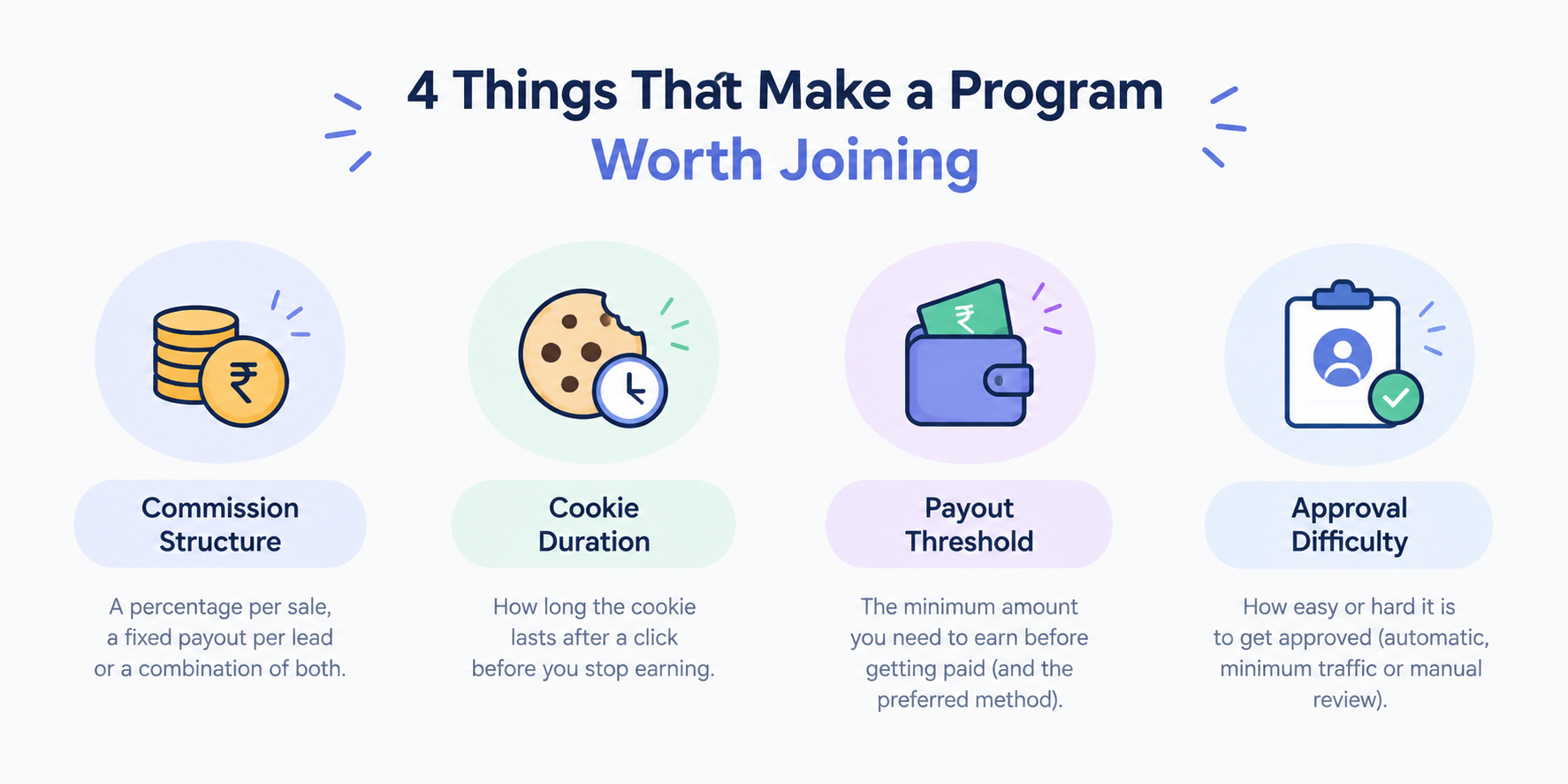
Use these as a basis for comparison while reading through the sections below. A higher commission rate, while appealing, is less important for a beginner with a small amount of niche traffic than one with a shorter cookie duration, or that has a ₹2,000 payout threshold with no support for UPI.
Best All-Round Affiliate Networks in India (Good Starting Point for Most Bloggers)
If you’re still unsure what to do with blog affiliate marketing, a good starting point is an aggregator network; one where you sign up once and receive access to hundreds of brands’ affiliate programs, rather than having to apply to each individually.
Cuelinks is a publisher-focused affiliate network that caters specifically to Indian bloggers. Unlike most other affiliate programs, it’s designed to automatically convert outbound links (to sites such as Amazon, Myntra, and Flipkart) to affiliate links, so you don’t have to create links to any particular product.
EarnKaro works on a similar premise of link-sharing, but is more geared toward sharing affiliate links across WhatsApp, Telegram, and other messaging services, alongside traditional blog posts. It is otherwise a good option for bloggers looking to share affiliate deals beyond their websites.
vCommission and Admitad India are older, broader affiliate networks that span multiple product verticals, including e-commerce, travel, education, and BFSI (banking, financial services, and insurance) campaigns. Both are good options for bloggers looking to move past some initial affiliate links and sign up for something with a larger brand catalogue, including higher-paying finance and travel-specific affiliate programs in one place.
Where they fit best: New blog, any niche, want to join one network rather than five different programs. Also useful for experienced bloggers looking to diversify.
Best for E-commerce And Product Blogs
If you run a product review blog, a direct e-commerce program is worth consideration alongside or in place of an aggregator network.
Amazon Associates India is the most recognisable affiliate program for Indian bloggers, both because Indian customers tend to be more familiar with and willing to shop on Amazon, and because it has a wide range of payout tiers for different categories of products (fashion/beauty tends to have higher rates than electronics). Check the Amazon Associates India rate card to see what applies to the categories you write about, as commission rates change regularly and it’s unwise to base content around a particular category if it’s likely to change shortly afterward. Amazon’s cookie duration is relatively short compared to other programs, which is worth considering for content that leans more “research phase” than “purchase now”.
Flipkart Affiliate is a natural counterpart to Amazon for Indian bloggers, both because of the popularity of the e-commerce site, and because it tends to offer competitive rates for fashion, mobiles, and electronics categories that Indian bloggers are likely to write about. Approval is generally easier for bloggers with an active website.
Myntra’s affiliate program (accessible via aggregators like Cuelinks and Admitad rather than a dedicated sign-up page) is worth consideration for Indian bloggers writing about fashion or lifestyle, or targeting a younger audience.
Where they fit best: Product review sites, gift-guide content, fashion/lifestyle blogs, and “best X under ₹Y” listicles.
Best for Hosting And Tech Content
If you blog about blogging, or about topics like website development, hosting affiliate programs tend to be some of the highest-paying options, as the products are generally higher-value (hosting a site for ₹2,000 a year) than most e-commerce items ( ₹2,000 for a t-shirt).
Hostinger and Bluehost both have well-established affiliate programmes targeting new bloggers and site owners, which makes them a natural fit if you write “how to start a blog” or WordPress setup guides, as the content is likely to appeal directly to new bloggers looking for hosting recommendations.
Zoho’s affiliate programme takes a different angle to most hosting-specific programs, and targets consultants and digital professionals that advise small businesses on their software needs, rather than individual bloggers. If your blog or newsletter has an audience of small business owners rather than individual bloggers, it’s a worthwhile alternative to more traditional “how to host a website” content, even if it’s less immediately obvious how it applies to a regular blogging audience.
Where they fit best: Blogging/WordPress tutorials, small-business and SaaS content, freelancer-focused blogs.
Best for Finance And Investment Content
Finance programs are among the highest-paying affiliate programs in the Indian space, due to the nature of the product being sold (qualified leads rather than cheap t-shirts), but also have greater compliance risk, and should be approached with care to ensure that you’re aware of the necessary disclosures and requirements.
Groww and Angel One both have affiliate/referral programs tied to demat account openings, which can be lucrative for qualifying leads, and are generally easier to join than a direct e-commerce program. If your audience is likely to open a demat account, you should consider one or both of these programs.
Upstox offers a similar referral structure to Groww and Angel One, and is sometimes included in finance-affiliate conversations alongside them.
A genuine caution applies here, not a formality: Only promote finance products you have a good understanding of, and disclose clearly that you’re not providing investment advice. This is not only good practice, but also protects your blog’s reputation and legal standing.
Where they fit best: Personal finance blogs, investing content for beginners, “how to start investing in India” guides.
Best for Education And Upskilling Content
If your blog is about career advice, or online courses and upskilling more generally (a genuinely large content category among Indian bloggers), most education platforms will generally offer higher payout rates per enrolment than most e-commerce affiliate programs.
Udemy, Coursera, UpGrad, and Simplilearn all have affiliate/referral programs, typically structured as a percentage of course/programme fees or a fixed amount per enrolment. These are ideal for “best online courses for X” or “how to switch careers into digital marketing” type content, making them a good fit for TrendChaska’s audience as well.
Where they fit best: Career and upskilling blogs, digital marketing education content, student-focused blogs.
Best Affiliate Programs for Indian Bloggers: Comparison at a Glance
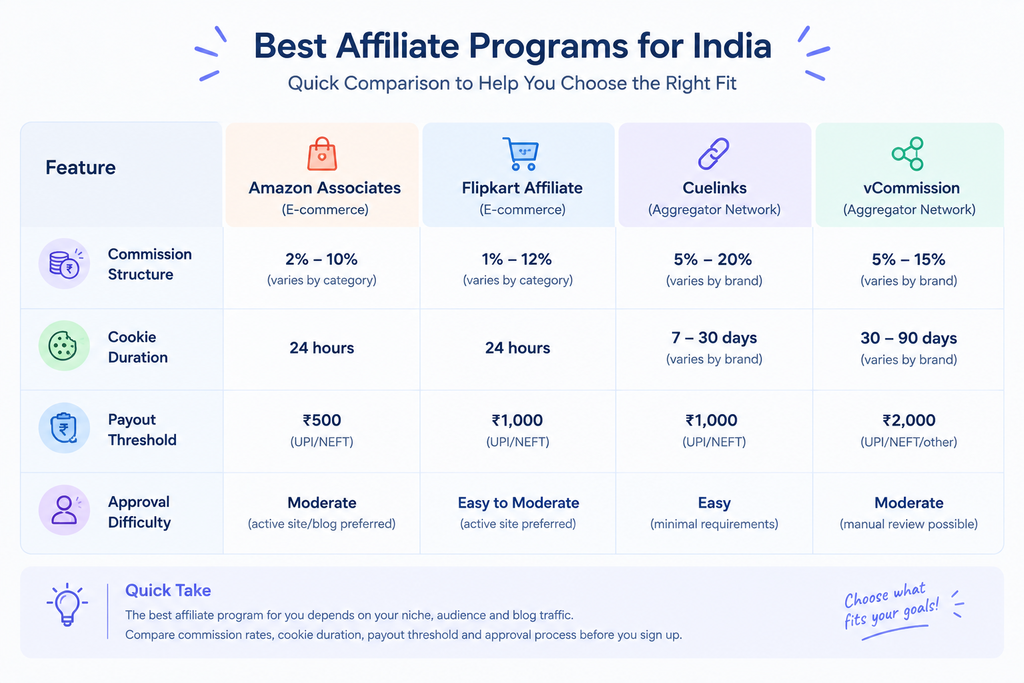
| Program Type | Examples | Typical Payout Threshold | Approval Difficulty | Best For |
|---|---|---|---|---|
| Aggregator networks | Cuelinks, EarnKaro, vCommission, Admitad | Generally low (often ₹500+) | Easy for most active blogs | New bloggers, general review content |
| E-commerce | Amazon Associates, Flipkart Affiliate, Myntra | Varies by programme | Easy–Medium | Product review and gift-guide blogs |
| Hosting/SaaS | Hostinger, Bluehost, Zoho | Varies by programme | Easy–Medium | Blogging/WordPress and small-business content |
| Finance | Groww, Angel One, Upstox | Often per qualified lead | Medium | Personal finance and investing blogs |
| Education | Udemy, Coursera, UpGrad, Simplilearn | Varies by programme | Easy–Medium | Career and upskilling content |
Actual commission rates and payout thresholds change fairly often – always confirm on the appropriate programme page for the latest information.
How To Actually Get Approved As A New Blogger

Most rejections are avoidable and stem from avoidable causes. The most common reasons for rejections include:
- Having a few genuine posts live before you apply. Most programmes want to see that your blog is a real, functioning site, rather than a blank WordPress install with one placeholder post.
- Filling out your profile accurately. Vague information in your application about your traffic levels or niche can be a common, avoidable reason for rejection.
- Matching the programme to the content you’re going to write, rather than the other way around. Applying to a finance affiliate programme with a food blog is unlikely to get approved, and even if it does, it won’t convert.
- Add a visible affiliate disclosure somewhere on your site before you apply. This demonstrates an understanding of the legal and platform requirements, and is a required step under Indian advertising guidelines.
- Start with one or two programmes, rather than ten. A blog with focused, well-integrated affiliate links in two or three programmes tends to perform better overall than one that’s trying to use links from every network it can join.
Mistakes To Avoid
- Joining every program you can. It’s counterproductive to spread yourself too thin, and harder to write content that genuinely helps a reader choose
- Dropping links without context. A bare “buy here” link is far less effective than a link contained within an explanation of who the product actually suits.
- Skipping the disclosure. Beyond being a legal requirement, it’s also a good way to gain the trust of your readers. ers
- Chasing commission percentage over relevance. A 9% commission on a product your audience will never buy earns less than a 2% commission on something they buy constantly.
Bringing It Together
There’s no single best affiliate program for India for every blogger, and the right mix is likely to depend on what you already write about and the volume of traffic being sent toward it. Start with one aggregator network to allow for flexibility, and add one or two direct affiliate programmes that clearly match your niche. Give it a genuine few months before deciding on what’s working, and consistency in the content you produce will have a bigger impact on your affiliate income than the number of programmes you join.
If you’re working out the basics of how affiliate marketing works before choosing programmes, our Affiliate Marketing for Beginners India guide is a good place to start. And once you’re ready to build proper disclosure pages and structured review content, our Free Digital Marketing Templates Pack has templates to help you set it up correctly from the start.
FAQs
Can a new blogger with low traffic join Amazon Associates India?
Yes – the programme doesn’t require minimum traffic to apply, though you typically need to generate a small number of qualifying sales (currently 180 days) to remain in the programme, and it’s therefore helpful to have a content plan before signing up.
Which affiliate program is best for a blog with no website yet?
Link-sharing programmes like EarnKaro don’t require a blog to be set up; links can be shared directly on WhatsApp, Telegram, or other messaging services. However, a blog is generally a better way to generate sustainable, search-driven traffic than social media or other platforms.
How much can a beginner actually earn from affiliate marketing in India?
This varies wildly based on niche, traffic, and the degree to which your content is targeted to your audience, and any specific number you see quoted online should be treated as one blogger’s result. Realistic early income tends to be modest and grows as your search traffic and content library grow; treat the first few months as testing which niche and programme combination is best for your audience.
Is it better to join individual programs or an aggregator network like Cuelinks?
For most new bloggers, one aggregator network is a better way to start, as it covers many brands through a single dashboard. As you begin to identify which product categories your audience is likely to be interested in, applying directly to the strongest-performing individual programmes can help to maximise commission rates and reporting detail.
Do Indian affiliate programs pay via UPI or bank transfer?
Most India-focused programmes (Cuelinks, EarnKaro, Amazon Associates India, Flipkart Affiliate) support NEFT/bank transfer, and increasingly UPI. Global programs occasionally default to PayPal or Payoneer, so it’s worth checking a programme’s payout methods before applying if it’s a deciding factor for you.
What are the best affiliate programs for Indian bloggers for someone with zero blogging experience?
Aggregator networks like Cuelinks or EarnKaro tend to be the easiest entry point, since approval is generally straightforward and you’re not committing to a single niche upfront while you figure out what your audience actually responds to.
How many affiliate programs should a blogger join at once?
Two or three well-matched programmes are more manageable and effective than ten. You can always add more once you understand what is working for your specific audience.

Nidhi Patel is an SEO and digital marketing content strategist focused on AI SEO, content marketing, blogging, and personal branding. Through TrendChaska, she shares practical digital marketing insights, SEO strategies, and AI tools for beginners, students, and small businesses in India.