
Learn this content repurposing guide to turn 1 blog post into 10 content pieces with practical ideas for Indian bloggers and small businesses.
Introduction
If you’re publishing one blog post per week and stopping there, you’re missing out on a huge marketing opportunity. That blog post you spent 3 hours researching and writing can be turned into enough social media content to fill your entire week.
That’s exactly what this content repurposing guide will teach you: how to take one blog post and repurpose it into ten different formats.
Whether you’re a solo content writer in India juggling 5 platforms at once, a student trying their hand at content marketing, or a small business owner who struggles to find time for writing, this content repurposing guide will show you a simple system to repurpose blog content into 10 different formats.
By the time you finish reading this content repurposing guide, you’ll have actionable ideas you can put to use on the very next blog post you write.
Tip: Pick just 3 formats from this guide to start with instead of trying all 10 at once — momentum matters more than volume in your first week.
What Is Content Repurposing?
Content repurposing is the process of transforming one piece of content (usually text) into multiple other content types.
It’s a way to extract value from the time and effort you’ve already put into one long-form piece of writing. Instead of writing 10 different social media posts from scratch, you can use the insights from your blog post to create multiple pieces of unique, related content.
A good content repurposing guide helps you understand how to pull the pieces of your blog post that can stand on their own and shows you how to present that information in other formats.
For example, a 2000-word blog post about “Local SEO for Indian small businesses” contains dozens of facts, figures, quotes, and pieces of advice. Each of these could become its own piece of content, if you know how to extract them and present them in a different format.
Why You Should Repurpose Blog Content
If you’re an Indian blogger or small business owner, chances are content creation itself isn’t your problem — getting your existing content in front of new eyes is. Most Indian creators publish one blog post, share it on a couple of platforms, and then move straight on to the next one. That’s where a good content repurposing guide comes in handy.
Here are 5 reasons you should repurpose your content instead of writing separate pieces from scratch every time:
- Saves you time: Most of the effort in a piece of writing goes into researching and outlining it. Once that’s done, it’s much quicker to pull value out of it than to build something new from nothing.
- Gets your content in front of new eyes: Not everyone who’d enjoy your content will find you through your blog. Some people only discover creators through social media, so spreading your ideas across formats and platforms widens your reach.
- Builds your authority: When people keep seeing your ideas across different platforms, it lands with more weight than a single post ever could.
- Drives more traffic to your blog: Every piece of content you create can — and should — link back to the blog post it came from, which helps both traffic and SEO.
- Gets more mileage out of evergreen topics: If your blog post covers something that stays relevant (like local SEO), you can keep pulling value from it for years by repurposing it into new formats.
This is also the underlying philosophy behind this content repurposing guide: one piece of pillar content, with dozens of smaller, evergreen posts built around it. It’s far more efficient to turn one post into 10 pieces of content than to create 10 separate pieces from scratch.
How To Turn 1 Blog Post Into 10 Pieces Of Content
Let’s walk through how one blog post could become 10 different pieces of content, using a fictional post as our example: “5 Local SEO Mistakes Indian Small Businesses Make (And How To Fix Them).”
Assume this post has the following structure: an introduction, 5 numbered mistakes with solutions, a mini case study, and a conclusion with a call to action.
Here’s how you could turn that single blog post into 10 pieces of content.
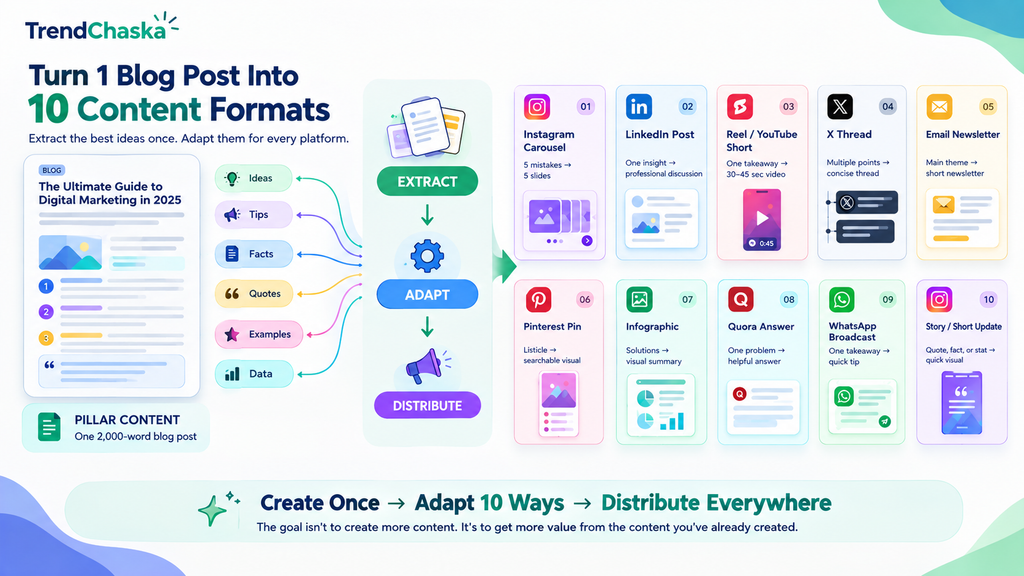
1. Instagram Carousel
What to extract: The 5 mistakes and their solutions.
How to adapt it: Turn each mistake into a slide, with a strong hook on the first slide and a CTA on the last one linking to the blog post in your bio.
Example: Slide 1 could simply state “Mistake #1: Your Google Business Profile is incomplete,” followed by a slide with a brief summary of the fix. Because the blog post already has 5 numbered mistakes with solutions, it practically hands you the carousel structure — one slide per mistake, one slide per fix.
2. LinkedIn Post
What to extract: One mistake or piece of advice that would resonate with a B2B or professional audience.
How to adapt it: Write a short post in the voice of a LinkedIn influencer — state the problem clearly, offer a brief solution, and end with a question to encourage comments.
Example: “I recently audited 10 small business websites in Pune and found that 7 of them had inconsistent phone numbers listed on Google, their website, and Justdial, hurting their local SEO rankings…”
3. Instagram Reel or YouTube Short
What to extract: The most surprising or relatable mistake from the blog post.
How to adapt it: Record a short video (30–45 seconds) that states the problem clearly, briefly explains the fix, and ends with a strong call to action pointing viewers to the full blog post. This format works best with a simple problem/solution structure.
Example: Open with “Your business might be invisible on Google Maps, and you don’t even know it…” and briefly explain one of the local SEO mistakes in a mix of Hindi and English.
4. X (Twitter) Thread
What to extract: The 5 mistakes, stated concisely.
How to adapt it: Build a thread with one mistake per tweet, followed by a brief explanation and a closing call to action pointing readers to the full blog post.
Example:
- Tweet 1: “5 Local SEO mistakes killing your Google ranking — and how to fix each one”
- Tweet 2: “Mistake #1: Your Google Business Profile is incomplete…”
- Tweet 3: “Mistake #3: No customer reviews since 2023… Google trusts businesses that get reviewed consistently, not businesses with 40 reviews from 3 years ago.”
5. Email Newsletter
What to extract: The main theme of the blog post, or one mistake explained more fully.
How to adapt it: Write a short, conversational newsletter that briefly walks through one of the local SEO mistakes and links to the full post for more detail.
Example: “This week I noticed a pattern while auditing local businesses… Here’s one of the mistakes I’m seeing and how to fix it: [brief description].”
6. Pinterest Pin
What to extract: The listicle format of “5 Local SEO Mistakes” — a clear, evergreen topic people actually search for.
How to adapt it: Design a Pinterest pin using your blog post’s title as the on-image text, with a short description to entice clicks.
Example: A pin with the text “5 Local SEO Mistakes Every Indian Small Business Makes → Full Guide on TrendChaska,” linked to the blog post.
7. Infographic
What to extract: The solutions to each local SEO mistake — infographics work well for step-by-step guides or lists.
How to adapt it: Create an infographic listing all 5 mistakes with brief explanations of each fix, using icons to represent each one.
Example: This infographic can go on your Instagram stories, as a visual inside the blog post itself, or shared in relevant Facebook groups and WhatsApp communities.
8. Quora Answer
What to extract: One of the local SEO mistakes, framed as an answer to a commonly asked question.
How to adapt it: Search Quora for questions related to your topic and answer them using research from your blog post, ending with a link for readers who want more detail.
Example: Answer “Why is my business not showing up on Google Maps?” with a brief fix based on one of the mistakes in your blog post, then link to the full post.
9. WhatsApp / Community Broadcast
What to extract: The single most important takeaway from your blog post, stated concisely.
How to adapt it: Write a short WhatsApp message or community broadcast summarizing one mistake and linking back to the blog post.
Example: “Quick tip: If your business phone number is different on Google, your website, and Justdial, you’re losing local search rankings. Here’s how to fix it in 10 minutes: [link].”
10. Instagram/WhatsApp Story or Short-Form Update
What to extract: A single quote, stat, or fact from the blog post.
How to adapt it: Use a poll sticker to ask a question related to your post, along with a link sticker pointing back to the blog.
Example: “Did you know? 60% of small businesses never update their Google Business Profile after creating it” (if that stat genuinely appears in your post), followed by a link to the blog post.
Tip: Blog posts with numbered lists, steps, or data are the easiest to repurpose — pick these first when deciding which post to turn into 10 pieces of content.
Simple Content Repurposing Workflow
You don’t need fancy tools or a team to repurpose your existing content. Here’s a simple workflow to get started:
- Publish the blog post — it will always be your pillar content, and everything else drives traffic back to it.
- Extract 5–10 “extractable” pieces of information while the post is still fresh in your memory.
- Batch-create the various pieces of content in one sitting — it’s far more efficient than spacing them out across the week.
- Schedule these pieces across 7–10 days rather than posting everything at once. This spreads traffic to your blog post instead of overwhelming your followers all at once.
- Track which format drives the most traffic back to your blog post, and lean into it in future weeks.
This way, content repurposing stops being a one-time task and becomes a repeatable content marketing strategy you can run every week.
Tip: Schedule your repurposed content across 7–10 days instead of posting everything on day one — steady traffic beats one big spike.
Content Repurposing Ideas For Indian Bloggers & Small Businesses
A few content repurposing ideas that work particularly well for an Indian audience:
- Hinglish captions on Instagram and Reels tend to get better engagement than purely English captions.
- WhatsApp Business broadcast lists are a great way to repurpose blog content into quick tips for your existing customers.
- Regional-language Quora and Reddit answers can put your content in front of an entirely new audience.
- Festival-timed repurposing works well if your blog post has any seasonal angle — a Diwali marketing post, for instance, can be repurposed right before the festival for a traffic boost.
- Cross-promotion works well between LinkedIn and Instagram — post a LinkedIn article version, then a simplified Reel version of the same idea.
These content repurposing ideas aren’t used often enough by Indian small businesses and bloggers, which is exactly why starting now gives you an edge.
Common Mistakes To Avoid
- Copy-pasting the same text everywhere — every platform has different audiences with different expectations.
- Repurposing everything on the same day, which can overwhelm your audience.
- Forgetting to link back to the blog post. The whole point of a content repurposing guide is to drive traffic back to your original content, so include a CTA in every piece.
- Only repurposing text-heavy posts — posts with lists, steps, or data are far easier to repurpose.
- Treating repurposing as an afterthought — plan which pieces you’ll create before you even finish writing the blog post.
Tip: Always include a link back to the blog post in every piece of content — that’s what turns repurposing into traffic, not just visibility.
Conclusion
You don’t need to write 10 separate pieces of content every week. You need one pillar blog post and a strategy to repurpose it into formats your audience actually enjoys consuming. That’s exactly what this content repurposing guide gives you: a way to pull value out of one long-form piece of writing and turn it into dozens of other pieces of content.
Start with your very next blog post. Pick 3 formats from this content repurposing guide, apply the content repurposing ideas that fit your platform, and build from there. Once it becomes a habit, repurposing content will feel less like extra work and more like getting full value from the writing you’ve already done.
Want more practical, no-fluff marketing guides like this one? Explore more beginner-friendly SEO and content marketing resources on TrendChaska, built specifically for Indian creators, students, and small businesses trying to grow with limited time and budget.
FAQs
1. How many pieces of content can I realistically get from one blog post?
It depends on the length and structure of the post, but most well-written blog posts (with lists, steps, or data) can produce at least 8 pieces of content using the framework in this content repurposing guide.
2. Do I need design tools to repurpose blog content?
Not necessarily. Canva works fine for carousels, Pinterest pins, and infographics. Text-heavy formats — LinkedIn posts, tweets, Quora answers — need no design tools at all.
3. Should I repurpose old blog posts or new ones?
Both. New posts are easier to work with while the content is fresh, but don’t overlook older posts that are still pulling in traffic.
4. How often should I follow this content repurposing guide for each new post?
Ideally, every time you publish. Even repurposing into just 3–4 formats consistently beats doing nothing at all.
5. Can I repurpose the same blog post more than once, months apart?
Yes, especially if the post covers an evergreen topic like local SEO. Just refresh any outdated stats or examples first, then run it through the same content repurposing guide again to create a fresh batch of formats.
6. What if my blog post doesn’t have numbered lists or steps?
You can still repurpose it, but you’ll need to work a little harder to find the extractable pieces — look for strong opinions, standout quotes, or a single key takeaway instead. Posts with lists, steps, or data are simply the easiest starting point, not the only option.

Nidhi Patel is an SEO and digital marketing content strategist focused on AI SEO, content marketing, blogging, and personal branding. Through TrendChaska, she shares practical digital marketing insights, SEO strategies, and AI tools for beginners, students, and small businesses in India.