Is Threads vs X a better brand marketing platform? An on-point comparison to help you clarify your 2026 strategy.
Introduction
Open any marketing WhatsApp group or Slack channel these days, and someone will ask the same question: do we invest in Threads or X? This Trivium wasn’t even a debate a few years ago. All the news was simply where brands went for realtime conversation, and Twitter (now X) was king. Yet Threads has grown rapidly, snatching tonnes of Instagram’s existing audience and quietly establishing itself as an attractive option for brands’ focus.
Dozens of smart techie people weighing in on Threads versus X are speaking from a short time frame, and not just an ongoing tech debate, but also about how marketers may realistically treat actual marketing budgets and time allocations. So where should your team’s post hours be dedicated to? This year, which platform will actually move the needle for your brand?
The Real Answer: The Threads vs X Debate Has No Winner
It really depends on your readers, the way you write content, and what goal you wish to pursue. Instead of dumping your brand a certain way just because that is the buzzword of the week on LinkedIn, this article takes you through what is real and what isn’t.
Threads vs X | What is it?
For the purposes of marketing, before comparing them, I need to clarify what each platform is today.
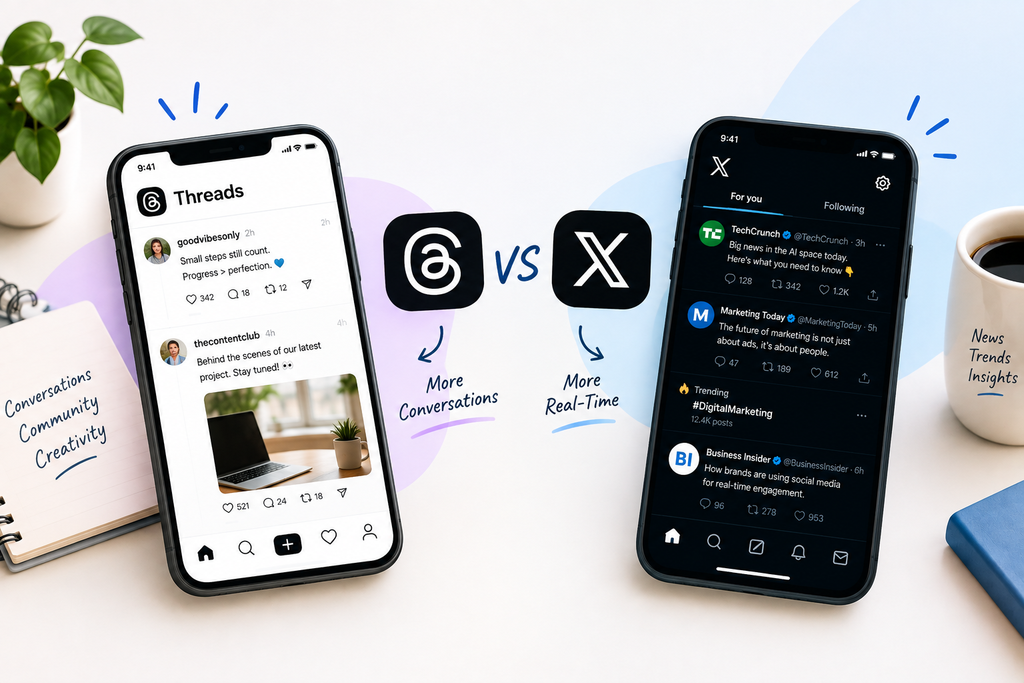
Meta‘s text-based app Threads is similar to Instagram. You log in with your Instagram account, and your followers can be migrated. Posts are limited in length to 500 characters, which you can use with images, carousels, and videos. There is a more casual and conversational tone on Threads — less breaking news, more opinion, reaction, and chitchat among the community. Growing as fast as it has is evidenced by the fact that Threads also just broke 400 million monthly active users, and its mobile daily usage has now recently pulled even with X’s (in some markets), for example.
What Made Twitter the Most Important Social Media Platform
In essence, X (formerly known as Twitter) is still where the world logs on for real-time updates, breaking news, and public discourse. Tweets are limited to 280 characters, unless you subscribe to X Premium for longer posts. X has existed for far longer, which means a unique pool of journalists, industry experts, and niche communities that can’t be otherwise recreated.
The audiences behave differently too. On X, people log in throughout the day to check for news, sports scores, market updates, or whatever outrage of the moment is trending. On Threads, there is a greater tendency for people to read more casually [as they would on Instagram] than anything else: less imperative to be curated and calculated in your posts, as it becomes scrolling when you feel like being social or trying new things. The size of the difference alone is enough to change how brands should perceive a Threads vs X strategy.
Brand Marketing on Threads vs X
Despite appearing to do a similar job, Threads and X serve two very different purposes when viewed from a brand marketing perspective.
Hashtags, trending topics, and quote-tweet culture help your post get in front of other people who do not currently follow you. Hashtags don’t function as they do on IG Threads, so it’s a little more reliant on the algorithm giving your stuff exposure based on engagement and relevance — thus truly interesting posts can have greater reach, even from smaller accounts.
Audience engagement looks different too. The algorithm in Threads promotes replies and depth of conversation instead of mere likes; therefore, a comment-scoring post is encouraged to be placed higher. Quote tweets and retweets are still a major driver of spread on X, so punchy, shareable takes are incentivized.
This is currently an area where Threads has the upper hand when it comes to organic reach for many brands. As an added benefit, a quality blog is more likely to be seen by someone who has never heard of your brand if the platform is new and less arrad-filled—while this obviously become everessential one the space becomes even more focused on promoted content through paid posts.
It feels like community building is much more organic on Threads. The comment sections are a lot more chill, and brands have also said that the interactions feel way less transactional than what one might think and actually feel like a discussion instead of an exchange. For example, if a bakery in Ahmedabad posts a behind-the-scenes video on Threads about a new dessert, it is less likely to get one-line replies than real excitement.
So if your brand is reliant on its news cycle presence — like a fintech startup making some news about their response to a policy change, or media brands that are reporting on the conversation around events live — then you still get into this real-time discoverability X has but Threads isn’t built for yet.
Threads Marketing: What Is the Best Strategy for Brands?
When it comes to what works on Threads, the best-performing content feels personal and unrefined, so if you are building a marketing strategy for Threads:
- Less formal posts that sound more like you talking than a PR
- Concise views on things pertinent to your field, á la a coffee company detailing why they believe oat milk lattes don’t live up to the hype
- Questions that lead to responses, such as what do you want your audience to see next
- Behind-the-scenes content of how a product is made, or what a small team does daily
- Condensed educational threads
- Interacting with other accounts in your niche, which enables their Foresight as well
The best type of brands that may benefit from Threads marketing are lifestyle, food, fashion, wellness, and consumer-facing businesses—basically anything where personality and relatability matters more than urgency. If you were a D2C skincare brand, well, Threads would probably be an easier sell to you than if you were a B2B SaaS selling enterprise software since the mindset of audiences on Threads is very casual.
X Marketing: What Do Well Brands?
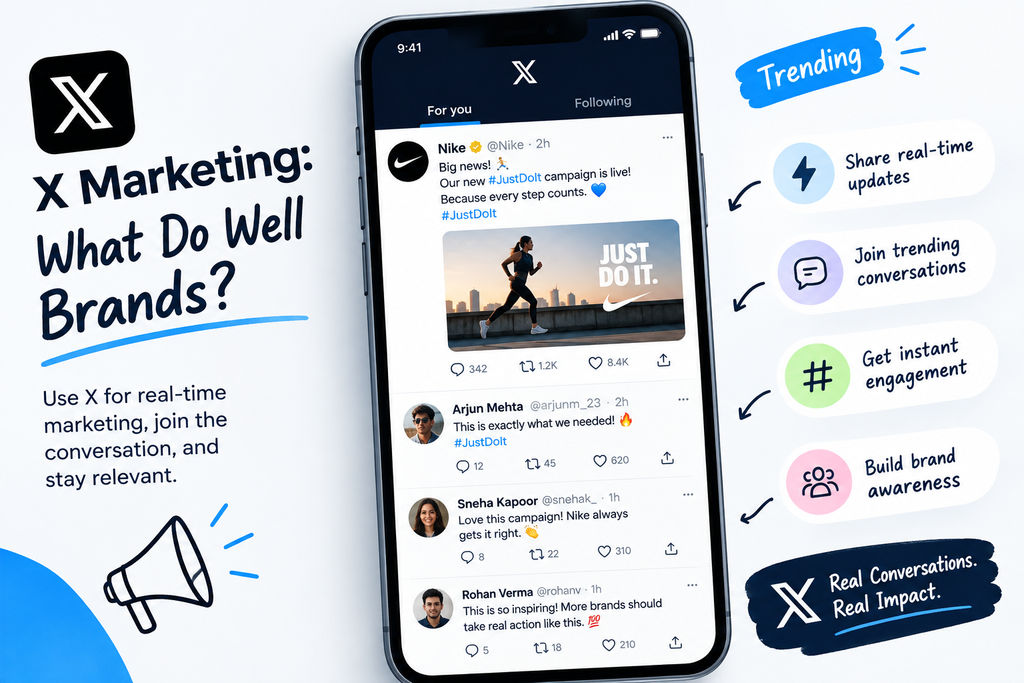
This alone, however, means nothing when it comes to X marketing — which runs on its own separate rhythm. What works well here is timely, incisive, and overly reactive.
- Live Discussions on events, launches, or news in the industry
- Thought commentary on topical industry news, making your brand a thought leader
- Utilisation of trending topics (to be used with caution and only when relevant)
- Single-author Thought Leadership Posts that promote this into actionable insights that your peers in the industry will want to engage with
- Customer support threads since many a user continues to believe that brands must respond to complaints or questions on X
- Product announcements that leverage the virality of the platform
- Bite-sized slams that are quotable and shareable
B2B, tech startups, news and media brands, finance, or anyone with an audience that follows the conversation in their verticals tend to benefit most from X marketing. If your customers are professionals who look at X during work hours for a report, that is where you need to consistently show up.
Threads vs X: Detailed Comparison
| Factor | Threads | X |
| Main content style | Conversational, personality-driven, casual | Fast-paced, opinion-driven, news-focused |
| Audience behavior | Browses casually, like Instagram | Checks frequently for real-time updates |
| Brand engagement | Warmer, more supportive replies | Quicker reactions, more debate |
| Real-time conversations | Restricted, not designed for breaking news | Good, this is at the heart of X strength |
| Community building | Feels more natural and relationship-based | Possible, but often more transactional |
| Brand personality | More easy to highlight a casual, human side | Suited for sharp humor or direct tone |
| News and trends | Weak – no hashtag and trending system | Strong — trending topics pushed visibility |
| Customer communication | Surely growing number of — but not the most use case yet | Well-established, users expect support here |
| Organic visibility | Now higher because of less ad saturation | Lower organically, more pay-to-play now |
| Best suited for | Lifestyle, consumer, community-first brands | News, B2B, tech brands, finance brand reactive brands |
Which One of the Two Is More Suitable For Several Brand Types?
1. Small businesses
For time-poor small firms, Threads tends to yield better value. The organic reach is better these days, and the tone fits how small brands communicate with customers by default — friendly and frank, in no need of an acerbic, debate-ready voice.
2. Startups
This varies from startup to startup as per its genre. An app for consumers or a D2C brand will probably go to Threads for community and awareness. For the credibility of a B2B or fintech startup, particularly in new but fast-growing industries like crypto and e-commerce on a short time horizon, it will necessitate X to be caught up with prospective investors involved in progress discussions right now.
3. Personal brands
Personal brands — coaches, consultants, creators — tend to do best on both platforms, for different reasons. Threads = relate/connect. X = authoritative + visibility in your peer network.
4. E-commerce brands
If the audience also overlaps with Instagram, Threads can be a great platform for product storytelling and community engagement for e-commerce brands. This makes it especially valuable for e-commerce brands dependent on flash sales, in-the-moment announcements, or even rapid-fire customer support during peak traffic times.
5. Agencies and marketers
Because agencies tend to have clients from varying sectors, agencies require both. Threads is great for sharing a glimpse of agency culture or case studies, and X keeps agencies in the loop with marketing trends and networking.
6. News, media, and current-affairs brands
This is one matter that isn’t exactly murky — X still comes out on top. News breaks more rapidly there, and the audience is looking for such updates in real time in a way that Threads users, on average, are not.
7. Lifestyle and consumer brands
This is where Threads finds a better footing. To add some flesh to those bones, brands in the food or fashion verticals lean into visual storytelling and casual conversation — precisely what Threads users are scrolling for.
In This Threads vs X Comparison, We Analyse Which Platform Gets Better Engagement
You can’t really answer this question cleanly with one number; any article that serves you a set engagement rate for Threads vs X is more than likely just pulling numbers out of thin air. There are too many factors that influence engagement — the content itself, how knowledgeable you are about your audience, consistency with posting, timing, and how actively you engage with comments.
That said, there are a few patterns that hold across most industries. Since Threads is still punting on authentic conversation, brands that reply to comments and continue the conversation see a stronger performance over time. Being on time is something that X pays you for, but the same piece posted in lock-step with a news cycle will often win out over being posted a week late.
If your team can only realistically engage in regular replies and community management on one platform, Threads is currently the best bet as it tends to reward that engagement more overtly, purely by virtue of less competition.
Threads vs X — Which Is Best for Brand Awareness?
Both are important for long-term brand recognition, but the way they build it is not the same between the two platforms. When a post is spotted in a larger conversation, X exposure can come through trending conversations, allowing people to see outside of your circle when it picks up. It is useful for quick visibility spikes.
Threads creates awareness through multiple interactions with a personality-driven approach. Users do remember which brands they’ve engaged with in the comments, as opposed to those they scroll past once. Threads is a better long-term play — for now, at least (it requires more patience) — if your brand awareness objective is to cultivate an audience of fans who return time after time rather than to bag a one-time viral hit.
Threads vs X: Which Platform Is Right for Your Brand?
Run through these questions honestly:
- Would you prefer discussions in real time, around news or events? X leans stronger here.
- Does your target market regularly keep an eye on industry news and trends? X is most likely where they’ll have evolved to by then.
- Does your energy sound more like community building & relationship-driven engagement? Threads fits better.
- Do you want to add more personality and a tone of voice that is relaxed? Threads gives you even more space to do that.
- Need a channel for customer support to flow? For now, X remains the more established alternative.
- Is your company heavily dependent on thought leadership? Either one works, but X gets you seen by your peers quicker.
The answer for most brands will land somewhere in the middle, which is exactly why so many are opting to do both rather than one or the other.
What Brands Should Do With Threads & X
That said, for the vast majority of mid- to larger-sized brands — yes, using both makes sense, provided you aren’t simply copying and pasting the same social post into both. Consider it allocation, not replacement. Where X can take care of your real-time updates and customer service, Threads helps you build out the slower, more personable side of your brand identity.
That said, if you’re a small business or solo founder with what I call “limited bandwidth,” the worst way to go about both of these platforms is shotgunning them half-assed. If that is the case, choose the platform where your current customers hang out and stick to it before investing in a second.
One way that works for teams doing both is to think of X as your newsroom and Threads as your lounge. Different tone, different goal, same brand behind the look.
Practical Posting Strategy for Brands
- On Threads: share conversational updates, pose questions, provide behind-the-scenes insights — anything you respond to every comment possible. Have a voice that sounds like a human being and not a press release.
- On X: provide real-time reactions, quick takes, product announcements, and engage in real-time conversations as they unfold.
- How much you post: consistency is key, not quantity. One or two nice posts a week is much better than filler content every day on either platform.
- Answering replies: make comments part of the content, not an afterthought. Just as quick, authentic responses create greater loyalty than the real post.
- Re-purposing content: do not use the same press release on both channels. Rewrite the same idea — long and informal for Threads, crispy short for X.
- Monitoring your success: watch how many replies, number of saves, and people who re-engage rather than number of followers. If no one is even talking to you, follower growth is a vanity metric.
- What to watch: Reply rate, click-throughs if running traffic, and how often the same users keep coming back for more.
Common Mistakes Brands Should Avoid
- Paste-pasting identical posts across the board — your audience sees through this, and every platform has a very different purpose.
- Disregarding responses — an unattended comment section is worse than silence.
- Sharing only promotional content — no one follows a brand account just to see the same announcement of the sale again and again.
- Chasing every trend — jumping on trends that do not align with your brand voice tends to feel unnatural or fake.
- No distinct brand voice — if your Threads and X posts could belong to any faceless corporation, they’re failing you.
- Not posting regularly — going M.I.A for weeks, then suddenly getting excited on the feed by posting up to five times a day is a great way to confuse both the algorithm and your audience.
- Speaking only in terms of followers — an engaged smaller audience is worth more than a huge silent one.
- Not tracking meaningful engagement — you can score a few likes; it is easy to get these done; real replies and shares are what really count.
- Exploiting hashtags or trends where they do not apply — particularly dangerous on X where irrelevant trend-jacking is soon called out.
Final Verdict: Threads or X?
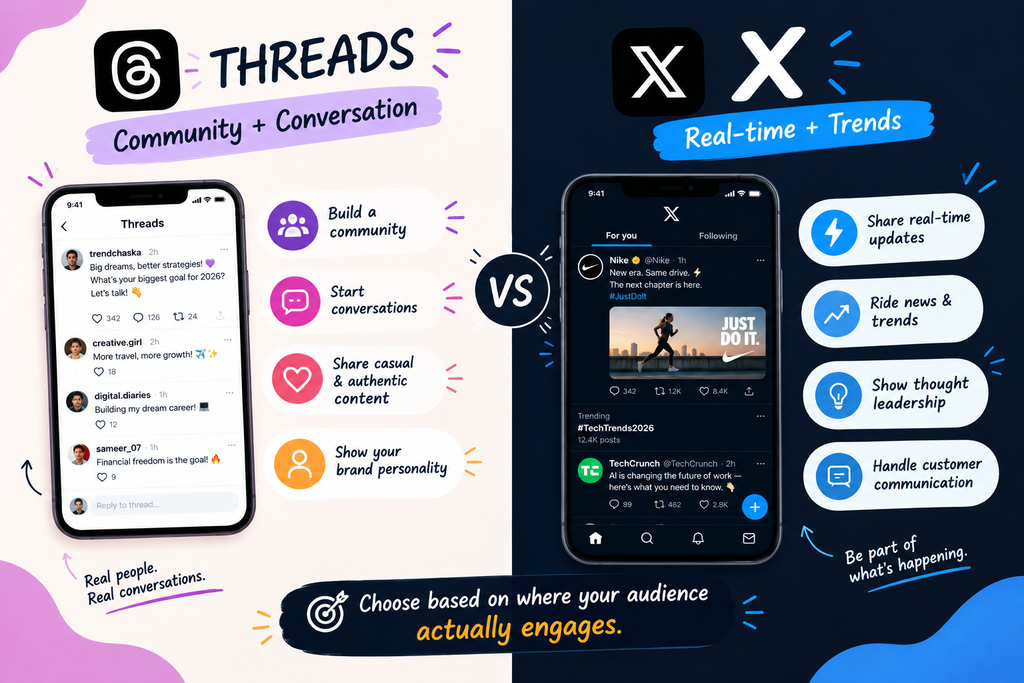
There are no overall winners in the Threads vs X debate, and anyone who tells you differently is overselling it. If brands are looking to foster conversation, community, and a more human brand voice over time, Threads may be the better bet. For brands that rely on real-time interactions, conversations around notable events or topics within an industry, breaking news, thought leadership, or speedy communication with customers, X may offer the greater value.
Takeaway: Avoid choosing a platform simply because it is the talk of marketing circles — make your choice based on where your real audience is engaging in conversation. If you can keep both in sync, let X be fast-moving updates and Threads slow work of cultivating community. It is that combination — more than any single choice of platform — that will lead to results in 2026.
FAQs
1. Threads vs X: Is Threads better than X for branding?
That all depends on your audience and your ultimate goal. Threads still generally has more organic reach and fosters community engagement, whereas X is better for real-time exposure and industry chatter.
2. Is Threads good for business?
Yes, particularly for consumer brands that are driven by lifestyle and community vibes. Threads is great for business when you want to build relationships, not make an immediate sale.
3. Is X still useful for brands?
Definitely. If you are a brand that needs real-time updates & customer support, or if there is any trending conversation/news happening, you still have X marketing working in your favour.
4. What is the best platform to reach and engage with an audience?
Neither platform is a golden ticket to ultimate engagement in isolation; you need good content, consistency, and so much of that rests on how well you engage your audience. You could make the argument that Threads has always preferred showing breadth (of conversation) — it suffers less for repeating your average tweet than it does for hitting the gold of something like an audience-favorite joke or topic.
5. How do small businesses benefit with Threads or X?
Smaller businesses often find that Threads makes more sense than posting on Facebook and Instagram, where organic reach is weaker, and the early audience-builders can head to Twitter
6. Is it possible for Threads to help build brand awareness?
Yes, over time via constant posting from a character and real interaction in the comments that grows a steady audience.

Nidhi Patel is an SEO and digital marketing content strategist focused on AI SEO, content marketing, blogging, and personal branding. Through TrendChaska, she shares practical digital marketing insights, SEO strategies, and AI tools for beginners, students, and small businesses in India.