E-commerce marketing for small businesses in India, SEO, social media, WhatsApp, ads, and a 90-day action plan to boost sales.
Introduction
Priya owns a small handloom saree business in Surat. She has nice products, some regulars locally, and reasonable Instagram stats. But her online sales? Barely a trickle. Sound familiar?
This is the story of a sea of entrepreneurs and small business owners across the country. You opened a Shopify store, or you listed your products on Meesho, and, wait. And wait. But orders don’t just arrive because you created a website.
Time for some pause and contemplation for this number: As of December 2024, there were more than 1.1 billion internet subscribers in India, according to data from the Telecom Regulatory Authority of India (TRAI). That’s a huge online market, and only those businesses that can promote their utilization capture it.
This is precisely why right now e-Commerce marketing for small businesses is so important. It’s not the largest budget you have to work with. Instead, it’s all about using the proven strategies in a consistent manner to reach the people who are already looking for your product.
This is a no-nonsense guide to e-commerce marketing in India for small businesses based on practical strategies—the type that you can begin implementing this week, not just read about.
What is E-commerce Marketing?
E-commerce marketing is basically the act of getting people to discover, trust, and ultimately purchase from your web store or products. It includes everything from SEO and social media to email and paid ads.
The online store feels like a stall in a massive digital bazaar. The store is not enough; you must have signboards, people, and motivation to come in. That’s what e-commerce marketing does.
The bottom line: The “best” product is invisible without marketing and lands on page 5 of Google or under thousands of listings buried on Amazon and Flipkart.
Presence of training: For instance, Mamaearth is at its roots a small D2C brand. It invested heavily in content marketing, influencer collaborations, and performance ads instead of relying solely on marketplace listings. And that consistent push to market is a major reason it eventually became a household name.
Pro Tip: Think of marketing as a long-term process and not just something to do once you have set up your store!
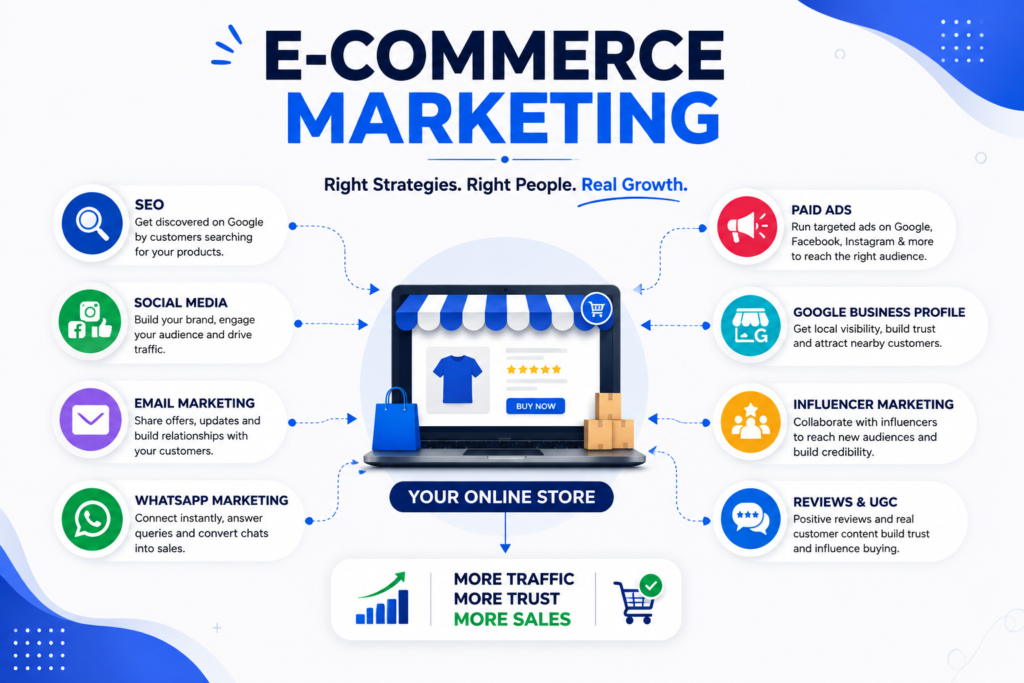
Why Small Businesses in India Must Look Out for E-commerce Marketing
With India’s changing online shopping behaviour in the last couple of years, small businesses that ignore this shift are leaving money on the table.
- Increasing online buying — More Indians, particularly those in Tier 2 and Tier 3 towns, are shopping for their groceries to furnishings through the internet. This is not just restricted to big cities anymore.
- Smartphone Users — A cheap smartphone and data mean most people have the internet in their pocket. The thing is that your customers are already online; the real issue is whether they discover you.
- Now with digital payments — UPI, online payments are easy and reliable to do. Today, people are way more comfortable paying online compared to five years ago.
- Lower marketing costs — Compared to traditional advertising such as newspaper ads or hoardings, digital marketing allows you to reach a targeted audience with much lower costs.
- Improved customer re-targeting — With e-commerce marketing in India making something almost impossible to sell from Indore to a customer seated in Guwahati, the reach has now improved many fold.
Quick Tip: Learn not to spread yourself too thin. Focus on one or two channels your customers actually spend time with, and get good at those first.
Benefits of E-commerce Marketing
Here is a breakdown of what you really get by investing in small business e-commerce & marketing.
- Increased website traffic — Good SEO and content drive people into your store — free clicks on every single one.
- Improved brand recognition — Consistent social media marketing and content keep your company in front of potential customers, even before they are ready to buy.
- Boosted online sales — Increased visibility will always lead to more orders, which becomes even better if paired with an impeccable checkout process.
- Increased customer confidence — testimonials, reviews, and competent content will be able to convince someone to buy from a small and less-known brand.
- Higher ROI — Digital channels allow for accurate tracking of the foundations that are delivering, giving you the means to invest your cash in places yielding impact.
- Long-term growth — Good marketing builds a system; sales push is one-off sales.
Quick Summary Box: Today you are using traffic + trust + smarts spend = sustainable growth for your online store powered by March 2023.
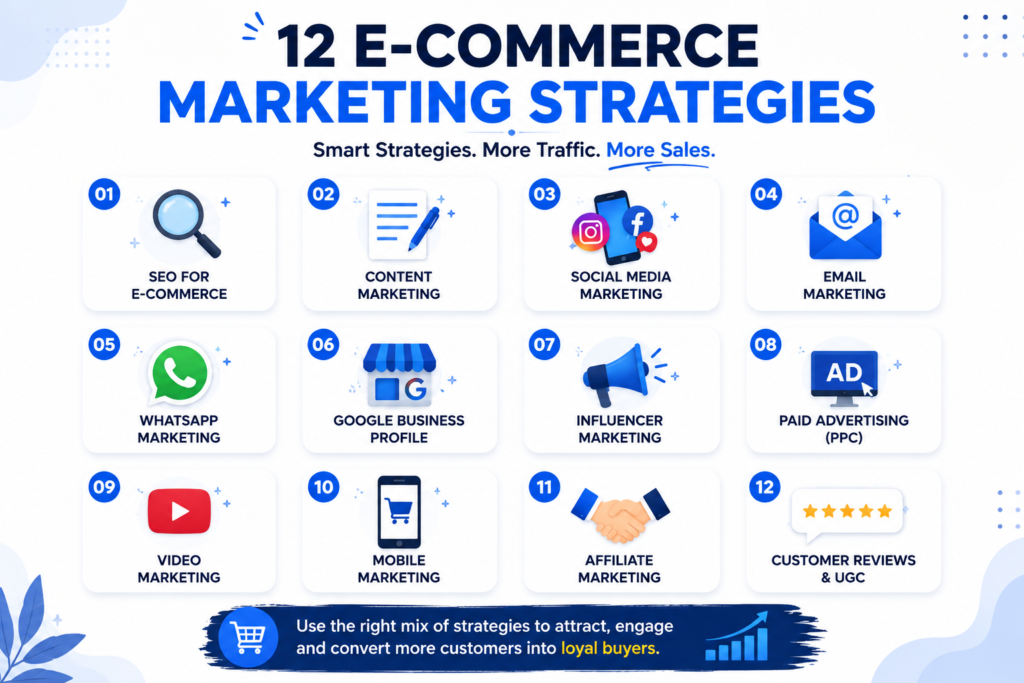
Top E-commerce Marketing Strategies
Here lies the gist of the guide. Let’s go strategy by strategy.
SEO for E-commerce
What it is: E-commerce SEO is the process of optimising your site to make sure it appears higher on Google when people search for stuff like yours.
Why it works: Because the majority of online journeys still begin with a search in Google. Good ranking means paid traffic is free and steady.
In practice: You should use clear and precise product titles, detailed descriptions, and relevant keywords! Make your site pages fast and use appropriate image alt text.
Proof with an Indian example: Long before Nykaa became a household name, it had built much of its initial traffic using solid SEO for beauty keyword searches.
Beginner tip: Only target one keyword per page. But when you write descriptions, you’re not stuffing keywords — treat it like you would be explaining the product to a friend.
Things to avoid: Copy-pasting manufacturer descriptions, completely ignoring mobile page speed, and stuffing content with keywords so that it is unreadable.
Content Marketing
What it is: Writing a helpful blog/guide/video on something related to your products, without trying to sell with every piece.
Why it works: Instills trust and stands as a preemptive answer to questions customers have before they get onto your product page.
Practicality: If you are a saree seller, write blogs such as how to choose the right cotton saree for summer.
Example from India: Wakefit created a complete content strategy around sleep health, which made readers fall into mattresses and furniture automatically.
For new entrants: Answer the same questions that your clients ask you on WhatsApp or in comments — that’s premium-free content.
Biggest mistake: You write about your products and not the problems of your customers.
Social Media Marketing
What it looks like: Using Instagram, Facebook, Pinterest, etc. to promote your business and drive engagement with your audience.
Why it works: It is a platform you visit daily to discover brands, especially for young Indian consumers.
How to do it: Post regularly — Product photographs, behind-the-scenes material, and client stories are all great options.
For example: In India, a lot of the D2C skincare and clothing brands have constructed their whole customer base via Instagram Reels without once running paid ads.
Tip for beginners: Plan your content a week ahead and batch it instead of posting whenever you remember.
Mistakes: Posting only PR material with little or no personality or narrative.
Email Marketing
What it is: Sending emails to your customer list about special offers, items that have arrived in-store, or content with useful information.
Why it works: One of the cheapest channels, and you own the email list — (unlike social media followers).
How do we do it in practice: Welcome mail, cart abandonment reminders, monthly newsletters.
An Indian example is that most of the Shopify sellers use simple welcome-discount emails for first-time visitors to become buyers.
Beginner Tip: Limit your subject lines and make them personal. Do not sound like a corporate newsletter.
Mistakes: Email too frequently with just sales pitches, resulting in high unsubscribe rates.
WhatsApp Marketing
What it is: WhatsApp for Business Updates, orders, and support verification.
Why it works: WhatsApp marketing is extremely effective in India since a majority of its customers already use the platform every day.
How to implement: Build a catalog on WhatsApp, use broadcast lists for offers, and respond quickly to queries.
For example, in India, tons of resellers at Meesho use WhatsApp almost exclusively to get local sales onboarded.
Start here: Get WhatsApp Business (not personal WhatsApp); you get catalog and quick-reply features.
Mistakes: Broadcast messages being too frequent makes customers block your number.
Google Business Profile
What it is: A Google profile which displays your business name, reviews, and location as a free Google listing in search results.
This is effective: It increases local SEO and immediately lends brands credibility to potential customers researching your business.
Actionable step: Make sure to add complete details, images, and reply to every review.
Indian Example: Local sellers with a small offline store receive walk-in customers straight from Google My Business Listing!
Beginner tip: Ask for a review right after a good moment for the happy customer.
Typical errors: Leaving the profile incomplete or never replying to negative reviews.
Influencer Marketing
What this is: Teaming up with social media influencers to showcase your product to their followers.
Why it works: Promotion by a trusted creator feels much less like an ad than direct advertising.
Implementation in practice: Target your niche form of micro-influencers (10,000–50,000 followers), these their cheap and have ultra-effective engagement.
Some good examples from India — with a quick proposition of sending free products to the regional micro-influencer, which helped many small fashion and beauty brands grow rapidly.
Influencer Marketing tip: Return to basics when selecting influencers – go for engagement rate, not numbers.
Big mistake: Collaborating only with mega influencers while their audience isn’t really your potential customers.
Paid Advertising (Google Ads & Meta Ads)
What it is: Paying for your ads to show up on Google search results or in Instagram & Facebook feeds.
Why it works: You get instant visibility (SEO takes time).
How to Do It Practically: Choose a small daily budget, have narrow targeting, and test creatives.
Indian example: Most Shopify store owners in India start at ₹300–₹500/day for Meta Ads to test what works.
Newbies hack: Always have a purpose (sales, sign-ups, traffic) before making the ad.
Perhaps the most common mistake: Running ads without tracking conversions, and therefore never knowing what is actually working.
Video Marketing
What it is: Demonstrating and showing what you sell via short videos, reels or product demos.
The reasoning: Video is a way better trust builder than images, and video works like magic with Indian social.
In practice: Record a basic unboxing, product in use, or customer review video with your smartphone only.
Example specific to India: Some of the home decor and kitchenware sellers on Instagram thrive mainly through short reels purely showcasing their product — just 15-30 sec “how it works”.
Beginners be warned: You don’t need an expensive setup; lighting and audio are more important than fancy cameras!
Mistakes to avoid: Keeping videos longer than what I said, or making it too much of a sale during the first seconds.
Mobile Marketing
What is it: Optimizing marketing and a website for mobile users.
Why it works: Mobile commerce is still a hard nut to crack, as 95% of Indian E-commerce traffic arrives from mobile.
How to implement it: Ensure your website loads quickly, buttons are easy to click, and checkout functions well on mobile.
Example from India: Meesho is an entire business around a mobile-first shopping experience for Tier 2 and Tier 3 customers.
Tip for the Beginners: Regularly check your own store checkout process on your phone for potential friction points.
Some common mistakes: You create your website only on desktop and never actually test it on a mobile device.
Affiliate Marketing
What is it: Paying someone to make a sale in your store (a commission on each sale that they help you get).
Why it works: It is a low-risk strategy because you only pay for what was done.
Implementation in practice: Use affiliate plugins or platforms to provide partners with unique tracking links.
For example, many D2C brands in India run affiliate programs where professional bloggers and YouTubers earn a certain percentage of sales on the traffic they drive through their links.
Tip for Beginners: Have an uncomplicated, clear commission structure, so that the partners know exactly what they earn.
Mistake: Affiliate performance tracking — you may think your program is running perfectly, but many times it is not the case due to incorrect affiliate performance tracking.
Referral Marketing
What it is: Getting your customers to bring friends or family on board, with an incentive.
What works: Who has more influence over you, a marketer who writes an ad or someone you know?
How: Discount for both the referrer and new customer.
Indian example: Most subscription-based D2C Indian brands are growing with a “refer and earn” program rather than heavy ad spend.
Beginner’s Tip: Make the referral process so simple, one click to share & one click to redeem.
Common Pitfall: Reward is too small to be worth it.
Customer Reviews
What it is: Real customer feedback shown on your store or marketplace listing.
Why it works: For new, unknown online sellers, reviews are one of the biggest trust signals.
Implementation in a practical flow: After delivery, send another message requesting a moment to review.
Indigenous instance: For instance, sellers on Amazon and intensifying with satisfactory review counts, dominate linked merchandise like Flipkart with fewer critiques since posting the review itself was/is a herculean task.
Tried and True: Try to make leaving a review as effortless as possible — a direct link will outperform anyone just asking.
Common Mistakes: Not responding to a negative review by professionally replying.
Remarketing
What It Is: Advertising to individuals who visited your site but didn’t purchase.
Why it works: These visitors were already interested, so they are exponentially more likely sale than cold audiences.
How to apply: Install the Meta or Google remarketing pixel on your website for tracking visitors.
Example of India: Most of the online store marketing campaigns in India depend on remarketing to counter abandoned carts.
Beginner tips: Best use cases contain a small offer (reminder ad) 24–48 hours after the visit.
Misall: Wanting to remarket with the same ad for weeks, inadvertently annoying potential customers.
Marketing Automation
What it is: The use of tools that automatically send emails, messages, and offers triggered by customer behaviour.
Why it works: It allows you to save time and guarantees that no leads or customers just slip through the cracks.
How do you implement it: Build automations for welcome emails, cart abandonment, and post-purchase follow-ups.
Indian Case In point: Many new-age D2C brands send an automated discount code on cart abandonment using marketing automation.
Easy tips for beginners: Build one or two automated flows before creating a complex system.
Mistakes made: Automating too much to the level that messages become robotic and uncaring.
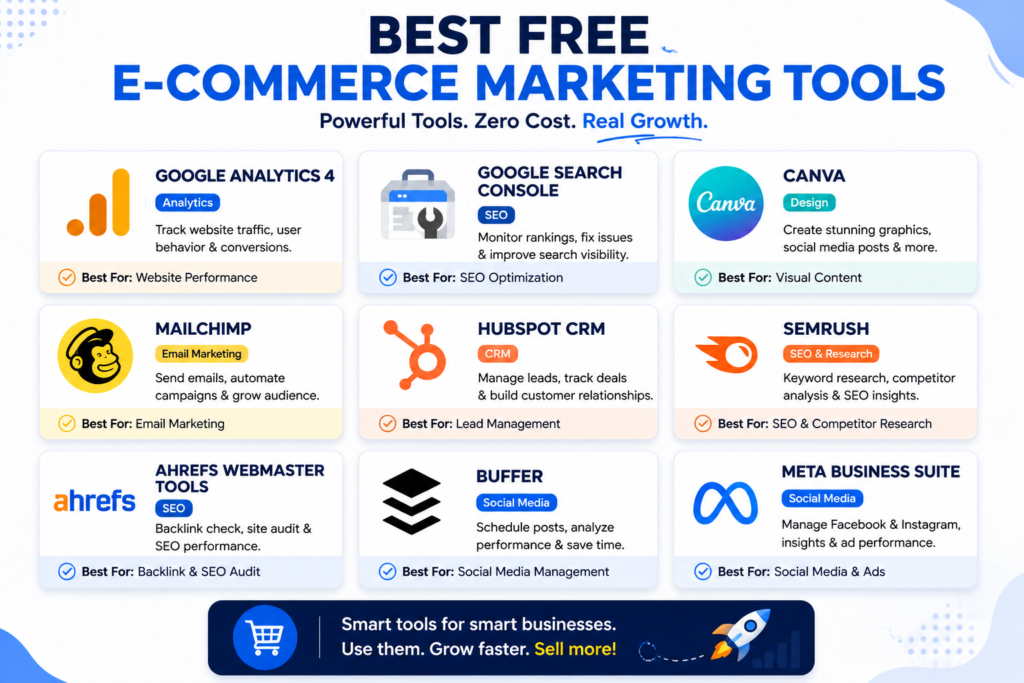
Best Tools for E-commerce Marketing
| Tool | Purpose | Best For | Free/Paid |
| Google Analytics | Track website traffic and behaviour | Understanding visitor data | Free |
| Google Search Console | Keep an eye on the performance of search and SEO errors | SEO for e-commerce | Free |
| Canva | Designs posts, graphics and banners for social media | Beginners with no design skills | Free/Paid |
| Mailchimp | Email marketing and automation | Small business email campaigns | Free/Paid |
| HubSpot | CRM and marketing automation | Growing businesses | Free/Paid |
| SEMrush | Keyword research and competitor analysis | Advanced SEO | Paid |
| Ahrefs | Backlink and keyword analysis | SEO professionals | Paid |
| Yoast SEO | On-page SEO optimisation for WordPress | WordPress store owners | Free/Paid |
| Buffer | Plan and publish your social media content | Social media marketing | Free/Paid |
| Meta Business Suite | Manage Facebook and Instagram ads/posts | Social media and paid ads | Free |
Pro Tip: You do not need all these tools on your first day. Google Analytics, Google Search Console, and Canva (the free tier) are all great places to start as they measure the essentials!
6 Common Mistakes Small Businesses Should Avoid
- Neglecting mobile experience — As most customers tend to browse on mobile commerce apps, a slow or clunky mobile site should lead to lost sales immediately.
- Your target audience does not take shape — When you attempt to sell “to everyone,” typically no one can be signed on.
- Irregular Posting — Posting once a month and disappearing doesn’t build any kind of momentum when it comes to social media marketing.
- Ignoring reviews — When you receive a review, good or bad, and do not respond, it shows utter indifference.
- Blind ad spending — Without tracking, a paid-up ad without conversion means money blindly spent.
- Copying your competitors — What works for a big brand might not suit the size of your dog in the first place.
- Poor product descriptions — If your product descriptions are vague or copied, you will struggle both with SEO and customer trust as well.
- No email list building — If all you know how to do is social media, then you do not have an asset with your own audience.
- Neglecting WhatsApp marketing — Overlooking the most-used communication channel in India.
- Failure to follow up post-purchase — Missing an opportunity for customer retention and repeat orders.
- Not claiming the Google Business Profile — Missing out on easy natural local visibility and trust signals.
- Expecting actionable results right away — E-commerce marketing for small businesses is a long-term play, not something that can be solved in one week.
E-commerce Marketing Trends to Follow in India (Latest, 2023)
- AI-Powered Personalization — Stores are leveraging AI to suggest products based on behaviour and browsing patterns; every store can begin to feel like it was made just for the individual.
- Voice search — As more users search via the help of voice assistants, simple conversational keywords are increasingly important for SEO.
- Hunger for short videos — To discover new brands through Reels and short videos — fashion, beauty and home decor brands thrive in this type of content.
- Social commerce — Social shopping is not new, but buying directly through Instagram or WhatsApp (or other social platforms like this one) without leaving the app is starting to stick for many smaller sellers.
- Conversational commerce — Customers can now buy through a simple conversation — thanks to Chatbots and WhatsApp-based ordering.
- Omnichannel marketing — Customers demand a consistent experience whether they discover you through Instagram, WhatsApp, or your website.
- Privacy-first marketing — As the privacy tide rises, leading modern marketers are leveraging compliance capabilities into trust factors around data practices.
Tip in Practice: You don’t have to jump on every trend right away. Choose a model suitable for the nature of your business and test it out before scaling.
First 90 Days Action Plan
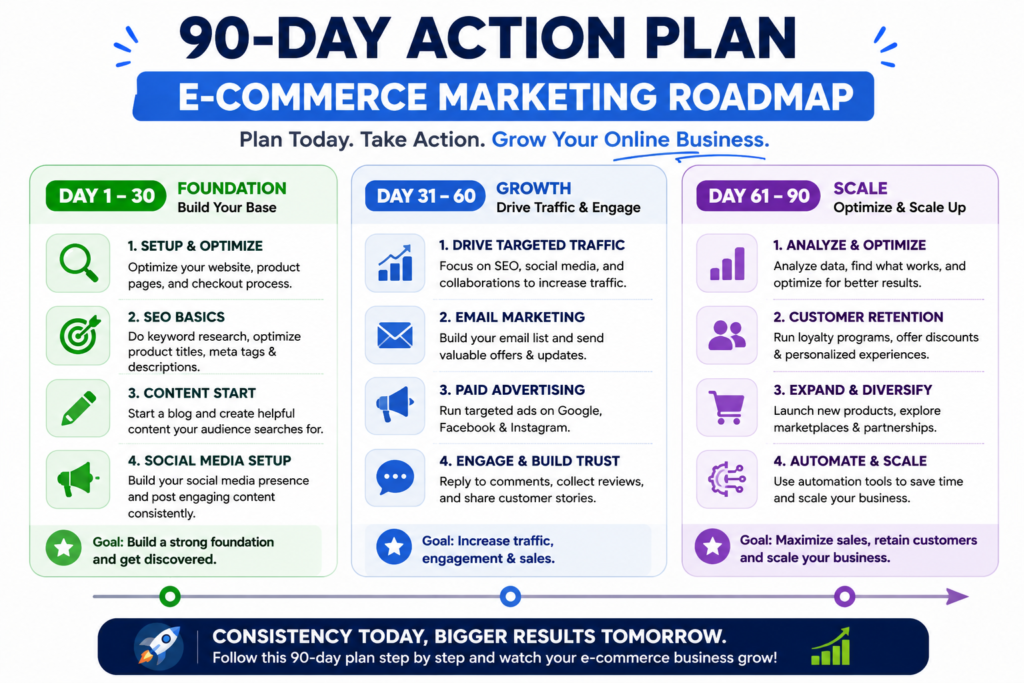
Days 1–15: Set up Google Analytics, Search Console, and Business Profile. Refine your merchandise descriptions and images.
Days 16–30: Content and Social Presence — Begin posting regularly on one social channel. Targeting the questions your customers have, write the first two blog posts.
Days 31–45: Creating Your Channels — Create WhatsApp Business with a catalogue. Use an easy welcome discount to start building an email list.
Days 46–60: Test Paid Advertising — Run a small budget test on Meta Ads or Google Ads. Focus on conversions, not just clicks.
Days 61–75: Add trust; solicit customer reviews. Reply to all the reviews and comments, whether positive or negative.
Days 76–90: Optimise & Automate — Put some marketing automation to cart abandonment and welcome emails. Step back, evaluate what is working and then do more of that.
Quick Summary Box: Begin with small data, track everything, and when you have created the first channel good enough, then add another one.
Conclusion
Small business e-commerce marketing is not as intimidating as you would think. Sure, the tactics are endless: SEO—social media—WhatsApp marketing—email—and paid ads—but you only need to master one of them at a time.
Just focus on a channel or two channels where your customers are already there. Monitor your success, discover what works & expand from there.
It’s not always the businesses with the biggest budgets that grow online in India. The ones that are always in the game, listening to their customers, constantly doing better.
Choose a strategy in this guide and implement it this very day. It all starts from that first step in growing your online store.
FAQs
1. What is e-commerce marketing for small businesses?
E-commerce marketing for small businesses is all about the action you take to promote an online store using various e-commerce strategies to get traffic and sell your products. For smaller vendors, it provides the ability to reach appropriate audiences without massive expenses as compared to larger brands. This often translates to Indian small businesses connecting free suites of tools such as Google Business Profile with paid ads in a low-cost manner. Basically, be more visible, establish authority and trust among your audience, and gradually convert visitors into paying customers instead of only deploying quick wins that won’t generate long-term traction.
2. How much budget to start e-commerce marketing in India?
You can begin with a very limited budget up to the amount of less than ₹5,000 monthly. Almost all of these strategies like SEO, content marketing, Google Business Profile, and organic social media marketing are completely free to use, requiring only your time and consistency. Paid ads start at ₹200–₹500 per day to see what works. The secret is to begin small, monitor results closely, and only scale up on channels with evident returns — not attempt to spread an enormous budget across all channels immediately.
3. Best social media platform for small business marketing in India?
Instagram is better for products like fashion and beauty, as well as home decor; Facebook continues to have plenty of users in Tier 2 and Tier 3 cities. You cannot let WhatsApp out of the equation if you manage to communicate directly and close a sale. Every customer base differs, and so does the best platform that their customers would prefer to spend time on. Don’t go all over the place trying to be active; focus on one medium that is defined by your audience and product type, master it, and then start expanding to other channels only when you have a regular posting schedule.
4. What is organic e-commerce marketing, and what is paid e-commerce marketing?
Organic marketing means free strategies like search engine optimisation, content marketing and social media posts that will be compounding results over a period of time without a direct ad spend. Paid advertising, such as Google Ads and Meta Ads, is a good option to achieve faster visibility; however, it will always require a budget. Combining the two is a common practice among successful small businesses: organic efforts cultivate long-lasting trust and traffic, whereas paid advertisements help test what messaging works best for your business and drive sales faster during time-sensitive campaigns or seasons (as lively as festive sales).
5. Can small brands compete with big brands in e-commerce marketing?
Small businesses usually have the upper hand over big brands — like building a personal connection with a customer base, catering to niche audiences, and having flexibility in an ever-evolving market. The bigger the brand, the more money they are able to spend on advertising, but it’s the small businesses that steal the show through OPC (Other People Content), better & quicker WhatsApp support, and word-of-mouth reviews. It’s better to tailor your small business marketing toward a niche audience, rather than trying to follow the overall strategy and budget of a large brand.

Nidhi Patel is an SEO and digital marketing content strategist focused on AI SEO, content marketing, blogging, and personal branding. Through TrendChaska, she shares practical digital marketing insights, SEO strategies, and AI tools for beginners, students, and small businesses in India.