Discover how Digital PR for Small Businesses can elevate your online presence, earn high-quality backlinks, and build lasting trust in your brand without a large budget.
Introduction
Priya, meanwhile, has a small handloom brand in Jaipur. Her sarees are well designed, her Instagram feed is tidy, and her loyal customers keep returning. But when she views her website traffic, most months appear stagnant. Hundreds at most, most of whom were people who already knew her brand. No discovery, no new links, no news sites that mention her name, read by people who have the access to lose a few minutes in front of this piece.
The story is such a cliché for thousands of small business owners across India. Even with a great product, an OK website, or even some social media following, you can still be unnoticed by all the people who matter — journalists, bloggers, industry publications, and just about anyone who uses a search engine to find businesses instead of scrolling through their phones. And THIS is the gap aims to fill.
What Is Digital PR?
Digital PR is the process of earning coverage, headlines, and links from relevant online publications, journalists, bloggers, and websites digitally, as opposed to only relying on print media, television, or radio. Traditional PR involved sending press releases to newspapers and television stations, whereas digital PR takes the form of email outreach, online newsrooms, blogger relations, and target publications that prioritise a digital presence over printed material.
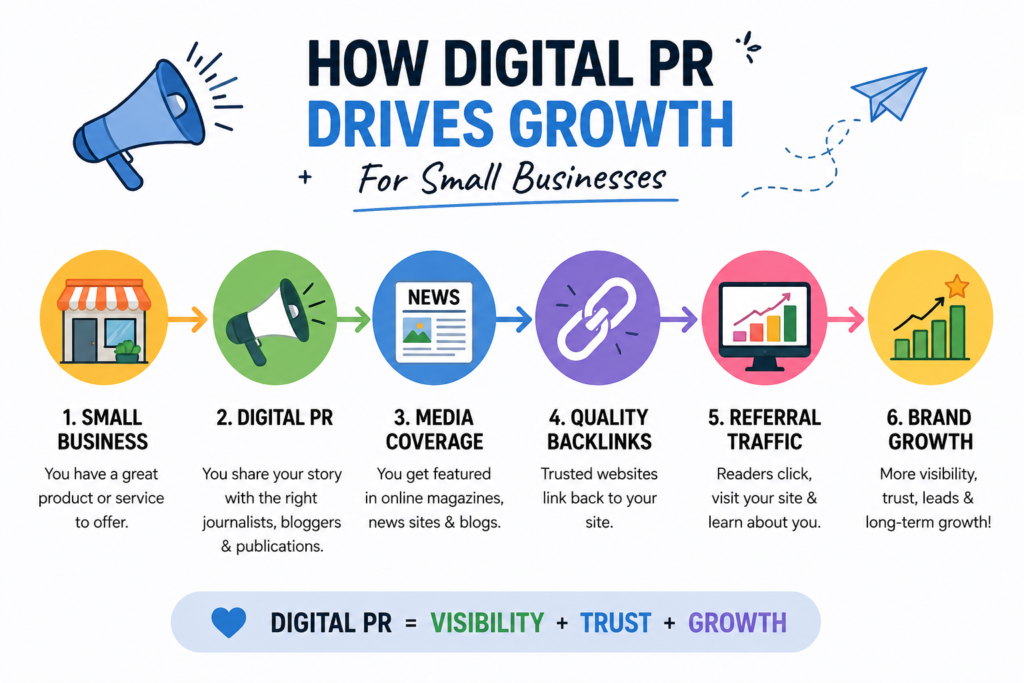
Understanding the relationship between digital PR and SEO, backlinks, and brand awareness is a must-learn for beginners. Two scenarios occur when a credible website writes about your company or links to your site. The first way is that users of that publication — this is the part about media coverage and brand awareness. Then, of course, search engines recognize that a trusted site is vouching for you, which can boost your rankings — that’s the SEO and backlink aspect. While link chasing alone is detrimental to small business digital PR, it works best when both these best possible outcomes are treated equally.
Here’s a simple example. Imagine that a small home bakery in Pune comes up with a recipe for an eggless dessert with local ingredients. It gets written about by a food blogger, linking back to the bakery’s website and showcasing it to their reader. Blog posts bring the bakery a little referral traffic, a backlink that search engines care about, and, if they do it right, an extra bump in online credibility thanks to one of those trusted voices in food giving them a shout-out. That is the whole sequence of events at work — it is digital PR.
Why SMALL Businesses Must Take Advantage of Digital PR
Big companies usually have PR teams and marketing budgets, which let them be everywhere. This is precisely why a smaller enterprise can matter even more to them, which small businesses do not have that luxury for; thus, the need to strategically approach. When done consistently, a few great stories can be transformed into continuous feet on the road through Digital PR for Small Businesses.
Builds Brand Awareness
If your business is featured on a website in the eyes of your target audience that has already earned their trust, you are being shown to people who may not have found out about you if they were mainly relying on paid ads or organic search. A carefully placed single feature can put you in front of thousands of readers who perfectly match your ideal customer profile.
Helps Earn Quality Backlinks
Search engine algorithms take as much notice of who links to your site, and not all links are created equal. That means that a citation from an authoritative, relevant publication carries much more weight than dozens of low-quality directory listings. The ideal here should always be relevance and quality – rather than the endless collection of backlinks.
Improves Online Credibility
It builds trust through third-party validation. Potential customers will pay attention when someone other than you says your product or service is worth their time. This is one of the more understated yet impactful digital PR advantages for small businesses: authoritative being a kind of credibility that advertising can hardly create.
Brings Referral Traffic
Each mention in the media or blog is also a doorway. Over a period of time, readers click through your link, arrive at your website, and quite a few convert into customers/subscribers/leads. Referral traffic typically tends to be more engaged than cold traffic from ads since it arrives with a discovery and likely recommendation in hand.
Supports Long-Term SEO
Digital PR does not supersede on-page SEO, technical fixes, or quality content — it is an next to one another strategies. Search engines examine / both your on-page content and the broader internet context around it. Digital PR is like SEO: a consistent and transparent strategy that lasts months, not days, and compounds over time for Small Businesses.
A Small Business Guide to Digital PR
This is actually a more formalized process than it appears at first glance:
- Have something to say — An angle in a story, insight, product positioning, or data point that does not read as promotional.
- Identify the appropriate audience- who will actually be concerned about this tale and where they spend their time online.
- Locate writers, blogs, and organizations that currently cover your niche or city.
- Build an irresistible story or content asset — be it an article, a brief report, an infographic, or just a captivating narrative.
- Write a tailored pitch that details why this story is relevant to the audience of this particular publication.
- Email relevant media associations, keeping it brief and genuinely helpful to the journalist.
- Just follow up professionally (not harshly) about a week after the first email.
- Keep an eye on mentions, links, and traffic to have a trace of what flew, so you know exactly what to repeat next time!
Getting through each of these stages takes work, but none require a big team or significant budget. It just takes consistency, and that’s where the best stand apart from those that fold up after one pitch.
Small Business Digital PR Ideas in India
Not every single business is lucky enough to have an easily newsworthy story lying around. More often, you have to search for it or forge it. A few directions worth exploring:
- Local biz stories — how a pozzed shop or service has evolved to serve its neoboost community.
- Founder stories — the journey, struggles, and decisions that went into building it.
- Even a small survey of your own customers can turn into a story — Original research or even an interesting find in secondary data.
- Customer trends — the trends you see in what people are buying or looking for.
- Industry insights — your sector perspective on the changes affecting your industry.
- Expert commentary — including a quote or thinking for reporters who are covering that same subject.
- This is data-backed content — uncomplicated graphs or numbers from your own business activity.
- Community Involvement — sponsorships, partnerships, or events related to your community.
- Introducing products — which is built around an actual innovation, not just an announcement.
- Seasonality stories — festival angles, seasonal shopping behaviors, or current local relevance.
- Case studies — a deep dive into how a customer utilized your product/service to solve a problem.
- Handy guides and action are useful tools — things that the audience of a publication would actually want to save.
For example, a small handloom business might tell a story about keeping an ancient weaving technique alive. For example, a local café might provide a piece on how its neighbourhood coffee culture has evolved over the years. For example, a D2C skincare brand might reveal results from a survey of customers who reported their skincare consumption habits. A coaching business could connect experts to provide commentary and insights on a trend or new development in the online education space. These are all perfect candidates because they give a publication something truly publishable – not just a plug.
Creating an Effective Digital PR Strategy in 7 Steps
The difference between a one-time mention in the press and a repeatable system is having this strategy written down clearly. A Quick Eight-Step Digital PR Process For Small Businesses You Can Revisit Every Quarter
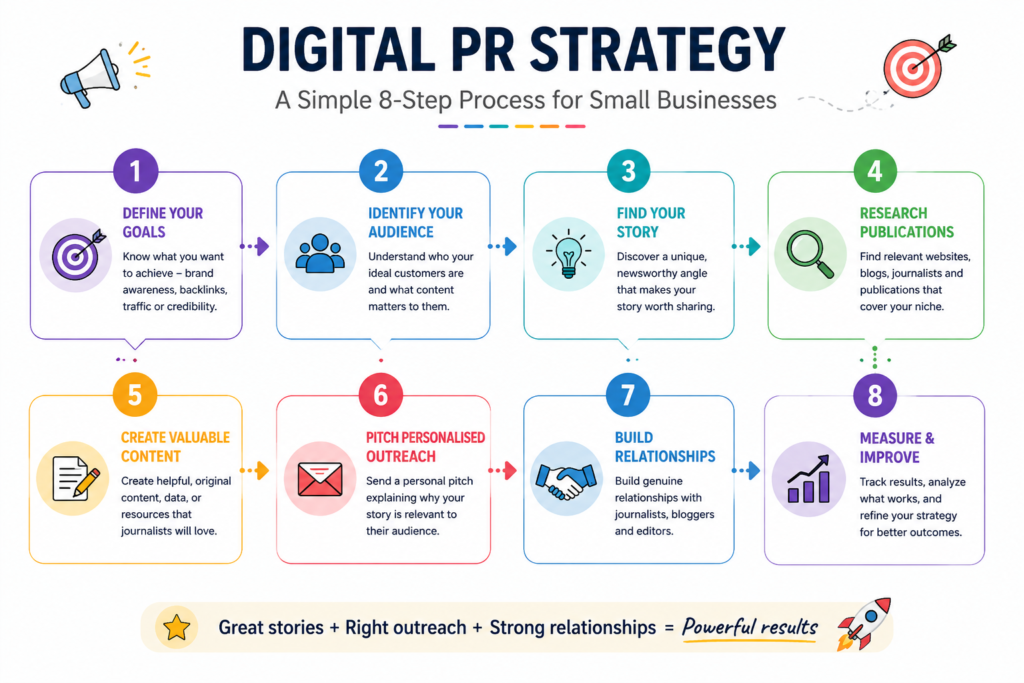
Step 1: Define Your Goal
Make a decision: are you aiming for brand awareness more than backlinks, referral traffic, or all of the three? Your goal dictates everything that comes next.
Step 2: Select Your Audience
Get specific about your target — hobbies, region, what they read.
Third step: Explore Your Uniqueness Story
Look inward first. What makes your business truly interesting to outsiders — what you know, see, or experience?
Step 4: Research Relevant Publications
Make a list of websites, blogs, and local media that already talk about your industry, your city, or your audience.
Step 5: Create Useful Content
Construct the article, data point, or resource that you will be able to use to help your outreach. You’re not asking for a favour; this is what you are here to offer.
Step 6: Draft a Personalised Pitch
Be sure to name the journalist or editor, cite their writing if possible, and stick to just a couple of short bullet points.
Step 7: Build Relationships
See journalists and bloggers as part of a relationship, not just a way to make your pitch once. Also, if you do good work for a publication, they’re most likely to cover you again.
Step 8: Measure Results
Know what coverage you got, where it led, and use that to sharpen your next outreach.
When taken together, these eight steps create a concrete, repeatable digital PR process that a business owner can execute without external support.
Breaking down Digital PR on a Budget
This is important because most small businesses simply cannot afford a PR agency, and they do not need one in the first place, really.
- Expertise of the founder — your own expertise.
- Journalist Questions – Services that are basically the same as HARO-style platforms where reporters ask for experts’ input on stories they are writing.
- Expert commentary — a calculated response is recommended if a publication has put out a call for quotes on a hot topic.
- For example, original data, e.g., a brief internal survey, could lend itself to the foundation of a pitch.
- Local media — regional newspapers and other city-centered websites are normally more accessible than national ones.
- Industry communities —across forums, associations, and online groups that you have, which journalists scour for sources.
- Strategic partnerships — lock in strategic alliances with other businesses that do something complementary and join forces to tell a bigger story.
- Guest contributions — one article for a pertinent publication with an author box link
- Useful resources – free tools, guides, or templates that other websites will want to cite and link back to.
- Public conversations on social media — interacting with journalists and industry voices helps build visibility over time.
All of these do not require spammy link-building tactics, and none of them are unrealistic for a spicy lean business. The heart of India is really here — it is about being resourceful rather than the size of your budget.
Digital PR vs Link Building
| Factor | Digital PR | Traditional Link Building |
| Main focus | Storytelling, media relationships, and coverage | Acquiring links, often at scale |
| Backlinks | Obtained naturally as a peripheral product of coverage | The primary, but often only goal |
| Brand awareness | A core outcome | Rarely a consideration |
| Media exposure | Central to the process | Not typically involved |
| Relationship building | Ongoing, with journalists and publications | Often transactional or one-off |
| Long-term value | Ace you Reputation and Coverage Repeat | Can drop if the links were removed or are of low quality |
The difference is rather clear from the table. Link building has links as the output. Small Business Digital PR not only considers links as an outcome of doing something newsworthy — the kind of thing which is less risky and tends to last much longer in the long run.
Mistakes: 8 Digital PR mistakes small business owners should avoid
It can not only flop but also do more harm if it repeats a few avoidable mistakes.
- Clichéd Pitches — Many journalists can spot a bland, copy-paste pitch from a mile away.
- Overly narrow approach to backlinks — resulting in pitches with a weak foundation and, remarkably, ignoring what the actual readers of that publication care about.
- Making Wobbly or Non-Stories — Not every announcement actually qualifies as news, and banging it through the system rarely works.
- Targeting the Wrong Publications — A misalignment between your story and it being a fit for this publication means wasted time for everyone involved.
- Sending outreach emails — Sending mass, non-personalized emails is almost always ignored or marked as spam.
- Looking Past Local Media — Regional Coverage Is Usually More Accessible, And Just As Important For Small Business SEO.
- Failing to follow up properly — One email is rarely sufficient, yet following up too aggressively backfires.
- Expecting to see results overnight — the effects of coverage and its SEO benefits take time and build over weeks, if not months.
- Not measuring results — if you don’t track, you will never know what stories/pitches have worked and which haven’t.
Getting Started with Your Digital PR Metrics
Results-driven is more than just looking at link count:
- Backlinks earned — Number and type of links from authoritative websites.
- Referral traffic — Visitors arriving on the site directly from articles or mentions.
- Brand mentions — when your business is mentioned even if not linked.
- Media placements — How many publications you end up being featured on and the quality of those articles.
- Search visibility — how are your rankings for relevant terms?
- Branded Searches — an increase in the number of people searching for your business brand directly.
- Website traffic — general activity in visits, mainly during the period of coverage.
- Engagement — the interaction of visitors from PR driven traffic after this traffic gets to your website.
- Leads driven — enquiries, sign-ups, or sales attributed directly to coverage.
If you only score success purely based on the backlinks earned, you are missing most of the real value. One piece of well-placed content that creates trust and real referral traffic can be worth more than ten amazing pieces of content that are hard to remember.
A Small Business Digital PR Plan
Okay, if all this still sounds a bit wishy-washy for you, here’s a real-life example of how it could be done in practical, no-holds-barred month.
Week 1: Research and Preparation
Know your story angles, compile your 15–20 relevant publications and journalists, and clarify what you want to achieve that month.
Week 2: Content Story Development
Create the content asset (i.e., an article, data summary, or case study) that will underpin your outreach.
Week 3: Outreach
Submit pitches gradually, in small batches. Do keep track of whom and when you contacted.
Week 4: Follow-Up and Measurement
Revisit anyone who hasn’t responded, assess what has worked to fine-tune your strategy next month.
Having a 30-Day Plan like this makes it realistic. You do not need a full-time PR person — just regular, targeted effort from someone who already has an understanding of the business.
Final Takeaway
Digital PR’s not just for brands with the biggest budgets either. These are the ones who will come up with a really exciting angle of a story and reach out constantly to the best people to spread it. To be clear: it is not a quick win, and it’s not just about getting backlinks — it’s building something worth writing about and pushing it live to an audience that actually gives a shit.
In fact, if you happen to be a small business owner in India wondering how to get started — keep it simple. Choose one pitch, investigate five relevant media publications, and write one honest pitch. From there, the momentum builds, and that small win is usually all it takes to start working Digital PR for Small Businesses into your regular growth playbook.
Guide/FAQ: Digital PR for Small Business Owners
Q1. What Is Small Business Digital PR?
This is the exercise of obtaining media coverage, mentions for your model, and backlinks from applicable online publications and journalists — regardless of traditional press channels.
Q2. How helpful can Digital PR be for small businesses as compared to traditional media outreach?
Yes. It gives smaller brands an opportunity for more visibility, credibility, and backlinks they might not be able to acquire otherwise, or at a much lower price than paid advertising.
Q3. How does Digital PR help SEO?
When relevant websites cover you in their media, the quality of backlinks and brand mentions will be weighed by search engines when assessing the authority of a website.
Q4. What is the cost of Digital PR?
This can be free — at the cost of founder time and expertise — or be a small budget for tools, content creation, or some sporadic freelancer work. That does not necessarily take a big agency retainer to start.
Q5. Backlinks for small businesses – Can Small Businesses Grab Their Backlinks With Digital PR?
Digital PR rarely has backlinks as its main goal (because it still functions more like media coverage), but it often does generate them naturally when implemented correctly.

Nidhi Patel is an SEO and digital marketing content strategist focused on AI SEO, content marketing, blogging, and personal branding. Through TrendChaska, she shares practical digital marketing insights, SEO strategies, and AI tools for beginners, students, and small businesses in India.