
Discover the best HARO alternatives India bloggers can use to get featured in press India and connect with journalist request platforms in 2026.
Introduction
If you are actively engaging in journalist outreach to build high-quality backlinks, brand credibility, and E-E-A-T signals, there is a strong chance you have heard of HARO. However, as this free-to-use platform has evolved in recent years, many Indian bloggers are now seeking reliable HARO alternatives India creators can use. This guide covers what changed with HARO, why Indian bloggers need new options, and which journalist request platforms India creators should consider in 2026.
Whether you are running a niche blog, a small business, or you work as a freelance SEO professional, getting featured in press remains one of the most viable forms of digital PR for bloggers, helping you earn high-authority backlinks, boost brand credibility, and improve your site’s E-E-A-T signals. This article shares actionable, no-fluff advice on how to get featured in press India audiences and journalists will notice.
Why Are Bloggers Looking for HARO Alternatives?
HARO (Help A Reporter Out) was a free platform where journalists would post requests to connect with source experts or contribute to their stories, making it one of the earliest reliable sources of media coverage for bloggers worldwide. The reporter would then select a pitch from a contributor, and credit would usually be given in the finished article, with a name and/or backlink to a website.
Over time, HARO transitioned to a paid platform run by Connectively, a shift that didn’t suit every Indian blogger’s budget, resulting in the search for other journalist request platforms India bloggers can access.
Below are some reasons why a number of Indian bloggers are opting for other options:
- Rising competition for each request
- A shift to paid tiers on many platforms
- A high volume of irrelevant or US/UK-focused requests
- An increased demand for more niche-specific or India-aware platforms
None of this suggests that journalist outreach is no longer viable, rather, a more diverse set of options is needed to find opportunities for getting featured in press India outlets and publications will take up.
Why Indian Bloggers Specifically Need Better Options
Most legacy platforms in this niche are US- and UK-focused, a real issue for Indian bloggers, as:
- Many requests are irrelevant to the Indian market.
- There is a real risk of time zone mismatches reducing a blogger’s chance of a placement.
- Indian journalists and publications are underrepresented on these Western-first platforms.
This is why a mix of both global and India-specific journalist request platforms India bloggers can use is essential for building genuine media coverage for bloggers in local publications. Having one source of journalist outreach only severely limits visibility and placement potential.
Best HARO Alternatives for Indian Bloggers in 2026
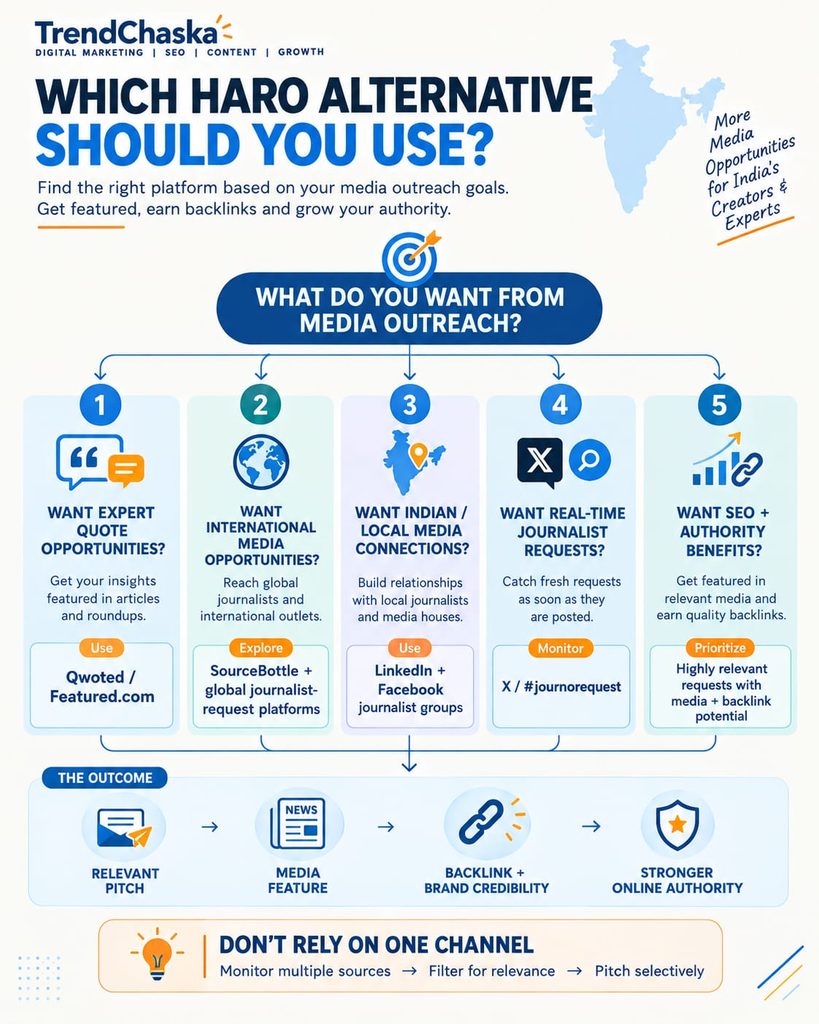
Below is a list of the platforms Indian bloggers commonly use as HARO alternatives India, along with what each option is best suited for. Together, these platforms form the backbone of a solid digital PR for bloggers strategy in 2026. Pricing, request volume, and availability can change, so always confirm this information on the platform itself before committing.
| Platform | Best Suited For | How It Works (General) | India Relevance |
|---|---|---|---|
| Connectively (formerly HARO) | Bloggers used to the original HARO workflow | Journalists post requests; sources pitch via email | Global requests; some may not apply to India |
| Qwoted | PR-savvy bloggers and small business owners | Source profiles are searchable by journalists; also has request-based pitching | Growing use among Indian PR and marketing professionals |
| SourceBottle | Bloggers new to journalist outreach | Journalists post callouts by category; sources respond directly | Originally founded in Australia, used internationally |
| Featured.com (formerly Terkel) | Bloggers wanting quick, expert-quote-style features | Experts answer specific questions; best answers get published | Useful for building a portfolio of media mentions |
| X journalist hashtags (e.g., #journorequest) | Bloggers comfortable with real-time pitching | Journalists post requests directly on social media | Increasingly used by Indian journalists and freelancers |
| Local Facebook and LinkedIn journalist groups | Niche bloggers, regional experts | Journalists post requests inside closed groups | Strong for India-specific and regional press requests |
An efficient approach for Indian bloggers is to not rely on just one platform, rather, use these journalist request platforms India creators use as a rotating toolkit, checking two or three regularly rather than trying to monitor everything at once.
Global Platforms vs India-Focused Channels
Global platforms give you access to a larger volume of requests, increasing your chances of finding something relevant. India-focused channels, like journalist groups on LinkedIn or Facebook, tend to have fewer requests but a much higher relevance for Indian bloggers.
The most effective approach combines both global and local platforms. Use global platforms for volume and use India-specific groups or social media monitoring to find requests that are genuinely a fit for your niche, giving you more consistent media coverage for bloggers across the year.
Step-by-Step Process to Respond to Journalist Requests
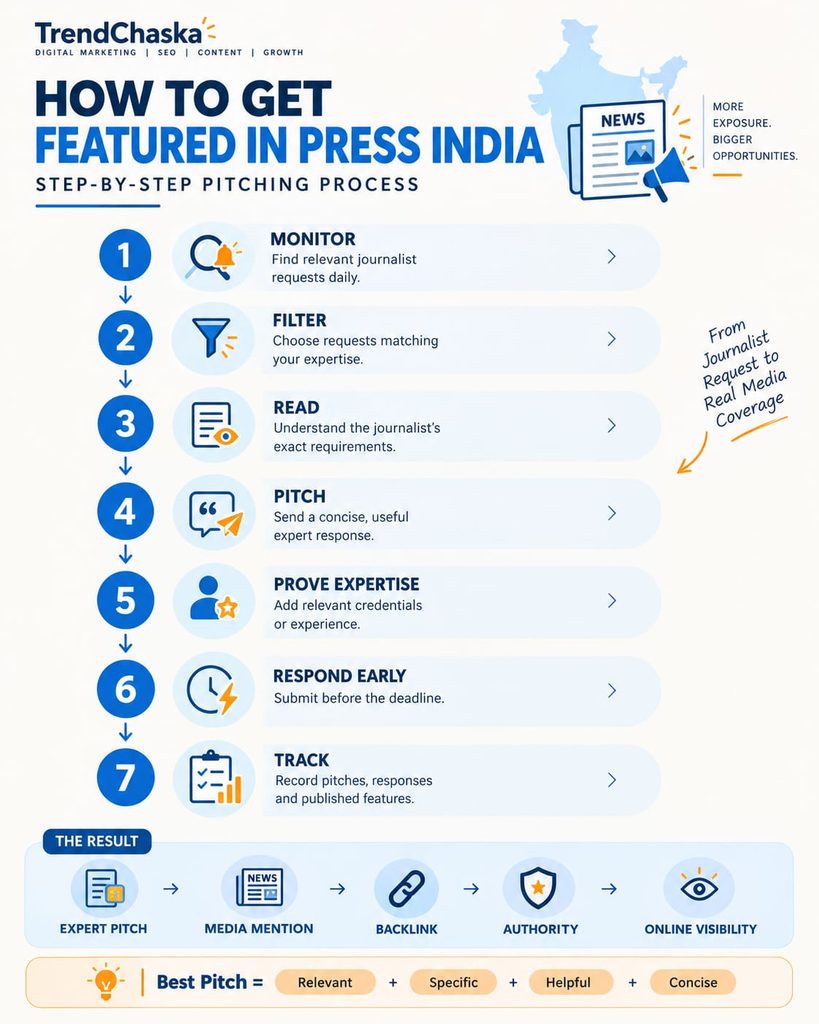
Getting featured in press is rarely a matter of luck, it is a matter of a consistent, repeatable process, the same discipline that underpins good digital PR for bloggers. Here is a practical guide Indian bloggers can follow.
- Set up daily or alternate-day monitoring. Subscribe to relevant categories on your chosen platforms and check journalist hashtags on X at least a few times a week.
- Filter requests by relevance first. Skip anything that is clearly US or UK-specific unless the request is genuinely open to a global or Indian perspective.
- Read the full request carefully. Note the deadline, word count expectations, and exactly what the journalist is asking for. Many pitches get rejected simply because they ignore the brief.
- Draft a focused response. Answer the specific question first, then add supporting context. Avoid generic introductions about who you are before answering the actual query.
- Include your credentials briefly. One or two lines about your expertise or blog niche is usually enough. Journalists are scanning quickly, not reading a full bio.
- Send before the deadline, ideally early. Journalists often stop reviewing responses once they have enough usable quotes, so early responses have a real advantage.
- Track what you send. Keep a simple spreadsheet of the platform, request topic, date sent, and outcome. This helps you understand which platforms and topics work best for you over time.
Quick tip: This step-by-step approach is the backbone of any approach to getting featured in press India media outlets that will pick up, because consistency matters more than any single well-written pitch.
How to Write Pitches That Actually Get Noticed
Journalists receive a high volume of responses for every request, so a generic pitch rarely stands out. A few practical tips:
- Lead with the answer, not your introduction. Journalists want the quote or insight first, not three lines about your background.
- Keep it concise. A tight 100- to 150-word response is often more useful to a journalist than a long, detailed one.
- Use specific examples or numbers where you genuinely have them. Vague statements are easy to skip; grounded, specific insight stands out.
- Match the tone of the publication. A pitch for a business publication should read differently from one aimed at a lifestyle blog.
- Offer a unique angle. If you can add a perspective others are unlikely to submit, especially an India-specific one, it increases your chances significantly.
- Proofread before sending. Typos and unclear sentences are one of the fastest ways to get skipped, regardless of how good the insight is.
Common Mistakes Indian Bloggers Should Avoid
- Pitching every request, regardless of fit. This wastes time and can hurt your reputation with a platform over time.
- Ignoring the deadline or word count. Journalists work on tight schedules and will move past submissions that do not follow instructions.
- Writing overly promotional responses. Journalist requests are not the place for a sales pitch about your blog or business.
- Forgetting to follow up appropriately. A brief, polite follow-up is fine if genuinely relevant, but repeated follow-ups can come across as pushy.
- Not tracking results. Without tracking, it is difficult to know which journalist request platforms India bloggers should prioritize going forward.
- Expecting instant results. Media placements from journalist requests usually build up gradually, not overnight.
Conclusion
The shift away from the original HARO model does not mean journalist outreach is any less valuable for Indian bloggers. If anything, using a mix of global and India-aware journalist request platforms India creators rely on gives you a stronger, more sustainable form of media coverage for bloggers and a way to build backlinks and get featured in press India audiences trust. The key is consistency: monitor regularly, pitch selectively, and track what works.
If you are building out your blog’s authority and looking for a structured way to plan content, backlinks, and press outreach together, TrendChaska can help you put together a practical roadmap suited to your niche and goals. Reach out to us to talk through where journalist outreach fits into your broader SEO strategy.
FAQs:
1. Is HARO still available in 2026?
HARO’s original free model was folded into Connectively, which now operates under a different structure. Always check the platform directly for its current pricing and features before relying on it.
2. What are the best free HARO alternatives India bloggers can use?
Several platforms discussed above, including SourceBottle and journalist hashtag monitoring on X, offer free or low-cost ways to find journalist requests. Confirm current pricing on each platform, as this can change.
3. Do Indian bloggers really get picked by international journalists?
Yes, particularly when the request is open to a global perspective or when the blogger offers a genuinely India-specific angle that adds value the journalist cannot easily source elsewhere.
4. How long does it take to get featured in press India outlets after pitching?
This varies greatly by platform and topic. Some journalists respond within a day, while others may take weeks or may not respond at all if they have already found enough sources.
5. Do I need a large blog following to get featured?
No. Journalists are usually looking for relevant expertise or a useful quote, not follower count. A smaller, focused blog can still land placements if the pitch is strong and relevant.
6. Can journalist placements actually help my SEO?
Yes, when a placement includes a backlink to your site, it can support your site’s authority signals. This is exactly what makes digital PR for bloggers so valuable, even placements without a direct backlink can help with brand visibility and credibility.

Nidhi Patel is an SEO and digital marketing content strategist focused on AI SEO, content marketing, blogging, and personal branding. Through TrendChaska, she shares practical digital marketing insights, SEO strategies, and AI tools for beginners, students, and small businesses in India.