
An example of a thin-content SEO audit—how we found low-value pages, identified what to fix, merge, or delete, rebuilt them around search intent, and improved rankings.
Introduction
We had a very odd complaint from one of our clients. They had a nice backlink profile, over 400 pages indexed on their site, and a blog that had been posting regularly for close to three years. But organic traffic had plateaued over the two previous quarters, and more & more pages were resting on search results page three, four… with zero impressions.
It appeared that nothing had broken at first glance. There were no manual actions, crawl errors, and nothing technically horrible. Once we had extracted the full page-level data and read through the underperforming URLs one by one, however, a pattern emerged almost immediately: dozens of pages that existed and ranked for nothing useful with little real content. Here’s how that thin content SEO issue was diagnosed and resolved — plus what we would tell any other site owner dealing with something akin to this.
What Is Thin Content?
Search around, and you will find that the term “Thin content” seeps into the SEO conversations quite often, but it rarely means the same thing. Probably the most common mistake people make is thinking thin content is all about word count — a 300-word page is automatically thin, and a 2,000-word page is automatically good. This is not true, and treating it as such will be one of the quickest ways to improve your website worse, not better.
The fact is that a short page can be more worthwhile. Someone might have just been looking for a quick answer to the question they asked you or a really simple product spec sheet, or even a one-paragraph definition page. It had nothing to do with length. Thin content actually is identified by value: does the page give something that deserves enough time to a visitor, or does it simply take up space on a URL?
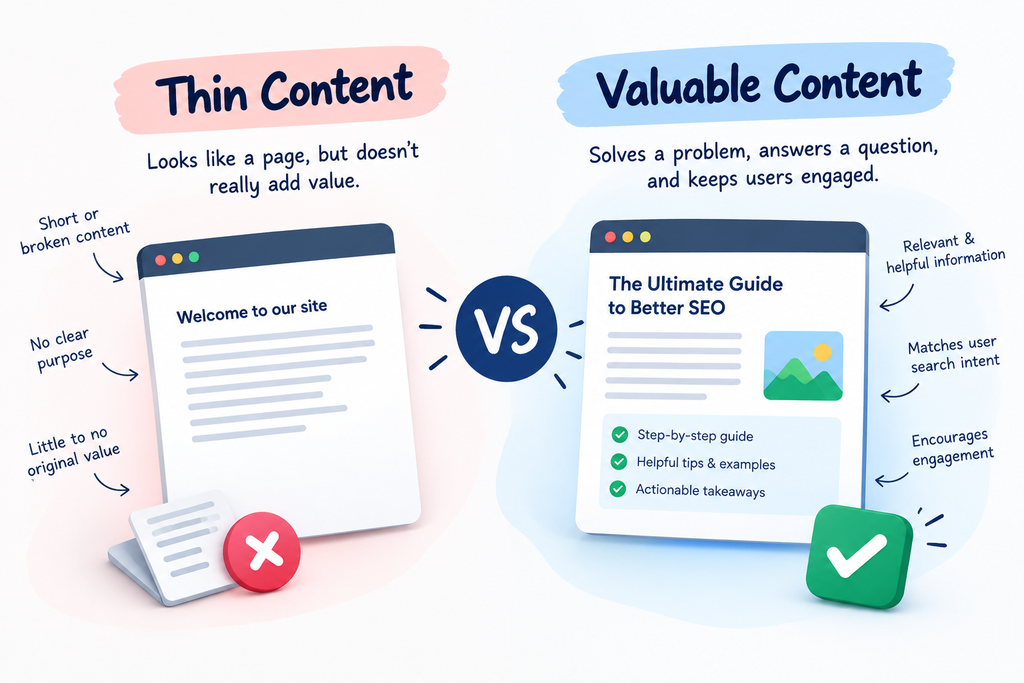
In practice, the thin content is generally of a small number of identifiable types:
- Abstracts with not much original content. Content that restates information found elsewhere on this site, or anywhere else on the web—without really delivering any new material.
- Landing pages that fail to please search intent. The page says something about the topic, but fails to cover the searcher intent behind it.
- Pages that were constructed with the primary intent to target a keyword. Any content made due to a keyword tool warning that certain term, rather than having real user need behind it.
- Competing Near-duplicate pages. Multiple pages about pretty much the same thing, diluting authority and leaving both users and search engines confused as to which should rank.
These have nothing to do with length. They’re about whether the page deserves to be in the index. That difference became the touchstone of the whole audit.
Thin Content Can Be A Problem
It’s worth being specific here, because much of the SEO content overstates how thin content works. It does not incur an automatic penalty, nor is it a ‘ban’ on ranking your site. The actual problem is far more practical than dramatic.
If a site has tons of thin content, some things usually occur:
- Crawl and indexing resources become scarce. This results in search engines wasting time crawling pages that do not add any value, rather than spending the necessary attention on those that do.
- Internal linking gets diluted. If link equity keeps flowing in the direction of pages that do not convert or rank, then those currently performing often have little support.
- User signals suffer. When visitors hit a thin page and immediately bounce back to the SERPs, that weak engagement signal is sent quietly into the ether, but without consistency, just as we discussed earlier, it impacts how the entire site is perceived over time.
- This makes building topical authority more difficult. These days, and with so much information available, a few detailed pages will typically win out over lots of shallow ones covering the same ground.
All of this has nothing to do with search engines “punishing” a site. That thin content rarely, by itself, earns rankings without other forces at work.
Starting the SEO Audit
It did not start with guessing which pages were in some way “thin.” Instead, it was harnessing data and letting the data lead you in the right direction. Multiple data sources are needed to execute a proper thin content SEO audit, because no single metric tells the complete story.
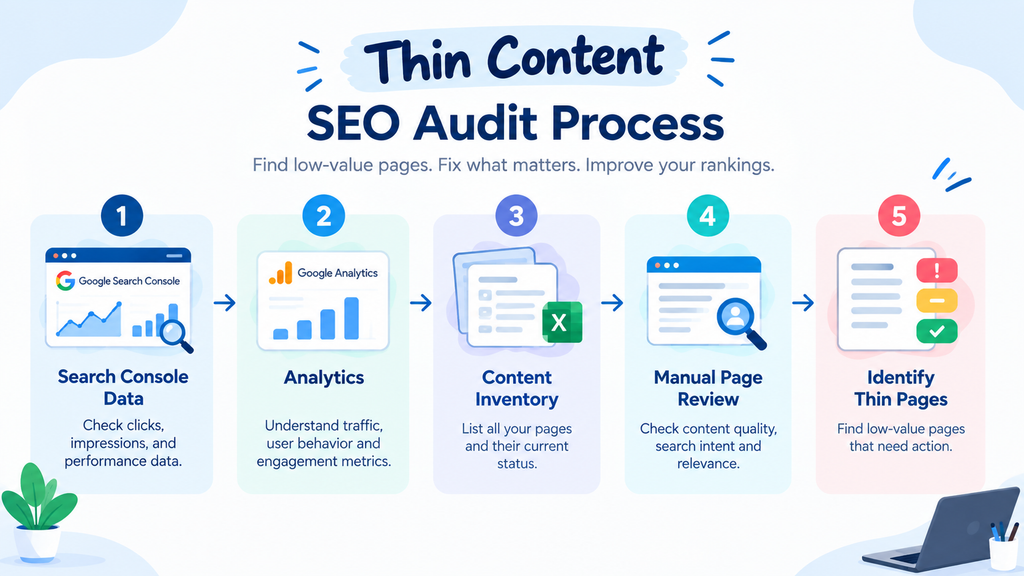
We combined:
- Search Console data, filtered by page-level metrics to see which URLs had impressions with near-zero clicks or lost visibility over the past 12 months.
- Engagement analytics data for organic landing pages (average time on page + bounce behavior)
- A complete content inventory — this is a list of every indexed URL, including word count, publish date, last updated date, and topic.
- Manual page review, reading a sample of the flagged pages to assess their quality, rather than simply looking at numbers.
To keep this simple, though, here is a simulated view of that inventory (these numbers are provided in the interest of illustration only and do not represent reported results):
| Page type | Approx. pages | Avg. organic clicks/month (example) | Notes |
| Well-performing pages | ~60 | 40+ | Top 10 ranking, intention averting |
| Thin or low-value pages | ~85 | 0–3 | Few unique contents, low or no rankings |
| Duplicate/overlapping pages | ~30 | Varies, split across pages | Competing for the same intent |
| Outdated but salvageable pages | ~25 | 2–8 | Useful topic, needs updating |
As organized this way, the scale of the problem jumped out at me. About a quarter of the sites indexed URLs were driving virtually no organic traffic, and many of those weren’t individually unique problems — they each wanted to compete for the same search intent.
Know What To Do With Each Page
This is the thin content SEO project step that is likely to get left out too often. It would be easy to treat every flagged page the same — usually just “add more content” — but that’s not really a strategy, and it often makes things worse when pages are padded with filler.
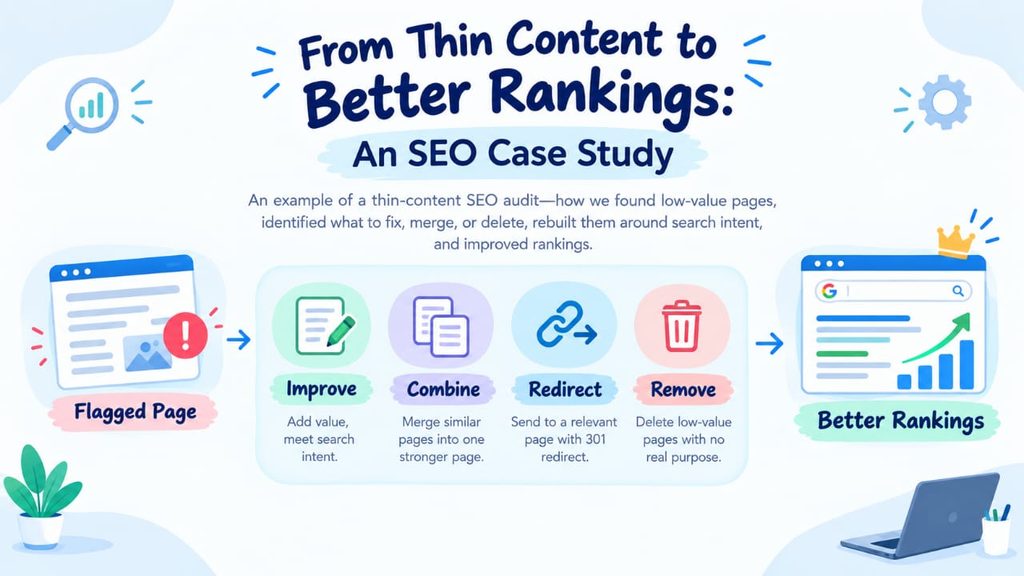
Instead, any flagged URL went through the same decision process:
- Improve. It was on topic, there was real search interest, and the page could really be redesigned to meet intent. This was the case for pages where the idea is there, but it was executed poorly.
- Combine. Several pages examined the same narrow topic from slightly different perspectives. Instead of competing against itself, these were consolidated into one completely relevant page with an appropriate redirect strategy so nothing fell through the cracks.
- Redirect. There was simply no reasonable way for some pages to ever be useful—they were built on keywords that weren’t relevant anymore, or the topic covered there would be better presented elsewhere in the site. This was a 301 redirect to the closest, most relevant page.
- Remove. In a handful of instances, they had zero search demand, no internal value, and as such felt there was no practical opportunity to improve the page. Instead, they have been removed with the correct status codes at least, rather than being left to rank nowhere in peace.
In our case study, this generally meant that around half the flagged pages were improvement candidates, a third merged and subsequently split between redirects and removals. That mix will be different site to site — the ratio is not the important part; what is actually doing it rather than defaulting simply to “hack some more words in there.”
How to Fix Thin Content Without Just Adding Words
When identifying the pages that require improvement, the guidance to the content team was intentionally narrow: we are not looking to write a longer page. To improve its utility.
That distinction shaped every rewrite. The process looked like this:
- Re-check search intent first. We wanted to know what was actually ranking for the target query before we touched the page. A high word count might have been justified if it was a product description competing with comparison tables in the top results.
- Fill real information gaps. We didn’t just make sentences longer; we considered what a reader would still need to know after finishing the page — pricing context, comparisons, common mistakes for each game class and skill specialisation, specific examples of games you might play (or not) — and added only that.
- Cut what didn’t add value. Lots of pages with padding: repetition, abstract leads, filler sentences that existed only to meet a word count. Oftentimes that removal made a page feel slightly more complete the shorter it had gotten.
- Update outdated information. Many of those “thin” pages weren’t thin when they were created — they’d just gone stale. Updating dates, numbers, and examples made pages relevant again — without a full overhaul.
- Write the page in relation to the real question at hand. Fracture in the content: headings were direct answers at the top and near-inversion to flow, which made parsing (for readers as well as search engines) of such pages easier.
This is primarily where content quality and the value of SEO content optimization intersect. The strong structure doesn’t matter if the underlying substance is weak, and no amount of on-page optimization can fix a page that fails to really answer the question it’s targeting.
Importance of Internal Linking and On-Page SEO
Frankly, rewriting the pages was just one side of the job. A perfectly written page struggles if no signal is pointing to it and nothing is telling search engines where the page fits in the rest of the set.
We divided the pages that are improved and combined into two categories:
- Fetched internal links from related, authoritative pages linking to this enhanced content with a descriptive anchor text as opposed to generic phrases such as “click here.”
- Searching and related-content areas enhanced so improved pages were actually discoverable, not just technically live.
- Title tags and meta descriptions reviewed to match what was revised, but also the intent of actual searches and not the previous version of a page.
- Checked the header structure so each page had one clear H1 followed by a logical hierarchy and not scattered or duplicated headings.
This is not the unusual on-page SEO guide you were expecting. The important part is that it was applied only to the pages just rebuilt, so the better content could potentially be discovered, crawled, and understood in context — as opposed to sitting improved but alone.
After the changes, we have monitored everything that was not running.
This is what most case studies don’t focus on, and this was always going to be the most likely important part. Repairing thin content is not a one-off job that you can mark as “completed” on the day the page goes live. The actual signal accrues from what occurs after, over weeks and months, NOT days.
We tracked:
- Merged and redirected pages status – old URLs are handled properly so they don’t get more visits or compete with the new ones
- Search Console impressions and average position for these queries, looking for a gradual movement rather than an overnight leap.
- CTR because an optimized meta description or title can move CTR before rankings do.
- Metrics such as time on page and scroll depth, as an early indicator of whether the rewritten content was satisfying actual visitors.
- Organic traffic trends, both at the page-level and site-level. Knowing that a small number of pages stick can often take a long while to become visible in aggregate numbers.
What we did NOT do was promise any outcome of having “25 positions jump (from 50th position to the 3rd position)” or “300% increase in traffic.” Those sorts of numbers appear all over the SEO marketing world, but they’re not reasonable promises, and representing them as a given result does a disservice to anyone who is trying to plan any real work. What is realistic, however, is a slow, controlled improvement in visibility and engagement for pages that deserve to be ranking now — but an easier-to-follow and more efficient site architecture overall.
Even with this information about open-source success specific to public engagement, there are general lessons for any kind of website.
A few lessons from this project stand the test of any type of industry or site size:
- Audit before you rewrite. To fix thin content SEO issues at scale without data is to guess. A proper audit will inform you of which pages deserve to be kept and which ones do not.
- Not all the least-thin pages need to be optimized. Sometimes the answer is not to recast, but rather to combine or be more ruthless and cut. If we treat every low-performing page like a “needs more content” case, we’re wasting time working on pages that were never aligning.
- The real measure of success is search intent. A page isn’t thin because it is short — it is thin because it’s not exactly what the searcher wanted. Firstly, you match intent to the page, and length normally sorts itself out.
- It is the pages, but also your links — and that leads me to the internal link. However, no great page performs up to its potential if it’s not properly linked to the rest of the site.
- Monitor, don’t assume. It can take time for improvements to show in rankings and organic traffic. Tracking the right metrics will show you if the changes are working long before it shows in the overall traffic numbers.
Final Thoughts
The thing about thin content SEO problems is that they rarely blow their own horns. They manifest as a slow roll of pages that technically exist but quietly fail to deliver, like rotting pages spread throughout a site until someone drags the data and examines it. The solution does not come from stuffing short pages with irrelevant paragraphs, but rather knowing what each page is really for, determining frankly if it deserves to live on its own, and rebuilding the ones that do around what searchers are actually looking for.
That’s the main takeaway from this case study, and it’s a methodology we would take to any site struggling with website visibility, stagnant organic traffic, or a content library that has outgrown its quality: audit first, decide methodically, build for usefulness — not word count.
Frequently Asked Questions
1. How do I know whether my content is really thin or just short?
Instead of counting words, check your page and see if it answers the search intent behind its intended search query. If a short page answers the specific question and nothing else, that is not thin content. A single long page which regurgitates the same boilerplate content without offering any value is, in general.
2. What would cause a Google penalty for thin content?
Not a manual review in most cases. Thin pages may not rank well, but they also dilute crawl budget, internal linking value, and overall site quality signals, which negatively impacts other parts of the site’s SEO success.
3. Now, is it a must to rewrite the thin pages or can I delete these?
It depends on the page. What makes sense, though, is to improve them if there is actual search demand and it fits on your site. When combining pages, it is often better to combine them when several overlap. With no search demand, and no organisational value, it can be smarter to redirect or remove a page entirely.
4. Time it takes to see results after fixing thin content?
It will be different by site authority, competition, and how big of changes were made, so there is not a specific timeline. Watch for what used to be known as indexation status, impressions, average position, and engagement metrics on the website over weeks or months rather than throughout the day to find a leap in rankings.
5. To fix a thin page, is adding more words the best approach?
The goal is not word count — but useful information. Instead, the right strategy is to determine what information has been missing, strip out redundancy and only provide value in your content, and organize around true search intent—the final page may be shorter than the original capture of material.

Nidhi Patel is an SEO and digital marketing content strategist focused on AI SEO, content marketing, blogging, and personal branding. Through TrendChaska, she shares practical digital marketing insights, SEO strategies, and AI tools for beginners, students, and small businesses in India.