Learn email marketing for small businesses India. Discover free tools, automation tips, and proven ways to grow sales in 2026.
Introduction
If you’ve been putting all your marketing eggs into Instagram and WhatsApp, you’re not alone — and you’re not wrong. But there’s a channel that quietly outperforms both of them in terms of return on investment, and most Indian small businesses haven’t touched it yet.
Email Marketing
Email marketing for small businesses India is becoming one of the most reliable ways to generate repeat sales and build direct customer relationships.
Before you scroll past thinking “emails are for big corporate companies,” hear this: a well-built email list of 500 genuine subscribers can generate more consistent sales than a 10,000-follower Instagram page where your posts reach maybe 3% of your audience on a good day.
Social media algorithms decide who sees your content. With email, you own that list. Nobody can take it away from you, shadow-ban it, or tank your reach overnight with a platform update.
This guide is specifically written for Indian small businesses — with INR pricing, Indian tool comparisons, and real examples you’ll actually recognize. By the end, you’ll know exactly how to start building your email list today, which free tools work in India, and how to send your first campaign without spending a single rupee on ads.
[KEY TAKEAWAY]
Email marketing gives you a direct, algorithm-free line to your audience. A list of 500 genuine subscribers can outperform a 10,000-follower Instagram page in actual sales — because you own the channel, not the platform.
What Is Email Marketing and Why Does It Work?
Email marketing is the practice of sending targeted emails to a list of people who have voluntarily shared their email addresses with you. The key word there is voluntarily — these aren’t cold emails, and they’re not spam. They’re messages sent to people who raised their hand and said “yes, I want to hear from you.”
That one distinction changes everything.
When someone gives you their email address, they’re doing something they don’t do casually. They’re trusting you with a direct line to their personal inbox — a space that feels far more intimate than a public social media feed. That trust translates directly into higher open rates, better click-through rates, and more conversions compared to almost any other digital channel.
[STATISTICS CALLOUT]
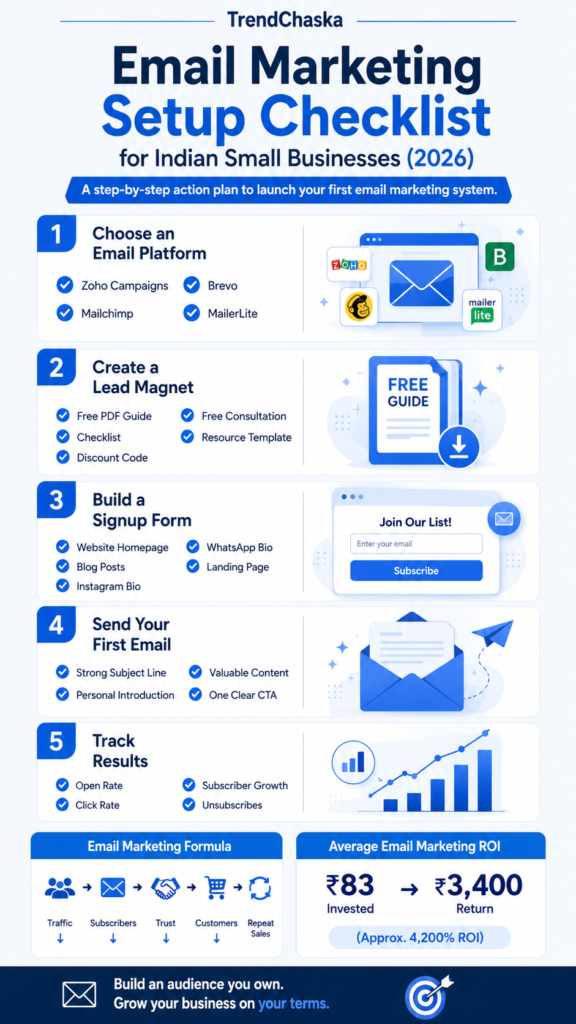
For every ₹83 (~$1) invested in email marketing, the average return is ₹3,400 (~$42). That’s a 4,200% ROI — according to industry research from Litmus and Omnisend. Even a rough approximation of that return in the Indian context would dwarf what most small businesses earn from boosted Instagram posts.
Why does it work so well? Three reasons:
You own the audience. An email list is an asset that belongs to you. Instagram could shut down tomorrow (unlikely, but possible), and you’d lose access to every follower overnight. Your email list lives in a CSV file that you can download and migrate to any platform, anytime.
You control the timing. You decide when your audience hears from you — not an algorithm. This is critical for time-sensitive promotions: sale announcements, limited-time offers, event invitations.
It’s personal by default. “Hi Priya” in a subject line already feels more personal than a generic Instagram post that went to 50,000 people. Email’s one-to-one format creates engagement that broadcast content never achieves.
Why Indian Small Businesses Are Missing Out
At TrendChaska, we frequently talk with Indian students, freelancers, and small business owners who are exhausted from chasing Instagram engagement. They’re posting Reels, running polls, doing everything the algorithm supposedly rewards — and still struggling to convert followers into paying customers.
The conversation usually goes something like this: “My Instagram reach dropped again. Should I post more?”
The real answer is often: “Have you started an email list yet?”
The honest truth is that email marketing has a bit of a perception problem in India. Many people still associate it with spam inboxes full of irrelevant offers. And yes, bad email marketing exists everywhere. But good email marketing — the kind built on permission, value, and consistency — is an entirely different experience. It’s also something very few Indian small businesses are doing well, which means the competition for inbox attention is far lower than the competition for social media attention.
The other barrier is tooling confusion. Many Indian business owners assume email marketing requires expensive software or technical expertise. Neither is true, especially with the free plans available from modern platforms.
[TRENDCHASKA INSIGHT]
At TrendChaska, we frequently see Indian small business owners struggling to convert their social media followers into paying customers. The common assumption is that posting more will fix it — but the real gap is almost always the absence of a direct, owned channel. Email solves that. The competition for Indian inbox attention is far lower than the competition for social media feeds — which means starting now, while most Indian SMEs haven’t, is a genuine first-mover advantage.
How Email Marketing Actually Works — Step by Step
Before diving into tools and tactics, let’s map the actual mechanics. Email marketing has four moving parts:
- Your list — the database of email addresses you’ve collected from people who opted in to hear from you.
- Your lead magnet or opt-in incentive — the reason someone gives you their email address. This could be a free PDF guide, a discount code, a checklist, a free consultation, or even just a promise of useful, regular updates.
- Your email marketing platform — the software that stores your list, lets you design emails, and handles sending, tracking opens/clicks, and managing unsubscribes automatically.
- Your email content — the actual messages you send. This includes one-off broadcasts (like a sale announcement) and automated sequences (like a welcome series that goes out automatically when someone joins your list).
The process works like this:
Someone discovers your business online — through your Instagram bio, your website, a WhatsApp group you’re in, or a referral. They see a reason to give you their email address (your lead magnet). They enter their details in a simple sign-up form. Your email platform adds them to your list and can automatically send them a welcome email. From that point on, you can reach them directly whenever you choose — no algorithm in between.
Choosing the Right Email Marketing Tool in India (Free Plans Compared)
The good news: you can start email marketing completely free. Here’s an honest comparison of the platforms that work well for Indian small businesses, specifically for the early stage when you have under 500 subscribers.
| Tool | Free Plan Limit | Free Emails/Month | INR Paid Plan (Starting) | India UPI/Card Billing | Best For |
|---|---|---|---|---|---|
| Mailchimp | 500 contacts | 1,000 emails | ₹835/month | Card only (USD billing) | Beginners, global brands |
| Zoho Campaigns | 2,000 contacts | 6,000 emails | ₹415/month | UPI + INR billing | Indian SMEs, Zoho users |
| Brevo (Sendinblue) | Unlimited contacts | 300/day | ₹0 (generous free tier) | Card (EUR billing) | Volume senders on free tier |
| MailerLite | 1,000 contacts | 12,000 emails | ₹835/month | Card only (USD billing) | Clean design, automation |
| ConvertKit (Kit) | 10,000 contacts | Unlimited | ₹2,500/month | Card only (USD billing) | Creators, course sellers |
Our take for Indian small businesses: Zoho Campaigns is the strongest choice if you want INR billing and the most generous free tier. Mailchimp has the best brand recognition and integrates with virtually every tool, but the free plan is now considerably more restrictive than it was before 2022. Brevo’s unlimited-contact free plan is underrated — if you’re sending to a large list infrequently, it’s worth exploring.
One important note: whichever platform you choose, start on the free plan. Don’t pay until you’ve actually sent a few campaigns, confirmed your list is growing, and seen that people are opening your emails. There’s no point paying for features you haven’t tested yet.
[PRO TIP]
If you want to avoid currency conversion hassles and billing in USD, Zoho Campaigns is the only major platform that offers UPI payment and INR-denominated pricing. This alone makes it the most friction-free option for Indian small business owners starting out.
How to Build Your Email List from Zero
This is the part most guides skip over or handle too vaguely. “Create a lead magnet” is standard advice. What that actually looks like for an Indian small business is more specific.
Step 1: Decide What You’re Offering in Exchange for an Email Address
Your lead magnet doesn’t need to be complicated. For most Indian small businesses, the most effective lead magnets are:
- A practical PDF (e.g., “10 Questions to Ask Before Hiring a Digital Marketer in India”)
- A discount code for first-time buyers
- A free resource directly relevant to your niche (a recipe card from a food brand, a sizing guide from a fashion label, a checklist from a services business)
- Access to a members-only WhatsApp group that provides value (educational content, not just promotional)
At TrendChaska, the content we’ve seen convert best for Indian student and professional audiences is specific, actionable, and immediately useful. Vague offers like “subscribe for updates” barely work anywhere in the world, and they work even less in India, where inbox cynicism is high and trust has to be earned.
Step 2: Create a Sign-Up Form and Put It Somewhere People Will Actually See It
Your email platform (Mailchimp, Zoho Campaigns, etc.) will let you create an embedded form that you can paste into your website. If you don’t have a website, you can use the platform’s built-in landing page feature — most offer this for free.
[QUICK ACTION CHECKLIST] — Sign-Up Form Placement
- On your website’s homepage, above the fold
- At the end of every blog post
- In your Instagram bio (link to your landing page)
- In your WhatsApp bio or status
- In your email signature
Step 3: Drive Traffic to That Sign-Up Form Consistently
Your email list grows from the same sources as your other digital audience — social media, blog content, word of mouth, partnerships. The difference is that you’re now routing that audience to a form that captures their email rather than just gaining a follower you might not reach next week.
One tactic that works particularly well for Indian service businesses: promote your lead magnet directly in relevant WhatsApp groups. A well-crafted message with a genuine free offer (not spam) in a relevant community group can add 50–100 subscribers faster than a week of Instagram content.
Step 4: Verify Your List and Keep It Clean
One mistake we frequently see: businesses that imported all their old contacts — WhatsApp numbers, enquiry emails, old customers — into their email platform without re-confirming permission. This is not just bad practice; it’s a path to high spam complaint rates, which damage your sender reputation and can get your account suspended.
Only import contacts who have genuinely opted in. If you have old contacts you want to reach, run a one-time re-engagement campaign asking them to confirm they want to hear from you. Keep only those who respond.
Writing Emails That People Actually Open and Click
The email that never gets opened does nothing. Here’s a practical framework for writing emails that work.
Subject Lines
Your subject line is the single most important part of your email — because it determines whether the email gets opened at all. Spend as much time on your subject line as you do on the email body.
| What Works in India | What Doesn’t Work |
|---|---|
| Specific numbers — “3 email mistakes costing you sales” | ALL CAPS or excessive exclamation marks (flagged as spam) |
| Curiosity gaps — “Most Indian businesses do this wrong with email” | Vague teasers — “Something exciting is coming…” |
| Direct value — “Your free marketing checklist is here” | Clickbait that doesn’t deliver — “You won’t believe this…” |
| Honest urgency — “Sale ends Sunday midnight” |
Email Body: Keep It Human
The tone that works best for Indian small business audiences is the same tone a helpful friend uses — direct, warm, not corporate. Write like you’re talking to one specific person, not broadcasting to a database.
[QUICK ACTION CHECKLIST] — Email Body Structure That Works
- Open with something relevant — a real observation, a relatable problem, a topical hook
- Deliver the value you promised — the tip, the update, the offer
- Include one clear call to action — not three. One.
- Sign off like a human — with your name, maybe a personal note
Email Frequency
Many Indian business owners either send emails every day (which leads to unsubscribes) or every few months (which means people forget they signed up). A consistent weekly or fortnightly cadence is the sweet spot for most small businesses — frequent enough to stay top-of-mind, infrequent enough that your emails feel like events, not noise.
[PRO TIP]
Consistency beats frequency every time. It’s better to send one well-crafted email every two weeks than to post daily for a month and then go silent. Your subscribers will remember you for showing up reliably — not for volume.
Email Sequences vs. One-Off Campaigns — What’s the Difference?
Once you’re comfortable with basic email sending, the real power of email marketing comes from automation.
One-off campaigns are emails you manually compose and send to your list on a specific date. A Diwali sale announcement, a new product launch, a blog post roundup — these are campaigns.
Email sequences (also called automated flows or drip campaigns) are pre-written series of emails that go out automatically when triggered by a subscriber action. The most valuable sequence for any new email marketer is a welcome sequence — a series of 3–5 emails that goes out automatically when someone joins your list.
A basic welcome sequence for an Indian small business might look like this:
| Email # | Timing | Content |
|---|---|---|
| Email 1 | Immediately on sign-up | Welcome + deliver the lead magnet promised |
| Email 2 | Day 2 | Your story — who you are, why you do what you do |
| Email 3 | Day 4 | Your best piece of content or your most useful free resource |
| Email 4 | Day 7 | Social proof — a testimonial, a result, a case study |
| Email 5 | Day 10 | Your soft offer — introduce what you sell, no pressure |
This sequence runs 24/7 without you doing anything. Every new subscriber automatically gets nurtured before they ever hear a sales pitch. That’s the foundational efficiency that makes email marketing genuinely scalable for small businesses with limited time.
[KEY TAKEAWAY]
A 5-email welcome sequence is the single highest-leverage automation any Indian small business can set up. It runs on its own, builds trust before any sales pitch, and works while you sleep. Set it up once; it works forever.
Common Email Marketing Mistakes Indian Businesses Make
5 Email Marketing Mistakes Indian Businesses Make
Mistake #1: Buying an email list. Purchased lists are full of unverified addresses, people who never asked to hear from you, and potential spam traps. Your emails will go directly to spam, your sender reputation will tank, and your account may get suspended. There are no shortcuts here — grow your list organically.
Mistake #2: Ignoring mobile optimization. Over 85% of Indians access email on their phones. If your email looks broken on mobile, you’ve already lost. Use your platform’s mobile preview before every send. Keep subject lines under 50 characters. Use single-column layouts. Make CTAs easy to tap.
Mistake #3: Never cleaning your list. An email list with a 10% open rate sounds small, but if the other 90% of addresses are either fake, abandoned, or unengaged, you’re paying for storage of dead weight that actively hurts your sender score. Run a re-engagement campaign every 6 months and remove contacts who haven’t opened anything in 6+ months.
Mistake #4: Sending too many promotional emails too soon. One of the most common patterns we see: a business builds a small list, immediately sends three promotional emails in a week, and watches 40% of subscribers unsubscribe. The trust has to come before the pitch. Provide genuine value first. Sell second.
Mistake #5: Not tracking results. Every major email platform gives you open rates, click rates, and unsubscribe data for free. Not reviewing this data means you’re marketing blind. Check your stats after every send. What subject lines got the best open rates? What content got the most clicks? Use that data to get better.
Email Marketing on a Budget: What ₹0 Can Get You
Let’s be concrete about what the free tier of email marketing actually allows an Indian small business to do:
[QUICK ACTION CHECKLIST] — What the Zoho Campaigns Free Plan Gives You
- Store up to 2,000 contacts
- Send 6,000 emails per month
- Create automated welcome sequences
- Track opens and clicks
- Run A/B tests on subject lines
- Use pre-built email templates
For most Indian small businesses in their first year of email marketing, that free tier is more than enough to build a genuine, engaged list and generate measurable revenue from it — without spending anything.
The paid plans become worth it when your list grows beyond 2,000 subscribers, when you need more complex automation, or when you want advanced segmentation (sending different emails to different groups based on behaviour). That’s a good problem to have — it means your email marketing is working.
[TRENDCHASKA INSIGHT]
Many Indian businesses assume they need to invest significantly before they can start email marketing. Based on what we consistently see, the free tier of Zoho Campaigns is sufficient for the first 12–18 months of list building for a typical Indian small business. The upgrade only makes sense once your list is genuinely active and growing — not as a starting assumption.
Conclusion
If there’s one thing to take away from this guide, it’s this: your Instagram followers are rented. Your email list is owned.
Social media is excellent for building awareness and community. But when it comes to converting that audience into customers — reliably, consistently, without paying for reach every time — email marketing is the channel that actually delivers.
The good news is that starting costs nothing. With Zoho Campaigns or Brevo’s free plans, you can build a list, set up automated welcome sequences, and send your first campaigns at zero cost. The investment is time and consistency, not money.
Start with one thing: create a simple lead magnet, set up a free Zoho Campaigns account, build a sign-up form, and put it in your Instagram bio. That’s it for week one. Build from there.
The Indian small businesses that figure out email marketing in 2026 while most competitors are still fighting for Instagram reach will have a serious advantage in 2027 and beyond.
[KEY TAKEAWAY]
Start with one thing: create a simple lead magnet, set up a free Zoho Campaigns account, build a sign-up form, and put it in your Instagram bio. That’s it for week one. Build from there.
Ready to Build Your Email List?
The biggest mistake most small businesses make is waiting until they “have more time” to start email marketing.
Don’t wait.
Choose a free email marketing platform, create a simple signup form, and start collecting subscribers today. Even your first 50 subscribers can become a valuable business asset over time.
Want to learn more about digital marketing, SEO, AI tools, and growth strategies for Indian businesses?
👉 Explore more practical guides on TrendChaska and start building a marketing system you truly own.
FAQ

Nidhi Patel is an SEO and digital marketing content strategist focused on AI SEO, content marketing, blogging, and personal branding. Through TrendChaska, she shares practical digital marketing insights, SEO strategies, and AI tools for beginners, students, and small businesses in India.