
A short guide to A/B testing for small websites with simple steps, test your ideas, and get traffic tips & tools (for landing pages)—a Handbook For Business Owners and Marketers in India.
Introduction
Consider a small business owner in Jaipur selling handcrafted home décor via the internet. She runs ads on Instagram, posts products on WhatsApp, and gets up to 100 customers each week. But few of them place an order. She starts guessing. Should the button be green? Is the page showing a price too high? Should she add more photos?
This is a problem that many website owners in India deal with. Half the battle is just getting visitors to your website. The other half consists of knowing the actions your visitors take once they reach your page. Do they scroll? Do they fill your enquiry form? Do they leave in ten seconds?
This is where small website A/B testing comes in handy. Rather than changing your site in accordance with opinions, you execute one thing at a time and allow actual visitor habits to decide your course of action.
In this A/B Testing Guide For Small Websites, you will learn the basics of how A/B testing works, what can be tested, how much traffic you need, and tools to consider when implementing an A/B test + mistakes to avoid. It is presented in an accessible way, for people with a basic website background but not statistics.
What Is A/B Testing?
A/B testing, or split testing, is a method of comparing two versions of a web page against each other. This means that visitors are exposed to either Version A or Version B, and then their actions (i.e., filling out a form or making a purchase) are tracked against a predetermined goal.
Here is a simple example:
- Version A (original): Submit button
- Version B (Variant): A button that states “Get my Free Quote”
Your test tool divides visitors among the two variations. To do this, you run an A/B test: some see A, others see B. After enough visitors have passed through, you compare how many people in total clicked or completed the form on each version.
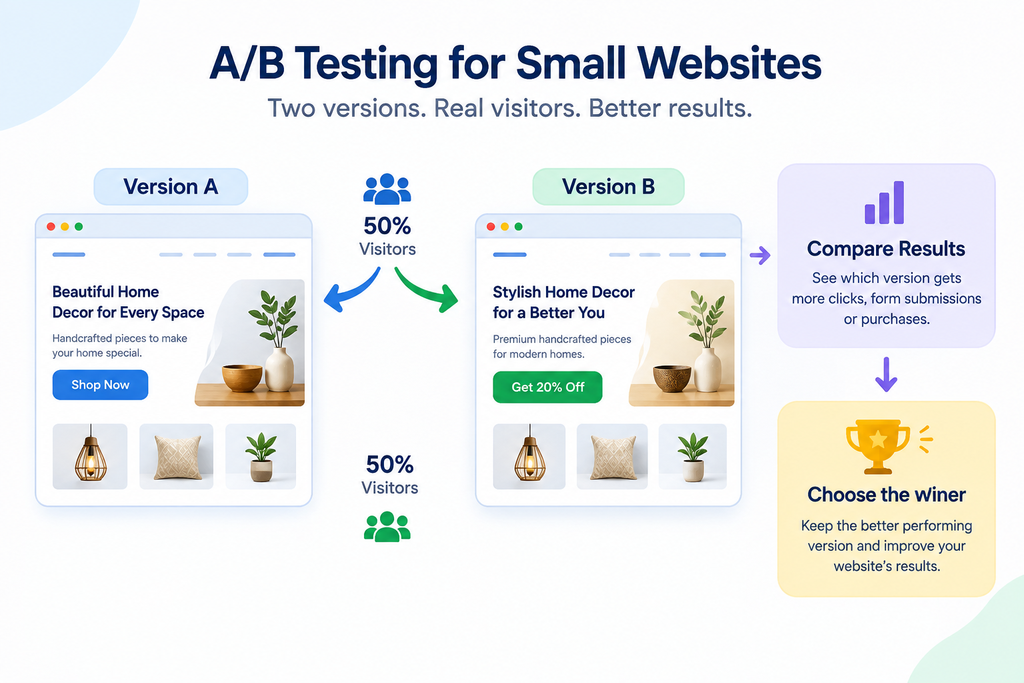
That is, A/B testing on small websites is using the phrase instead of saying I think this looks better to visitors responded that they preferred announcements of this.
Read Next: What Does A/B Testing Mean for Small Websites?
Small businesses typically do not have large budgets for ads and redesigns. That makes every visitor valuable. Testing allows you to do more with the traffic you have.
Here are the practical benefits:
- More conversions: Changes to a headline, form, or button can influence the conversion rate on your website. Testing shows you what works for your audience (which is not guaranteed).
- Know Your Visitors: Every Test Reveals Something About What The Audience Cares Most (Price, Trust or Speed)
- Better call-to-action: You can see what wording or where to place a text that triggers more clicks.
- Improved landing pages: When A/B testing is implemented on a landing page, those built for the ads or campaigns can be fine-tuned.
- Less guesswork: Rather than getting opinions from a friend, designer, or competitor, we base our decisions on evidence.
- Enhanced website decision-making: Eliminate costly redesigns and solutions with little or no tangible improvement.
An honest note: results depend on traffic ⇄ target audience ⇄ industry & quality of test crafted. A/B testing helps you learn; it is not a cure-all. And, of course, some tests will show no winner — which is itself valuable information.
How A/B Testing Works
If you divide the process into steps, it becomes easy:
- Identify a problem. For example, you receive a lot of visitors on your services page, but only a few fill the enquiry form. Use tools like Google Analytics and Microsoft Clarity to identify these types of pages.
- Create a hypothesis. A hypothesis is a guess that can be tested. For instance: “If the enquiry form is reduced from six fields to three, more visitors will fill it out.”
- Make Version A and B. A is treated as it is. Only vary 1 critical component in B.
- Decide the goal. Have one primary objective (i.e., form submissions, WhatsApp clicks, calls, or purchases).
- Run the test. Use some kind of testing tool that randomly splits the traffic between both versions at the same time.
- Collect enough data. Do not conclude after receiving a few folks.
- Compare results. Decide how many days to run the test: The longer you keep your experiment going, the dive into conversion rate for each of the versions, and determine if that difference is statistically significant or simply down to chance.
- Implement the winning variation carefully. Implement the change, continue measuring data, and document lessons learned.
Regardless of whether you are blogging, running a local service site, or an online store, this is the basic A/B testing workflow.
What To A/B Test in Small Websites?
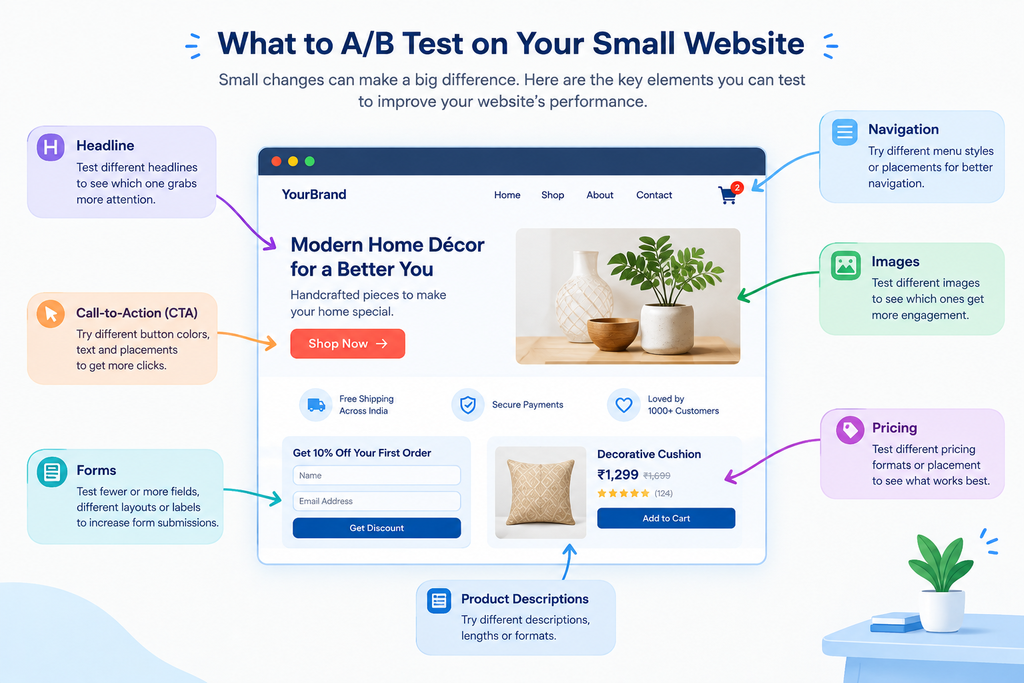
Not every single thing has to be tested. For small websites, your A/B testing should start with things closer to the action – visitors deciding whether or not to enquire/call/buy.
Headlines
Headline testing is generally the simplest place to begin, as it’s the first item visitors see. For instance, a coaching business might run a clear headline like “Learn Spoken English in 90 Days” or the benefit-led “Speak English With Confidence at Work”.
Call-to-Action Buttons
You test CTAs through choice of words, colour, size, and placement. For example, you can compare “Book Now” with “Book a Free Demo Class” as the action that a tutor wants.
Landing Page Layout
You can experiment with placing the enquiry form at the top or after the service details to see what works better. It matters a lot for pages that have ad traffic.
Images
For example, perhaps a restaurant might test a photo of its famous thali against one of the dining room to see which generates more clicks-to-table bookings or orders.
Forms
Long forms can discourage people. Fewer fields to test, or labels are clearer, or the submit button is different.
Product Descriptions
For example, an ecommerce website might compare a short description with a more detailed alternative that specifies material, size, and delivery & returns information.
Pricing Presentation
For example, you could experiment with “₹999” vs. “₹999 (including GST),” or a monthly price versus an annual price. Be careful here. Pricing tests should not only be open.
Navigation
Having too many menu items draws visitors away. Experiment with a simpler landing page menu or just put the “Contact” link more in focus.
Social Proof
Social proof is proof that other people trust you — reviews, a list of testimonials, client logos, or star ratings. Check where it sits and the click direction; you can place testimonials right next to the enquiry form. Only accept real reviews from real customers.
Lead Generation Forms
If you are testing lead generation, you can experiment with the number of fields — a field for a phone number vs. an email field. Or add a line explaining what happens after the visitor submits. For example: “We will get back to you in one working day.”
Start with one idea. We should not test all at once.
Case Study of an Indian Small Business for A/B Testing
Disclaimer: This is a theoretical example used to illustrate how the process works. There is no actual case study, or real performance data is presented.
REMEMBER: Your business idea can be anything
Business – A landing page for a home-cleaning service in Pune where you get the enquiries.
Case Study 4: Superchaps Problem: Google Ads bring traffic to the page, but minimal visitors fill out the enquiry form. Google Analytics data shows a large exit rate at this section of the form.
Hypothesis: A smaller form with a clearer button will produce more enquiries.
| Version A (original) | Version B (new) | |
| Form fields | Full Name, Phone Number, Email Address, Location, Nature of Service Required, Message | Name, phone, service type |
| Button text | “Submit” | “Get a Free Quote” |
This changes two things at a time, so you will not know which change caused any difference. To ensure cleaner tests, typically you will want to first test your form length and in a second test the button text.
What was tested: A/B testing with the form length (button text kept the same).
Objective → No of completed enquiry forms
Possible result interpretation:
- You can keep it if Version B receives significantly more inquiries during a full test period. Lead quality is also one thing that an owner should check, because often shorter forms actually lead to less serious enquiries.
- The form length may not be the actual issue if you’re getting about equal performance from both versions. The subsequent test will probably examine the headline or trust signals.
- If Version B has more leads but fewer of them go on to become payers, the business will have to balance quantity with quality.
The lesson: A test result is data to be interpreted, not an order to follow.
How to Best Select an A/B Test
Due to traffic constraints, A/B testing small websites requires prioritisation. You can not test everything, so choose any web pages that change could generate the most difference.
- Traffic-intensive sites: A higher number of visitors equates to faster, sustained learning.
- High-value pages: Pricing pages, service and product pages that have a direct impact on revenue;
- Pages with low conversions: A poorly converting page means a lot of people came to the page, but fewer acted; there is something to fix.
- Critical landing pages: Landing pages created solely for ads/campaigns need focus because you are paying for that traffic.
- Checkout or enquiry pages: Friction points in this aspect, such as more form fields or an ambiguous delivery charge, can rob you of sales.
Then write down your test ideas in order of possible impact, ease of execution, and page traffic. Take it from the idea that scores highest.
A/B Testing: How Much Traffic Do You Need?
There is no traffic number applicable to every site — so beware of tailored articles. The truth is, A/B testing for small websites really comes down to what your existing conversion rate is and how large of an expected change you have vs. how confident you want to be in the outcome.
- The importance of traffic: Visitors behave at random by nature. A difference of one person is small and could be just a random coincidence if 10 people see Version A and 12 people see Version B. Reading between the lines—more visitors, more conversions.
- The Misleading Small Sample: Flip a coin 10 times at random; you get seven heads. That does not invalidate the coin. Some visitors behave as such and yield results that look valid but are not.
- Statistical Significance Simplified: Statistical significance provides an alternate means of determining how likely it is that a difference between two versions is real or if it could have happened randomly. The majority of testing tools tell you this. The higher the confidence level, the more you can trust the result (but nothing is 100% accurate).
- Avoid ending tests too quickly. When one version is ahead after 48 hours, don’t be tempted to call the winner. A lot of times early leads disappear or are reversed.
Even if your site does not enjoy high traffic, you have options:
- Test bigger changes, like an entirely new page structure, as larger differences are easier to identify.
- Focus on your highest-traffic page.
- Watch how real visitors behave using tools such as Microsoft Clarity, then fix blatantly obvious issues without conducting a formal test.
- Most testing platforms have sample size calculators to predict the visitors required for your case.
How Long Should You Run the A/B Test?
How long the duration depends on a bunch of things:
- Higher website traffic: More visitors lead to faster conclusions.
- Conversion volume: A page with 50 conversions per week learns faster than one with 3.
- Test type: A small adjustment requires much more data than a new campaign.
- Audience behaviour: Weekdays & weekends – Visitors act differently on weekends vs weekdays, payday weeks vs mid-month
For instance, festive seasons (Diwali, wedding season), sales event days, or exam periods can skew results —يڪ
Try to run your test over full weeks, so that you fill in every weekday, and don’t stop when one version leads ahead. Before testing, decide on the stopping rule, not during the approach.
Early numbers swing wildly, so stopping after a handful of visitors can be dangerous. You could deploy a change that did nothing or hold back one that would have helped.
Top A/B testing tools for small-level websites in India
Realising the fact that these tools are used to perform different jobs. Some quantify it, some qualify it, and not everyone even does proper A/B tests. For small websites, you don’t need an expensive setup to start A/B testing.
Analytics tools (measure what happens):
- Google Analytics: Google Analytics can tell you how visitors discover and use your site (what pages are failing, where people bounce off ). Note: Google Analytics 4 is not an A/B testing tool. It is a metric that measures results, and other processes of testing are done in parallel with a separate tool.
- Source: Google Search Console: Displays how your site fits into Google Search, queries and pages that generate organic traffic. It informs you which pages are worthwhile improving but will not conduct the tests itself.
Session-recording & heatmap tools (tell how humans behave):
- Microsoft Clarity: A free offering of heatmaps and session recordings. It basically lets you see where people click, scroll, and go nowhere. It is not an A/B testing platform, but it’s great for discovering what to test.
A/B testing platforms (actually do split traffic and version comparison):
- The only difference here it is an experimentation platform dedicated to your web pages where you can create tests and perform them without heavy coding. Visit its website for current plans and pricing to determine if it would work with your budget.
- Optimizely — Just like Optimizely, this is a popular experimentation platform typically targeted at more established, larger organisations and teams. That could be more than a very small site needs.
- More to check: You also have tools like Convert and AB Tasty for testing their products. If you’re an ecommerce store owner, go see whether your platform (Shopify or WooCommerce) has the testing app or plugin available.
Important note on Google Optimize: Google shut down this free testing tool in September 2023, making older guides recommending it obsolete. As tool features and prices often change, you should validate all details on each tool’s official website before choosing.
A/B Testing vs Guessing
The process through which most small business websites are modified is gut. The owner is fond of a specific colour, or the designer recommends a layout, or the competing site’s looks nice, and then we change it.
Opinions are not useless. You have experience, your design principles, and what customers tell you can only be a better starting point. That means that they may be wrong for you, for your audience.
When to Use a: Testing allows you to test ideas without committing to them. But it has limits too:
- Tests require sufficient traffic to be reputable.
- They take time.
- A result = one page + one audience + one period
The best approach is balanced. Generate ideas with your experience and customer insight, then validate through testing, as to which ones deserve to remain.
A/B Testing Mistakes Every Small Business Should Avoid
A walk-through of common pitfalls of A/B testing for small sites.
- If you test multiple things together (like a headline, an image, and a button all at once), you won´t know what created the result.
- Overquick Tests: Leads early in a race are generally misleading,
- Testing without a clear goal: Clarify what success means prior to beginning.
- Desktop-only changes: A change that works on desktop may not work on mobile.
- How to be unscientific: Use tiny sample sizes – Not many visitors = misinformation.
- Modifying the tests within the experiment: The data is almost meaningless if you edit a variant in the middle of an experiment.
- Focusing solely on clicks: More clicks don’t equate to more sales or better leads.
- Walking over business results – a form that gets more submissions but useless leads might be worse for your trade.
- But copying your competitors without testing: What is effective on one website may not be effective on another.
- Aye, one good test treated as a forever guarantee: Audiences, seasons, and markets change. Take a look at the important results now and then.
A/B Tests of Mobile Websites in India
A/B testing for small websites also needs unique attention to mobile experience, as most people in India browse and shop from their phones. Instead of generalising, you can find out the device split for your own site in Google Analytics.
Mobile visitors behave differently. Like how the screens are usually smaller, and connections can also be slow; people typically browse while doing something else. Some Concrete Things to Test on Mobile:
- Location of CTA: A clickable button that can be seen without scrolling compared to one located further down the page.
- Length of page — a page that is short or long and detailed
- Form size: Less number of fields typically are easier to fill in on a phone, but test.
- Use of Button Size: Buttons that can be easily tapped by a thumb.
- Page layout − Single-column layouts against busier designs.
- Navigation: Simple menu and long menu
- User experience impacting page speed: Such as heavy images, popups that make the page slow/irritating.
Keep one caution in mind. Importantly, test scripts can slightly slow down load speed, so be sure that your testing environment isn’t harming the user experience.
When your tool allows for it, always split mobile and desktop results.
How SEO and A/B Testing Complement Each Other
They are independent but complementary: SEO solves a different problem than A/B testing for small websites.
- SEO focuses on search visibility. This enables you to get people to your website via Google.
- A/B testing is something that comes after visitors land on your site; in short – user experience & optimizing conversion.
Testing is what takes the organic traffic you get through SEO and turns more of it into an enquiry or sale. Google Search Console can show how many pages already have impressions (or clicks), which are the best options for testing.
A very important note: A/B testing is not a ranking factor, and there have been no credible studies that show running a test helps your Google rankings. Testing can assist your business objectives with a better user experience; however, do not promise yourself an SEO Gauntlet boost.
You should also follow the guidance available on Google for testing a website. As you are trained in 2023, starting in October, do not show different content to Googlebot and users (cloaking); use correct canonical tags for variations by separate URLs; and run tests that take considerable time.
4-Step A/B Testing Strategy for Your Small Business
For small websites, here is a guide for an A/B testing workflow that you can implement without the help of a huge team:
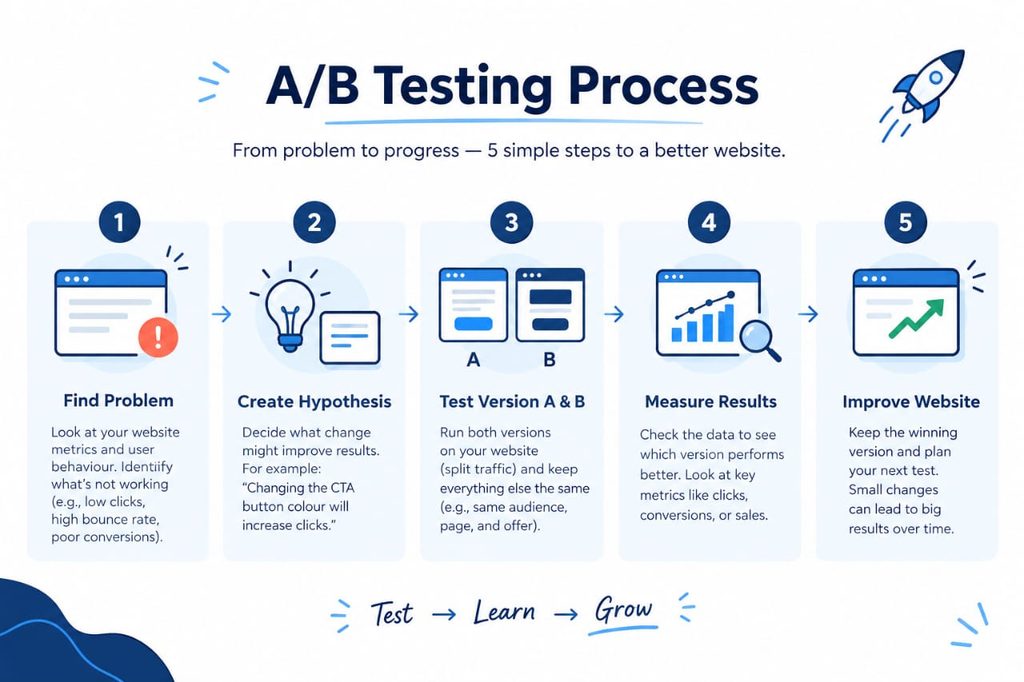
- Look at your data. Now head to your Google Analytics and look for a page that has decent traffic, but is simply not performing very well.
- Watch real behaviour. Microsoft Clarity lets you see where users freeze, scroll past, or exit.
- Write one hypothesis. Make it specific (their example was “A shorter form will get more enquiries”);
- Change one element. Create a single variation.
- Set one goal. Select a metric, e.g., form submissions or WhatsApp clicks.
- Run the test for full weeks. Do not check, and do not react every day.
- Review results calmly. Focus on conversions, not clicks, and assess the quality of leads.
- Write down what you learned. You learn from any contest, even an empty one.
- Pick the next test. You get better once you test a few dozen here and there.
A/B Testing Checklist
- Choose one page
- Identify one problem
- Create a hypothesis
- Choose one variable
- Define the conversion goal
- Run the test properly
- Collect enough data
- Analyze the results
- Document the learning
- Apply the result carefully
Final Takeaway
We still have data collected up to October 2023 for free. You can start right now; you do not need a big team or budget and statistics to improve your site today. All you require is patience and a mind that always asks: “What prevents visitors from engaging?”
Here are the main lessons:
- Traffic alone is not enough. It Matters What Visitors Do On Your Site
- Test a single actionable change at once — for example, your conversion goal.
- Tests require time and visitors.
- Look past simple clicks to actual business objectives.
- Think of results as lessons, not promises.
A/B testing for small websites is more of a habit than a project. Choose one page, change one thing, measure that properly (for a given value of properly), and learn. These little tentative footfalls over time can help you strut out the type of website that understands your visitors with a much more nuanced eye.
Common Questions About A/B Testing for Small Websites
Q1.What is A/B small website testing?
For small websites, A/B testing is the process of serving two different versions of a page or element (such as a headline/button) to key visitors and determining which one boasts better performance. It enables small businesses to decide based on what visitors do instead of guessing.
Q2.How much A/B testing traffic is needed for a small website?
There is no fixed number. That depends on your conversion rate when you start, how much of the change you make, and how certain you want to be. Test results are more visible on high-traffic and high-conversion pages. If you are low on traffic, try testing larger changes on your busiest page using a sample size calculator from your test tools.
Q3.How to test what a small business should do first?
So what do you need to know about getting started with A/B testing for small sites? Once you understand what a possible successful test would look like, try to focus your website where the most impact can be made — on an important page, ideally changing only one or two high-impact elements (e.g., headline, call-to-action button, or a part of an enquiry form). Pick a good traffic, low-conversion page of yours
Q4.A/B tests should run long enough to be able to get statistically significant results.
It really depends on traffic, conversion volume, and your business cycle. Test for complete weeks because both weekday and weekend behaviour are covered, avoiding the situation where, as soon as one version looks a day ahead, you stop. Determine your stopping rule before the test is administered.
Q5.Does A/B testing keep relevance for small business in India?
It can be, particularly if your business already receives consistent search, ads, or social referrals and is seeking more effective inquiries or sales. These will differ by audience, industry, traffic, and so on, and lower-traffic sites may have a greater reliance on behaviour tools like Microsoft Clarity until traffic grows.

Nidhi Patel is an SEO and digital marketing content strategist focused on AI SEO, content marketing, blogging, and personal branding. Through TrendChaska, she shares practical digital marketing insights, SEO strategies, and AI tools for beginners, students, and small businesses in India.