
Content marketing vs SEO explained with 7 steps, examples, and tips to build a stronger digital marketing strategy.
Introduction
If you run a blog, a small business or a freelance practice in India, you have probably heard “content” and “SEO” used as if they mean the same thing. They don’t. Understanding content marketing vs seo is one of the first steps toward building a website that brings in traffic, leads and customers.
In this guide, we explain the difference between SEO and content marketing in simple language. We compare their goals, methods and KPIs, and show how the two work together. By the end, you will know where each one fits and how to use both without wasting time or money.
Quick answer: Content marketing is about creating useful content that attracts an audience and builds trust. SEO is about making sure search engines can find and understand that content, so the right people discover it. In the content marketing vs seo question, one creates the value and the other helps people find it.
What Is Content Marketing?
Content marketing is the practice of creating and sharing valuable, relevant content for a clearly defined audience, with the aim of eventually inspiring a useful action. That action could be subscribing, enquiring, buying or simply remembering your brand.
Content takes many forms: articles, videos, newsletters, social media posts, WhatsApp messages, podcasts, infographics, case studies and downloadable templates. It is not limited to blogs, and not all of it is meant to rank on Google. The key is to help the reader first and sell later.
A content marketer asks, “What does my audience need to know, and in what format would they like to consume it?” If you want a step-by-step plan, check out our guide on “Content Marketing Strategy for Small Businesses India“.
What Is SEO?
SEO, or search engine optimization, is the set of techniques used to improve a website’s visibility in search results for the queries your audience types in. In simple terms, it helps your pages show up on Google.
SEO is usually split into three areas:
- On-page SEO: keyword research, title tags, headings, internal links and content structure
- Technical SEO: site speed, mobile-friendliness, URL structure and indexing
- Off-page SEO: backlinks and mentions from other websites
An SEO specialist asks, “Can search engines find and understand this page, and is it useful enough to show to someone searching for this topic?” If you are starting from scratch, our “SEO Guide for Beginners India” is a good place to begin.
Now that both terms are clear, the content marketing vs seo comparison becomes much easier to follow.
Content Marketing vs SEO: Key Differences
The easiest way to understand content marketing vs seo is to compare them side by side. The table below shows the difference between SEO and content marketing across the factors that matter most.
| Factor | Content Marketing | SEO |
|---|---|---|
| Main purpose | Attract and educate an audience, and encourage action | Increase visibility and appear in search results |
| Core question | “What do my audience members need to know?” | “How are people searching, and how can I be found?” |
| Main methods | Blogs, videos, newsletters, social media posts, case studies | Keyword research, on-page SEO, technical improvements, backlinks |
| Where it works | Search, social media, email, communities and offline | Mainly search engines |
| Timeframe | Can get quick engagement, but building an audience is slow | Usually slow, and needs patience and consistency |
| Typical KPIs | Engagement, shares, subscribers, enquiries, brand recall | Rankings, impressions, clicks, organic traffic, conversions |
The main difference between SEO and content marketing lies in the questions they ask. They answer different parts of the same goal: reaching the right audience. Keep this table handy whenever content marketing vs seo comes up in a team meeting or a class discussion.
Goals, Methods, Timeframe and KPIs Explained
Goals. Content marketing aims for awareness, education and engagement, often across several channels. SEO aims to get your pages discovered in search and ranking for the terms people use.
Methods. Content marketing leans creative: topics, formats and storytelling. SEO leans on analysis and technical work, such as making sure search engines can read a page and that it targets the right keywords.
Timeframe. On timeframe, content marketing vs seo looks surprisingly similar: neither is instant. A social media post can get engagement within minutes, but building a loyal following takes much longer. SEO rankings also take time, depending on competition and technical factors. Be careful with anyone who promises quick results from either one.
KPIs. Content marketing is measured by signs of interest, such as engagement, subscribers and enquiries. SEO is measured by visibility and performance, such as rankings, clicks and organic traffic. Google Search Console and Google Analytics help you track both.
Simple Real-World Examples
Here are three everyday examples that show content marketing vs seo in practice.
A Jaipur handloom seller posts Instagram videos showing how block-printed fabrics are made, and writes a blog on how to care for cotton kurtas. That is content marketing. She then researches the phrases buyers use in search and optimizes her posts to appear for them. That is SEO.
An Ahmedabad-based chartered accountant writes a blog on filing ITR as a freelancer. That is content marketing. He then adds the right keywords, a clean URL, an FAQ section and links to related tax posts. That is SEO. Without the blog, there is nothing to optimize. Without the SEO, the right readers may never find it.
A student blogger writes a post about internships. If she shares it only on LinkedIn, that is content marketing. If she also targets a phrase students actually search for, she is doing SEO too.
How SEO and Content Marketing Work Together
Think of a shop. Content marketing is the stock: the products on display. SEO is the signboard and directions that help people find the shop. A shop with great stock but no signboard will struggle to get customers. A shop with a bright signboard but poor stock will not keep them.
Here is how the two support each other:
- SEO gives content marketing direction. Keyword research shows what questions your audience asks and which topics are worth covering.
- Content marketing gives SEO something to work with. Search engines need useful pages to show. Every well-written post is another chance to appear in results.
- Good content can earn links. When other websites cite your content, it can strengthen your site’s authority.
- SEO makes content easier to use. Clear structure, fast loading and good formatting help both readers and search engines.
Both also build credibility and trust. Accurate, well-researched and honest content is what search engines aim to surface, so it is a sound foundation for both. This is why the better question is not content marketing vs seo, but how to use them together.
Content Marketing vs SEO: Which Should a Small Business Prioritize?
There is no single right answer, but these guidelines help.
If you have no content yet, start with content marketing. There is little for SEO to optimize without web pages.
If you have content but it isn’t getting traffic, focus on SEO. Review your keyword targeting, titles, internal links and site speed.
If your customers mostly come through word-of-mouth, WhatsApp or social media, keep investing in content marketing, and add SEO practices so people searching on Google can find you too.
If your customers actively search for your service (a local dentist, a teacher, a chartered accountant), SEO becomes especially important, but you still need quality pages to rank.
For most small businesses, the best approach to content marketing vs seo is to start with whichever one you are missing, and bring in the other as soon as you can.
A Practical Combined Strategy
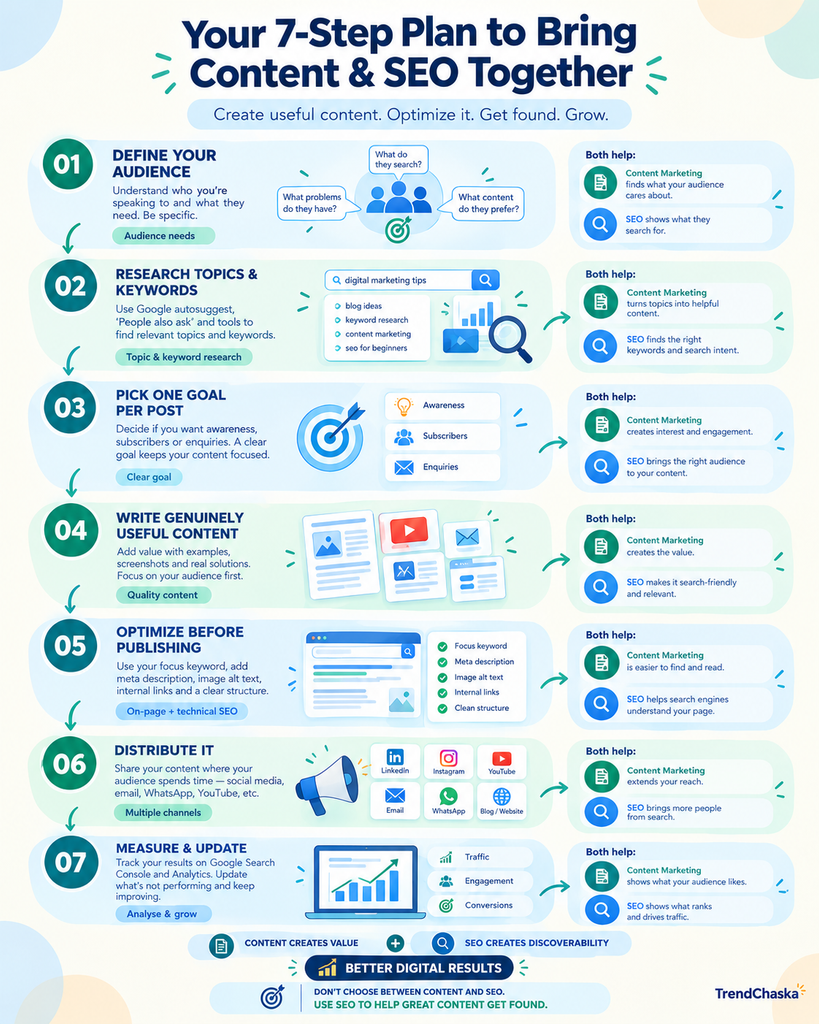
Whichever side of content marketing vs seo you start with, you don’t need a large team to do both. Here is a simple step-by-step plan.
Step 1: Define your audience
Be as specific as possible. Instead of “everyone online,” try something like “small business owners in Tier-2 cities who want more local customers.” That is a much more useful definition.
Step 2: Research topics and keywords
Use Google autosuggest and “People also ask” to find the questions your audience is asking. Add Google Search Console and a keyword research tool to spot popular terms. Note them down in English and Hinglish where relevant.
Step 3: Pick one goal per post
Do you want awareness, subscribers or enquiries? One clear goal keeps your content focused.
Step 4: Write genuinely useful content
Add value wherever you can. Use examples and screenshots, and don’t sacrifice quality for quantity.
Step 5: Optimize before you publish
Use your focus keyword naturally in the title, the introduction and at least one subheading. Write a clear meta description, add image alt text and link to related posts on your site.
Step 6: Distribute it
Share it on LinkedIn, social media, WhatsApp communities, email or YouTube, wherever your audience spends time.
Step 7: Measure and update
Check Google Search Console and Google Analytics every month to see how each post is doing. Update posts that are underperforming, and keep creating new ones.
If you want a detailed editorial plan, go back to our “Content Marketing Strategy for Small Businesses India” guide, and use our “SEO Guide for Beginners India” as your optimization reference.
Common Mistakes Beginners Make
- Treating them as separate activities. Publishing without optimizing, or optimizing without useful content, wastes effort. The whole content marketing vs seo discussion is a reminder that the two are connected.
- Stuffing keywords. Repeating a phrase unnaturally damages quality and readability. Write for people first.
- Publishing without a purpose. Content created for the sake of it will not help your blog or business grow.
- Ignoring search intent. A “buy now” page will not satisfy someone searching for an explanation of SEO.
- Rushing for quick wins. Both need patience and consistency. Publishing dozens of poorly optimized posts rarely works.
- Neglecting technical SEO. A poor mobile experience can turn away potential customers.
- Forgetting to refresh old posts. Information goes out of date, so review your older content from time to time.
- Copying competitors. Original insights, solutions and examples relevant to your audience are more valuable than recycled information.
Conclusion
Content marketing and SEO are separate practices with different goals, methods and ways of measuring success. The main difference between SEO and content marketing is that content marketing creates value for your audience, while SEO helps that value get discovered through search engines.
For Indian bloggers, students and small-business owners, the real lesson in content marketing vs seo is simple: create genuinely helpful content, optimize it so people can find it on Google, and measure what works. Treat content marketing vs seo as a partnership rather than a contest, start with the one you are missing, then use both together for steady, sustainable growth.
Want more practical, beginner-friendly guides like this one? At TrendChaska, we explain digital marketing in simple language for Indian students, bloggers and small businesses. Explore our latest guides on SEO, content marketing and more, and put what you learn into practice on your own website, one post at a time.
FAQs:
1. What is the main difference between content marketing and SEO?
Content marketing focuses on creating and sharing valuable content to engage an audience across multiple channels. SEO focuses on improving a website’s visibility in search results. The difference between SEO and content marketing comes down to value creation versus discoverability.
2. Is SEO part of content marketing?
They are related but not identical. SEO can be one part of a content marketing strategy, especially for blog posts. Content marketing also covers channels like email, social media and video, which don’t depend on search rankings.
3. Can I do SEO without content marketing?
Not effectively for long. Technical and on-page SEO can improve an existing website, but you still need useful content to rank. That is why content marketing vs seo works best as a partnership, not a choice.
4. Do I have to choose between content marketing vs SEO?
No. The content marketing vs seo debate makes it sound like a competition, but the two are meant to work together. Content gives people a reason to visit, and SEO helps them find it. If you can only focus on one right now, start with the area that is currently holding you back, then add the other.
5. Can you explain the difference between SEO and content marketing in simple words?
Of course. Content marketing is the helpful stuff you create for your audience, such as blogs, videos and newsletters. SEO is the work that helps people find that stuff on Google. Put simply, the difference between SEO and content marketing is creating value versus making it easy to discover.
6. Content Marketing vs SEO: Which Is Better for a Small Business in India?
It depends on your situation. If you have little or no content, start with content marketing. If you have content but low visibility, turn to SEO. Most small businesses benefit from combining both.
7. How long does it take to see results?
It depends on your competition, niche, site quality and consistency. As a general guide, both usually take months rather than days, so track progress over time instead of expecting quick results.

Nidhi Patel is an SEO and digital marketing content strategist focused on AI SEO, content marketing, blogging, and personal branding. Through TrendChaska, she shares practical digital marketing insights, SEO strategies, and AI tools for beginners, students, and small businesses in India.