
Diwali falls on a Sunday, 8 November 2026 (Dhanteras: 6 November, Friday; Bhai Dooj: 11 November, Wednesday). For most Indian online stores, this is the most important selling stretch of the year, as people go gifting, buying household goods, clothes, sweets, gadgets and décor for the whole family at once.
As with all festive seasons, this one sees every brand fighting for the same customers and ad budgets rising as the event approaches. This Diwali marketing checklist for ecommerce brands is designed to be implemented step by step, covering campaign goals, offers, website, SEO, social media, ads, WhatsApp, email, delivery, and post-Diwali follow-up.
You are reading this about 5 weeks before Diwali, which is just enough time to do everything listed below if you start now.
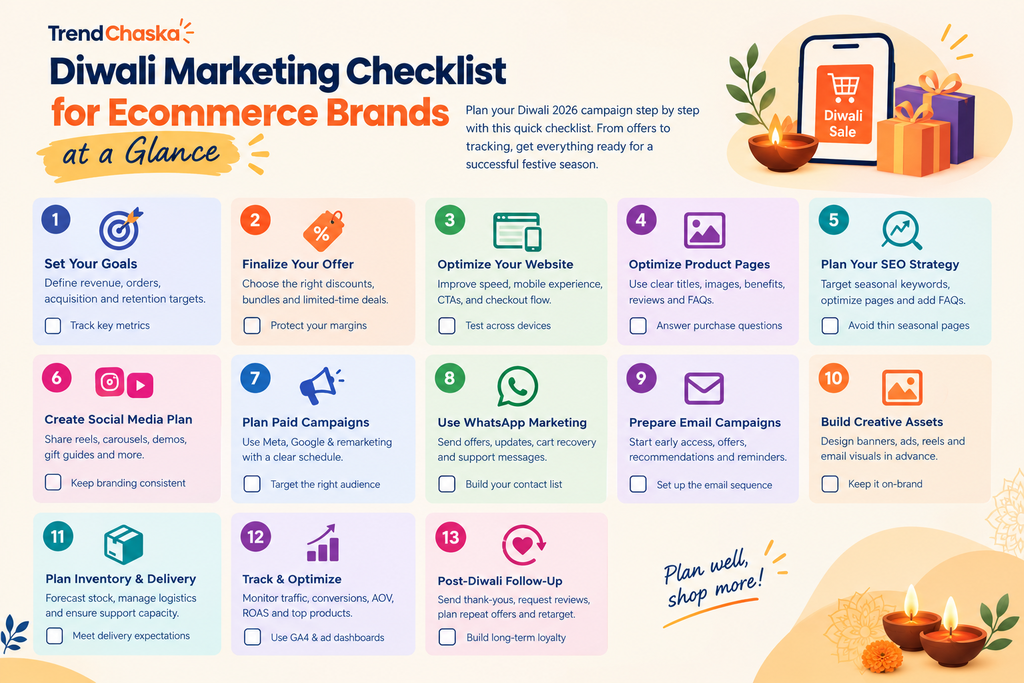
Diwali Marketing Checklist at a Glance
☐ Define campaign goals and a target number
☐ Finalize Diwali offers with margin checks
☐ Create a festive landing page
☐ Test mobile checkout, UPI and COD
☐ Update product pages with delivery and offer details
☐ Add festive keywords to key category pages
☐ Plan 15–20 days of social content
☐ Set up Meta and Google remarketing audiences
☐ Prepare WhatsApp and email sequences
☐ Finish all creatives before the festive rush
☐ Confirm inventory, courier cut-off dates, and support staffing
☐ Set up GA4 tracking and a daily review routine
☐ Plan post-Diwali thank-you and repeat-purchase campaigns
1. Start With Your Diwali Marketing Goals
It doesn’t begin with creatives; it begins with a number. A small store has limited resources, so it’s best to pick 2–3 priority metrics.
- Revenue and order targets: your basic scoreboard. Example: “₹4 lakh across 800 orders.”
- Average order value (AOV): the average order size. Bundles and a free-shipping threshold raise this.
- ROAS (return on ad spend): revenue earned per ₹1 of ad spend.
- Conversion rate: the share of visitors who make a purchase.
- New vs repeat customers: festive buyers are a chance to build your customer list.
For newer brands, prioritize customer acquisition and conversion rate; if you already have a customer base, prioritise repeat purchases and AOV since selling to your existing customers is more cost-effective.
☐ Define campaign goals
☐ Choose 2–3 priority metrics
☐ Set a target date range (example: 12 October to 12 November)
2. Define Your Diwali Offer
A good offer is attractive to the buyer and profitable to you. Here’s a comparison of common types:
| Offer type | Works well for | Watch out for |
|---|---|---|
| Percentage discount | Fashion, beauty, décor | Deep cuts eat margin quickly |
| Flat discount (₹500 off) | Higher-priced items | Set a minimum cart value |
| Buy 1 Get 1 | Fast-moving, low-cost products | Stock can vanish fast |
| Bundles/gift sets | Gifting, family shopping | Needs good packaging |
| Free shipping | Small-ticket orders | Set a threshold to lift AOV |
| Gift with purchase | Brand building | Gift cost must be planned |
| Early-bird offer | Building pre-Diwali demand | Don’t repeat it later at the same level |
| First-order offer | New customers | Can attract one-time buyers |
Discounts are easy to launch but difficult to recover the margin on. Calculate your profit after discount, ad cost, shipping, and packaging before jumping in. A bundle or a gift with purchase may protect your margin better than a flat 30% off.
☐ Finalize Diwali offers
☐ Check profit per product after discounts
☐ Decide offer start and end dates
3. Prepare Your Website for Festive Traffic
Most of this festive traffic will arrive on mobile, so test everything on a phone and not just a laptop.
Website checklist:
- Mobile responsiveness: buttons are tappable, and text is readable.
- Page speed: compress images and get rid of unnecessary plugins. Google’s PageSpeed Insights is a good free tool.
- Festive landing page: one dedicated page for your Diwali offers (more in Section 5).
- Offer banner: visible on the homepage and cart with the end date.
- Search and filters: allow filtering by price, occasion, or gift type.
- Clear CTAs: “Add to Cart” and “Buy Now” should stand out.
- Checkout: as few steps as possible, with guest checkout allowed.
- Payments: UPI, cards, net banking. If you offer it, COD. Many Indian buyers will prefer UPI or COD, especially in Tier 2 and Tier 3 cities.
- Shipping and returns: show delivery timelines and your return policy clearly.
- Trust signals: reviews, secure payment badges, contact number, real address.
- Availability: hide or mark out-of-stock items so customers aren’t disappointed at checkout.
Do this now: place a real test order on your mobile phone, via UPI, and note every point where it feels slow or confusing.
4. Optimize Product Pages for Diwali Shopping
A shopper deciding on a gift wants quick answers. A good product page answers them without a phone call.
- Titles: clear and specific, such as “Handmade Soy Wax Diwali Candle Gift Set (Pack of 6)”.
- Descriptions: start with benefits and use cases, then add details like size, material,l and care.
- Images: multiple angles, a size reference,ce and one gifting-style photo.
- Pricing and discount: show the original price, discounted price, and end date.
- Reviews: feature your best ones near the buy button. Only use real reviews.
- FAQs: 3–4 questions per product, such as “Can this be gift-wrapped?”
- Delivery information: an estimated delivery date or a pincode checker.
- Stock: a “few left” note is fine if it’s true.
- Internal linking: link to related products, bundles, and your festive page.
☐ Update top 10–20 product pages first
☐ Add FAQs and delivery details
☐ Link products to the festive landing page
5. Plan Your Diwali SEO Strategy
SEO takes time, so plan to start it early. The best festive season marketing India campaigns start in September and October, not the week before Diwali.
- Seasonal keywords: think “Diwali gift hamper for family,” “Diwali décor under ₹999,” and “Diwali gifts for employees”. Longer, specific phrases like these are easier to rank for than “Diwali gifts.”
- One strong festive landing page: keep the same URL every year and update it annually to build authority.
- Category and product pages: add festive keywords to titles and descriptions of best-sellers.
- Meta titles and descriptions: include the offer or gift angle, like “Diwali Gift Sets | Free Shipping Over ₹999.”
- Image alt text: describe the image plainly.
- FAQ content: answer real questions about delivery, gifting,g and returns.
- Internal links: link from your homepage, blog,og and category pages to the festive page.
Avoid thin pages: don’t create a dozen different “Diwali gifts for [city/price/person]” pages with little unique value. Google’s own guidance (see Google Search Central) favours helpful, original content. A few strong pages are better than many weak ones.
☐ Create festive landing page
☐ Optimize 5–10 key category pages
☐ Update meta titles and descriptions
6. Create a Diwali Social Media Content Plan
Plan the content mix first, then the posting dates.
7 content ideas you can use:
- Gift guide Reel: “5 Diwali gifts under ₹1,000,” showing each briefly.
- Carousel: “How to pick a Diwali gift for parents/in-laws/colleagues.”
- Product demo: a 20-second video, showing the product in use or being unboxed.
- Customer content: reshare photos or videos from real buyers, with permission.
- Behind the scenes: packing orders, making products, or your team prepping for the rush.
- Countdown posts: “3 days left for early-bird pricing.”
- Before/after: works for home décor, skincare, or cleaning products, but only where it’s honest.
Add short festival greetings on key days (Dhanteras, Diwali, Bhai Dooj) and keep offer posts clear and time-limited. If your audience is regional, add captions in their language (Hindi, Gujarati, Marathi) to make it feel personal.
☐ Plan 15–20 days of content
☐ Schedule posts ahead of time
☐ Keep one weekly slot for customer content
7. Plan Your Paid Advertising Campaigns
Social media (Meta Ads, Google Ads), retargeting (Meta, Google), and influencer marketing. If you sell products, set up your product feed in Google Merchant Center so Shopping campaigns can run. Review the documentation from each platform before launch, since policies and formats change.
Audiences to set up:
- Website visitors who didn’t buy
- Cart abandoners
- Existing customers (to sell again)
- Lookalike or similar audiences built from your best customers, if you have enough customer data
I won’t be giving you benchmark numbers for costs or returns. They vary by category, season, and account, so use your own past data as the baseline.
☐ Prepare ad creatives
☐ Set up remarketing audiences
☐ Set daily budgets and a review schedule
Diwali Marketing Checklist for Ecommerce Brands at a Glance
| Marketing stage | Main goal | Recommended actions | Key metric |
|---|---|---|---|
| Pre-Diwali (now–mid Oct) | Awareness | Brand reach, gift guides, list building | Reach, landing page visits |
| Early shopping (mid–end Oct) | Early orders | Early-bird offers, bundles | Orders, conversion rate |
| Peak (around Dhanteras, 6 Nov) | Sales | Strong offers, remarketing | ROAS, revenue |
| Last-minute (7–8 Nov) | Urgency | Fast-delivery or digital gift options | Orders, AOV |
| Post-Diwali (from 9 Nov) | Retention | Thank-you, review request, repeat offers | Repeat rate |
8. Use WhatsApp Marketing
WhatsApp is where many Indian customers already talk to businesses, so it fits naturally into festive selling. Use the WhatsApp Business app or API, and only message people who have opted in. WhatsApp’s Business policies explain the rules.
Practical uses:
- Product announcements: a new Diwali collection or gift set.
- Personalized offers: “Because you bought X last year, here’s Y.”
- Cart recovery: a reminder with the cart link.
- Order updates: confirmation, dispatch,h and delivery messages.
- Gift recommendations: answer “what should I give my boss?” via WhatsApp.
- Customer support: quick replies on delivery and returns.
- Repeat purchases: a post-Diwali offer for past buyers.
For setup details, read our guide on WhatsApp Marketing Strategy. Keep messages short, don’t spam, and always make opting out easy.
☐ Create WhatsApp campaigns
☐ Set up quick replies and a catalog
☐ Prepare 3–4 message templates
9. Prepare Email Marketing Campaigns
Email still works well for existing customers and subscribers. A simple sequence:
- Early access (about 2 weeks out): subscribers get the offer first.
- Festive offer launch: your main offer with best-sellers.
- Product recommendations: gift ideas by budget or person.
- Abandoned cart email: sent a few hours after the cart is left.
- Last-day reminder: a clear deadline and delivery cut-off.
- Post-purchase email: thanks, order details, LSS, SSs, and care tips.
- Repeat purchase campaign: a follow-up offer after Diwali.
☐ Write the 7-email sequence
☐ Test links and mobile layout
☐ Segment buyers and non-buyers
10. Build Festive Creative Assets in Advance
Finish creatives before the rush so you can focus on performance during Diwali.
☐ Website and offer banners
☐ Social media creatives and Reels
☐ Ad creatives (static and video)
☐ Product images with gifting angles
☐ Email banners
☐ WhatsApp creatives
☐ Offer graphics
Keep your branding consistent. A few diyas and warm colours are enough – too much festive decoration will hide your product and hurt your brand.
11. Prepare Inventory, Delivery & Customer Support
This is where many festive campaigns fail – your promise to the customer must match what you can deliver.
- Inventory forecasting: use last year’s sales and current ad plans to estimate demand.
- Fast-moving products: keep extra stock of your best-sellers.
- Stock alerts: set low-stock warnings.
- Shipping deadlines: work backwards from Diwali. If delivery to Tier 2 and Tier 3 cities takes longer, state a clear order-by date for each region.
- Courier delays: festive volumes can slow down couriers – talk to your partners early and have a backup.
- Return policy: keep it simple and visible.
- Support capacity: add staff or extend hours around Dhanteras.
- Packaging: sturdy and gift-ready where it makes sense (wrapping, a card, a gift option at checkout).
If you can’t deliver in time, don’t advertise it. A late gift hurts your reviews more than a missed sale.
☐ Confirm inventory
☐ Set order-by dates
☐ Brief customer support team
12. Track and Optimize the Campaign
Check your numbers every day during the campaign, not once at the end.
Track:
- Traffic and conversion rate: are visitors turning into buyers?
- Revenue and AOV
- ROAS and CAC (customer acquisition cost)
- Cart abandonment
- Top-selling products
- Channel performance: which source brings real orders
Use GA4 for website behaviour and each platform’s own dashboard for ad data.
Make sure purchase events are tracking correctly before you launch; Google Analytics Help explains how. Shift budget to the channels and products that perform, and pause what doesn’t.
☐ Track campaign performance
☐ Set a daily 15-minute review
☐ Test purchase tracking before launch
13. Post-Diwali Follow-Up
Diwali is a great opportunity to win customers. Retaining them is how that effort pays off.
- Thank-you campaign: a short, genuine message.
- Review requests: a few days after delivery.
- Repeat-purchase offers: timed for wedding season, winter, or gifting occasions.
- Customer segmentation: separate first-time buyers, repeat buyers,s and big spenders.
- Retargeting: re-engage people who visited but didn’t buy.
- Loyalty ideas: points, early access, or a small birthday offer.
- Performance analysis: note what worked, and save it for Diwali 2027.
Your Diwali Marketing Checklist for Ecommerce Stores to Follow (2026)
Planning
☐ Define goals and a target number
☐ Choose 2–3 priority metrics
☐ Finalize offers after checking margins
Website & Products
☐ Test mobile checkout, UPI, and COD
☐ Check page speed
☐ Create festive landing page
☐ Update product pages (titles, FAQs, delivery info)
☐ Show shipping and return policy clearly
SEO & Content
☐ Optimize key category pages
☐ Update meta titles and descriptions
☐ Plan 15–20 days of social content
Ads & Messaging
☐ Set up Meta and Google remarketing
☐ Prepare ad creatives
☐ Create WhatsApp campaigns
☐ Write the email sequence
Operations
☐ Confirm inventory
☐ Set order-by dates
☐ Check courier partners
☐ Prepare support team
Tracking & Follow-up
☐ Test GA4 purchase tracking
☐ Review performance daily
☐ Send thank-you and review requests
☐ Plan repeat-purchase offers
☐ Save learnings for Diwali 2027
Conclusion
A good Diwali marketing checklist for ecommerce brands can actually come down to planning early, protecting margins, keeping your website and delivery reliable, and following up after the festival ends. You don’t need to do everything at once – start with goals, offers, checkout testing, and inventory, and build outward from there.
Next step: Copy the checklist above, assign a date to each item, and complete the website and offer tasks this week, before you spend anything on ads.
FAQs
What is a Diwali marketing checklist for e-commerce?
It is a step-by-step list of tasks to complete before, during, ng and after Diwali: setting goals, planning offers, preparing your website, running campaigns, managing delivery, and following up with customers.
When should e-commerce brands start Diwali marketing?
Ideally four to six weeks before Diwali. For Diwali 2026 (8 November), that means starting in early October at the latest, with SEO and creatives first.
What are the best Diwali sale marketing ideas for small businesses?
Gift bundles, early-bird offers, free shipping above a set order value, limited-time offers, and customer photo campaigns are effective without heavy discounting.
How can small e-commerce businesses promote Diwali offers?
Combine a festive landing page, Instagram Reels, WhatsApp messages to opted-in customers, email, and remarketing ads for visitors who didn’t buy.
How can WhatsApp help with Diwali marketing?
It helps with announcements, personalised offers, cart reminders, updates,s and quick customer support. Use it only with customer permission.
What should an e-commerce website prepare before Diwali?
A fast mobile experience, a festive landing page, clear offers, working UPI and other payment options, delivery information, a visible return policy, and accurate stock.
How can I measure the success of a Diwali marketing campaign?
Track revenue, orders, conversion rate, AOV, ROAS, CAC, and cart abandonment in GA4 and your ad dashboards, and compare against your goals.

Nidhi Patel is an SEO and digital marketing content strategist focused on AI SEO, content marketing, blogging, and personal branding. Through TrendChaska, she shares practical digital marketing insights, SEO strategies, and AI tools for beginners, students, and small businesses in India.