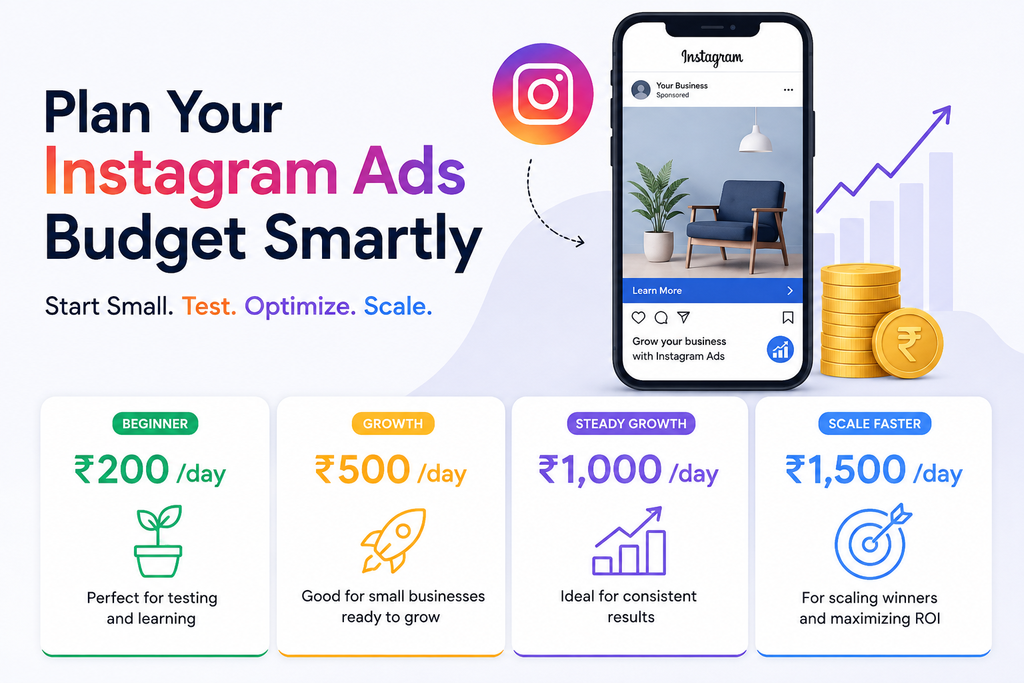
Learn how Indian small businesses can plan their daily and monthly Instagram Ads budget with a practical, data-driven framework for 2026.
Introduction
If you own a small business in India, chances are you’re looking at the Instagram Ads Manager page, wondering whether to set your daily budget at ₹300, ₹500, ₹1,000, or ₹2,000 — you’re not alone. Arguably the most asked question by small business owners before launching their first campaign.
And to be honest, there is no clean-cut, one-line answer. Anyone who tells you this: “If you spend ₹500 every day, you can get 20 leads” — is either making nonsense or selling you something. Your perfect Instagram Ads budget is a combination of several things: your industry, audience, location, campaign objectives, competition level, creative quality, offer & even your landing page or WhatsApp number conversion ratio.
This guide will not give you an exact number, or a set of numbers. Instead, it will talk you through how to consider your Instagram Ads budget so that you plan one which actually makes sense for your business in 2026, whether you’re a Jaipur-based boutique owner or Bengaluru café owner, or a freelance designer at home.
Cost of Improving Instagram Ads in India 2026
There is no concrete ‘price list’ for ads on Instagram. Thus, each time you run an ad, it enters into an auction against all other advertisers targeting the same audience at that particular moment.
The auction takes your bid, your estimated action rate (the probability that someone will take an action), and the quality of your ad into account. More engaging creatives lead to a reduced cost-per-audience for a business than its counterpart, the businesses running low-engagement and generic ads — something confirmed by Meta’s own guidance on ad auctions.
Thus, the real answer to what is Instagram Ads budget and cost, when you are asked:
- Who do you want to target with your ad?
- How good is your ad at getting attention?
Of course, compared to industry benchmarks and overall tendencies for Indian small business campaigns, you may expect something in the following range (very approximate ranges, not at all guaranteed) by 2026:
- Cost per click (CPC) — ₹2 to ₹15 approximately (depends on industry and targeting)
- Cost per mille (CPM) — around ₹50 to ₹300
- Cost per lead (CPL) — $1 to $5+ depending on your niche + offer
Those are broad industry averages, not hard pricing from Meta, and they can be highly dynamic based on the season of the year (Q4 is crazy high), competition in your specific space, and market. The numbers you acquire will be drastically different for a peak wedding season photographer from top couples in Delhi, as opposed to raising awareness ads run by a stationery brand located on the outskirts of some smaller city. Think of these as scale indicators (not a guarantee).
How Much You Should Be Spending on Instagram Ads for Small Business
In brief: You can test Instagram Ads with most small to medium businesses in India starting at a monthly budget of anywhere between ₹5,000 and ₹30,000 depending on your objectives — but this is merely a range to get you started, not an exact number, and results are entirely subject to the quality of your industry, offer & creative.
Then break this down into 3 loose tiers. These are more like reference points than boxes you should be contained in.
Starter / The test budget: ₹5,000–₹10,000 per month
This is the point where most novices should start. Here, you’re not looking to create a full sales funnel — you’re testing. You want to find out if this audience will convert against your ad. Does my offer make sense? Is my creativity any good?
This budget is sufficient for running a few basic campaigns, collecting initial data, and realizing your baseline costs. It won’t give you a huge scale, but it’ll tell you something about what is working.
Monthly Budget: Starting Small Business: ₹15,000–₹30,000
This range allows for more space once you have some direction and are tested a bit. You can run 2–3 plays at once — for instance, one for lead generation and another to retarget customers who visited your Instagram profile or website. This is a common scenario for small business owners who have moved beyond pure testing, but haven’t begun to scale aggressively.
Growth Budget: ₹30,000–₹75,000+ per month
This level, then, is for businesses who have already established a campaign or two that have been both profitable and proven. And they want to take it up a notch — get in front of more people, explore new markets, or add retargeting layers. An Instagram Ads budget this high should be based on real performance data from a previous, smaller campaign – not estimates.
None of these ranges gives you a certain number of leads, sales, or followers. If you spent that same ₹30,000 each month for a premium interior design service, the predictions will behave entirely differently than if a publisher raised it from advertising with their ₹199 t-shirt brand; it only has to do with customer journey, market size, and price point.
Daily Instagram Ads Budget: How Much Should You Spend?
What this really boils down to for lots of small business owners is that when launching something new or doing a test, daily budgets often make the most sense. This gives you a rough idea of each budget per day, as shown in the nice, simple table below.
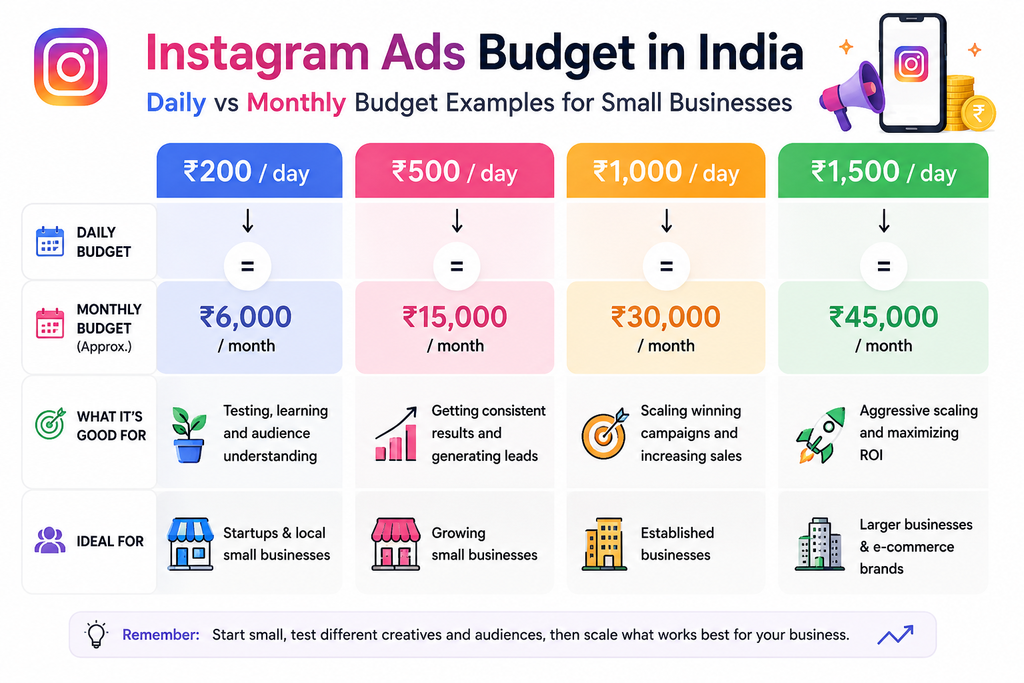
| Daily Budget | Approx. Monthly Spend | Best For |
| ₹200/day | ₹6,000 | Basic testing |
| ₹300/day | ₹9,000 | Local awareness/testing |
| ₹500/day | ₹15,000 | Lead generation testing |
| ₹1,000/day | ₹30,000 | More consistent testing |
| ₹1,500/day | ₹45,000 | Growth and multiple tests |
Important note: Delivery and outcomes are different for every business, audience, and time of year. A local sweet shop might get decent mileage for ₹200 a day in the locality, but the same amount would hardly register for businesses selling to pan-India with much bigger scale and competitive categories like fashion. Meta sets your budget NOT for an even daily portion of that amount (half spent between now and tomorrow, half spent the next day) but on whether or not it will be able to spend that money.
If you have to choose between ₹300 a day and ₹500 a day, ask yourself whether the audience size is large enough and the offer clear enough for ₹500 to be worth the extra test. If yes, the additional data you gain is typically worth it. If you’re still defining your offer or creative, then it is generally a smarter move to start small and iterate rather than committing more spend too early.
Types of Businesses along with Instagram Ads Budget
Not all businesses will start out in the same spot. Here is a rough guide — again, take these as guidelines to start with; not hard rules.
| Business Type | Suggested Starting Monthly Range | Suitable Objective | Main Metric to Watch |
| Chances are you either run or work for a local service business (plumber, electrician, tutor etc). | ₹5,000–₹15,000 | Leads / Messages | Cost per lead |
| Restaurant/café | ₹8,000–₹20,000 | Awareness / Traffic | Reach, in-store footfall |
| Salon/beauty business | ₹8,000–₹20,000 | Leads / Messages | Booking rate |
| Boutique/fashion business | ₹10,000–₹25,000 | Sales / Traffic | Conversion rate |
| E-commerce business | ₹15,000–₹40,000 | Sales | ROAS |
| Coaching/education | ₹10,000–₹30,000 | Leads | Cost per qualified lead |
| Real estate | ₹15,000–₹50,000+ | Leads | Lead quality, cost per lead |
| D2C brand | ₹20,000–₹75,000+ | Sales | ROAS, repeat purchase rate |
| Freelancers/service providers | ₹5,000–₹15,000 | Messages / Leads | Cost per conversation |
Why the difference? When you are a real estate company aiming for the moon, your trail to 100K+ sale, that is high value and low frequency enough — then so be it: higher CPL on a huge budget is justified. A local tutor has a more modest service (lower ticket) and audience, thus a smaller budget works better. Comparing your numbers to an entirely different category business.
What Should a Beginner Budget For Instagram Ads?
Here’s the ground-up, real-world route for how to do ads — especially if this is your first time around:
- Start with a controlled test. Choose a low, specific Instagram Ads budget — ₹5000 or ₹10000 for the month — And treat it as an experiment and not a growth driver.
- Test creatives, not just budgets. 2–3 different ad creatives (a Reel, a carousel, a static image) to understand what actually grabs attention to stop scrolling.
- Test audiences carefully. One broader audience and one niche audience-based campaign for comparison.
- Track results properly. If you are using message ads, either set up Meta Pixel or Conversions API on your website, or manually track WhatsApp/DM responses.
- Avoid changing campaigns too frequently. Do not judge a campaign before it has had at least 3–5 days’ worth of data — Meta’s algorithm takes time to learn and optimise.
- Do not scale until you discover a winner. You only increase your budget once you see the creative-audience combination performing well enough consistently.
Out-of-memory novices typically rate a campaign after 6 hours or one day—attest to them. What looks like an expensive campaign on day one can end up with a much cheaper cost per result as early as day four or five when the algorithm has enough data.
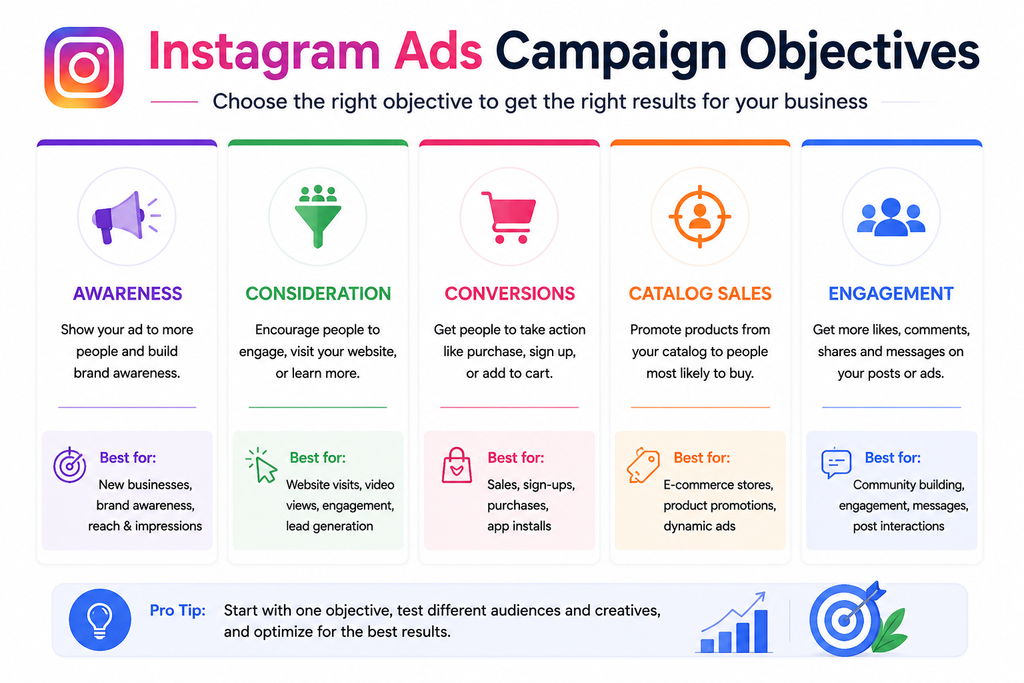
The Amount Two Global View If We Look at Instagram Ads Budget You Will Fill Your Budget Based on Each Campaign Objective
Your goal dictates how you should approach your ad budget and what “success” even means.
Brand Awareness
The aim here is merely to be exposed to maximum relevant traffic. Because you’re not bidding for action, but reach and impressions — budgets can be very low. This comes in handy for restaurants and cafés and even local businesses who seek name recognition among locals.
Traffic
Traffic campaigns drive traffic from ads to your site or Instagram profile. Pay attention to CPC (cost per click) in this case — a low CPC is good, but only if those clicks are actually hitting a page that can subsequently convert them into customers.
Engagement
Niche — Engagement campaigns (likes, comments, shares, saves) can build social proof primarily for newer accounts. On their own, they rarely get a bulk of ad spend but can warm up an audience to support other campaigns.
Leads
That said, many coaches, consultants, real estate agents, and service businesses run lead generation campaigns using in-app forms or driving traffic to a landing page. Cost per lead is important in this case, but so is the quality of leads; a low-cost lead that never replies becomes pretty costly.
Sales
Sales campaigns for e-commerce and D2C brands optimize for real purchases. This is where your CPA (cost per acquisition) and ROAS (return on ad spend) become your main numbers. A budget focused on sales usually requires a working Pixel and enough historical data for the algorithm to perform optimally.
WhatsApp/Message Campaigns
For a lot of Indian small businesses (salons, local shops, home sellers), WhatsApp or Instagram DM ads perform especially well because they are aligned to the way customers would want to communicate in the first place. Anyone can ask a question, get a prompt response, and schedule or purchase without having to depart from the conversation.
There is no one objective that is always “better.” To take an analogy, a restaurant may benefit from more awareness ads than a coaching business does – and vice versa. Align your goal with what you really want.
Instagram Advertising Cost in India and Factors Affecting It
Different factors raise or lower your advertising price on Instagram:
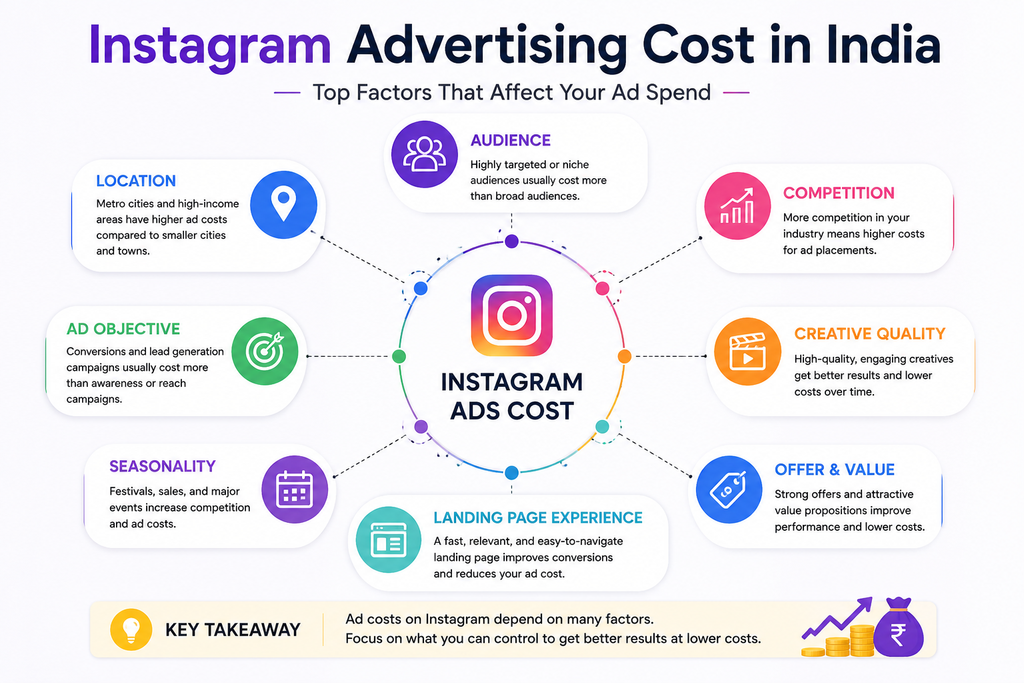
- Audience size — smaller audiences generally cost more per result due to limited supply.
- Location — the bigger the market, like Mumbai or Bengaluru, the more expensive they tend to be than smaller towns.
- Competitive niche — niches like real estate, finance, and education are generally more competitive.
- Age Group and Gender Targeting — attracting specific audiences.
- Focus on interests and behaviours — with broader interest targeting, you may sometimes reduce costs.
- Creative quality — a really good Reel beats out banner-style images every time
- Ad format — Reels ads, Story ads, and Feed ads all perform differently in different audiences
- Campaign objective — awareness campaigns usually have a lower CPM than conversion ones.
- Seasonality — prices usually increase in the holiday period (e.g., Diwali, wedding season, year-end sale), as a result of the increased demand from advertisers
- Offer clarity — a well-structured, clear offer naturally receives better engagement; this can reduce your ad spend.
- Poor landing page experience — a slow/unclear landing page is just burning clicks you have already paid for
- Conversion rate — a great ad won’t solve a non-converting page or process
- Retargeting — targeting people who have already heard about you is normally a cheaper option than targeting cold audiences.
- Ad frequency — overexposed individuals within a group will see the ad too often, increasing costs and decreasing performance (ad fatigue)
It is normal to get a low audience size, but large local intent for a café that is only targeting people up to 3 km. There is a lot more competition for a national D2C skincare company aimed at all of India, and thus the CPM is higher. Both situations aren’t “bad”; they just have to budget differently.
Instagram Ads Cost: Converting CPC, CPM and CPL
If you’re a Meta Ads beginner, you will see these three things everywhere.
CPC (Cost Per Click)
It shows you how much, on average, you’re paying for each click on your ad.
Formula: CPC = Total Ad Spend ÷ Total Clicks
For Example, if you spent ₹1000 and got 200 clicks, then your CPC would be ₹5/-.
CPM (Cost Per 1,000 Impressions)
This is the cost per 1,000 impressions of your ad shown (whether it gets clicked or not).
CPM Formula: CPM = (Total Ad Spend / Impressions) x 1,000
If you pay ₹1,000 and receive 20,000 Impressions in return, then your CPM will be ₹50.
CPL (Cost Per Lead)
That will tell you how much it costs for each lead.
Formula: CPL = Total Ad Spend divided by Number of Leads
You could have spent ₹5,000 and received 25 leads; Your CPL is then ₹200.
The main thing to consider here is that the lowest CPC or CPM does not equal a winning campaign. You are trained on dirt-cheap clicks that lead nowhere, or a cheaper CPM to people who will never buy from you. What matters, after all, is whether clicks, impressions, or leads really lead to paying customers. A slightly higher Cost per Click that generates actual sales is worth far more than a rock-bottom alternative that results in nothing.
How to Calculate Your Instagram Ads Budget
You can avoid the pick-a-random-number approach and work your way back from what you want out of your business. Here’s a simple approach:
- Choose how many customers you want in 1 month.
- Predict your prospect-to-customer rate (what percentage of the leads usually convert)
- Determine your ideal costs per lead or customer.
- Consider the average order value and profit margin.
A hypothetical example (illustrative only):
For example, let’s say you own a small skincare company and need 30 sales this month. This means, historically, 1 in 20 of those people clicking through your ad will buy something (5% conversion). To put it succinctly, this would require some 600 clicks. For a per-click cost of ~₹8, your monthly Ads budget for Instagram Ads would be INR 4,800 (600 × ₹8) + some additional budget for testing and learning.
This is a stylised example, not a promise. Your true conversion rate, cost-per-click (CPC), and results are wholly determined by the audience you target, your offer, creative assets, and site experience. However, this type of reverse engineering gives you a much more realistic number to start with than winging it.
How to Allocate the Budget for Your Instagram Ads
With a working budget, it can be helpful to separate your allocations between purposes versus spending it all in one campaign. So a typical start split could look:
- 40% — Highest-performing campaign: Your all-star, the one whose results speak for themselves
- 25% — Retargeting: people who visited your site, saw your videos, and/or responded to your profile
- 20% — Testing out new audiences: finding your next winner having tested some new ones
- 15% — Testing new creatives: experiment with formats, hooks, and messages
Remember that this is not a one-size-fits-all formula — the right split entirely depends on how your campaigns are doing. If retargeting is converting like crazy, it deserves a bigger slice of the pie. What often makes more sense, if your best campaign is getting to the point of being at a plateau anyway, is to shift more towards testing those new creatives or audiences.
You still have until the end of October 2023 to do this: [Internal Link: How To Run Retargeting Campaigns On Instagram]
7 Budget Blunders Small Businesses Make for Instagram Ads
- Spending without a clear objective. With the attention span of a goldfish, one viewpoint is that if you do not know what “success” looks like, even an Instagram Ads budget of $1 million will never seem enough.
- Increasing the budget too quickly. If one of your assets goes from having a ₹500 daily budget to suddenly ₹5000 overnight, it will throw off the way that the algorithm has been learning and will often lead to a higher cost per result (at least for a bit).
- Having one creative run for too long. There is a time for everything, even good advertising; audiences stop clicking after they have seen the same ad one too many times.
- Targeting everyone. Spray and pray at unspecific audiences means often wasting budget on people who would never buy.
- Focusing only on likes. Vanity metrics are warm and fuzzy, but they do not pay bills — track leads, messages, or sales.
- Ignoring conversion tracking. If you also don’t have a Pixel, then you’re optimizing blind.
- Investing more without optimising the offer/page. If your WhatsApp response and website are broken, but you have a bigger budget, then you’re just throwing away money at an accelerated rate.
When to Boost Your Instagram Ads Budget
A few signals indicate a campaign may be fit for additional spend:
- Steady growth through at least 5–7 days, not just one good day
- A viable cost per result for your business (determined by you, not someone else — especially not in a CS)
- Your click-to-lead or sale conversion should be reasonably healthy.
- Strong, repeatable creative performance
- A steady response from audiences, without large drop-offs
- A positive return on investment (ROI) or, if applicable, return on advertising spend (ROAS)
Assuming all of these look solid, generally speaking, it works better to slowly raise your Instagram Ads budgets (like 20–30% every couple of days vs doubling them overnight) because most accounts respond positively to slow changes rather than big jumps. Meta will enter a learning phase if there are large increases, and performance during this period can suffer.
And conversely, don’t scale because it “feels” like a campaign is working. Bottom line: If you have not tracked real leads or sales, you do not have enough data to make it worth your while at this stage.
When to Increase or Decrease Your Instagram Ad Spend?
Look for these warning signs:
- Increase in cost per result for days with no interpretation
- Lead quality is poor: Many leads, few buyers.
- Have a poor conversion from click to REAL outcome.
- Insufficient ad frequency (people seeing the same ad too many times)
- Weak or declining creative performance
- Reasonable spending vs lack of convincing business outcome
- Tracking problems that make it difficult to know what’s really going on
Before identifying the cause of your Instagram Ads budget being “too low” or “not working.” Sometimes it’s creative. Sometimes it’s the offer. Sometimes it’s the landing page. Throwing money at some problem rarely addresses it properly — it merely aggravates the situation.
Instagram Ads or Other Marketing Channels for Small Businesses?
Instagram Ads are a tool for your marketing kit, but they shouldn’t be the only one in your kit.
- SEO: Longer lead time but results in sustainable, mostly free organic traffic over time.
- Google Ads: Targets people looking for what you sell — usually a higher CPC than Instagram in most categories, but targets users with higher intent.
- SEO-Free Instagram Marketing: Expensive but faster and a bit more guaranteed (as the probability that following people will lead to getting new followers when they follow back is higher than randomness).
- Influencer: Quick builds credibility, especially with trusted voices, but very broad, based results by creator and audience fit.
- WhatsApp marketing: Best for driving existing leads and customers, but you need to have contacts in the first place.
For new businesses that are too small to have their own audience yet, Instagram Ads generally provides much quicker and more manageable reach vs. organic or SEO efforts. However, SEO and organic content frequently provide longer-term, lower-cost value over time. Neither is inherently “better” — most small businesses in India would just use a combination of both instead of just Instagram Ads.
Specifically: How to Achieve Better Outcomes Without Increased Finances
Before presuming that you require a higher Instagram Ads price range, get the most out of what you already have:
- Improve the hook. It is the first 2–3 seconds of a Reel that will determine if someone continues watching.
- Use better Reels. In 2026, video typically performs better than static images for reach and engagement.
- Test multiple creatives. That single ad is not going to shoulder the entire campaign.
- Improve the offer. Sometimes it’s not the ad — sometimes it’s the offer!
- Narrow targeting when appropriate. For local businesses, a more targeted audience may sometimes yield better results than one that targets everyone.
- Retarget warm audiences. You convert better with people who know you than with strangers.
- Improve landing pages. A page that is faster and clearer converts a larger portion of the traffic you are already paying for.
- Use strong CTAs. Give people specific next steps: “DM us,” “Book now,” or “Order today.”
- Test different ad formats. Different formats such as Carousels, Reels, or Stories work better with your audience than others.
- Monitor actual business results. Real leads, calls, and sales, not just Ads Manager metrics.
Conclusion
There is no “one perfect” Instagram Ads budget, and anyone who tells you there is, is oversimplifying the issue. The right budget is one that you can truly afford to test, measure, and scale based on actual data as opposed to a hunch.
Start small if you need to. Measure what really matters — leads, conversations, sales — rather than just likes and impressions. Don’t judge your campaigns too early; allow them to collect real data. And only increase your ad spend when you have proof that it is worth spending more.
Instagram marketing in 2026 is still a legitimately helpful weapon for any type of small business across India — restaurants, boutiques, salons, coaches, and everyone in between — but it rewards patience and testing over a big spend on day one.
Frequently Asked Questions
Q1.How much does Instagram Ads cost in India?
There are big variations in costs, but as a rough rule of thumb, CPC can often be around ₹2–₹15, whilst CPM is anywhere from roughly ₹50 to ₹250 depending on your industry, audience & season. The price of Instagram advertising is not one-size-fits-all.
Q2.How much does it cost to spend on Instagram Ads?
Meta has an incredibly low daily budget—like ₹40–₹100 a day at times—but this small daily budget typically will not capture valuable data. Results are often more useful for small businesses from ₹200–₹300 per day onwards.
Q3.Can ₹500 run Instagram Ads?
For an ad of local or niche nature, ₹500 a day may be enough for initial testing also. Now, to be fair, how many leads/sales you get will depend on your audience/offer/creative AND campaign objective — not just budget.
Q4.What affects Instagram Ads’ cost?
Cost is determined by audience size, location, competition in that area, quality of creative & available ad formats based on your campaign objective (e.g.).
Q5.How to know when you should increase your Instagram Ads spend?
Once you see consistent results that are trackable — stable cost per lead or sale, reasonable conversion rates, and reliable creative performance — for a period of at least 5–7 days, it is usually better to increase the budget gradually rather than suddenly.

Nidhi Patel is an SEO and digital marketing content strategist focused on AI SEO, content marketing, blogging, and personal branding. Through TrendChaska, she shares practical digital marketing insights, SEO strategies, and AI tools for beginners, students, and small businesses in India.