
Shopify vs WooCommerce India: Compare SEO, pricing, payments and marketing to choose the right ecommerce platform in 2026.
Introduction
If you’re selling products online in India, you’ll need to pick between Shopify and WooCommerce pretty early on. Your choice matters a lot. It shapes your budget, SEO potential, payment options like UPI, and how much you can control your store as you grow.
No single best answer exists. What works depends on your budget, technical skills, how much customization you want, and your SEO goals long-term. This breaks down both platforms specifically for Indian sellers, whether you’re just starting with Instagram or moving away from marketplaces as a D2C brand. You’ll have what you need to decide instead of guessing.
Shopify vs WooCommerce: Quick Look
Here’s where each platform stands:
| Factor | Shopify | WooCommerce |
|---|---|---|
| Ease of use | Very beginner-friendly, guided setup | Requires WordPress familiarity |
| Setup | Quick, hosted out of the box | Manual setup, more steps |
| Pricing | Fixed monthly subscription | Variable: hosting, plugins, themes |
| Hosting | Included, managed | You arrange your own |
| Customization | Good, limited by theme and apps | Extremely flexible, near-unlimited |
| SEO | Solid built-in basics, some restrictions | Highly customizable with plugins |
| Payment gateways | Native gateway plus Razorpay and others via apps | Wide range via WooCommerce plugins |
| Marketing tools | Built-in email, discounts, apps | Plugin-dependent, very flexible |
| Scalability | Strong, handles high traffic well | Depends on your hosting choice |
| Security | Managed by Shopify | Your responsibility with plugins |
| Best suited for | Beginners wanting speed and simplicity | Sellers wanting control and WordPress integration |
| Technical knowledge required | Low | Moderate to high |
What Is Shopify?
Shopify is fully hosted. You don’t arrange hosting, install software, or manage servers yourself. Sign up, pick a theme, add products, and go live. Shopify handles security patches, uptime, and infrastructure behind the scenes so you focus on business.
Shopify has a large library of themes, free and paid. An app store lets you add reviews, upsells, subscriptions, and marketing tools without writing code. Your dashboard covers orders, inventory, customers, and reports all in one place.
For Indian sellers, simplicity is huge. Small clothing brands or first-time online sellers without developers can launch in days instead of weeks. Beginners often lean toward Shopify because the barrier to entry is genuinely low.
What Is WooCommerce?
WooCommerce isn’t a platform like Shopify. It’s a free, open-source plugin that turns WordPress into a store. This distinction matters because WooCommerce uses all of WordPress’s content and SEO tools instead of working inside a closed ecosystem.
WooCommerce runs on WordPress, so you need your own hosting and domain. You pick a theme, install plugins for payments, shipping, and security, and keep everything updated yourself. You get significantly more control. You own your code, data, and hosting outright instead of renting space on someone else’s platform.
Indian sellers already comfortable with WordPress, or those who blog alongside selling, often prefer WooCommerce because of ownership and flexibility. It demands more technical skill, though, which is worth being honest about upfront.
Shopify vs WooCommerce India: Pricing and Costs
Cost comparisons between Shopify and WooCommerce in India get way too simplified. Neither one is just “expensive” or “free.” Both have real costs you need to understand.
Shopify charges add up like this:
- Monthly subscription fee that varies by features
- Paid themes if you want something custom
- Paid apps for reviews, loyalty programs, upsells
- Payment gateway fees
- Domain registration
WooCommerce costs break down differently:
- The plugin itself, which is free to download
- Hosting, anywhere from cheap shared servers to premium managed WordPress hosting
- Domain registration
- Premium themes, if you skip the free ones
- Premium plugins for SEO, backups, security
- Maintenance, updates, developer help when things break
Reality check: Calling WooCommerce “free” in India is misleading. Hosting costs money. Security costs money. Premium plugins add up. Maintenance adds up. A broken WooCommerce store fixed by a developer can cost more than a Shopify subscription.
Say you’re a small home-décor seller in India weighing Shopify against WooCommerce. Shopify’s bill stays the same every month. WooCommerce? It’s all over the place. Cheap when you’re tiny, then climbs as you add premium plugins, better hosting, and security tools. Neither wins automatically. Depends on your setup and how much technical work you’ll handle yourself.
Shopify vs. WooCommerce for SEO
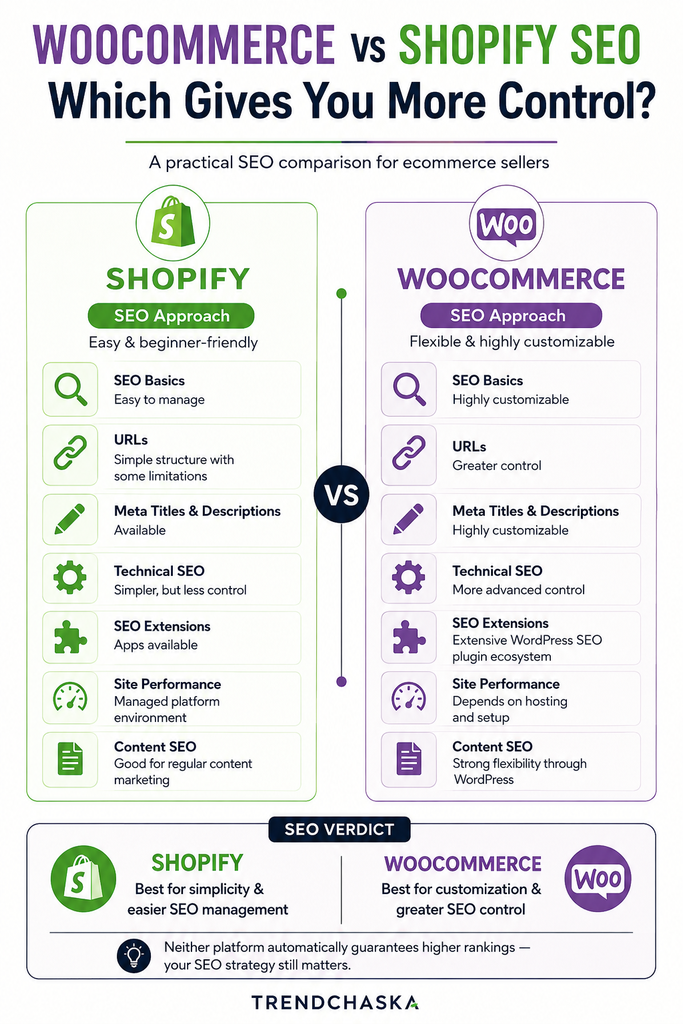
SEO matters most in any Shopify vs. WooCommerce comparison for India. Indian customers find you through search, or they don’t find you at all.
WooCommerce gives you more control here. WordPress runs underneath, so you control permalinks completely. Clean URLs, keyword-rich, whatever you want. Meta titles and descriptions are yours to tweak. Plugins like Rank Math or Yoast give you even more granular control. Image optimization, custom schema markup, redirects, and XML sitemaps are all open to you.
Shopify’s SEO game got better over time. Clean site structure out of the box. Meta tags work fine. Sitemaps generate automatically. Themes load reasonably fast. But some things stay rigid. Collection page URLs don’t bend the way WooCommerce lets them, because you’re stuck inside Shopify’s walls instead of open-source code.
Indian sellers miss something crucial here. Blogging matters for SEO. Both platforms blog. WordPress blogs better because WordPress started as a publishing platform. WooCommerce keeps that DNA.
Speed and technical SEO belong on every checklist. Both platforms handle them, but neither guarantees Google rankings. E-commerce SEO in India works the same as anywhere else. Content quality wins. Site speed wins. Backlinks win. User experience wins. Platform choice doesn’t. A polished Shopify store beats a messy WooCommerce one in search. A polished WooCommerce store beats a messy Shopify one. That’s how it works.
Which Is Better for Indian Sellers?
India-specific stuff matters a lot here. Local payment habits and marketing channels work differently than in Western markets, so picking the best e-commerce platform really comes down to what actually works on the ground, not generic advice.
Both platforms support Indian payment gateways like Razorpay and UPI payments, which Indian shoppers use constantly. Cash on Delivery works on both too, depending on your integrations and plugins. There’s no guarantee it comes built in, but you can usually set it up.
GST compliance applies no matter which platform you pick. Shopify won’t file your GST for you. WooCommerce won’t either. Both let you display GST-inclusive pricing and generate invoices through apps or plugins.
WhatsApp marketing and Instagram marketing matter hugely for Indian D2C brands. Both platforms integrate with these channels through apps and plugins, though the tools and setup differ. Picture a small Indian clothing brand selling through Instagram and WhatsApp. It needs a platform that connects smoothly to those channels. Both do it, just through different app ecosystems.
Local SEO works if you have physical locations. Both platforms support this through structured content. WooCommerce gives you extra flexibility here because of WordPress’s native tools.
Shopify vs. WooCommerce for Marketing
Marketing tools often come down to flexibility versus what’s already built in. Another angle to consider alongside the overall platform question.
Shopify includes native email marketing and integrates with apps for retargeting, analytics, and conversion optimization. WhatsApp marketing and social media tools are easy to add through the app store without much technical work.
WooCommerce’s plugin ecosystem offers more flexibility for content marketing, influencer tracking, and custom analytics. It usually needs more configuration, though. Sometimes you’ll need developer help.
Shopify works better if you want marketing tools ready to go immediately. WooCommerce wins if you want a highly customized marketing stack, combining specific email tools, custom landing pages, and detailed content marketing. Worth the extra setup effort if that’s your style.
Shopify vs WooCommerce: Pros and Cons
Shopify Pros
- Fast, beginner-friendly setup
- Managed hosting and security
- Reliable uptime and scalability
- Large app ecosystem for marketing and sales
- Predictable monthly pricing
Shopify Cons
- Less flexibility for custom SEO and technical tweaks
- Ongoing app costs pile up
- Relies on third-party apps for advanced features
- Content marketing isn’t as deep as WordPress
WooCommerce Pros
- Full ownership of your website and data
- Deep customization and SEO control
- Strong content marketing foundation via WordPress
- No mandatory monthly platform fee
WooCommerce Cons
- Requires more technical involvement
- You handle hosting, security, and updates
- Costs become unpredictable as you scale
- Steeper learning curve for beginners
Shopify vs WooCommerce: Which One Should You Choose?
| Choose Shopify if: | Choose WooCommerce if: |
|---|---|
| You want the easiest possible setup | You already use WordPress, or plan to |
| You have limited technical experience | You want maximum customization over design and functionality |
| You prefer managed hosting and don’t want to worry about servers | SEO and content flexibility matter a lot to your strategy |
| You want to launch your store quickly | You’re comfortable managing hosting, plugins, and updates |
| — | You want more long-term control over your website |
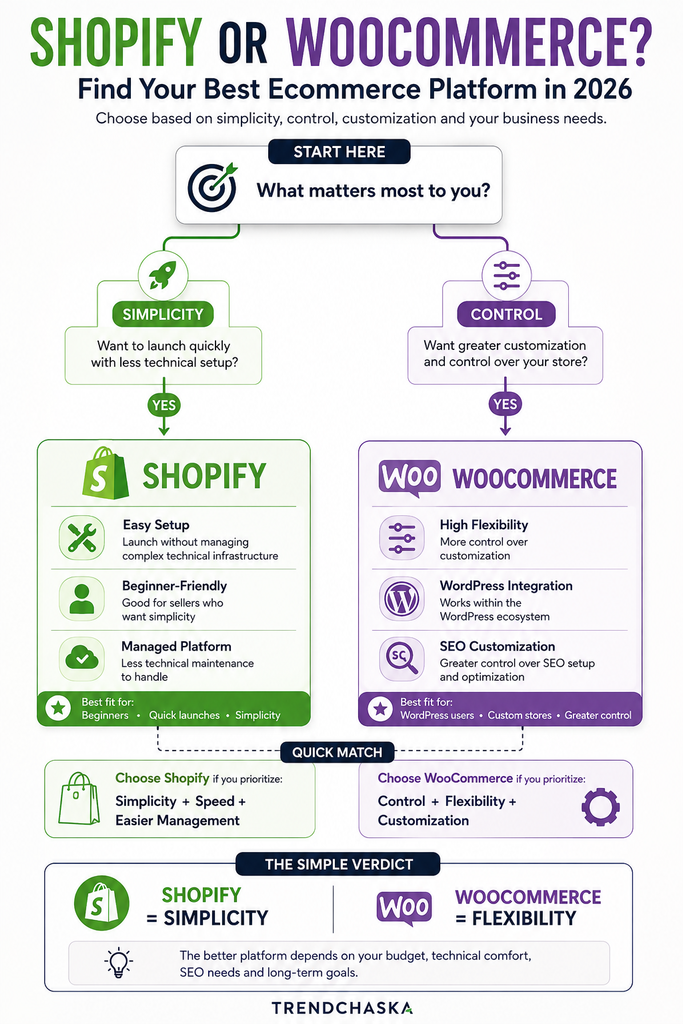
Neither platform is universally better for Indian sellers. Your answer depends entirely on how comfortable you are with technical work, your budget structure, and your growth plans. What works best is personal to each seller.
Shopify or WooCommerce: Better for SEO in 2026?
Zooming back into SEO specifically: WooCommerce generally offers more SEO control, but that doesn’t automatically mean better rankings.
WooCommerce wins on flexibility. Deeper plugin options. More granular technical control. Stronger blogging infrastructure. Shopify delivers a cleaner out-of-box experience with solid fundamentals that need less manual setup.
Rankings depend on content quality, technical optimization, site speed, internal linking, backlink profile, matching search intent, and user experience. A seller choosing WooCommerce but neglecting content and site speed gets outranked by a Shopify store that nails the fundamentals. The same thing works backwards. Platform choice sets your ceiling. Execution determines your actual results.
Best Ecommerce Platform India: Final Verdict
No universal best e-commerce platform exists. Only the best one for your specific situation.
Shopify works better if you want simplicity, speed to launch, and managed infrastructure. Beginners like it. Solo sellers like it. Anyone wanting to spend more time on marketing and product than technical maintenance likes it.
WooCommerce fits better if you want control, deep customization, WordPress integration, and long-term SEO flexibility. Sellers with some technical comfort benefit from it. Sellers planning heavy content marketing benefit from it. Sellers wanting full ownership of their store benefit from it.
Revisit your platform choice as your store scales. Needs change with growth. Your SEO strategy, marketing consistency, and customer experience matter as much as platform choice, maybe more. Check our guide to e-commerce marketing for small businesses in India on Trendchaska if you’re building out your broader marketing plan alongside your platform decision.
FAQs
1. Is Shopify better than WooCommerce in India?
Neither is universally better. Shopify suits sellers wanting fast, managed setup. WooCommerce suits sellers wanting deeper customization and control. Your technical comfort and business goals determine the right choice.
2. Is WooCommerce cheaper than Shopify in India?
Not necessarily. WooCommerce cost in India varies based on hosting, plugins, and themes. You can end up paying comparable or higher amounts than Shopify depending on your setup and scale.
3. Which is better for SEO, Shopify or WooCommerce?
WooCommerce generally offers more technical SEO control due to its WordPress foundation. Shopify SEO fundamentals are solid too. Rankings ultimately depend more on content and execution than platform alone.
4. What is the best e-commerce platform in India for beginners?
Shopify’s guided setup and managed hosting make it easier for most beginners. Launch quickly without technical expertise.
5. Can Shopify handle Indian payment methods?
Yes, Shopify supports Indian payment gateways, including Razorpay integrations, which commonly enable UPI payments for online stores.
6. Is WooCommerce good for Indian small businesses?
Yes. Particularly for sellers already using WordPress, wanting strong content marketing capability, or needing more customization than Shopify allows.
7. Which platform is better for a small online store?
Small store with limited technical resources? Shopify is often simpler to manage. Small store with WordPress experience and content marketing plans? WooCommerce can offer more long-term value.

Nidhi Patel is an SEO and digital marketing content strategist focused on AI SEO, content marketing, blogging, and personal branding. Through TrendChaska, she shares practical digital marketing insights, SEO strategies, and AI tools for beginners, students, and small businesses in India.