Torn between Google ads and Meta ads? This guide compares cost, targeting, and goals to help you choose the right option.
Introduction
If you are running a small business in India, chances are that you have asked yourself this same question dozens of times: should I spend my first ad rupee on Google or Meta advertising? Both can get you customers—and both can burn through your monthly budget if you choose the wrong option for your product, industry, and current customer intent.
This guide compares Google Ads vs. Meta Ads in India and covers the differences, nuances of targeting and cost, and the pros and cons of each. If you are trying to find the easiest ad platform for small businesses to start with, keep reading: there is actually a simple decision framework at the end of this article that will let you pick the right tool.
Google Ads vs Meta Ads India: The Short Answer
The short answer to the question “Google ads or Meta ads: which is better?” is that each platform has its strengths. Here is a quick summary of what to choose in which situation:
- Google Ads targets people actively searching for your product or service.
- Meta Ads targets people with similar interests and behavioral patterns to those who have already bought from you.
Each has its use cases. The rest of this guide will explain the differences between Meta and Google ads in more detail and will give examples of when to choose one over the other.
How Does Google Ads Work?
With Google Ads, you can bid for ad placement when a person is searching on Google, YouTube, or other websites that have partnered with Google, and when they are using Gmail or Maps. Google Search ads are most common for small businesses and are usually the easiest way to start.
Let’s say you have an AC repair service business in Pune. Someone types in “AC repair near me” on their phone, and your ad shows up at the top of the search results. They call you, and you fix their air conditioning. With Google Search ads, you bid on relevant keywords (in this case, probably “AC repair service in Pune”), write a compelling text ad, and pay every time someone clicks on your link. If you want to learn more about getting started with Google Search advertising, read our guide to Google Ads India 2026.
What About Meta Advertising? How Does It Work?
Meta advertising lets you show your ads on the social media platforms of Facebook and Instagram and on Messenger and WhatsApp. Meta platforms generally work differently from Google: instead of keywords, you select audiences based on region, age, interests, and behaviors, or upload audiences based on who has already visited your website.
Let’s say you have a handblock-print kurti brand in Jaipur, and you are selling online. People are unlikely to search for “handblock kurti brand,” so it makes sense to advertise on Meta. You might create a Reel that shows your new collection and share it with women aged 22-40 who have expressed an interest in ethnic clothing on Instagram. Meta advertising allows you to get your product in front of a wide audience without waiting for them to type a search term. If you are just getting started with Meta advertising and want to learn more about how to set it up, read our guide to Meta Ads for Beginners India.
Google Ads vs Facebook Ads: The Major Difference Is Ad Intent
When people talk about the difference between Google and Meta advertising, they tend to focus on the details rather than the big picture. The one thing that really separates these two platforms is the intent of the person who sees your ad.
Searcher intent versus social media intent: which is better for small business advertising?
| Characteristic | Google Search | Meta (Facebook/Instagram) |
|---|---|---|
| Person’s mindset | “I need this now” | “This looks interesting” |
| Type of demand | Existing | Created or nurtured |
| Ad experience | Text-based, informational | Visual, interruptive |
| Typical buying speed | Faster | Often slower, requires nurturing |
Someone who types “CA for GST registration in Indore” into Google is clearly interested in buying your service. They are much more likely to convert than someone who casually scrolls through your Facebook ad while watching Reels. However, the person on Meta might be a perfect fit for your product and could become a loyal customer with the right approach.
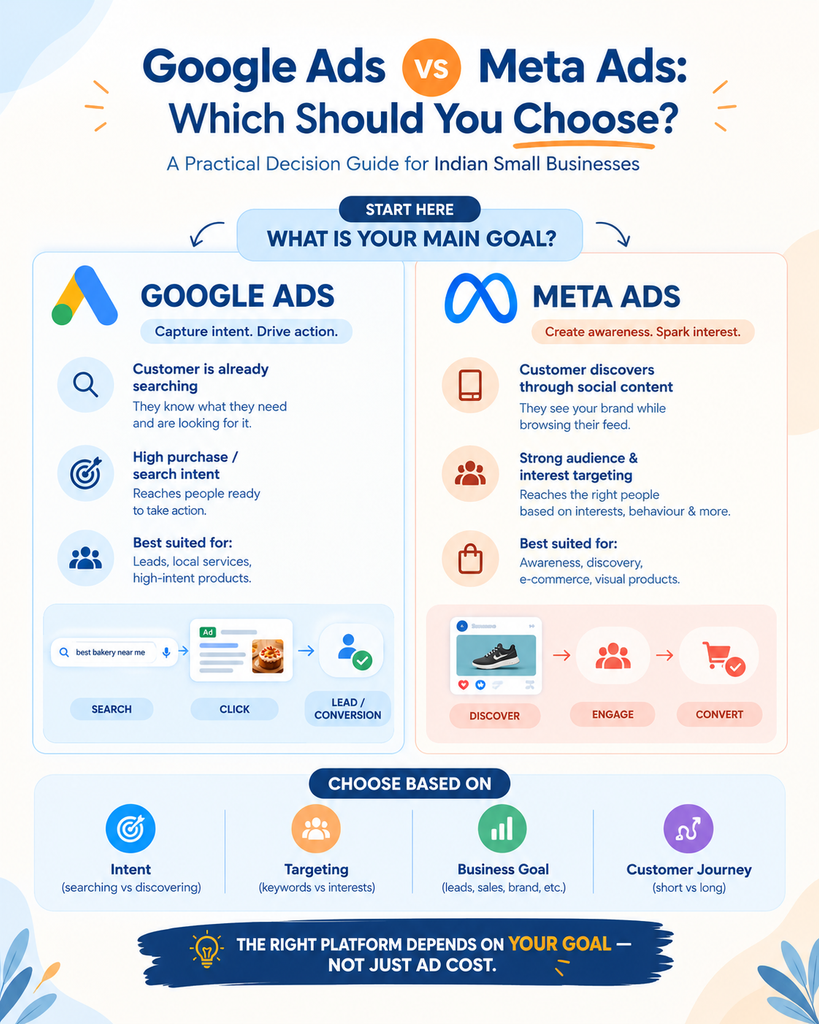
Google Ads vs Meta Ads India: Pros and Cons Comparison Table
Here is a summary of the differences between the two ad platforms. This is not an exhaustive list of features, but rather a side-by-side comparison of the major advantages and disadvantages of each.
| Factor | Google Ads | Meta Ads |
|---|---|---|
| Best for | Capturing people ready to buy or enquire | Building awareness and generating interest |
| Targeting basis | Keywords, location, search intent | Interests, demographics, behaviors, lookalikes |
| Main formats | Search, Shopping, Display, YouTube, Performance Max | Image, video, Reels, Stories, carousel, lead forms |
| Creative effort | Low to moderate (mostly text) | High (requires good visuals or video) |
| Cost per click | Often higher, varies by keyword competition | Often lower, varies by audience and season |
| Lead intent | Generally higher | Generally lower, but volume can be larger |
| Learning curve | Keyword and bidding knowledge helps | Creative testing and audience knowledge helps |
| Remarketing | Strong (Search, Display, YouTube) | Strong (Facebook, Instagram, Messenger) |
| Suits | Services, high-consideration products, urgent needs | D2C, fashion, food, courses, new products |
This list should serve as a general guide, but your specific situation and industry will determine which advertising platform is the right choice for you.
Google vs Meta Advertising: Targeting Options Compared
When it comes to targeting in advertising, Google and Meta have fundamentally different approaches. Here’s how they compare:
Google Ads targeting options include:
- Keywords: search terms that the searcher has typed in or has seen on other websites
- Location: region, city, or area where the searcher is currently located
- Search intent: the user’s intent when they type a keyword or short phrase
- Exclusions: words or phrases to exclude to ensure your ad only appears in relevant searches
Meta targeting options include:
- Location: region, city, or area where the user is located
- Age: Choose an age range for your audience.
- Interests: select users who have engaged with content related to your offer
- Behaviors: choose users who act in a certain way on social media
- Lookalikes: show ads to people with similar characteristics to those who have already purchased from you.
In most cases, Google’s targeting options are more specific and easier to use: if you know what a potential customer would search for to find your offering, Google is the right choice.
A more visual approach is needed for products such as fashion and food and for experiences such as travel and entertainment: this is where Meta advertising can provide better options.
Google Ads vs Meta Ads: Advertising Formats Compared
Google advertising formats include:
- Search ads: text ads that appear alongside Google search results
- Shopping ads: visual product ads that appear in Google search results
- YouTube ads: video ads that can be shown before, during, or after a video
- Display ads: image ads that can be shown on websites that have partnered with Google
- Performance Max: automated ads that use a combination of Google’s formats
Meta advertising formats include:
- Image ads: single-image banners that appear within social media feeds
- Carousel ads: multiple images that can be viewed in a slideshow format
- Video ads: Facebook and Instagram videos, including Reels and Stories
- Lead form ads: website forms that can be filled out within the Facebook app
- Click to WhatsApp ads: WhatsApp messages that are sent to potential customers
Google Search is easier to set up if you don’t have a strong creative team: it primarily involves writing text ads. Meta requires more designer input but provides more flexibility in visual presentation. Click-to-WhatsApp advertising is particularly powerful in India, where many consumers prefer to communicate with businesses via WhatsApp before making a purchase.
Advertising Cost: Google Ads vs Meta Ads India Compared
When it comes to the cost of advertising, there is no single answer to the question of whether Google or Meta is cheaper in India.
Anyone who pretends to know the exact cost per click (CPC) for ads in India is not being entirely truthful: it will vary between industries, between locations, and between seasons. For example, Diwali and the wedding season are expensive times to advertise, simply because there is more demand.
These are the main factors that affect the cost of advertising on Google:
- Industry: Some types of businesses, such as those in the financial services sector, tend to have higher CPC than others.
- Location: Metro cities typically have higher CPC than Tier 2 or Tier 3 cities.
- Search intent: Keywords that indicate a person is ready to buy will generally have a higher CPC than those that indicate they are still researching.
- Competition: If many advertisers want to bid for the same keywords, they will have to bid more to get their ad to show.
And these are the main factors that affect the cost of advertising on Meta:
- Creativity: Poor visual quality or an uninteresting concept will generally lead to a lower click-through rate (CTR), which means you will have to pay more to get the same number of responses.
- Audience size: A larger audience means a higher potential reach, but it also increases the cost.
- Audience relevance: A narrower audience will generally be more relevant to your offering but may not provide a large enough pool to reach your target number of leads or sales.
Although average CPC will typically be higher on Google than on Meta, it is important to consider the cost per lead or cost per sale, rather than the cost per click: leads or sales obtained through Meta can be cheaper or more expensive, depending on the situation.
For a broad overview of advertising costs in India and your particular industry, you can consult the WordStream Blog. It is a good idea to keep in mind that industry-specific information may vary, and the figures mentioned there may not fully apply to a small business in India.
It is also important to understand how little money you should start with in order to minimize the risks of experimenting with the wrong advertising platform. A small business owner should set aside a modest sum of money that they would be willing to spend as an initial test and then observe the results carefully before deciding whether to continue using that platform.
Note that it is usually not advisable to make any conclusions about a particular advertising platform based on experimenting with it for only a couple of days: both Google and Meta typically require at least a few weeks of testing in order to see meaningful results.
Lead Generation: Which Advertising Platform Generates Quality Leads?
When it comes to generating quality leads, both advertising platforms can be effective—but in different ways.
On Google, you are likely to generate fewer leads. However, the leads you do get will typically be of higher quality. On Meta, you are likely to get more leads, but the quality of these leads will vary. Generating quality leads in both platforms requires different approaches:
- Google: Generating leads in Google Search involves getting the searcher to visit your landing page and fill out a form. Because Google users are generally looking for a specific offering, it is usually not difficult to convince them to provide their contact information if the offering is relevant to them
- Meta: Generating leads in Meta requires you to entice the viewer to engage with your ad. One of the best ways to do this is to use a lead form ad or a click-to-WhatsApp ad—ideally both. Once a person has provided their contact information, it is important to follow up with them quickly in order to encourage them to make a purchase.
The number of your sales team and their capabilities will also influence your choice of advertising platform. If you have a small team and cannot follow up on many leads, it is best to advertise on Google. But if you have the resources to follow up on multiple leads, advertising on Meta can be a good option.
As a rule of thumb, if you want quantity, advertise on Meta; if you want quality, advertise on Google.
Should Small Businesses Advertise on Google or Meta for E-commerce Sales?
When it comes to advertising on Google and Meta for e-commerce sales, both platforms have distinct advantages and disadvantages.
Google Shopping and Google Search ads allow you to advertise individual products to people who are already looking for similar items. Meta advertising, on the other hand, is ideal for discovering new products. Visual products such as fashion and food are much more likely to succeed on Meta than on Google. There are very few products that cannot be advertised successfully on either platform, but the choice really depends on the nature of the offering.
Many small businesses use a combination of Meta advertising and Google Search advertising to advertise their e-commerce products. If you have to choose between the two, it is a good idea to use Meta advertising for products that are good candidates for visual presentation and Google advertising for products that have search intent and are ready to be discovered by consumers.
Which Advertising Platform Is Better for Local Businesses?
Local business advertising includes a variety of offerings, such as restaurants, spas, salons, and repair services. The advantages and disadvantages of advertising on the two platforms are quite different for each type of offering.
Urgent-need local services such as plumbing, electrical work, pest control, and AC repair are much more likely to succeed when advertised on Google, because customers are more likely to search for these services when they need them.
Experience-led local services such as restaurants and spas tend to be more successful when advertised on Meta, because customers are more likely to engage with visual content. That being said, both platforms can provide excellent results for local business advertising, depending on the offering.
Remarketing: Should Small Businesses Use This Powerful Advertising Tool?
There is a third advertising option available to small businesses in India: remarketing. Remarketing ads can appear to people who have previously visited your website. Advertising platforms such as Google and Meta allow advertisers to specifically target remarketing audiences.
These audiences tend to produce excellent results, with high engagement and conversion rates, compared to non-remarketing audiences. Remarketing is also a good option if you have a small advertising budget, because it tends to be a good use of your funds if you have already invested in acquiring these consumers.
However, remarketing audiences will only be available in the first place if you have already spent some money and acquired website visitors through other means. It is usually not a good idea to remarket to a new audience straight away without first advertising to a broad audience. This is because it tends to be quite expensive in most cases, due to the low engagement and conversion rates.
Advantages and Disadvantages of Advertising on Google and Meta
Google Ads
Advantages
- Targets people with buying or inquiring intent
- Easier to measure results for search-oriented advertisers
- Perfect for urgent and high-consideration services
- Less reliance on creative design
Disadvantages
- Clicks can be expensive in competitive industries.
- Ineffective if customers are not yet familiar with your offering
- Requires keyword research and bid management
- Can be quite costly without careful planning
Meta Advertising
Advantages
- Ideal for creating brand recognition and discovering new customers
- Powerful audience targeting and segmentation
- Perfect for visually arresting products and experiences
- Click-to-WhatsApp advertising caters to India’s specific consumer behavior.
Disadvantages
- Lower intent makes conversion rates lower.
- Ads can get stale and require constant refreshing.
- Leads can vary greatly in quality.
- Becoming less precise than in the past, due to enhanced privacy features
Which Advertising Platform Is Better for What Type of Business?
Below, you will find a few examples of different types of small businesses and the best advertising platform for each.
| Type of business | Advertising platform reasons |
|---|---|
| Local service business (plumber, electrician, pest control) | Google: The customer intent is high when searching for services like these. |
| D2C, or e-commerce brand (fashion, skincare, home décor) | Meta: The products are visually arresting and have discovery potential. |
| Coaching or education business: | Google and Meta. Google can target students actively searching for an education offering, and Meta can be used to advertise to parents and students. |
| Restaurant or café, | Meta Visual media can entice customers to visit the restaurant, but Google might be useful if the customer is looking for a specific restaurant. |
| B2B service (accounting, software, logistics, consulting) | Google Search intent can be quite high among B2B buyers, but Meta can be used to remarket to qualified leads. |
A Simple Framework to Help Small Businesses Choose Between Google and Meta Advertising
To choose the best advertising platform for a small business, simply answer the following questions with “yes” or “no”:
- Do people already search for what you sell?
- Yes: Google is probably the right choice
- No: Meta is probably the right choice.
- Is what you sell a visual or impulsive purchase?
- Yes: Meta is probably the right choice.
- No, it’s a problem-solving purchase: Google is probably the right choice.
- Is your buyer in a hurry?
- Urgent need: Google is probably the right choice.
- Looking around for something to buy: Meta is probably the right choice.
- Can you produce good creatives on a regular basis?
- Yes: Meta is probably the right choice.
- No: Google search ads is probably the right choice
- Do you need a few high-quality sales, or can you handle a flood of leads?
- Few, high-quality sales: Google is probably the right choice.
- Flood of leads and the resources to follow them up: Meta is probably the right choice.
- What are your immediate goals?
- Immediate sales or inquiries: Google is probably the right choice.
- Generating brand awareness and building an audience: Meta is probably the right choice.
Based on your answers, you should now be able to choose the advertising platform that is the best fit for your small business.
Can You Use Both Google and Meta Advertising?
Yes, and no small business should try to use both advertising platforms in the very early stages of their growth, simply because it will be too expensive.
The way advertising usually works is that you use one advertising platform to build up your customer base and then move to the next one. This is because the learning curve for both advertising platforms is quite steep, and it will be difficult to get good results from either one without spending a significant amount of time and resources on it.
If you want to use both advertising platforms but only have a small budget, start with the one that you feel is more suitable for your offering, and then use the extra funds to experiment with the other platform. If you want to learn more about setting up advertising on either of these platforms, read our guides to Google Ads India 2026 and Meta Ads for Beginners India.
Common Mistakes When Advertising on Google or Meta
- Failing to understand the nuances of advertising on each platform
- Assuming that everyone who uses Instagram is a good fit for your B2B accounting or consulting services
- Trying to judge results too soon after launching an advertisement
- Sending website visitors to a weak or unconvincing landing page
- Not measuring results accurately without conversion tracking
- Not following up on leads, especially in the case of Meta lead form advertising or WhatsApp advertising
FAQs:
1. Which Advertising Platform Is Better for Small Business in India?
Neither is universally better: each has its advantages and disadvantages. Google Ads tends to be much better at targeting people who are actively searching for an offering, while Meta tends to be much better at targeting people who are browsing social media with similar interests to your target audience.
2. What Is the Main Difference Between Google and Meta Advertising?
The main difference between these two advertising platforms is the intent of the person who sees your advertisement. Google search ads appear when a person types a search term that is relevant to your offering. Meta advertising appears while a person is browsing social media and is targeted to people with similar interests to your target audience.
3. Is Google or Meta Advertising Cheaper in India?
Meta advertising tends to be cheaper than Google advertising, but it depends on your industry, location, and the value of the offering that you are advertising. It is always best to compare the cost per lead or cost per sale on either platform, rather than the cost per click.
4. Which Advertising Platform Is Better for Local Businesses?
Urgent-need local services such as plumbing, electricians, pest control, and AC repair tend to be more successful on Google, because customers are more likely to search for these services when they need them. Experience-led local services such as restaurants and spas tend to be more successful on Meta, because visual content tends to entice customers to visit.
5. Which Advertising Platform Should a Beginner Start Advertising With?
If people already search for your offering, it makes sense to start with Google. If your offering is a visually arresting product that has discovery potential, it makes sense to start with Meta. In most other situations, simply answer the questions at the end of the previous section to determine which advertising platform is right for you. If you decide that Meta is right for you, read our beginner’s guide to Meta Ads for Beginners India.
6. Can I Run Google and Meta Advertising at the Same Time?
Yes, but it is usually not advisable to do so unless you have enough of a budget to experiment with both advertising platforms.
7. How Much Money Do I Need to Start Advertising on Google or Meta?
There is no minimum budget for advertising, but it is a good idea to only spend a small amount of money at first so that you can minimize your losses if the experiment is not successful.

Nidhi Patel is an SEO and digital marketing content strategist focused on AI SEO, content marketing, blogging, and personal branding. Through TrendChaska, she shares practical digital marketing insights, SEO strategies, and AI tools for beginners, students, and small businesses in India.