Learn topical authority SEO with a step-by-step strategy using content clusters, pillar pages, and internal links to rank higher.
Keyword-Focused SEO Is Outdated
A decade ago, SEO was straightforward. You picked a keyword, wrote a page about it, added a few backlinks, and saw it rank. Times have changed.
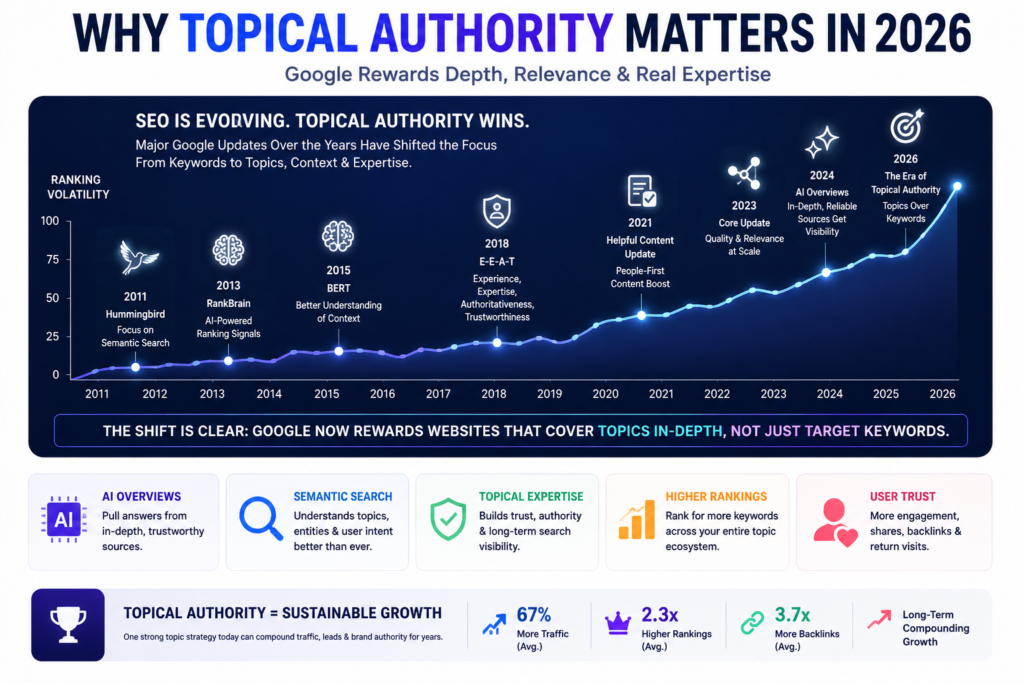
Google’s algorithms have grown a lot smarter. Tools like Hummingbird, RankBrain, BERT, and the Helpful Content System, along with AI Overviews gaining traction in 2025 and 2026, changed how Google evaluates websites. Instead of boosting sites focused on single keywords, it favors those that show deep knowledge across a full topic.
This change forms the basis of topical authority SEO, a key strategy for any digital marketer, blogger, or business owner looking to succeed right now.
A well-planned topical authority SEO strategy helps Google understand your expertise on a subject, making it easier to rank multiple pages instead of relying on a single keyword-focused article.
If your website posts random articles without a clear focus, you might miss out on a lot of organic traffic. By creating organized content clusters based on key topics your audience is interested in, you let Google know your site is a go-to source for that subject.
This guide breaks everything down step by step. You’ll get examples, a solid framework, and a 30-day plan you can start using right now.
What Does Topical Authority Mean in SEO?
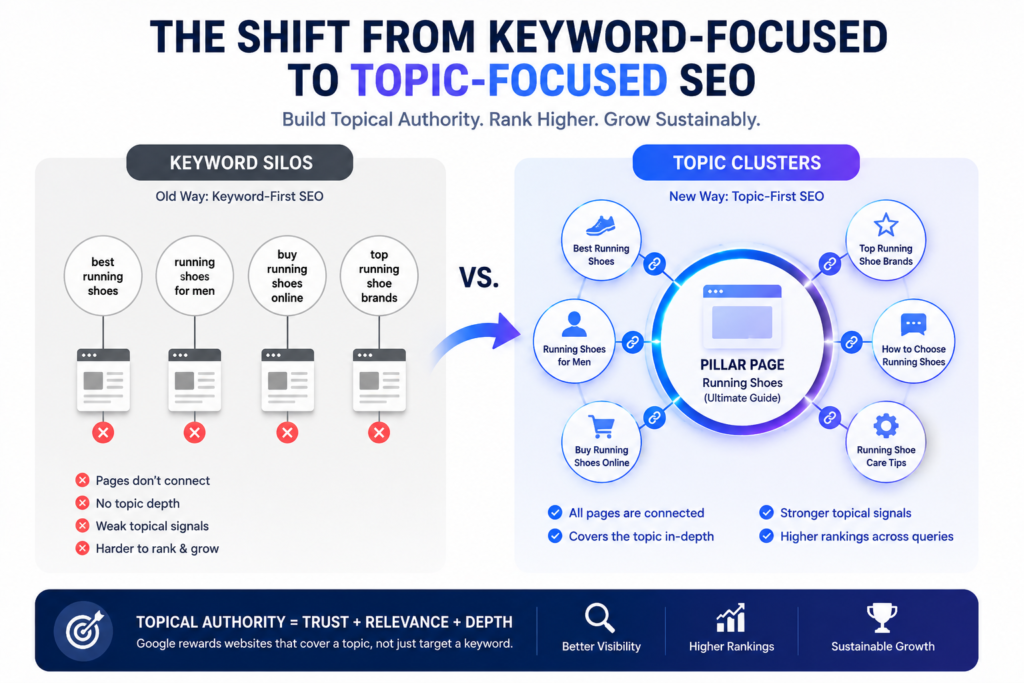
In modern search, topical authority is built by consistently publishing high-quality content that covers a subject from multiple angles and answers related user questions comprehensively.
Topical authority shows how much expertise, depth, and relevance a website has on a specific topic, as judged by both search engines and users.
When Google sees that a website explores a topic — not just one keyword but all the related subtopics, questions, and ideas — it recognizes that site as an authority. This makes it easier for the site to rank for keywords tied to the topic, even if those keywords are tougher to compete for.
How It Stands Apart from Old-School Keyword Targeting
Traditional Keyword SEO Topical Authority SEO Targets one keyword on each page. Explores an entire topic area. Pages stand alone. Pages connect to each other with purpose. Focuses on keyword search volume. Emphasizes completeness and depth. Avoids overlap by organizing content better. Risks of content cannibalization. Boosts one page’s rank. Strengthens authority across the whole domain.
Traditional SEO asks: “Which keyword should I rank for?”
Topical authority SEO asks one big question: “What topic should I dominate, and what does a full expert-level resource on it look like?”
Why Google Cares About Topical Expertise
Google works to deliver users the best and most reliable answers possible. A website covering a topic from all major angles shows:
- Strong knowledge and depth in the subject
- A dependable source that creates high-quality content
- Applicability to a lot of similar search queries
- A go-to site that meets user needs, not just one question
This fits with Google’s E-E-A-T guidelines, which stand for Experience, Expertise, Authoritativeness, and Trustworthiness. These elements now play an important role in how sites rank.
Why Topical Authority SEO is Crucial in 2026
The search world in 2026 doesn’t look the same as it did just a few years ago. Here’s why you can’t ignore topical authority anymore:
1. AI Overviews Choose In-Depth Sources
Google’s AI Overviews now dominate both informational and commercial search results. They pull answers from websites that dive into a topic. Simple, one-page sites almost never make the cut. Sites with well-organized content clusters that explore a subject in detail from many perspectives are much more likely to show up in AI-driven summaries.
2. Semantic Search Focuses on Topics, Not Just Words
Google no longer looks at keywords one by one. Instead, it focuses on meaning, context, and how ideas connect to each other. This is what semantic SEO is all about. When you add related topics, use similar terms, and address common questions, your pages can rank higher even if the keywords don’t match.
3. Entity-Based SEO Has Become the Norm
Google’s Knowledge Graph revolves around entities, which refer to things like actual people, concepts, places, organizations, or ideas. If your website keeps putting out organized and detailed content tied to a particular entity or topic theme, Google starts linking your site with that entity. This practice is called entity SEO, and it can give you a solid edge over time in rankings.
4. Matching Search Intent on a Large Scale
Topical authority makes sure that your site includes content to match every part of the user’s journey related to a topic. Whether a person looks up a simple definition, wants to compare tools, or needs a detailed guide to apply something advanced, your site provides an answer that fits. Covering this wide range of search intent mapping helps users stay longer, lowers bounce rates, and builds strong engagement signals for Google.
5. Signals of User Trust Build
When people visit your website and find not just one helpful post but a whole collection of connected high-quality content on the subject they care about, they save your page, share it, and come back when they have more questions. They might even link back to your site. These actions build trust and send signals that boost your authority.
How Google Looks at Topical Authority
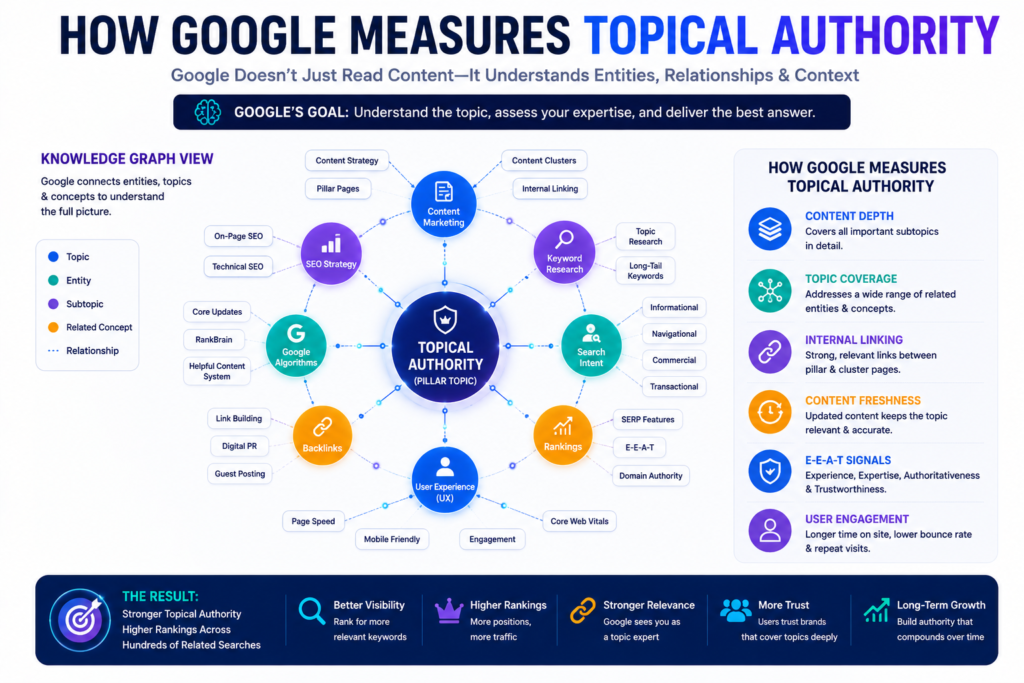
Google checks topical authority by tracking a few key things:
Content Depth: Does each post dig deep into its topic, or does it just skim the surface? Google favors pages that go in-depth, tackle related questions, include details, and offer practical advice.
Topic Coverage: How well does your site handle all the key subtopics in the main theme? If your site skips parts of the subject, it weakens your authority signal.
Internal Linking: How are the pages on your site linked together? A clear and logical internal linking setup helps Google explore your site more . It also shows how your pages relate to each other and how your content structure is laid out.
Content Freshness: Do you update your content ? Keeping it current shows you are an active and trustworthy source. This matters even more for topics that change , like SEO, AI, or digital marketing.
E-E-A-T Signals: Does your content show real-life experience, proven expertise, reliable references, and clear author details? These elements play a big role in how Google measures your site’s credibility and trust.
User Engagement: Are people sticking around on your site? Do they go on to click into related articles? When bounce rates are low and engagement metrics look strong, they play a key role in boosting topical authority signals.
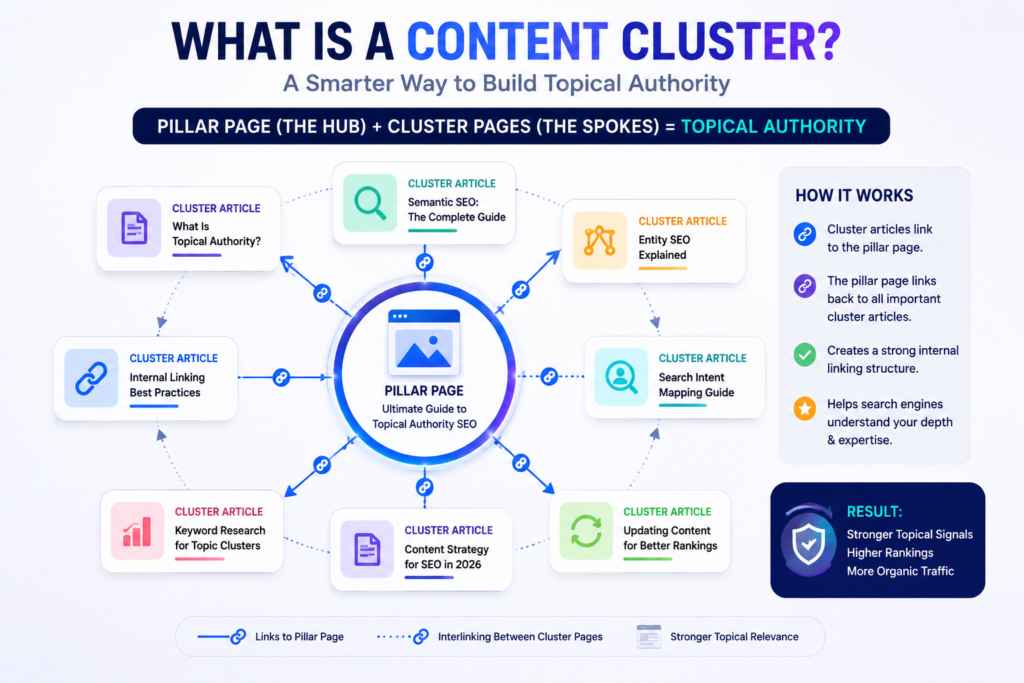
What Are Content Clusters?
A content cluster, also known as a topic cluster, is a smart setup of connected web pages that together explore a topic with thorough detail.
It has three main parts:
1. The Pillar Page
The pillar page acts as the main overarching content piece that introduces and gives a broad overview of a primary topic. It connects to all the related cluster articles and works as the main authority point for that subject on your site.
Imagine the pillar page like the table of contents in a textbook. It gives a broad overview but skips the finer details of every subtopic. Its purpose is to show both readers and Google that your website has ownership over this subject.
2. Cluster Content (Detailed Articles)
Cluster content is made up of individual articles that each dive deep into one specific part of the main topic. These articles add the detailed information that the pillar page introduces.
3. Internal Linking
Each cluster article connects back to the pillar page, while the pillar page links out to every cluster article. This two-way connection forms a knit content hub that helps Google’s crawlers move through your site easily, while also making the relationships between topics clear.
A successful content cluster SEO strategy connects a comprehensive pillar page with supporting articles through strategic internal linking, creating a clear topic hierarchy for both users and search engines.
How to Create a Content Cluster SEO Strategy: Step-by-Step Guide
Step 1: Choose a Main Topic
Make sure your main topic checks these boxes:
- It should be wide enough to allow writing 8 to 15 supporting posts.
- It must stay relevant to your niche and work for your readers.
- It has to offer value to your business, either informational or commercial.
- It needs search interest but should remain manageable based on your domain ranking.
Examples of main topics: SEO, Email Marketing, Content Marketing, Social Media Strategy, Personal Finance, Cloud Computing, Yoga for Beginners.
Stay away from topics that are way too broad, like “Marketing,” or too specific, like “Google Ads bid adjustments for mobile devices.”
Step 2: Make a Topic Map
A topical map is like a well-organized plan. It lists all the subtopics, angles, and questions your content cluster will address. Think of it as the guide for building your cluster.
To create a topical map:
- Check Google’s “People Also Ask” and “Related Searches” to find ideas for your main topic.
- Use tools such as Semrush, Ahrefs, or Google Search Console to spot useful subtopics.
- Come up with user questions for each stage: awareness, consideration, and decision.
- Figure out the informational, navigational, and transactional needs within the topic.
- Study competitor websites to find content gaps you can target
A good topical map keeps you from skipping over key points and avoids duplicate efforts or keyword cannibalization between your articles.
Step 3: Create a Pillar Page
Your pillar page needs to:
- Focus on a broad high-traffic keyword tied to the main topic.
- Cover the entire topic in a clear and detailed way.
- Have a well-organized table of contents.
- Offer short introductions and links to every key subtopic found in the cluster articles.
- Be between 2,500 and 5,000+ words, based on how complex the topic is
- Get regular updates whenever new information is available.
The pillar page doesn’t dive into each subtopic. Instead, it serves as a structured resource that orients readers and encourages them to explore cluster articles for more details.
Step 4: Write Cluster Articles
Each cluster article must:
- Zero in on a single focused topic that ties to your topical map
- Pick a more specific, niche keyword with less competition.
- Dive deep into the topic with content that shows real expertise.
- Link back to your main pillar page and other cluster articles as needed.
- Cater to a clear search purpose, such as answering questions or offering step-by-step advice.
- Structure your content with headers, precise answers, and FAQ sections to boost chances of getting featured snippets or higher AI summarization.
Plan for cluster articles to range between 1,200 and 2,500 words, using more space to tackle detailed or tough topics.
Step 5: Build Smart Internal Links Within the Cluster
Internal links connect your topic cluster like glue. You need a solid plan for internal linking that:
- Connect each cluster article to the pillar page using appropriate anchor text.
- Ensure the pillar page includes links to every cluster article.
- Link related cluster articles to each other when they add value.
- Use clear, keyword-focused anchor text instead of generic phrases like “click here” or “read more.”
- Avoid linking to irrelevant pages in a cluster article to keep the focus on the main topic for readers and search engines.
Tip:
Make a simple spreadsheet to track which cluster articles link to the pillar, which ones cross-link, and any that lack internal links. Check and update this every few months.
Step 6: Keep Content Fresh and Relevant
Building topical expertise isn’t something you do once; it needs constant attention.
- Revise pillar pages and their related articles one or two times each year.
- Write new cluster articles when you find missing subtopics.
- Update facts, examples, and tool mentions to keep the information current.
- Use Google Search Console to check for queries where you’re visible but not on the first page. This data can uncover chances to write new cluster articles or add more details to existing ones.
Example Content Cluster: Digital Marketing Website
Here’s a working example of a well-organized content cluster for a digital marketing site.
Pillar Page: The Complete Guide to SEO
Supporting Cluster Articles:
| Cluster Article | Target Keyword | Search Intent |
| What Is Technical SEO? | technical SEO guide | Informational |
| On-Page SEO: The Complete Checklist | on-page SEO checklist | Practical |
| How to Do Keyword Research in 2026 | keyword research guide | How-to |
| Local SEO Strategy for Small Businesses | local SEO strategy | Informational + Strategic |
| Link Building Strategies That Work | link building strategies | Strategic |
| Best AI SEO Tools in 2026 | AI SEO tools | Comparative |
How They Interrelate:
The main pillar page gives an overview of all key SEO topics and connects to seven cluster articles. The Technical SEO piece connects back to the pillar and links to the SEO Audit article because audits require checking technical aspects. The Keyword Research article connects to the On-Page SEO article because proper on-page optimization relies on placing keywords . The Local SEO article also links to On-Page and Link Building articles.
This system of linking creates a web that shows Google the site covers SEO . This increases the site’s chances of appearing in search results for many SEO-related questions targeting different search intents and keyword levels.
Things You Shouldn’t Do
Posting Unrelated and Disconnected Content
The biggest mistake many websites make is putting out articles based on trendy keywords without any organized plan. Random articles don’t build trust or authority over time. It’s important to post content within a planned cluster.
Weak Internal Links or None at All
Lots of websites work hard to produce solid content, but mess up when it comes to linking it correctly. If your cluster articles fail to link to the main pillar page or connect to unrelated pages, you weaken your framework. You need to check your internal links often.
Repeated Topics and Keyword Overlap
When two pages on your site aim at the same keyword or discuss almost identical subjects, they compete with each other in search rankings. A clear topical map is needed to define the purpose and focus of each cluster article and avoid this issue.
Low-Quality Content
Writing 400-word cluster articles about detailed subtopics doesn’t make sense anymore. It wastes time and hurts rankings. Google’s Helpful Content System pushes down thin and low-quality pages. Make every cluster article worthwhile and insightful.
Ignoring Why People Search
Even a well-made content cluster can flop if the articles don’t align with what users need. Always check if a keyword points to an informational guide, a how-to, a comparison, or just a simple definition. Format the content to meet that demand.
Building Topical Authority for Indian Websites
In 2026, Indian businesses and digital marketers will find great potential by focusing on topical authority SEO strategies.
Opportunities in Local Search
India has a huge and growing internet user base, with millions looking up information in both English and local languages. Websites that focus on India-related topics like GST rules, SEBI guidelines, the Indian startup scene, travel spots, or regional cuisines deal with less global competition and can reach active local users.
SEO Pillar Page India: Example Areas
Companies aiming at Indian audiences should create strong content hubs about subjects like:
- Digital Marketing in India → Using SEO to grow Indian businesses, social media trends in India, influencer marketing strategies, and creating content in local languages
- Personal Finance in India → Understanding mutual funds in India, a practical guide to the NPS, tips for filing income tax, and a straightforward UPI payment guide
- E-commerce in India → How to sell on Flipkart, a guide to selling on Amazon India, choosing reliable logistics partners, and understanding GST rules in e-commerce
An SEO pillar page designed to target India-specific searches should include keywords in regional languages, highlight cultural examples, and address local laws. Include mentions of Indian platforms and tools to connect with the local audience better.
Ideas for Regional Content
Making content in local languages like Hindi, Tamil, Telugu, Kannada, and Bengali opens up a big chance to build topic authority. Few people take full advantage of it. Competition is less, and people engage more when content connects with their culture and language.
Key Industry Areas in India
India offers great chances to build authority in industries like EdTech, HealthTech, AgriTech, BFSI, and local services. These fields have rich topics with lots of search interest but not much strong competition to challenge.
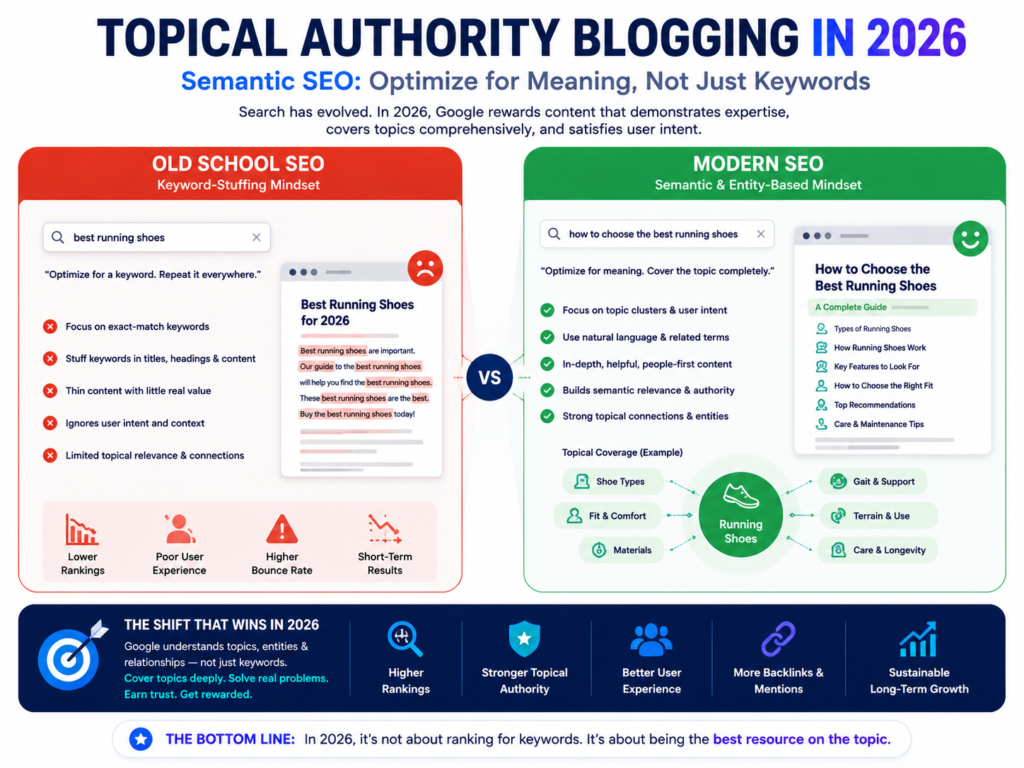
Blogging with Topical Authority in 2026
How we establish topical authority has changed a lot with AI tools and shifts in how people search online.
Creating Content with AI Help
Tools like Claude, ChatGPT, and Gemini have made producing content much cheaper. In 2026, the real edge isn’t about being the fastest at writing. It’s about strategy and real human knowledge.
You can use AI to research, create outlines, draft articles, and rework old content. However, make sure a human expert reviews and improves each cluster article. They can bring their real-world know-how, unique examples, and credible insights to the table.
Standing Out with Human Knowledge
Google’s E-E-A-T rules focus on Experience rewarding content written by individuals who know what they’re talking about. By 2026, the strongest content clusters will mix the speed of AI tools with the trust that comes from authentic human knowledge.
Entity Optimization
To build strong expertise on a topic, aim to optimize entities. Name, explain, and link important ideas, people, tools, and organizations in your writing. Use Schema.org for structured data markup. This helps Google’s Knowledge Graph figure out relationships between entities in your content.
Knowledge Graph Indicators
Create a solid author presence by building clear bio pages, growing social profiles, and showcasing published work. Aim to create a Google Knowledge Panel for your organization if possible. Link to trustworthy external sources. These efforts help Google connect your domain with strong entity relationships.
Future Trends in SEO
In the future, topical authority will tie more to programmatic SEO. This means scaling content using structured data and templates. Voice search optimization and multimodal search, which mixes text, image, and video within topic clusters, will also grow in importance.
But the core principles stay the same: cover topics , organize your content well, and focus on creating real value for users.
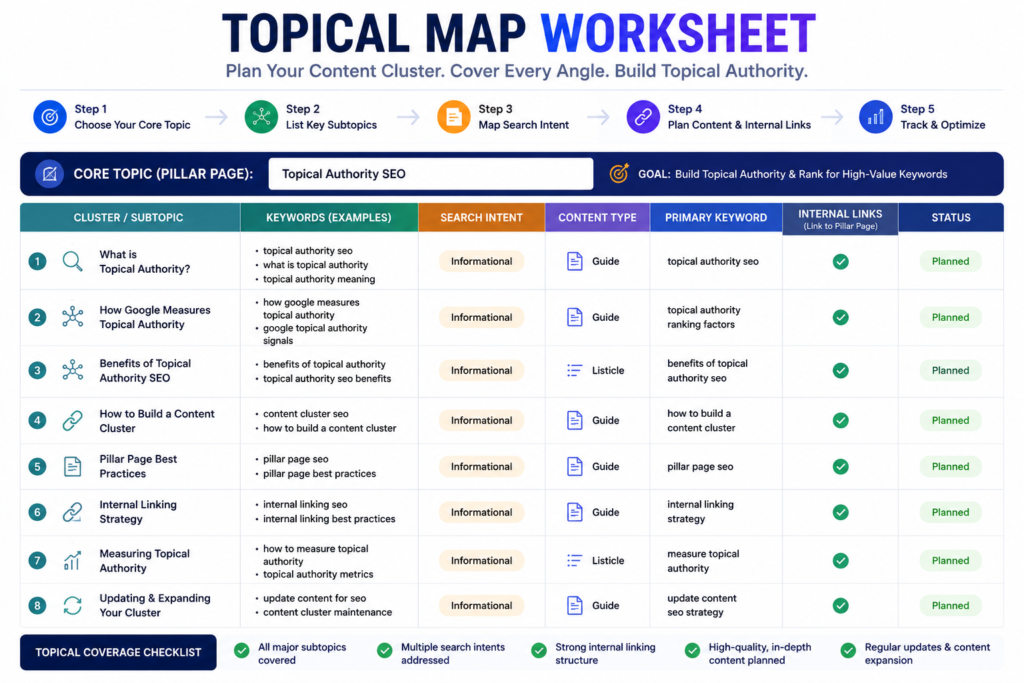
30-Day Plan to Build Topical Authority
Follow this guide to get your first content cluster started:
Week 1: Research and Planning (Days 1–7)
- Days 1 and 2: Pick a main topic and check its popularity using keyword tools
- Days 3 and 4: Put together a thorough topic plan that includes 10-15 subtopics
- Days 5 and 6: Review current content to see what works with the cluster and what doesn’t
- Day 7: Set up a content schedule for your pillar page and the first five cluster articles
Week 2: Building the Pillar Page (Days 8–14)
- Days 8 to 10: Spend these days researching topics, creating an outline, and drafting your pillar page.
- Day 11 to 12: Focus on improving the pillar page. Adjust on-page SEO by working on the title tag, meta description, headings, and structured data.
- Day 13 to 14: Use these days to review everything, make edits, and get the pillar page ready to publish.
Week 3: Start Writing Cluster Articles (Days 15 to 21)
- Day 15 to 17: Write the first two cluster articles. Begin with subtopics that have the most search volume.
- Day 18 to 19: Work on creating the third article for your cluster.
- Day 20 to 21: Set up internal links between your published pages. Add FAQ schema for rich search results.
Week 4: Make Improvements and Add More Content (Days 22 to 30)
- Days 22 to 25: Create two or three more cluster articles.
- Days 26 and 27: Review internal links and repair any broken ones or add missing links.
- Days 28 and 29: Add your content cluster URLs to Google Search Console to get them indexed.
- Day 30: Use GSC and analytics tools to track rankings, impressions, and traffic for each content cluster.
Final Thoughts
Switching from focusing on keywords to prioritizing topics isn’t a passing fad. It’s the new way SEO works. In 2026, Google prioritizes websites that prove strong topical authority. These sites offer detailed, organized, high-quality content that covers all user needs and questions about a topic.
Creating a content cluster SEO plan is one of the best ways to build authority. Start by picking your main topics , outlining all the connected subtopics, making a strong pillar page, writing detailed cluster articles, and linking these together with purposeful internal linking. Keep growing and improving your clusters over time.
Websites set to lead in Google search or AI Overviews in the next few years won’t be the ones pushing out the most posts. Instead, they’ll be the ones mastering entire topics.
Get started with your first content cluster now. Select a topic, design your topical map, and publish your pillar page. The authority you grow from this point will bring lasting rewards.
Whether you’re a blogger, agency, or business owner, investing in topical authority SEO, a strong content cluster SEO strategy, and well-structured pillar pages can create sustainable organic growth in 2026 and beyond.
Found This Useful? There’s a Lot More Where That Came From.
TrendChaska publishes in-depth guides on SEO, AI, content marketing, and digital strategy — written for marketers who want to stay ahead, not catch up.
👉 Follow TrendChaska on Instagram, LinkedIn, and Twitter for bite-sized SEO tips, strategy breakdowns, and the latest in AI search posted every week.
And while you’re here — bookmark this page. You’ll want to come back to it.
FAQs
Q1: What does topical authority SEO mean?
Topical authority in SEO means search engines see a website as an expert when it explores one subject. A site builds this authority by creating clear, detailed content that tackles a topic from all angles. It includes subtopics related to queries and covers what different users might want to know about. Google values this depth and ranks such content better in searches tied to that subject.
Q2: How is a content cluster not the same as posting separate blogs?
A content cluster is a well-planned collection of connected pages focused on one main subject. Instead of random blog posts with no clear arrangement, cluster content works as a team. Every piece helps the main pillar page and links back to other related cluster pages. This combined setup shows Google the level of expertise on a topic and helps build authority that stand-alone posts can’t match up to.
Q3: What’s a pillar page, and how do I create it?
A pillar page acts as the main hub for a topic cluster. It serves as a detailed guide that explains the main subject, touches on its key parts, and links to deeper articles about those areas. To make one, start by picking a main keyword that matches your topic. Write a long guide, around 2,500 to 5,000 words or more addressing all the big points about the subject. Organize it with clear sections, use a table of contents, and add links to related cluster articles for more details.
Q4: How many articles do I need to create strong topical authority?
There isn’t an exact number. Most successful content clusters hold between 8 and 20 supporting articles built around a main pillar page. What matters most is covering the topic . Your cluster should answer all important questions and include every key subtopic tied to your main theme. Leaving gaps can hurt your chances of showing authority in your niche. Instead of aiming for a specific number, focus on making your content as complete as possible.
Q5: Can small sites and new blogs benefit from topical authority SEO?
Sure, and , it can often benefit smaller sites even more. A new site can grow authority faster by zeroing in on one or two main topic clusters rather than scattering limited efforts over unrelated keywords. Google’s algorithms don’t just look at age; they value genuine, in-depth content and subject expertise. Being focused right from the start helps smaller websites compete .
Q6: How does internal linking help build topical authority?
Internal linking forms the main framework of a content cluster. It shows Google how your pages connect and helps crawlers grasp the structure and scope of your topic. Every article in the cluster should connect to the pillar page using suitable anchor text. At the same time, the pillar page should link to all the cluster articles, and the cluster articles should link with each other when it fits the context. By using solid internal links, you spread page authority across the cluster, which boosts the ranking chances for all the pages.
Published on TrendChaska — Your go-to spot for SEO AI, and updates in digital marketing.

Nidhi Patel is an SEO and digital marketing content strategist focused on AI SEO, content marketing, blogging, and personal branding. Through TrendChaska, she shares practical digital marketing insights, SEO strategies, and AI tools for beginners, students, and small businesses in India.